INTRODUCTION
Millets are gaining increasing importance in agriculture due to their nutritional value, climate resilience and suitability for cultivation under rainfed and resource-constrained conditions. As concerns over food security, malnutrition and climate change continue to rise, millets offer a sustainable solution by requiring less water, fewer inputs and exhibiting greater tolerance to drought and adverse weather conditions. However, despite their advantages, millet cultivation and consumption remain constrained by weak market linkages, inadequate processing facilities and limited value addition opportunities. A well-functioning value chain involving farmers, commission agents, distributors, wholesalers, processors and retailers plays a crucial role in enhancing the efficiency, profitability and competitiveness of millet production. Understanding the structure, stakeholder roles and performance of millet value chains can help identify bottlenecks and opportunities for improving market access, value addition and income generation for all stakeholders involved.
MATERIAL AND METHODS
The study followed a descriptive research design to assess the profile of millet farmers in Nandurbar district, Maharashtra, which was purposively selected as the researcher hails from the region. Among the 6 mandals, 3 villages with high production of millets jowar and bajra were chosen purposively. From each mandal, two villages were selected, total of six villages. 90 farmers were selected by proportionate random sampling, 30 stakeholders were selected of 120. Based on a literature review and expert input, 11 variables were identified. Data were collected through a structured interview schedule and analysed using frequency, percentage, mean, and standard deviation for meaningful interpretation.
RESULTS AND DISCUSSION
The stakeholders were distributed into different categories based on their selected profile and the results were presented in the table.
Age
The table shows that nearly half (48.89%) of the millet farmers belonged to the middle age category followed by young age (27.78%) and old age (23.33%). Whereas, a vast majority (86.67%) of the other stakeholders belonged to the middle age category followed by young age (6.67%) and old age (6.67%). The probable reason might be that middle-aged millet farmers are actively engaged in farming activities as they possess adequate farming experience, physical ability and decision-making skills. Majority of the other stakeholders belonged to the middle age category as value chain activities such as trading, processing and marketing require both experience and managerial skills. The above findings were in consonance with Sahil (2022).
Education
The table depicts that more than one-fourth (27.78%) of the millet farmers had graduation level education followed by secondary school (25.56%), primary school (14.44%), intermediate (14.44%), illiterate (12.22%) and functional literate (5.56%). Whereas, majority (60.00%) of the other stakeholders had intermediate level education followed by secondary school (20.00%) and graduation (20.00%). The probable reason might be that educational facilities and awareness regarding the importance of education have gradually improved in the study area, enabling farmers to attain higher levels of education. Majority of the other stakeholders possessed intermediate level education as trading, processing and marketing activities require basic literacy and record-keeping skills for efficient business management. The above findings were in line with Woldemedhin et al. (2016).
Unit size
The results illustrated in table stated that most (45.56%) of the millet farmers were small farmers followed by marginal farmers (33.33%), small medium farmers (14.44%), medium farmers (3.33%) and large farmers (3.33%). The probable reason might be due to fragmentation of landholdings from generation to generation, which resulted in the predominance of small and marginal farmers in the study area. Another reason might be the division of agricultural lands among family members over time. Similar results were reported by Deepthi (2013).
Experience
The results shown in table revealed that majority (56.67%) of the millet farmers had low level of farming experience followed by medium (31.11%) and high (12.22%) levels of farming experience. Whereas, majority (53.33%) of the other stakeholders had low level of enterprise experience followed by medium (33.33%) and high (13.33%) levels of experience. The predominance of middle-aged respondents among both farmers and other stakeholders might have also contributed to the low to medium levels of experience observed in the study area. Results were in conformity with Keerthana (2013).
Credit availability
Table shows that majority (61.11%) of the millet farmers availed credit from their own sources followed by formal sources (23.33%) and informal sources (15.56%). Whereas, majority (43.33%) of the other stakeholders availed credit from their own sources followed by informal sources (30.00%) and formal sources (26.67%). The probable reason might be that most of the respondents preferred utilizing their own savings and resources to meet the financial requirements of farming and business activities, thereby avoiding repayment obligations and interest burden. The results were in consonance with Luan and Kingsbury (2019).
Communication pattern between partners
Table provides evidence which shows majority (68.89%) of the millet farmers had medium level of communication pattern between partners followed by high (16.67%) and low (14.44%). Whereas, majority (66.67%) of the other stakeholders had medium level of communication pattern followed by high (16.67%) and low (16.67%). The probable reason might be that stakeholders maintained regular communication with one another for exchange of information related to production, processing and marketing activities, resulting in a medium level of communication pattern. The above findings were in line with Parveen (2021).
Training received
The findings reported in table suggested majority (72.22%) of the millet farmers had not received any training, while only 27.78 per cent had received training. Whereas, majority (66.67%) of the other stakeholders had not received any training, while 33.33 per cent had received training. The probable reason might be the limited availability of training programmes related to millet cultivation, value addition and marketing in the study area. The above findings were in conformity with Sultana et al. (2015).
Risk taking ability
In the table half (50.00%) of the millet farmers had medium level of risk taking ability followed by high
Table 1. Distribution of farmers according to their profile (n=120)
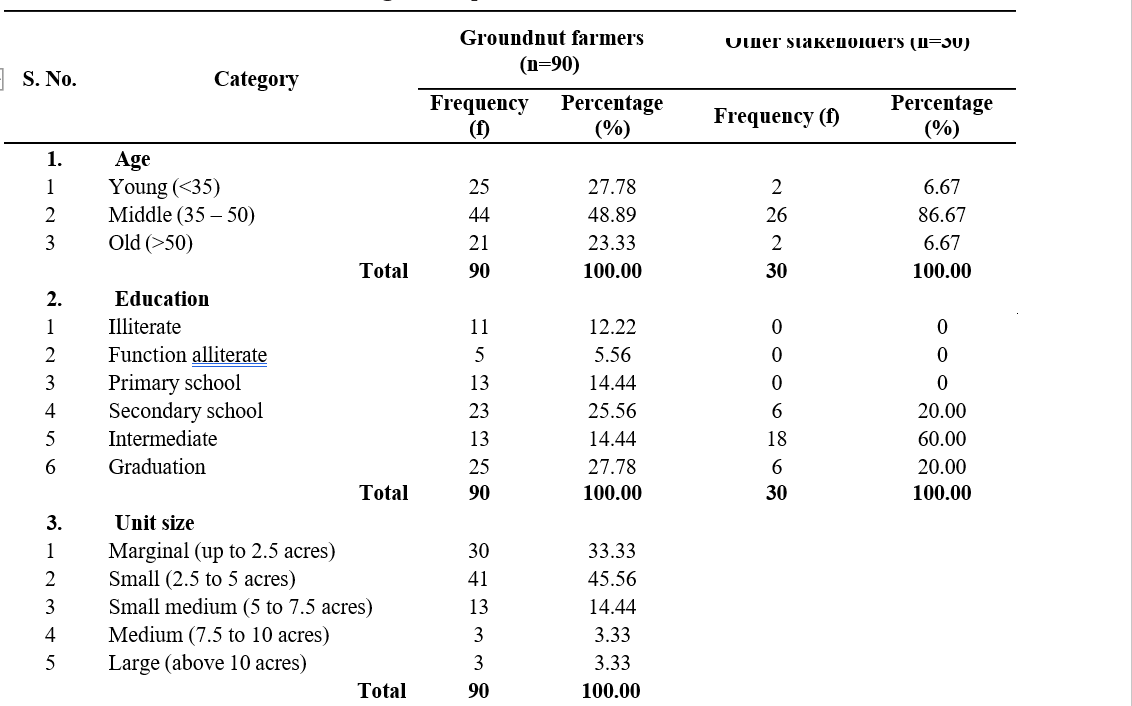
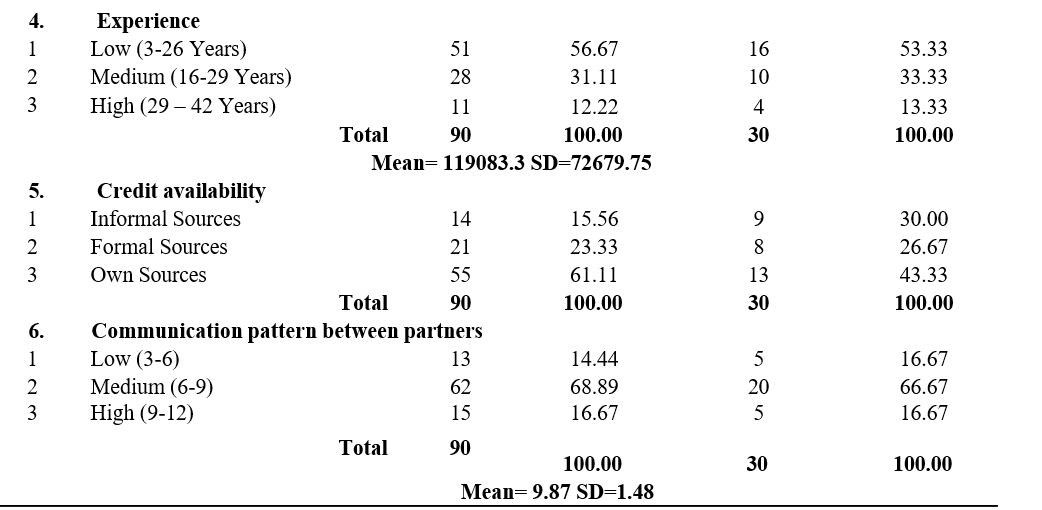
Table 1. Distribution of farmers according to their profile (n=120)
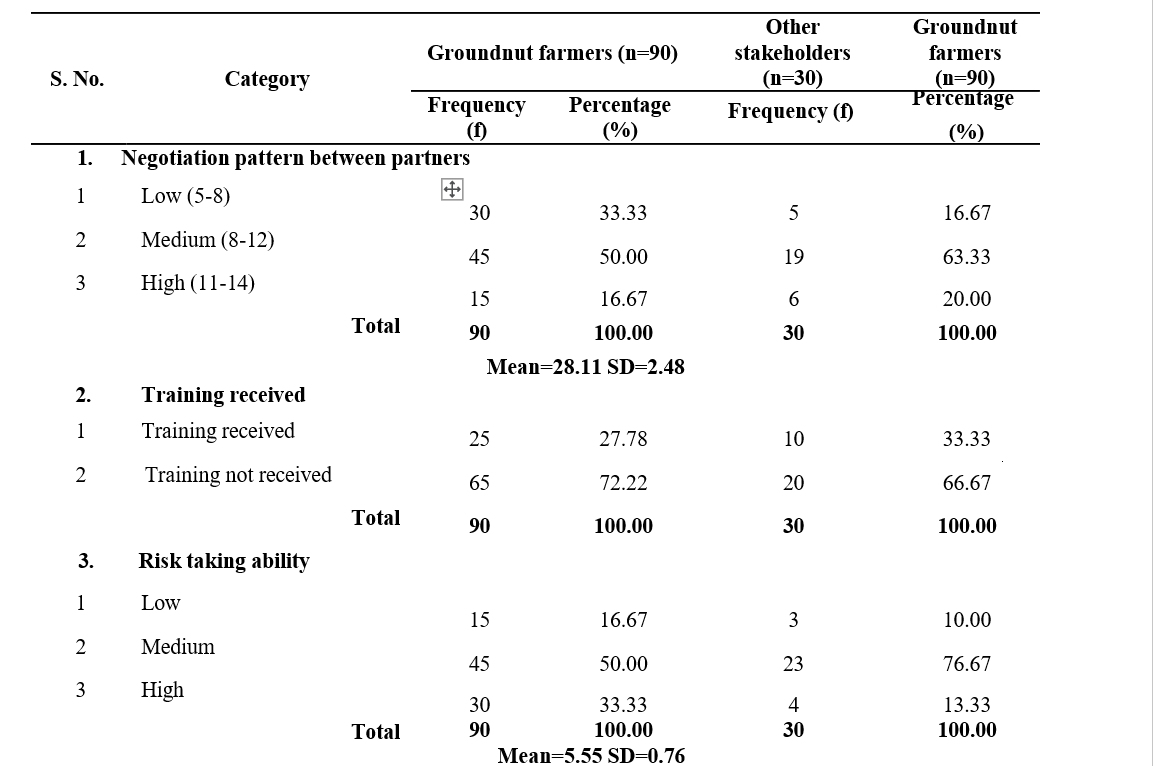
(33.33%) and low (16.67%). Whereas, majority (76.67%) of the other stakeholders had medium level of risk taking ability followed by high (13.33%) and low (10.00%). The probable reason might be that both farmers and other stakeholders preferred adopting practices and decisions with moderate levels of uncertainty to avoid potential losses while ensuring stable returns. The above findings were in line with Harini (2021).
Quality management
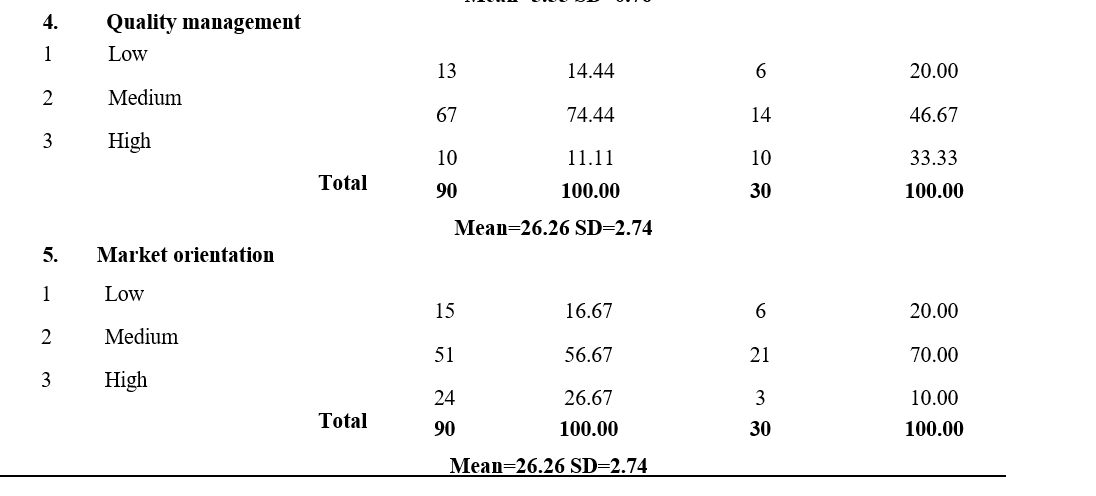
The findings presented in table indicated that majority (74.44%) of the millet farmers had medium level of quality management followed by low (14.44%) and high (11.11%). Whereas, majority (46.67%) of the other stakeholders had medium level of quality management followed by high (33.33%) and low (20.00%). The probable reason might be that both farmers and other stakeholders followed basic quality management practices, but lacked advanced knowledge and infrastructure for maintaining higher quality standards. The above findings were in line with Shelke and Bapat (2022).
Market Orientation
As shown in table, the results depicted that majority (56.67%) of the millet farmers had medium level of market orientation followed by high (26.67%) and low (16.67%). Whereas, majority (70.00%) of the other stakeholders had medium level of market orientation followed by low (20.00%) and high (10.00%). The probable reason might be that both farmers and other stakeholders possessed moderate awareness regarding market information, price fluctuations and marketing opportunities, which resulted in a medium level of market orientation. The above findings were in line with Lairenjam (2020).
The study revealed that millet value chain stakeholders in Nandurbar district were predominantly middle-aged and possessed moderate educational attainment. Most millet farmers had small landholdings, low farming experience, and relied on their own financial resources for agricultural activities. The majority of farmers and other stakeholders exhibited medium levels of communication pattern, negotiation pattern, risk-taking ability, quality management, and market orientation. Training exposure among stakeholders was found to be inadequate, indicating a need for focused capacity-building programmes. Informal information sources played a major role in disseminating agricultural knowledge among farmers. market linkages, training opportunities, and stakeholder coordination can significantly improve the effectiveness of millet value chains.
LITERATURE CITED
Deepthi, K. 2013. Adoption behaviour and profile characteristics of farmers. M.Sc. (Ag.) Thesis, Acharya N.G. Ranga Agricultural University, Guntur.
Harini, G. 2021. Risk orientation and entrepreneurial behaviour among farmers. M.Sc. (Ag.) Thesis, Professor Jayashankar Telangana State Agricultural University, Hyderabad.
Keerthana, V. 2013. Entrepreneurial behaviour of rural youth. M.Sc. (Ag.) Thesis, Tamil Nadu Agricultural University, Coimbatore.
Lairenjam, M. 2020. Market orientation behaviour among agricultural producers. Indian Journal of Extension Education. 56(4): 70-75.
Luan, N., & Kingsbury, A. J. (2019). Credit accessibility and market performance among agricultural stakeholders. Agricultural Finance Review, 79(3): 315–328.
Parveen, S. 2021. Communication and negotiation patterns among value chain actors. Ph.D. Thesis, Bangladesh Agricultural University, Mymensingh.
Sahil, S. 2022. Entrepreneurial characteristics of agribusiness stakeholders. M.Sc. (Ag.) Thesis, Punjab Agricultural University, Ludhiana.
Shelke, R. D and Bapat, V.A. 2022. Post-harvest management constraints in millet production systems of Maharashtra. Indian Journal of Agricultural Sciences. 92(5): 601-607.
Sultana, S., Ahmed, M., and Islam, M. 2015. Training needs and capacity building among agricultural producers. Journal of Agricultural Extension and Rural Development, 7(8): 239–246.
Woldemedhin, G.D., Seifu, Z.L and Wassie, E.A. 2016. Mushroom value chain analysis in addis Ababa, Ethiopa. Journal of Agricultural Extension and Rural Development. 8 (8): 130 – 140.