
0 Views
Department of Agricultural Extension Education, ANGRAU-S.V. Agricultural College, Tirupati-517 502.
The present study was conducted in Ananthapuramu district of Andhra Pradesh with a sample of 120 beneficiaries of Annadatha Sukhibhava scheme selected through random sampling. The findings revealed that a majority of the beneficiaries belonged to the middle-aged category (53.33%), had high school education (29.17%), medium landholding (44.16%), medium farming experience (65.83%), medium annual income (43.33%), medium extension contact (60.83%), medium social participation (65.00%), medium achievement motivation (67.50%), medium economic motivation (80.00%), medium credit orientation (50.83%) and medium awareness regarding government schemes (75.83%).
KEYWORDS: Annadatha Sukhibhava Scheme, PM- KISAN, farmer welfare.
The Annadatha Sukhibhava Scheme was a farmer welfare and income support programme implemented by the Government of Andhra Pradesh to provide financial assistance to farmers. The scheme was originally introduced in 2019 and was later continued as YSR Rythu Bharosa–PM KISAN (https://pmkisan.gov.in/ PM kissan). In 2025, it was relaunched as Annadatha Sukhibhava with enhanced financial support. Under the scheme, eligible farmer families receive ₹20,000 annually, including ₹14,000 from the State Government and
₹6,000 under PM-KISAN. The assistance was provided through Direct Benefit Transfer (DBT) in instalments to help farmers meet cultivation expenses, purchase quality inputs, reduce dependence on non-institutional credit and improve agricultural productivity and livelihood security. Annadatha Sukhibhava Scheme (https:// annadathasukhibhava.ap.gov.in/). Profile characteristics play a significant role in understanding the socio-economic background of farmers benefiting from the Annadatha Sukhibhava Scheme. These characteristics include age, education, landholding, annual income, farming experience and extension contact, which help describe the beneficiaries and their farming circumstances. Studying these attributes provides insights into the diversity of farmers, their resource availability and their information needs. It also helps assess the representation of different categories of farmers among the beneficiaries and provides a basis for interpreting their experiences with the scheme. Understanding farmers’ profile characteristics is therefore essential for developing appropriate extension strategies and improving the implementation of farmer welfare programmes.
The study followed an ex-post facto research design to analyse the profile characteristics of the Annadatha Sukhibhava Scheme farmers Ananthapuramu district of Andhra Pradesh which was purposively selected. Three mandals, namely, Peddapappur, Gooty and Bukkaraya Samudram, were selected purposively and two villages from each mandal were chosen randomly making a total of six villages. Beneficiaries were selected from the identified villages using a random sampling procedure, resulting in a sample size of 120 respondents. Based on a literature review and expert input, 11 variables were selected for the study. Data were collected through a structured interview schedule and analyzed using frequency, percentage, mean and standard deviation for interpretation.
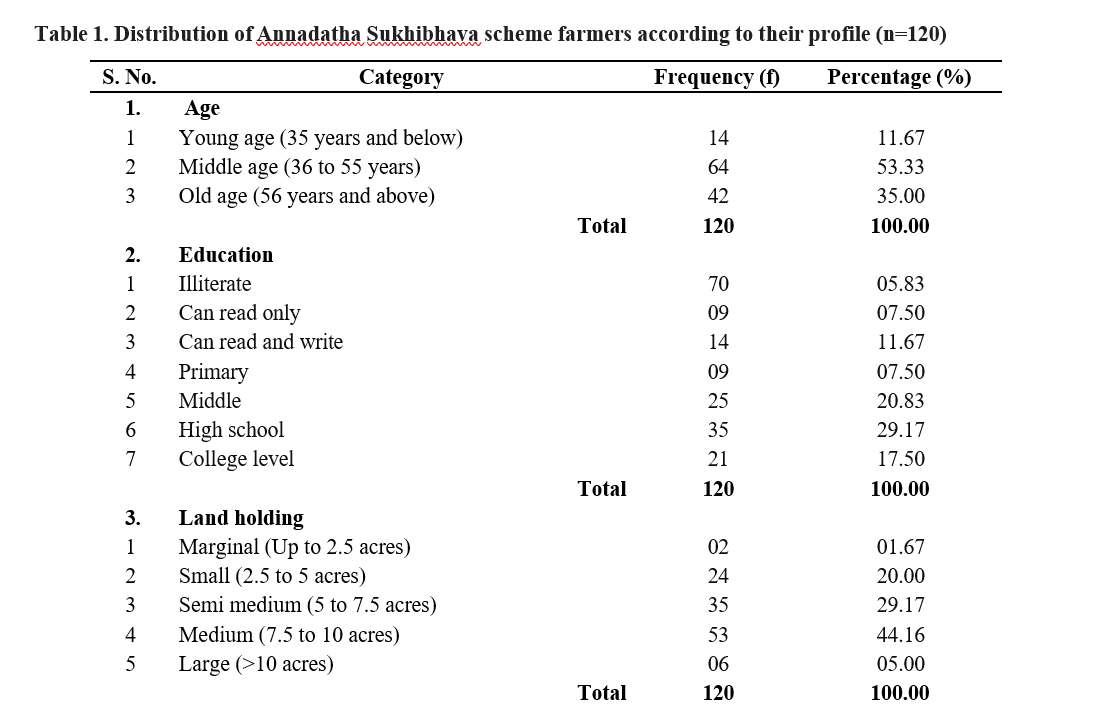
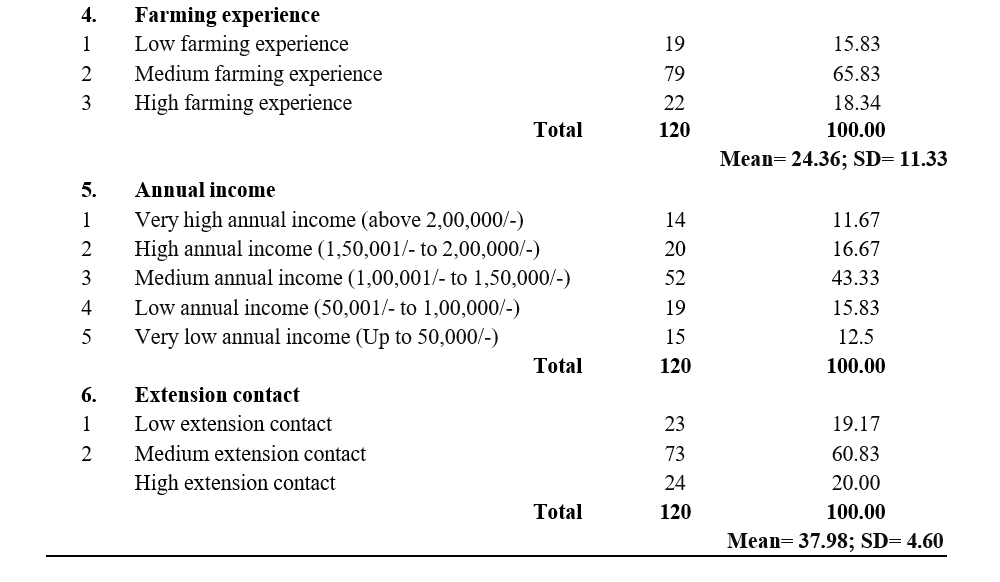
The farmers were distributed into different categories based on their selected profile characteristics and the results were presented in the Table 1.
The results from Table 1 revealed that half of the of Annadatha Sukhibhava Scheme beneficiary farmers belonged to the middle aged (53.33%) followed by old (35.00%) and young (11.67%) age. The predominance of middle-aged and older farmers indicated that the beneficiary group largely comprised farmers with established roles in agricultural activities and household management. The comparatively lower proportion of young farmers highlighted the need to encourage greater participation of younger individuals in agriculture and related extension programmes. This finding was in conformity with Nagesh (2019).
The findings from Table 1 showed that 29.17 per cent had education up to high school level followed by middle (20.83%) school, college (17.50%) level education, those who could read and write (11.67%), primary education and could read only (7.50% each) and (5.83%) were illiterate. The distribution indicated that the respondents had varied educational backgrounds, with high school education being the most common. Extension programmes should therefore use clear, accessible communication methods, combining written information with verbal explanations to address the needs of farmers with different educational levels. This finding was in conformity with Choudhary (2021).
The results furnished in Table 1 stated that, more than one-third 44.16 per cent beneficiaries belonged to the medium land holding category followed by (29.17%) semi medium farmers, (20.00%) were small farmers, (5.00%) were large farmer and only 1.67 per cent were marginal farmers. The predominance of medium and semi-medium landholders indicated that these categories formed a substantial share of the respondents. Differences in landholding size may be associated with variations in cultivation expenditure and the scale of farming operations. The result was in accordance with the finding of Hani et al. (2022).
The results from Table 1 revealed that, majority (65.83%) beneficiaries belonged to the medium farming experience category followed by (18.34%) high farming experience and (15.83%) low farming experience. The predominance of medium-experience farmers suggested that most respondents had accumulated considerable practical experience in agricultural activities. Such experience can be useful in farm management and decision-making; however, continued extension support remains important for improving awareness of new agricultural practices and government programmes. This finding was in conformity with Adhikari et al. (2021).
From the Table 1, it can be inferred that, 43.33 per cent of the beneficiaries belonged to the medium annual income category followed by (16.67%) high annual income category, (15.83%) low annual income category, (12.50%) very low annual income category and (11.67%) fell under the very high annual income category. The predominance of the medium-income category indicated that this was the most common income group among the surveyed beneficiaries. Nevertheless, the presence of farmers across all five income categories demonstrated variation in their economic circumstances. This variation highlights the importance of timely financial assistance and accessible extension services to help farmers manage cultivation expenses according to their individual needs. The results were in line with the findings of Reddy (2026).
The findings on extension contact from Table 1 projected that, 60.83 per cent of the beneficiaries belonged to the medium extension contact category followed by (20.00%) high extension contact and (19.17%) low extension contact. Most respondents had a moderate level of interaction with extension personnel and related information sources. However, the proportion with low extension contact suggested that some farmers might have limited opportunities to obtain timely agricultural information. Strengthening village-level extension activities and regular communication with farmers could help improve access to information about agricultural practices and welfare programmes. The result was in accordance with the finding Hani et al. (2022).
It could be understood from the Table 1 that, 65.00 per cent of the beneficiaries belonged to the medium category followed by (20.00%) high social participation and (15.00%) low social participation category. The predominance of medium social participation suggested that most respondents had some level of involvement in social organisations or community activities. Such participation may provide opportunities for information
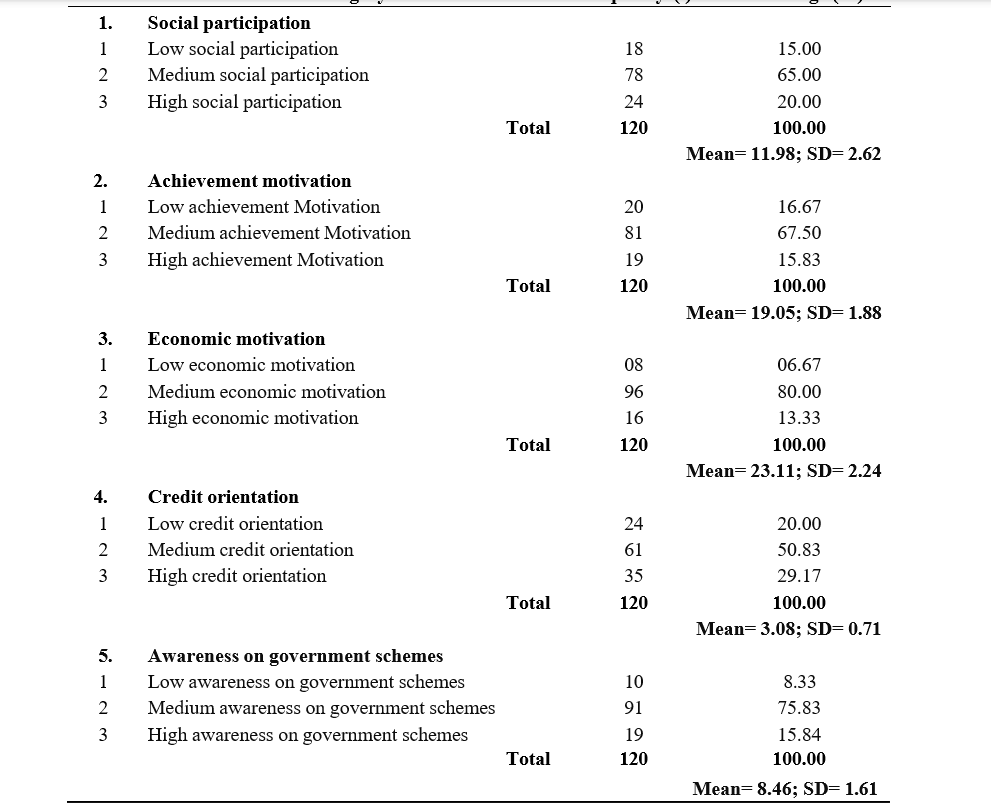
exchange and collective learning among farmers. Encouraging participation in farmer groups, self-help groups and other relevant community organisations may further strengthen communication and awareness regarding agricultural support programmes. This finding was in conformity with Dhulgand (2020).
It could be concluded from the Table 1 that, majority (67.50%) of the beneficiaries belonged to the medium achievement motivation category followed by (16.67%) low achievement motivation category and (15.83%) high
Mean= 8.46; SD= 1.61
achievement motivation category. The predominance of medium achievement motivation suggested that most respondents demonstrated a moderate orientation towards achieving farming-related goals. Extension programmes that promote goal setting, exposure to successful farming practices and interaction with progressive farmers may help strengthen farmers’ motivation to improve their agricultural performance. The result was in accordance with the finding Thakur et al. (2022).
It could be observed from Table 1 that, majority (80.00%) of the beneficiaries belonged to the medium economic motivation followed by (13.33%) high and (6.67%) low economic motivation category. This distribution indicated that most beneficiary farmers demonstrated a moderate orientation towards improving their economic position through farming. Timely access to agricultural information, suitable technologies and financial support may help farmers make informed decisions regarding input use, farm investment and income improvement. The result was in accordance with the findings of Dhulgand (2020).
From the Table 1 it could be interpreted that, more than half (50.83%) of the beneficiaries belonged to the medium credit orientation category followed by the high credit orientation category (29.17%) and low credit orientation category (20.00%). This highlights the importance of providing information about institutional credit facilities, loan procedures and responsible credit management. Better access to appropriate credit information may help farmers make informed financial decisions and manage cultivation-related expenditure. The findings of the present study were similar to that of Sreedaya and Suresh (2022).
The findings from the Table 1 showed that, Majority (75.83%) of the beneficiaries belonged to the medium awareness category followed by (15.84%) high and (8.33%) low awareness category. The predominance of medium awareness suggested that most beneficiary farmers possessed a moderate level of knowledge about government support programmes. However, the presence of farmers in the low-awareness category indicated a need for continued awareness-building activities. Regular village-level meetings, farmer-oriented information materials and direct communication through extension personnel could help farmers understand scheme provisions, eligibility requirements and application procedures. The findings of the present study were similar to that of Singh and Rathore (2023).
The present study conducted in Ananthapuramu district of Andhra Pradesh revealed that the beneficiary farmers of the Annadatha Sukhibhava Scheme were predominantly middle-aged, had high school education, possessed medium landholdings and had medium farming experience. Most respondents belonged to the medium annual income, extension contact, social participation, achievement motivation, economic motivation, credit orientation and awareness of government schemes categories. These findings highlighted the diverse socio-economic and psychological characteristics of the beneficiary farmers. The profile information can serve as a useful basis for planning farmer-oriented extension programmes and improving communication regarding agricultural welfare schemes. Greater attention to farmers’ educational backgrounds, information needs and awareness levels may help extension agencies provide more accessible and appropriate services to different categories of beneficiaries.
Adhikari, B., Prasad, S.V., Praveena, P.L.R.J., Sagar, G.K and Ravindra Reddy, B. 2021. Socio-personal and communication characteristics of Pradhan Mantri Krishi Sinchayee Yojana (PMKSY) in Uttarkhand. Asian Journal of Agricultural Extension, Economics and Sociology. 39 (11): 11-19.
Annadatha Sukhibhava Scheme. Retrieved from https:// annadathasukhibhava.ap.gov.in/
Choudhary, S. 2021. A study on repayment behaviour of beneficiary farmers among Kisan Credit Card scheme in Dewas district, Madhya Pradesh. M.Sc. (Ag.) Thesis. Rajmata Vijayaraje Scindia Krishi Vishwa Vidyalaya, Gwalior.
Dhulgand, V.G. 2020. Socio-economic impact of Mahatma Gandhi National Rural Employment Guarantee Act (MGNREGA) on its beneficiaries in Marathwada region. M. Sc. (Ag.) Thesis. Vasantrao Naik Marthwada Krishi Vidyapeeth, Parbhani.
Hani, U., Raju, R., Moorthy, G and Nagesha, G. 2022. Attitude of farmers on Pradhan Mantri Fasal Bima Yojana (PMFBY) in Tumkur district of Karnataka. Asian Journal of Agricultural Extension, Economics and Sociology. 40(2): 93-99.
Nagesh, H. 2019. A critical study on Pradhan Mantri Fasal Bima Yojana (PMFBY) in Srikakulam district of Andhra Pradesh. M.Sc. (Ag.) Thesis. Acharya N. Ranga Agricultural University, Guntur.
PM Kisan Retrieved from https://pmkisan.gov.in/
Reddy, M. V. 2026. Association between PM-KISAN and Rythu Bharosa schemes fund utilization and indebtedness among marginal and small paddy farmers. EPRA International Journal of Agriculture and Rural Economic Research. 14(1): 36-44.
Singh, M. and Rathore, R. 2023. Agricultural schemes in India: A review. Asian Journal of Agricultural Extension, Economics and Sociology. 41 (9): 730-736.
Sreedaya, G.S and Suresh, N. 2022. Perception of farmers towards crop insurance schemes in Kerala, India. Asian Journal of Agricultural Extension, Economics and Sociology. 40 (1): 437-447.
Thakur, D., Pathak, K.N., Minakshimeshram and Vidhimotiwale. 2020. Profile of beneficiaries rural women under KVK in Madhya Pradesh. International Journal of Current Microbiology and Applied Sciences. 9(10): 3535-3541.