
0 Views
Department of Agronomy, ANGRAU-S.V. Agricultural College, Tirupati-517 502.
A field experiment was conducted during rabi, 2025-26 on sandy loam soils of S.V Agriculture College, Dry land farm, Tirupati, Andhra Pradesh to study the “Sustainable cultivation of finger millet (Eleusine coracana L.) through natural farming”. The experiment was laid out in a randomized block design and replicated thrice. The findings of the experiment revealed that significantly highest growth parameters and yield of finger millet were recorded with application of Ghanajeevamrutham @ 1500 kg ha-1 + Dravajeevamrutham @ 1000 l ha-1 + Sapthadhanyankura kashayam @ 25 l ha-1 at flower bud initiation and grain filling stage (T10), which was however comparable with Ghanajeevamrutham @ 1000 kg ha-1 + Dravajeevamrutham @ 1000 l ha-1 + Sapthadhanyankura kashayam @ 25 l ha-1 at flower bud initiation and grain filling stage (T8) and Organic Package – Enriched FYM @ 5 t ha-1 + Foliar spray of Panchagavya 5 per cent @ 30 & 45 DAT (T11). Application of Ghanajeevamrutham @ 500 kg ha-1 (T1) recorded the lowest stature of growth parameters and yield. However, considering the comparable yield performance and economic returns with a lower quantity of Ghanajeevamrutham than application of Ghanajeevamrutham @ 1500 kg ha-1 + Dravajeevamrutham @ 1000 l ha-1 + Sapthadhanyankura kashayam @ 25 l ha-1 at flower bud initiation and grain filling stage (T10), application of Ghanajeevamrutham @ 1000 kg ha-1 + Dravajeevamrutham @ 1000 l ha-1 + Sapthadhanyakura kashayam @ 25 l ha-1 at flower bud initiation and grain filling stages (T8) was found to be promising and economically viable natural farming practices on sandy loam soils of Southern Agro-Climatic Zone of Andhra Pradesh.
KEYWORDS: Natural farming practices, ghanajeevamrutham, dravajeevamrutham, panchagavya, fish amino acid, sapthadhanyankura kashyam, yield and finger millet.
Modern agriculture has led to the excessive use of chemical fertilizers and pesticides,raising serious concerns in recent years. Although these inputs have contributed to enhanced crop productivity, their continuous and indiscriminate use has resulted in declining soil fertility, soil degradation, erosion and contamination of surface and groundwater resources. Furthermore, the rising cost of chemical inputs has increased the financial burden on farmers, reducing the profitability of cultivation. These challenges have emphasized the need for sustainable and environmentally friendly farming practices.
In this context, natural farming has emerged as a promising alternative that reduces dependence on external inputs while restoring and strengthening the ecological processes and functions of the farm ecosystem. It is gaining widespread recognition as a chemical-free production system that utilizes locally available resources, protects soil health, conserves biodiversity and promotes sustainable crop production. By minimizing the use of synthetic fertilizers and pesticides, natural farming also helps reduce the cost of cultivation.
Millets are gaining tremendous attention as climate-resilient and nutrient-rich crops that contribute to food and nutritional security, particularly in rainfed and resource-poor regions (Brahmachari et al., 2019). India is the world’s largest producer of millets, accounting for about 44 per cent of global production (USDA, 2026). Among them, finger millet (Eleusine coracana L.) is an important millet crop valued for its high calcium, iron, protein content and low glycaemic index, making it a nutritious food for health-conscious consumers. In India, it is cultivated over 12.29 lakh hectares with a production of 18.34 lakh tonnes and a productivity of 1,492 kg ha-1 (Indiastat, 2024–25). Its nutritional richness and adaptability to diverse agro-climatic conditions make finger millet a promising crop for sustainable agriculture and future food security.
However, the production potential of finger millet is constrained by several agronomic factors, among which nutrient management plays a crucial role. Although natural farming has gained considerable attention as a
sustainable production system, scientific information on the validation of different natural farming inputs and their combinations for finger millet cultivation is still limited. This knowledge gap highlights the need for systematic evaluation of natural farming nutrient management practices to improve crop growth, productivity and soil health.
A field experiment entitled “Sustainable cultivation of finger millet (Eleusine coracana L.) through natural farming” was conducted during rabi, 2025-26 at S. V. Agricultural College, Dry land Farm, Tirupati. It is geographically situated at 13.6o N latitude and 79.3o E longitude and at an altitude of 182.9 m above mean sea level in the Southern Agro-Climatic Zone of Andhra Pradesh. The soil of experimental field was sandy loam in texture, neutral in reaction, low in organic carbon and available nitrogen, medium in available phosphorus and available potassium content. The experiment was laid out in a randomized block design and replicated thrice.
The experiment consisted of eleven treatments viz., Ghanajeevamrutham@500kgha-1(T1),Ghanajeevamrutham @ 1000 kg ha-1 (T2), Ghanajeevamrutham @ 1500 kg ha-1 (T3), Ghanajeevamrutham @ 500 kg ha-1 + Dravajeevamrutham @ 500 l ha-1 + Fish amino acid 1 per cent at 30 and 45 DAT (T4), Ghanajeevamrutham @ 500 kg ha-1 + Dravajeevamrutham @ 1000 l ha-1 + Fish amino acid 1 per cent at 30 and 45 DAT (T5), Ghanajeevamrutham @ 1000 kg ha-1 + Dravajeevamrutham @ 500 l ha-1 + Fish amino acid 1 per cent at 30 and 45 DAT (T6), Ghanajeevamrutham @ 1000 kg ha-1 + Dravajeevamrutham @ 1000 l ha-1 + Fish amino acid 1 per cent at 30 and 45 DAT (T7), Ghanajeevamrutham @ 1000 kg ha-1 + Dravajeevamrutham @ 1000 l ha-1 + Sapthadhanyankura kashayam @ 25 l ha-1 at flower bud initiation and grain filling stage (T8), Ghanajeevamrutham @ 1500 kg ha-1 + Dravajeevamrutham @ 500 l ha-1 + Fish amino acid 1 per cent at 30 and 45 DAT (T9), Ghanajeevamrutham @ 1500 kg ha-1 + Dravajeevamrutham @ 1000 l ha-1
+ Sapthadhanyankura kashayam @ 25 l ha-1 at flower bud initiation and grain filling stage (T10) and Organic Package – Enriched FYM @ 5 t ha-1 + Foliar spray of Panchagavya 5 per cent @ 30 & 45 DAT (T11). Seedlings were treated with beejamrutham and groundnut shell was used as mulch, ghanajeevamrutham is applied 50 per cent at basal and 50 per cent as topdressing at 30
DAT. Dravajeevamrutham applied through irrigation water at 20, 40 and 60 DAT according to the treatments
i.e 500 l ha-1 and 1000 l ha-1. Fish amino acid and Sapthadhanyankura kashayam applied as foliar spray and plant protection measures are carried out by natural inputs through neemastra.
Fresh cow dung (25 kg), cow urine (25 L), jaggery (5 kg), Bengalgram flour (5 kg) and fertile soil (2 handfuls) were mixed in 500 L water, kept under shade for 2 days and stirred three times daily.
For 200 kg FYM, Drava Jeevamrutham (20 L) was uniformly mixed, covered with a jute bag and fermented for 48 hours, followed by spreading and sun-drying completely.
Fish Amino Acid (FAA): Fish waste and jaggery were taken in a 1:1 ratio, mixed layer by layer and stored in a cool, dry place away from sunlight for 30 days. The fermented liquid was then filtered to obtain the FAA stock solution.
Sesame, greengram, blackgram, cowpea, horsegram, chickpea and wheat seeds (100 g each) were soaked overnight, sprouted to about 1 cm and ground into a fine paste. The paste was mixed with 200 L water and 10 L cow urine, stirred, kept for 2 hours and filtered to obtain the stock solution.
Panchagavya Fresh cow dung (7 kg) and cow ghee (1 kg) were mixed thoroughly and kept for 2 days, followed by addition of cow urine (10 L) and water (10 L) and kept for 15 days. Milk (2 L), curd (2 L), jaggery (250 g), ripe bananas (12 nos.) and tender coconut water (3 L) were then added and the mixture was stirred twice daily and kept under shade for 15 days.
All the growth parameters differed significantly with the application of various natural farming practices (Table 1 and Table 2).
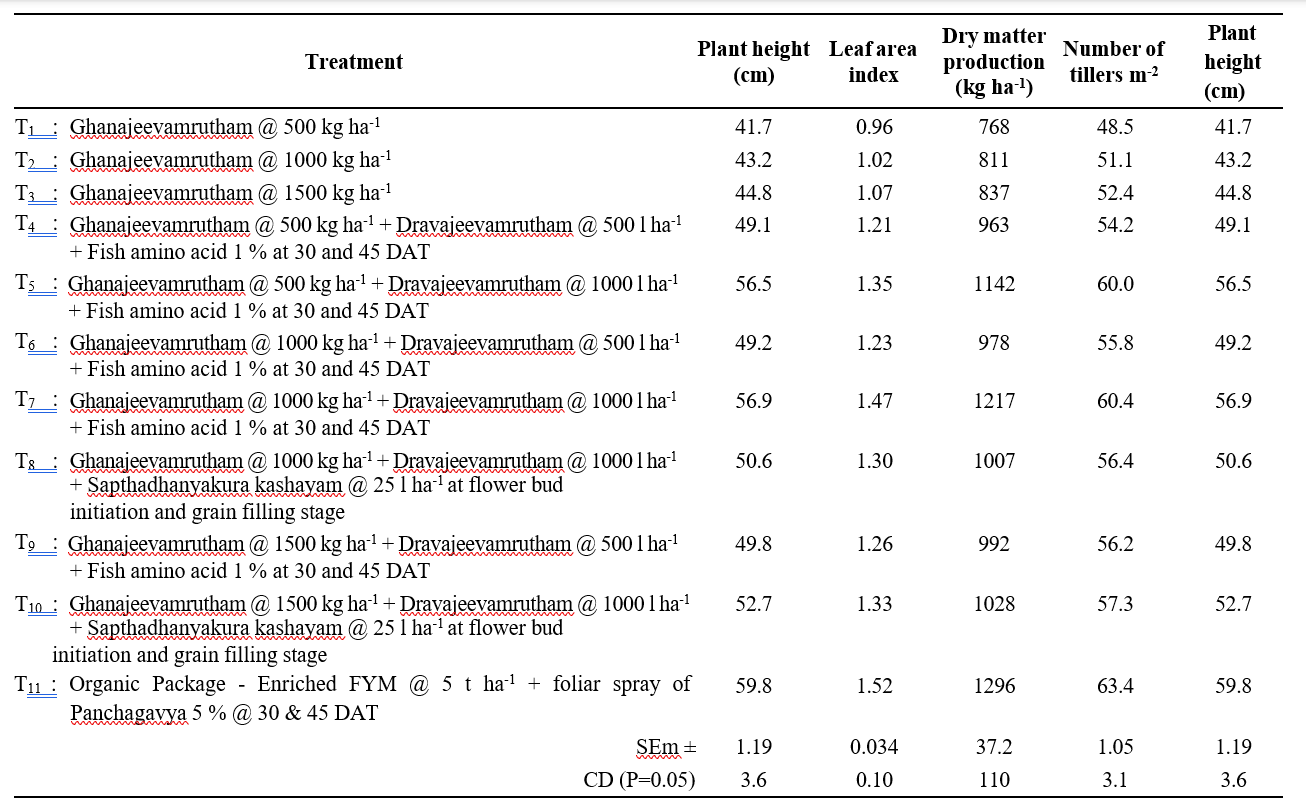
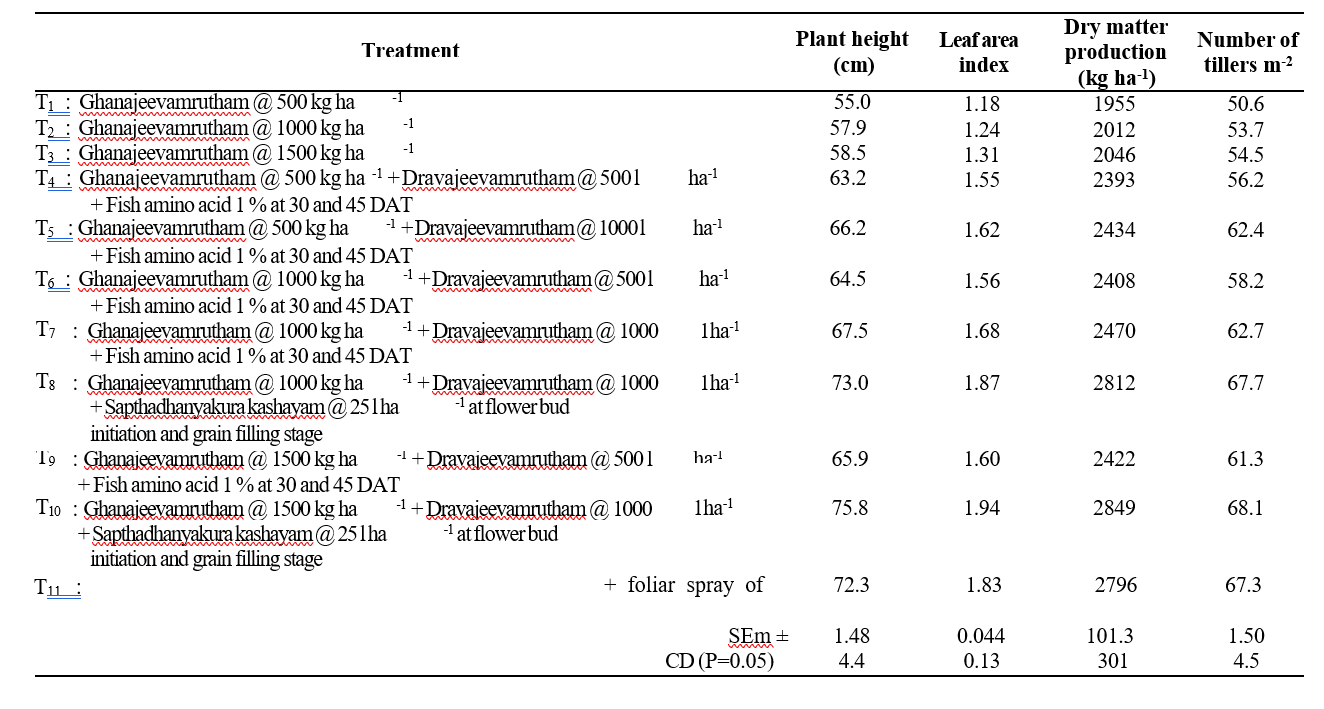
Among the different natural farming treatments tried, application of Ghanajeevamrutham @ 1500 kg ha-1 + Dravajeevamrutham @ 1000 l ha-1 + Sapthadhanyankura kashayam @ 25 l ha-1 at flower bud initiation and grain filling stage (T10) recorded significantly higher growth parameters (plant height, LAI, dry matter production) at harvest, which was however, comparable with Ghanajeevamrutham @ 1000 kg ha-1 + Dravajeevamrutham @ 1000 l ha-1 + Sapthadhanyankura kashayam @ 25 l ha-1 at flower bud initiation and grain filling stage (T8) and Organic Package – Enriched FYM @ 5 t ha-1 + foliar spray of Panchagavya 5 per cent @ 30 & 45 DAT (T11), which were superior over rest of the treatments. Wheareas the lowest growth parameters were recorded with Ghanajeevamrutham @ 500 kg ha-1 (T1) which was in turn on par with Ghanajeevamrutham @ 1000 kg ha-1 (T2) and Ghanajeevamrutham @ 1500 kg ha-1 (T3). The increased plant height, leaf area and dry matter production at harvest might be attributed to the combined application of higher doses of Ghanajeevamrutham and Dravajeevamrutham along with Sapthadhanyankura kashayam, which enhanced soil biological activity, nutrient mineralization and the production of growth-promoting substances. The increased availability and uptake of nutrients throughout the crop growth period might have promoted root proliferation, cell division, leaf expansion and photosynthetic efficiency, thereby enhancing biomass accumulation and overall crop growth. Similar findings were reported by Kumbar and Devakumar (2016), Chaithra and Sujith (2021), Mahapatra et al. (2020) and Kumari et al. (2025).
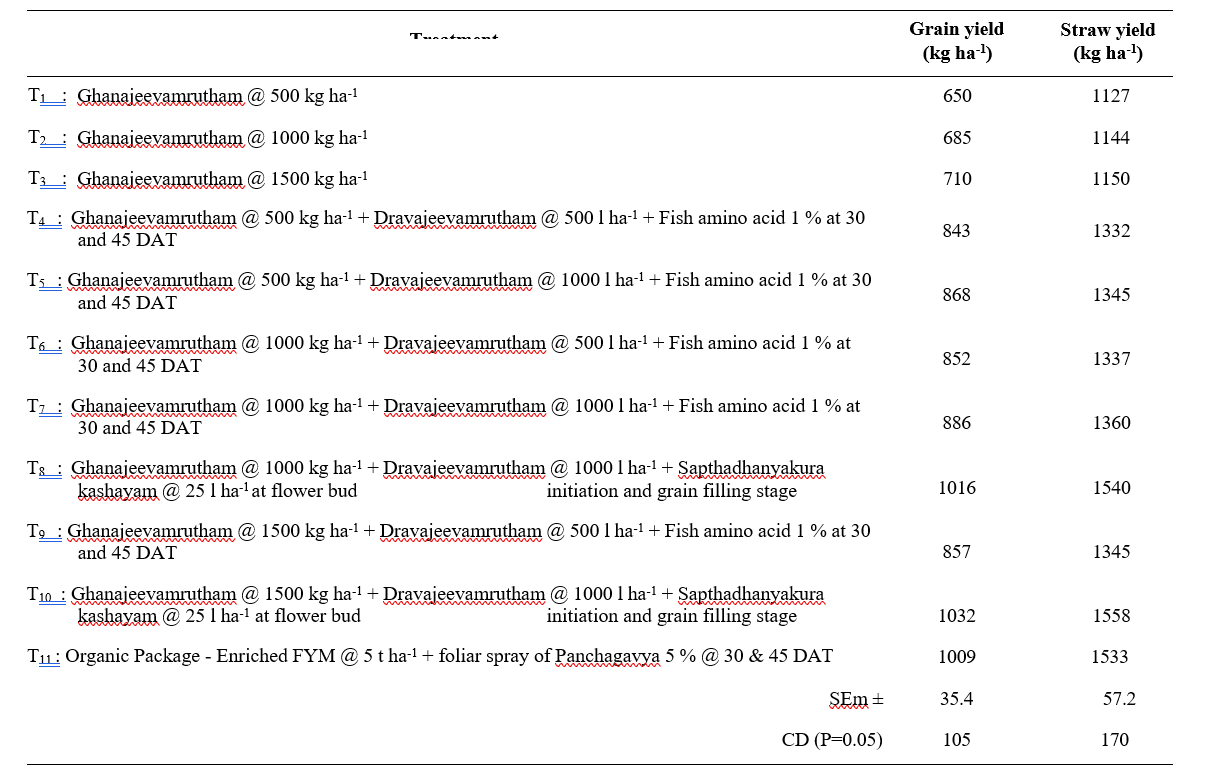
Application of different natural farming practices exerted significant influence on grain and straw yield of finger millet (Table 3).
Application of Ghanajeevamrutham @ 1500 kg ha-1 + Dravajeevamrutham @ 1000 l ha-1 + Sapthadhanyankura kashayam @ 25 l ha-1 at flower bud initiation and grain filling stage (T10) recorded higher grain and straw yield, which was however, comparable with application of Ghanajeevamrutham @ 1000 kg ha-1 + Dravajeevamrutham @ 1000 l ha-1 + Sapthadhanyankura kashayam @ 25 l ha-1 at flower bud initiation and grain filling stage (T8) and Organic Package – Enriched FYM @ 5 t ha-1 + Foliar spray of Panchagavya 5 per cent @ 30 & 45 DAT (T11) followed by Ghanajeevamrutham @ 1000 kg ha-1 + Dravajeevamrutham @ 1000 l ha-1 + Fish amino acid 1 per cent at 30 and 45 DAT (T7) and these treatments are significantly superior over rest of the treatments tried. The lowest grain and straw yield of finger millet was recorded with Ghanajeevamrutham @ 500 kg ha-1 (T1) and these are comparable with Ghanajeevamrutham @ 1000 kg ha-1 (T2) and Ghanajeevamrutham @ 1500 kg ha-1 (T3).
The higher yield might be attributed to enhanced microbial activity and sustained availability of nutrients throughout the crop growth period. Sapthadhanyankura kashayam, being a fermented formulation prepared from sprouted grains, might have supplied readily available macro and micronutrients, enzymes, amino acids and growth-promoting substances, thereby favourably influencing crop growth and development. The combined application of these natural farming inputs might have enhanced nutrient mobilization and uptake, resulting in improved photosynthetic efficiency and efficient translocation of photosynthates to the developing sinks. Moreover, the presence of growth-promoting hormones such as IAA and GA₃ (Mahapatra et al. 2020) might have stimulated physiological and metabolic activities, leading to improved source–sink relationships, greater biomass accumulation and ultimately higher grain and straw yield of finger millet. These results were in confirmity with the findings of Choudhary et al. (2022), Kumar et al. (2023), Veeranna et al. (2023) and Devakumar et al. (2018).
Brahmachari, K., Sarkar, S., Santra, D.K and Maitra, 2019. Millet for food and nutritional security in drought prone and red laterite region of Eastern India. International Journal of Plant & Soil Science. 26(5): 1-7.
Chaithra, M and Sujith, G.M. 2021. Influence of farmyard manure and jeevamrutha on growth and yield of sunflower. International Journal of Environment and Climate Change. 11(11): 135-141.
Choudhary, R., Kumar, R., Sharma, G.D., Sharma, R.P., Rana, N and Dev, P. 2022. Effect of natural farming on yield performances, soil health and nutrient uptake in wheat + gram inter cropping system in sub-temperate regions of Himachal Pradesh. Journal of Crop and Weed. 18(2): 1-8.
Devakumar, N., Lavanya, G and Rao, G.G.E. 2018. Influence of jeevamrutha and panchagavya on beneficial soil microbial population and yield of organic field bean (Dolichos lablab L.). Mysore Journal of Agricultural Sciences. 52(4): 790-795.
https://www.fas.usda.gov/data/production/0459100
Kumar, S.P., Latha, M.R., Janaki, P., Parameswari, E., Kalaiselvi, T and Krishnan, R. 2023. Natural farming practices impact on yield and macro nutrient uptake of sorghum. International Journal of Plant and Soil Science. 35(20): 221-227.
Kumari, S., Singh, J., Kumar, R., Kumar, P., Sachin and Mali, S. 2025. Effect of natural and organic nutrient sources on growth parameters and yield of blackgram (Vigna mungo L.). Himachal Journal of Agricultural Research. 51(2): 281-284.
Kumbar, B and Devakumar, N. 2016. Effect of jeevamrutha and panchagavya on growth, yield and microbial population of french bean (Phaseolus vulgaris L.). Advances in Life Sciences. 5(9): 3619-3623.
Mahapatra, S.S., Sunitha, N., Ramu, Y.R and Rahman, F.H. 2020. Potential of various organic nutrient management practices for augmenting the growth, yield attributes and yield of finger millet [Eleusine coracana (L.) Gaertn]. Current Journal of Applied Science and Technology. 39(33): 126-135.
Veeranna, H.K., Shilpa, H.D., Shilpa, M.E., Adarsha, S.K and Deepa, A.G. 2023. Response of different levels of jeevamrutha and ghanajeevamrutha on pod yield and yield components of rainfed groundnut (Arachis hypogaea L.). Applied Ecology and Environmental Research. 21(2): 1219-1231.
www.indiastat.com, 2024-25.