

0 Views
Department of Entomology, ANGRAU-S.V. Agricultural College, Tirupati-517 502.
A roving survey was conducted on pesticide usage pattern in rice crop grown in Southern Agro-climatic Zone of Andhra
Pradesh during rabi, 2024-25. Data from 120 farmers were collected in four districts viz., Kadapa, Nellore, Chittoor, Tirupati, two mandals from each district and three villages from each mandal. The data on crop management practices followed by the rice farmers, occurrence of insect pests and diseases, time of plant protection, pesticides, dose, method of application, etc., was recorded. The results indicated that, stem borer, leaf folder, gall midge and brown plant hopper are the common insect pests of rice in surveyed areas and the insecticides viz., chlorantraniliprole, dinotefuran, triflumezopyrim, acephate, cypermethrin, were used in the insect pest control. Diseases viz., sheath blight, blast, grain discoloration were observed in common and fungicides azoxystrobin, tebuconazole, propiconazole, tricyclazole, carbendazim were the most frequently used to control the diseases. Among the insecticides, chlorantraniliprole being applied to the extent of 77 per cent against stem borers in Kadapa district followed by triflumezopyrim (70%) in Tirupati and Nellore districts against brown plant hoppers. In Chittoor district, 66.7 per cent farmers used cypermethrin against leaf folder. Among the fungicides, the combination of azoxystrobin and tebuconazole was used against sheath blight to the tune of 25.0 per cent, followed by tricyclazole (23.33%) against rice blast and propiconazole (20.8%) against sheath blight. Highest fungicide usage was observed in Tirupati district. The studies revealed that most of the farmers are using insecticides and fungicides in combination spray after tank mixing, limited to 3-5 no. of sprays with the power sprayer. This study provides an overview of the history and evolution of pesticide use in rice cultivation, explores the functions and application patterns of different types of pesticides.
KEYWORDS: Survey, rice, insecticides, fungicides, Andhra Pradesh.
Pesticides constitute the key control tactics for management of pests and diseases and the productivity of crops depends on their effective control. As global food demand continues to grow, the use of pesticides in rice cultivation has become a common practice to ensure high yields. In India, 76 per cent of the pesticides were used as insecticides as against 44 per cent globally. The use of herbicides and fungicides were correspondingly less (Dey et al., 2013). Rice crop is known to attack by more than 100 insect pest species worldwide and among them 10-12 are major in Indian context. Yellow stem borer, leaf folder, brown plant hopper, gall midge, green leaf hoppers, are the major insect pests in one and other rice growing locations of Andhra Pradesh. Rice crop is next to cotton in pesticidal application. Several new molecules with novel modes of action are applying in rice ecosystem for insect pest and disease control (Reddy et al., 2023). The pesticide application in rice crop is started from nursery till maturity. In recent years end of the season pesticide application observed in different rice growing areas of Andhra Pradesh. In view of the availability and usage of latest pesticide molecules, the present studies were planned to collect the data on pesticide usage in rice crop from Southern Agro-Climatic Zone of Andhra Pradesh.
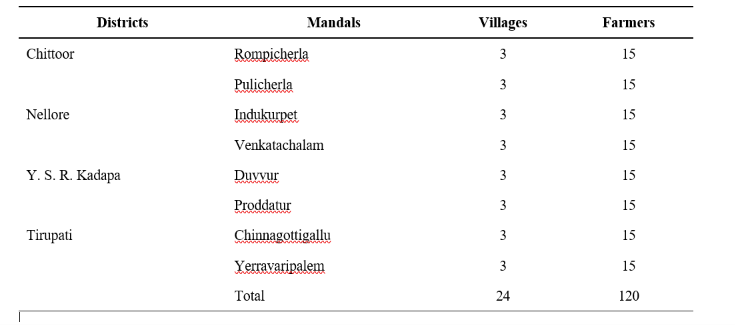
Roving survey was conducted in major rice growing areas of Andhra Pradesh viz., Chittoor, S P S Nellore, Tirupati and Y S R Kadapa districts during early rabi, 2024-2025 to study the pesticide usage pattern. In each district, two mandals were selected and in each mandal, three villages were choosen randomly and 5 farmers in each village will be selected for conducting the survey. The list of districts, mandals and villages surveyed are mentioned in (Table 1). Survey was conducted as per standard proforma to access the pesticide usage pattern in rice crop by collecting the information on variety sown, seed treatment, date of sowing and transplanting, fertilizer dosage, insecticides and fungicides sprayed,
stage of spraying, date of harvesting, source for pesticides, precautionary measures etc.,
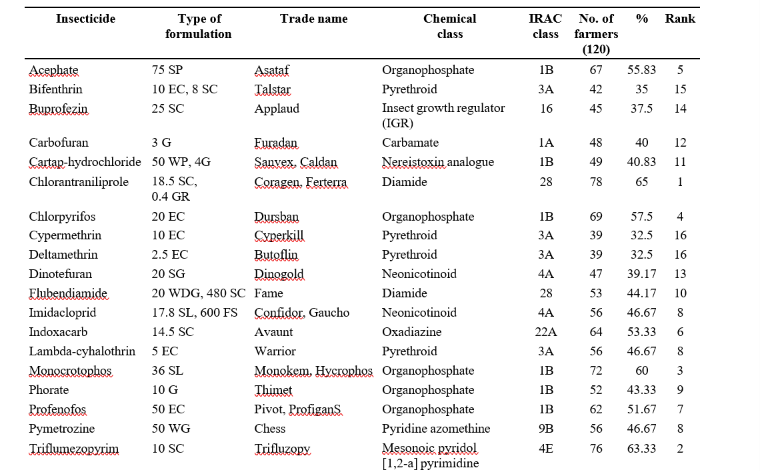
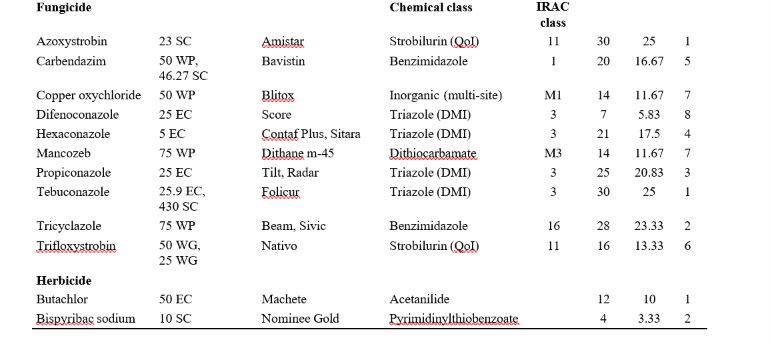
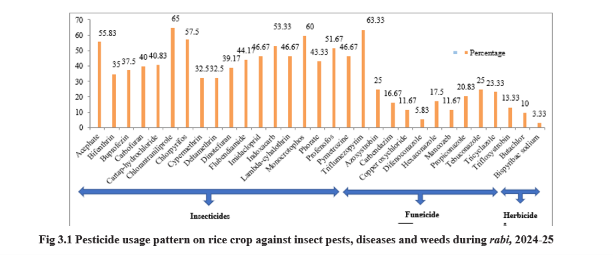
From the Table 2, it was clear that different formulations of 19 insecticides, 10 fungicides were used by paddy farmers throughout the crop growing season during rabi, 2024-25. The highest number of farmers (65.00%) used chlorantraniliprole followed by triflumezopyrim (63.33%) and monocrotophos (60.00%), while the least number of farmers used bifenthrin (35.00%) for control of different insect pests, while, in case of fungicides, azoxystrobin and tebuconazole (25.00%) followed by tricyclazole (23.00%) and propiconazole (20.83%) were used by farmers against different fungal infections. In case herbicides, 10.00 and 3.33 per cent farmers used butachlor and bispyribac sodium and the remaining farmers (86.67%) followed manual method for weed control.
Among the insecticides used by the farmers, bifenthrin, cypermethrin, profenophos, phorate, deltamethrin and lambda-cyhalothrin and fungicide, copper oxychloride were not recommended on rice crop as per CIB & RC (2024). Pesticides viz., trifloxystrobin fungicide recommended in combination with other fungicides. Among the pesticides used monocrotophos belongs to class Ib which was highly toxic and likely to cause ill-effects whereas, chlorantaniliprole, azoxystrobin, mancozeb and carbendazim unlikely to cause ill-effects in normal use and belongs to class ‘U’ according to WHO Classification 2019.
Based on the survey during rabi, 2024-25, it was concluded that farmers used more insecticides followed by fungicides and herbicides to reduce the insect pests, diseases and weeds. These results were similar with the observations of Sai et al. (2019) who reported that insecticides (72%) were the most commonly used among pesticides, followed by fungicides and bactericides (18%) and herbicides (6%). From the obtained results it was revealed that among different pesticides, farmers used different formulations of insecticides and fungicides which were available in different trade names. The results were in conformity with the survey done by Ahmad et al. (2014) who reported that, most of the insecticides which were used frequently by the famers contains active ingredients of thiamethoxam, lambda-cyhalothrin, chlorpyrifos, cypermethrin, buprofezin and cartap hydrochloride and among the fungicides, difenoconazole and isoprothiolane were the active ingredients used to control fungal pathogens (Rhizoctonia solani and Pyricularia oryzae).
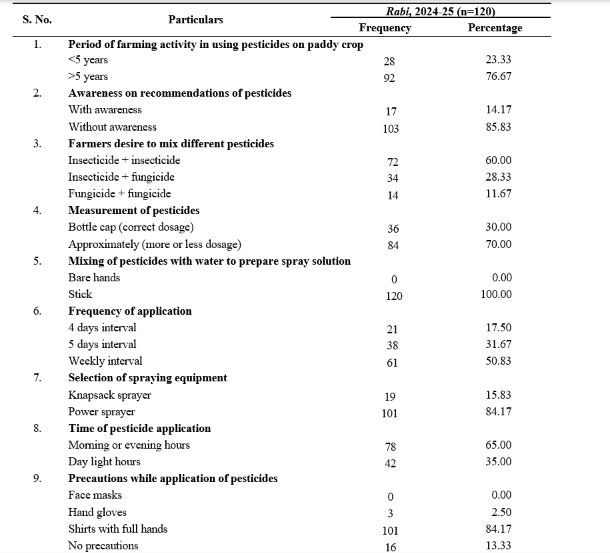
From the table 3, information on paddy farmers of 76.67 and 23.33 per cent have been using different chemical pesticides for more than five and less than five years respectively against different pests. Since most of the famers had an farming experience of 10-15 years on different crops. These results were similar with the findings of Sankoh et al. (2016) who reported that most of the respondents used at least one type of pesticide on their farms throughout their farming experience. Only 14.17 per cent of the farmers had awareness to use recommended pesticides for different pests and 85.83 per cent of the farmers used recommended pesticides without
awarenesss. The results were similar with the outcome of Deviprasad et al. (2015) who observed that most of the pesticide formulations which were used against different pests at various stages of crop production by the farmers were recognized. Shetty et al. (2010) observed that 52.49 per cent of the farmers applied combination of two to three pesticides against major pests and 48 per cent of the respondents in the study area sprayed pesticides without mixing two or more pesticides. Fajardo et al. (2000) observed that the pesticides were sprayed with a 15 litre capacity knapsack sprayer on paddy crop by majority of the farmers. This output was similar with the findings of Hamsan et al. (2017) who observed that 89.60 per cent of farmers sprayed in the morning or evening and only
4.0 per cent sprayed pesticides while it was so hot in the afternoon. The findings of Jallow et al. (2017) who reported that the majority (58%) of the farmers did not use any protection equipment when mixing or spraying pesticides due to lack of availability when needed.
Present surveys in Southern Agro-Climatic Zone of Andhra Pradesh revealed that the farmers were using
19 insecticides, 10 fungicides and 2 herbicides. The compounds viz.,bifenthrin, cypermethrin, profenophos, phorate, deltamethrin and lambda-cyhalothrin were not recommended on rice crop and fungicides; copper oxychloride also not recommended. Pesticides viz., trifloxystrobin fungicide recommended in combination with other fungicides. The farmers applying tank mixture of insecticides and fungicides alone and in combination also. End season application of fungicides was resulted for fungal diseases and grain discoloration. Hence the harvest time residues in rice also need to be studied.
Ahmad, M.I., Ahmad, N.A., Muhammad, S.A. and Esa, N., 2014. A survey on use, hazards and potential risks of rice farming pesticides in Permatang Keriang, Pulau Pinang (Malaysia). International Journal of Scientific and Research Publications. 4(10): 1-11.
Deviprasad, A.G., Radha, S. and Manonmani, H.K., 2015. Pesticide usage pattern in four districts of Karnataka: A survey. IOSR J. Environ. Sci. Toxicol. Food Technol. 9: 48-51.
Dey, K. R., Choudhary, P. and Dutta, B. K., 2013. Impact of pesticide use on the health of farmers: A study in Barak valley, Assam (India). Journal of Environmental Chemistry and Ecotoxicology. 5(10): 269-277.
Fajardo, C. B. L., Roldan, G.V., Escandor, R. P., Moody, K., Litsinger, J. A and Mew, T. W. 2000. Understanding small scale rice farmers pest perceptions and management practices as a foundation for adaptive research and extension: A case study in the Philippines. Philippines Journal of Crop Science. 25(2): 55-67.