

0 Views
Department of Plant Pathology, ANGRAU-S.V. Agricultural College, Tirupati-517 502.
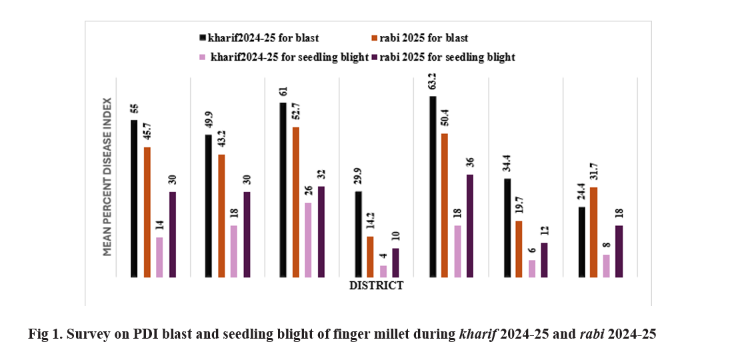
A comprehensive roving survey was conducted during the kharif 2024 and rabi 2024–2025 seasons across seven districts of Andhra Pradesh to assess the severity of blast and seedling blight diseases in finger millet. The survey revealed that blast disease (mean PDI of Blast with 41.1%) was more prevalent and severe compared to seedling blight (mean PDI of Seedling blight with 18.7%). The highest blast incidence during kharif 2024 was recorded in YSR Kadapa district with a mean PDI of 63.2 per cent, followed by Satya Sai (61.0%) and Vizianagaram (55.0%). In rabi 2024–2025, Satya Sai district showed the highest mean PDI of 52.7 per cent, while Chittoor and Nandyal districts exhibited lower infection levels. Seedling blight incidence was comparatively lower, with a maximum mean PDI of 26 per cent in Satya Sai during kharif 2024 and 36 per cent in YSR Kadapa during rabi 2024–2025. A comparative analysis indicated that disease severity was higher during the kharif season, likely due to favourable environmental conditions. The findings underscore blast as the more dominant and damaging disease in finger millet, necessitating targeted disease management strategies.
KEYWORDS: Finger millet, blast, seedling blight, survey, Andhra Pradesh.
Finger millet (Eleusine coracana Gaertn. L.) is a cereal crop cultivated primarily for food in parts of Africa and South Asia, especially in India across states such as Uttar Pradesh, Bihar, Tamil Nadu, Karnataka, and Andhra Pradesh. Finger millet is a major crop in the arid and semi-arid regions of developing countries across Asia and Africa (Ceasar et al., 2018; Krishna et al., 2020).
Among all cereals and millets, finger millet contains the highest levels of calcium (344 mg per 100 g) and potassium (408 mg per 100 g). It also provides more dietary fiber, minerals, and sulfur-containing amino acids than white rice, which is currently the major staple food in India (Shobana et al., 2013). Finger millet is also a rich source of essential amino acids such as arginine, lysine, methionine, and lecithin. These compounds play vital roles in promoting health, including acting as precursors for nitric oxide synthesis and aiding in the stimulation and release of growth hormone (Pragya, 2012). Leaf blast symptoms caused by Pyriculria grisea typically appear as elongated, diamond-shaped lesions with gray or whitish centers and brown to reddish-brown margins (Acharya et al., 2019). In severe cases, the portion of the panicle above the infected neck turns dark brown to black, often resulting in the complete death of the plant.
Brown spot, also known as seedling blight or leaf blight, caused by Helminthosporium nodulosum (Berk and Curt.), is the second most severe and widely distributed disease of finger millet after blast. The characteristic symptom on the leaf lamina is the appearance of brown to dark brown spots. In finger millet, Helminthosporium infects nursery seedlings or very young plants, attacking the coleoptile, collar or first leaves, causing rapidly spreading lesions that lead to wilting, drying and collapse of seedlings. The pathogen primarily infects leaves either from the upper surface or in the region between the leaf and the leaf sheath. Infection occurs through stomata, epidermal cells, or more commonly via certain epidermal outgrowths.
In the past few years, the production of finger millet has faced significant constraints due to blast and seedling blight diseases in the Vizianagaram and Rayalaseema districts of Andhra Pradesh. A survey was conducted to determine the severity of blast and seedling blight diseases.
To assess the prevalence of blast and seedling blight diseases in finger millet, a roving survey was undertaken in one mandal was selected for each district and two villages were randomly selected across the districts of Vizianagaram, Tirupati, Sri Sathya Sai, Chittoor,
Y.S.R. Kadapa, Ananthapuram, and Nandyala of Andhra Pradesh.
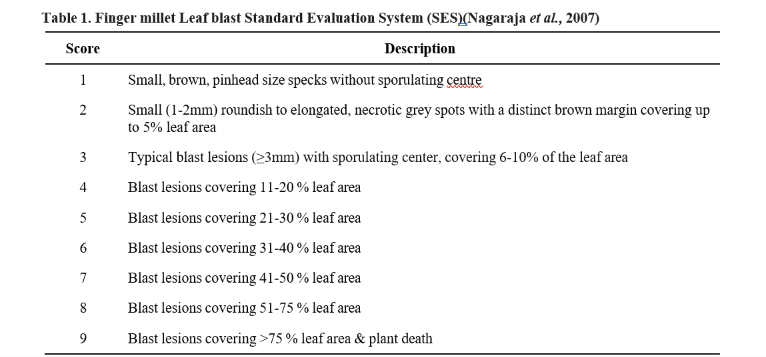
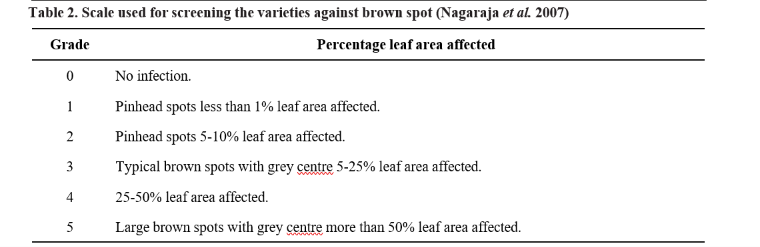
Ten representative leaves from one plant were selected from each field and evaluated using a 1–9 rating scale for blast disease (Table 1) and a 0–5 rating scale for seedling blight (Table 2). These scores were then used to calculate the percent disease index (PDI) for each surveyed field, following the method outlined by Nagaraja et al. (2007). Disease severity was determined based on the visible symptoms of blast and brown spot on the plants.
The per cent disease index was computed with the following formula.
Sum of all the scores
PDI =————————————– × 100
(Total number of scores x Maximum score)
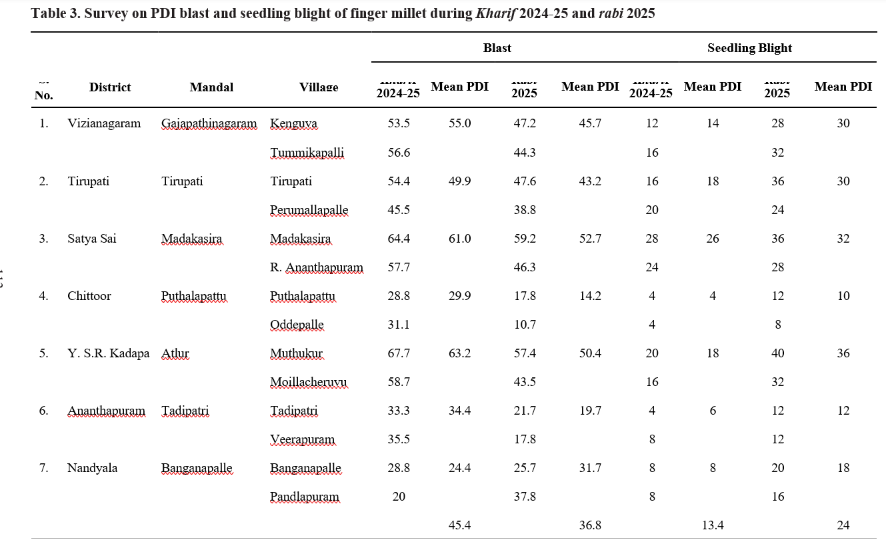
The results revealed considerable variation in disease PDI among the surveyed locations. The highest mean PDI was recorded in YSR Kadapa district (63.2), where the villages of Muthukur and Moillacheruvu showed very high infection levels of 67.7 per cent an 58.7 per cent, respectively. Satya Sai district followed with a mean PDI of 61.0 per cent, as both Madakasira (64.4 %) and R. Ananthapuram (57.7%) exhibited significant disease pressure (Table 3).
Vizianagaram district reported a moderately high mean PDI of 55.0 per cent, with Kanguva (53.5%) and Tummikapalli (56.6%) showing notable infection levels. Tirupati district recorded a moderate level of disease, with a mean PDI of 49.9 per cent, ranging from 45.5 per cent in Perumallapalle to 54.4 per cent in Tirupati. In contrast, relatively lower disease incidence was observed in Ananthapuram (mean PDI of 34.4%) and Chittoor (mean PDI of 29.9%), where village-level PDIs ranged from 28.8 to 35.5 per cent. The lowest disease incidence was found in Nandyal district, which had a mean PDI of 24.4 per cent, Pandlapuram village recorded the least infection with a PDI of 20.0 per cent (Table 3).
During rabi 2024-25 the highest mean PDI was recorded in Satya Sai district (52.7%), where Madakasira and R. Ananthapuram villages reported high PDIs of 59.2 and 46.3 per cent, respectively, indicating a significant blast infection. YSR Kadapa followed with a mean PDI of 50.4 per cent (Table 3), Muthukur recorded a PDI of 57.4, while Moillacheruvu had 43.5 per cent (Table 3)
In contrast, lower disease incidence was observed in Chittoor district with lowest mean PDI of 14.2 per cent, with Puthalapattu at 17.8 per cent and Oddepalle at jus 10.7 per cent, (Table 3) indicating minimal disease PDI.
A comparison of blast disease surveys from Kharif 2024 and rabi 2024–2025 in Andhra Pradesh showed that the Percent Disease Index (PDI) was higher during the Kharif 2024 season, with a PDI of 63.2 (table 3) recorded in YSR Kadapa district, compared to a PDI of 52.7 (table 3) in Satya Sai district during the rabi 2024–2025 season, likely due to more favorable conditions for disease development during Kharif.
The highest incidence was observed in the Satya Sai district, where the Madakasira and R. Ananthapuram villages exhibited a mean PDI of 26 per cent, suggesting a severe incidence. In contrast, Chittoor district (Puthalapattu mandal) recorded the lowest mean PDI of 4 per cent, indicating minimal disease index (Table 3).
The highest mean PDI of 36 per cent was reported in YSR Kadapa district (Atlur mandal), particularly in Muthukur and Moillacheruvu villages, indicating a severe outbreak of seedling blight (Table 3). In contrast, Chittoor district (Puthalapattu mandal) had the lowest mean PDI of just 10 per cent (Table 3).
Aravind et al. (2024) conducted a roving survey to gather rice samples affected by blast disease from key rice-producing regions of the Northern Telangana zone. The Percent Disease Index (PDI) showed considerable variation, ranging from 18.5 per cent in Mancherial to
79.41 per cent in Peddapalli. Likewise, disease severity fluctuated between 22.2 per cent and 85.1 per cent, reflecting the extensive and intense occurrence of blast disease in specific areas of the region. Odeph et al. (2020) conducted a survey on finger millet blast severity across selected counties in Kenya and reported that Busia County had the highest disease severity, with an average of 82.3 per cent, based on whole-farm observations. Bungoma and Machakos followed closely with severity levels of 67.0 per cent and 66.0 per cent, respectively, while Makueni recorded the lowest severity at 61.0 per cent.
Acharya, B., Shrestha, S. M., Manandhar, H. K and Chaudhary, B. 2019. Screening of local, improved and hybrid rice genotypes against leaf blast disease (Pyricularia oryzae) at Banke district, Nepal. Journal of Agriculture and Natural Resources. 2(1): 36–52.
Aravind, K., Rajeswari, B., Babu, T.K., Pushpavalli, S.N.C.V.L. and Rajeswari, E., 2024. A comprehensive survey and assessment of rice blast disease incidence from major rice growing districts of Telangana State, India. J Experimental Agric Int, 46: 484-491.
Ceasar, S. A., Maharajan, T., Krishna, T. P.A., Ramakrishnan, M., Roch, G. V., Satish, L and Ignacimuthu, S. 2018. Finger millet [Eleusine coracana (L.) Gaertn.] improvement: current status and future interventions of whole genome sequence. Frontiers in Plant Science.9: 1052-1054.
Krishna, T. A., Maharajan, T., Roch, G. V., Ramakrishnan, M., Ceasar, S. A., and Ignacimuthu, S. 2020. Hybridization and hybrid detection through molecular markers in finger millet [Eleusine coracana (L.) Gaertn.]. Journal Crop Improvement. 34: 335–355.
Nagaraja, A., Kumar, J., Jain, A. K., Narasimhudu, Y., Raghuchander, T., Kumar, B and Gowda, B. H. 2007. Compendium of small millets diseases. Published by Project coordinator, All India Coordinated Small Millets Improvement Project. 1-75.
Odeph, M., Luasi, W.W., Kavoo, A., Mweu, C., Ngugi, M., Maina, F., Nzilani, N., Mbinda, W.M., Bekele, D., Abera, G. and Gobena, A., 2020. Occurrence, distribution and severity of finger millet blast caused by Magnaporthe oryzae in Kenya. African Journal of Plant Science, 14(4): 139-149.
Shobana, S., Krishnaswamy, K., Sudha, V., Malleshi, N.G., Anjana, R.M., Palaniappan, L and Mohan, V. 2013. Finger millet (Ragi, Eleusine coracana L.): a review of its nutritional properties, processing, and plausible health benefits. Advances in food and Nutrition Research. 69: 1-39.