

0 Views
Department of Genetics and Plant Breeding, ANGRAU-S.V. Agricultural College, Tirupati-517 502.
Fifty-five sesame genotypes were evaluated in a Randomized Block Design during rabi 2025–26 at S.V. Agricultural College, Tirupati to estimate genetic variability, heritability and genetic advance for seventeen yield and yield component traits. Significant genotypic differences were observed for all traits. PCV slightly exceeded GCV, indicating limited environmental influence. High GCV and PCV were recorded for secondary branches, primary branches, internodes, capsules per plant and seed yield per plant. These traits, along with harvest index, first capsule axis height and plant height, showed high heritability with high genetic advance, indicating additive gene action and suitability for direct selection. Oil content, capsule length and 1000-seed weight showed high heritability with moderate genetic advance, suggesting hybridization followed by pedigree selection.
KEYWORDS: Sesame, genotypic coefficient of variation, phenotypic coefficient of variation, heritability, genetic advance.
Sesamum indicum L., commonly known as sesame or gingelly, is one of the oldest domesticated oilseed crops with archaeological evidence tracing its cultivation back more than 5,000 years in the Indus Valley and African regions. It belongs to the family Pedaliaceae with a chromosome number of 2n = 26 and is predominantly a self-pollinated species, though limited cross-pollination by insects can occur. Sesame often referred to as the ‘Queen of Oilseeds,’ and it occupies a prominent position in dryland farming systems globally owing to its nutritional, medicinal and economic significance (Arpitha et al., 2025). The crop exhibits remarkable genetic diversity and ecological adaptability, enabling successful cultivation across over 70 countries worldwide. Despite its economic importance, sesame is often cultivated on marginal lands with minimal management, leading to low productivity. The lack of suitable high-yielding varieties adapted to different agro-climatic conditions remains a major constraint.
A clear understanding of genetic variability, heritability and genetic advance is essential for effective crop improvement. These parameters reveal the extent of heritable variation and the potential response to selection. Therefore, the present study was undertaken to estimate GCV, PCV, heritability, and genetic advance as percent of mean for seventeen yield and yield component traits in 55 sesame genotypes.
A field experiment was conducted during rabi, 2025–26 at the Dryland Farm, S.V. Agricultural College, Tirupati, Andhra Pradesh. Fifty-five sesame genotypes along with three checks (YLM 146, YLM 66, Swetha til) were evaluated in a Randomized Block Design (RBD) with three replications. Each genotype was grown in two rows of 3 m length at a spacing of 30 × 15 cm, following recommended agronomic practices. Observations were recorded on five randomly selected plants for seventeen quantitative traits, except days to 50 per cent flowering and days to maturity, which were recorded on a plot basis. The mean data were subjected to statistical analysis to assess genetic variability, heritability, and genetic advance.
Analysis of variance was carried out following the method described by Panse and Sukhatme (1961) to test significance of genotypic differences. Genotypic and phenotypic variances were estimated following Johnson et al., (1955a). GCV and PCV were computed as per Burton (1953). Heritability in broad sense (h²) and genetic advance (GA) at 5 per cent selection intensity and genetic advance as percent of mean were calculated as per Johnson et al., (1955b). The GCV and PCV values were interpreted following the classification of Sivasubramanian and Menon (1973): low (<10%), moderate (10-20%) and high (>20%). Heritability estimates were categorized as low (<30%), moderate (30-60%) or high (>60%), and genetic advance as percent of mean as low (<10%), moderate (10-20%) or high (>20%).
Analysis of variance revealed highly significant differences among genotypes for all 17 traits studied, confirming the existence of substantial genetic variability in the experimental material. This wide genetic variation provides a strong foundation for identifying superior genotypes and for planning effective selection and hybridization-based breeding strategies. Similar significant genotypic differences among sesame genotypes have been reported by Swapna et al., (2024) and Khuntia et al., (2024).
The GCV and PCV estimates for all traits are presented in Table 2. PCV values were higher than the corresponding GCV values for all traits, indicating the influence of environmental factors on trait expression. The relatively small difference between PCV and GCV for most traits suggests that genetic factors played a major role and selection based on phenotype would be effective. The results were in consistent with reports by Swapna et al., (2024).
High GCV and PCV (>20%) were recorded for number of secondary branches per plant (GCV: 77.36%; PCV: 77.97%), number of primary branches per plant (GCV: 31.20%; PCV: 32.19%), number of internodes (GCV: 28.15%; PCV: 28.70%), number of capsules per plant (GCV: 29.37%; PCV: 29.84%) and seed yield per plant (GCV: 24.21%; PCV: 24.78%). Similar high GCV and PCV for capsules per plant and seed yield per plant were reported by Rahna et al., (2023), Roy et al., (2022).
Moderate GCV (10-20%) was observed for harvest index (19.86%), first capsule axis height (19.25%), specific leaf area (11.54%), plant height (12.94%), capsule length (12.45%), 1000-seed weight (12.90%) and number of seeds per capsule (14.13%). Low GCV (<10%) was recorded for oil content (9.25 %), internodal length (9.80%), days to 50% flowering (4.43%), days to maturity (3.57%) and SCMR (3.49%). The low GCV and PCV values are observed for days to maturity, days to 50% flowering and SCMR.
Heritability estimates in broad sense (h² bs) and genetic advance as percent of mean values for all traits are presented in Table 1. Heritability ranged from a low of 18.38 per cent for SCMR to a high of 99.07 per cent for capsule length. High heritability (>60%) was recorded for all traits except SCMR (18.38%), underlining the predominantly genetic nature of trait expression in the present experimental material.
Traits that exhibited high heritability coupled with high genetic advance as percent of mean (>20%) included: number of secondary branches per plant (h²: 98.45%; genetic advance as percent of mean: 158.13%), number of primary branches per plant (h²: 93.97%; genetic advance as percent of mean: 62.31%), number of internodes (h²: 96.24%; genetic advance as percent of mean: 56.89%), number of capsules per plant (h²: 96.88%; genetic advance as percent of mean: 59.56%), seed yield per plant (h²: 95.50%; genetic advance as percent of mean: 48.74%), harvest index (h²: 82.64%; genetic advance as percent of mean: 37.19%), first capsule axis height (h²: 88.27%; genetic advance as percent of mean: 37.25%), number of seeds per capsule h²: 89.82%; genetic advance as percent of mean: 27.58%),plant height (h²: 62.03%; genetic advance as percent of mean: 20.99%) and specific leaf area (h²: 73.81%; genetic advance as percent of mean: 20.43%).The combination of high heritability with high genetic advance as percent of mean confirms the predominance of additive gene effects for these traits, indicating that simple phenotypic selection would be highly effective. These findings are in close agreement with the observations of Divya et al., (2018) for seed yield per plant, number of capsules per plant and number of branches per plant, and with Mohanty et al., (2020) for plant height and seed yield.
High heritability combined with moderate genetic advance as percent of mean (10-20%) was observed for capsule length (h²: 99.07%; genetic advance as percent of mean: 25.54%), 1000-seed weight (h²: 91.96%; genetic advance as percent of mean: 25.49%), oil content (h²: 98.47%; genetic advance as percent of mean: 20.47%), internodal length (h²: 83.03%; genetic advance as percent of mean: 18.40%) and specific leaf area (h²:
Table 1. Analysis of variance for 17 yield and yield attributing traits in 55 sesame genotypes
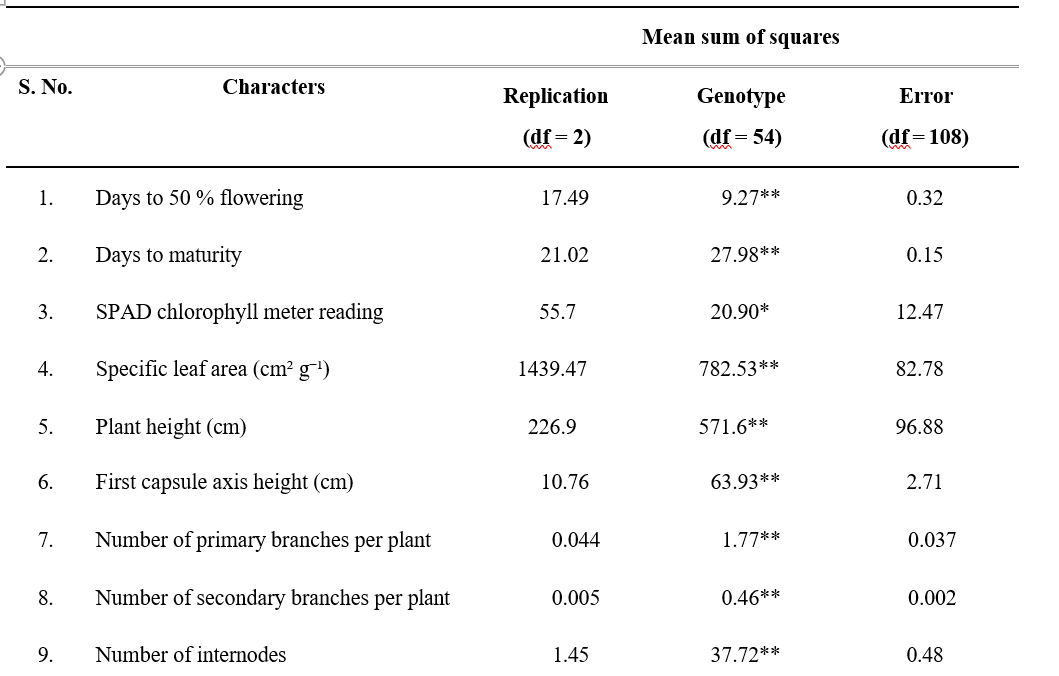
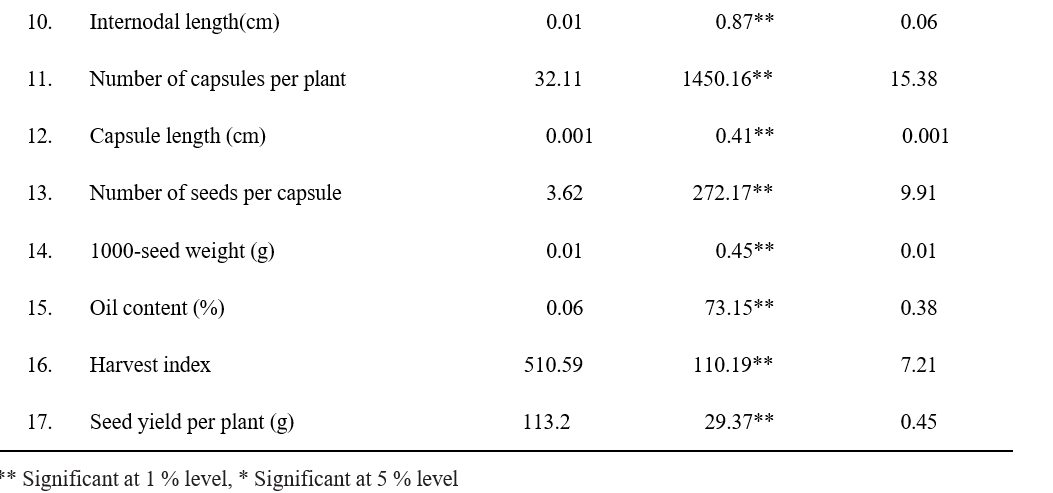
Table 2. Genetic parameters for yield and yield component traits in 55 sesame genotypes
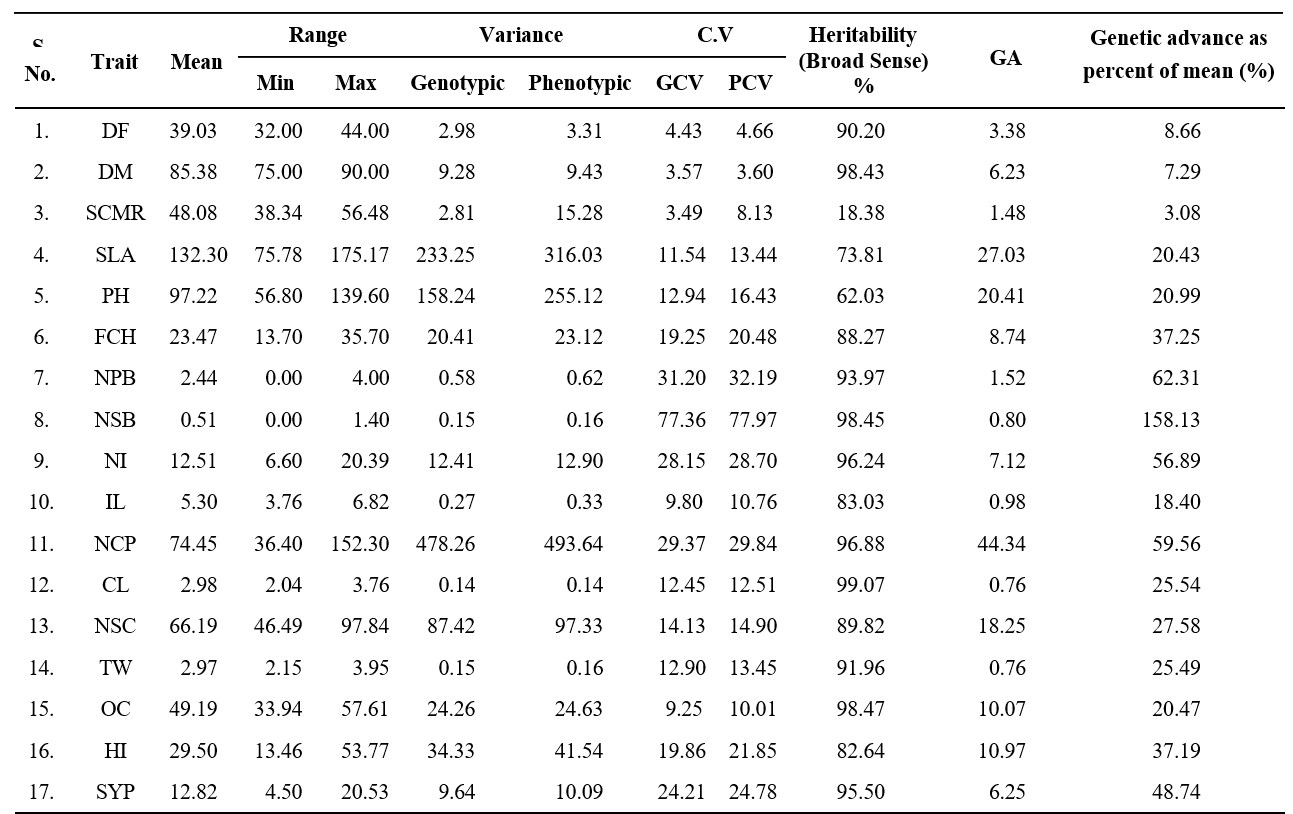
DFF: Days to 50% flowering (days); DM: Days to maturity (days); SCMR: SPAD chlorophyll meter reading; SLA: Specific leaf area (cm2 g-1); PH: Plant height (cm); FCH: First capsule axis height (cm); NPB: No. of primary branches/plant; NSB: No. of secondary branches/plant; NI: No. of internodes; IL: Internodal length (cm); NCP: No. of capsules/plant; CL: Capsule length (cm); NSC: No. of seeds/capsule; TW: 1000-seed weight (g); OC: Oil content (%); HI: Harvest index (%); SYP: Seed yield/plant (g); GCV: Genotypic coefficient of variation; PCV: Phenotypic coefficient of variation; h2: Heritability broad sense; GA: Genetic advance at 5% selection intensity; GENETIC ADVANCE AS PERCENT OF MEAN: Genetic advance as percentage of mean.
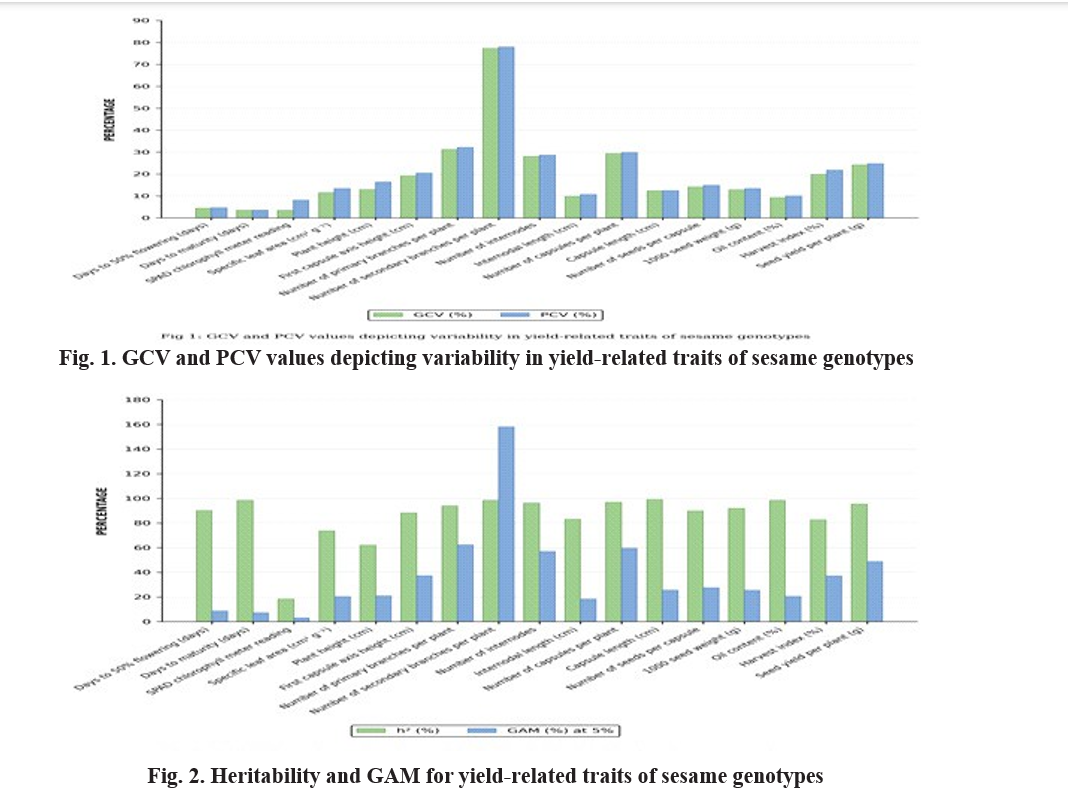
73.81%; genetic advance as percent of mean: 20.43%). Despite high heritability, the moderate genetic advance for these traits suggests possible involvement of non-additive gene action. Similar findings were reported by Kehie et al., (2020) for oil content and 1000-seed weight and capsule length by Kant et al., (2021).
High heritability with low genetic advance as percent of mean (<10%) was recorded for days to 50 per cent flowering (h²: 90.20%; genetic advance as percent of mean: 8.66%) and days to maturity (h²: 98.43%; genetic advance as percent of mean: 7.29%) which indicates dominance and epistatic gene effects.
The present study revealed considerable genetic variability among existing 55 sesame genotypes for all the seventeen traits. The narrow differences between PCV and GCV for most traits indicated limited environmental influence and predominance of genetic control. High heritability coupled with high genetic advance as per cent of mean was observed for number of secondary branches per plant, number of primary branches per plant, number of internodes, number of capsules per plant, seed yield per plant, harvest index, first capsule height and plant height indicating additive gene action. Therefore, these traits can be effectively improved through direct selection. Selection can be practiced in early segregating generations as the phenotypic performance of individual plants is expected to reliably reflect their genetic potential. Oil content, capsule length and 1000-seed weight exhibited high heritability with moderate genetic advance, indicating the involvement of both additive and non-additive gene action. Hence, hybridization followed by pedigree selection would be an appropriate breeding strategy for improving these traits.
The authors are grateful to the Department of Genetics and Plant Breeding, S.V. Agricultural College, Tirupati and Regional Agricultural Research Station, Tirupati, ANGRAU, for providing the seed material, experimental facilities used in this study.
Arpita, J., Bharathi, D., Sabitha, N. and Ramana Murthy, B. (2025). Estimation of genetic variability for yield and yield attributing traits in sesame (Sesamum indicum L.). Andhra Pradesh Journal of Agricultural Sciences. 11(1): 13–17.
Burton, G.W. and De Vane, E.H., 1953. Estimating heritability in tall fescue from replicated clonal material. Agronomy Journal. 45(3): 481-487.
Divya, K., Rani, T.S., Babu, T.K. and Padmaja, D. 2018. Assessment of genetic variability, heritability and genetic gain in advanced mutant breeding lines of sesame. International Journal of Current Microbiology and Applied Sciences. 7(6):1565–1574.
Johnson, H.W., Robinson, H.F and Comstock, R.E. 1955a. Estimates of genetic and environmental variability in soybeans. Agronomy Journal. 47(7): 314–318.
Johnson, H.W., Robinson, H.F and Comstock, R.E. 1955b. Genotypic and phenotypic correlations in soybean and their implications in selection. Agronomy Journal. 47: 477-483.
Kant, L., Dwivedi, S.K. and Phogat, D.S. 2021. Genetic variability, heritability and genetic advance in sesame genotypes. Journal of Oilseeds Research, 38(1): 45–49.
Kehie, M., Kumaria, S. and Tandon, P. 2020. Genetic variability, heritability and genetic advance studies in sesame genotypes. The Bioscan, 15(1): 109–113.
Khuntia, J.B., Dash, A.P., Kar, R.K., Lenka, B., Pradhan, H., Samal, A. 2024. Unveiling genetic variability and character associations in sesame. Biochemical and Cellular Archives. 24(1): 250-265.
Mohanty, A., Lenka, S. and Pradhan, B. 2020. Genetic parameters of variation in sesame. Indian Journal of Agricultural Research. 54(6): 743–748.
Panse, V.G. and Sukhatme, P.V. 1961. Statistical Methods for Agricultural Workers. New Delhi: ICAR.
Rahna, K., Kalaiyarasi, R., Umadevi, M., Senthil, A. and Sudha, M. 2023. Genetic variability and diversity analysis in sesame germplasm. Electronic Journal of Plant Breeding. 14(3): 1055–1062.
Roy, S., Chakraborti, M. and Ghosh, M. 2022. Genetic variability, heritability and genetic advance in sesame genotypes. The Pharma Innovation Journal.11(3): 1200–1205.
Sivasubramanian, S. and Madhavamenon, P. 1973. Genotypic and phenotypic variability in rice. Madras Agricultural Journal. 60(3): 1093–1096.
Swapna, B., Srikanth, T., Padmaja, D. and Srinivasnaik, 2024. Unveiling genetic variability and breeding potential for yield enhancement in sesame. Journal of Scientific Research and Reports. 30(12): 361–368.