
0 Views
Department of Genetics and Plant Breeding, ANGRAU-S.V. Agricultural College,Tirupati-517 502.
An investigation was conducted to assess the Combining ability for yield and its attributing traits in maize (Zea mays during rabi, 2024–25 at S. V. Agricultural College, Tirupati. A Line × Tester mating design was carried out for 30 inbred lines and 2 testers to evaluate the GCA and SCA effects for grain yield and associated traits. For the considered 12 traits, sca variance exceeded GCA variance for all traits except for ear length, confirming the predominance of non-additive gene action. Based on per se performance and gca effects, the lines PL 23084 and PL 23110 were identified as best general combiners for grain yield and its components. Among hybrids, PL 23100 × LM 14, PL 23090 × CML 451, and PL 23059 × LM 14 exhibited significant positive sca effects for grain yield and its components, identifying them as the best crosses for exploiting hybrid vigour. The two crosses PL 23100 × LM 14 and PL 23059 × LM 14 were identified based on the per se performance and sca effects for grain yield. These hybrids need to be further evaluated across locations and over seasons to select best hybrids for commercial exploitation.
KEYWORDS: Combining ability, non-additive gene action, line x tester mating design.
Maize (Zea mays L.) originated from South and Central America and belongs to the Poaceae family and subfamily Panicoideae with chromosome number 2n=20. It is considered as the “queen of cereals” owing to its high genetic production potential. It is a globally significant staple crop vital for human and animal food (Wang et al., 2023). In India, Maize is the third most important cereal crop, after rice and wheat, accounting for approximately 10 per cent of the country’s total food grain production (Anonymous, 2023-24a). Maize grains contains nearly 70 per cent starch, 10 per cent protein, 4 per cent oil and 2.7 per cent crude fibre (Bisen et al., 2017) also offers substantial nutritional benefits to combat malnutrition through QPM variety and it has having wide range of utilities like starch, pharmaceuticals, cosmetics, textiles and biofuel production (Vidadala et al., 2025). Being an allogamous and C4 plant, it is physiologically more efficient as well as resilient to changing climatic conditions and able to grow successfully throughout the world (Rajesh et al., 2018). It has been successfully exploited in the production of hybrids which played a vital role in increasing the acreage and productivity of maize. Constant efforts have been made to improve grain yield and its contributing characters through hybridization in maize.
Developing a hybrid with high vigour and productivity requires the careful selection and crossing of parent lines that show a favourable combining ability to harness the potential of heteros is fully (Bhavana et al., 2011). In this perspective, L × T analysis has widely been used for evaluation of inbred lines by crossing them with testers (Vardhini et al., 2024). Combining ability gives insights into the potential of inbred lines that can be used to develop hybrids and also reveals the nature and magnitude of different types of gene action, assisting the breeders in selecting parental lines with superior performance. This analysis encompasses both general combining ability (GCA) and specific combining ability (SCA) (Hayman, 1954; Griffing, 19566). GCA reflects the average performance of an inbred line when crossed with various other lines (Chiuta et al., 2020). It reveals the parental line’s overall genetic contribution to the hybrid’s performance. This information enables the breeder to evaluate and classify selected parental material for their utility in development of high yielding F1 hybrids in maize, where hybrids are being cultivated on a commercial scale. The sca effects help breeders
to determine heterotic patterns among populations or inbred lines to identify promising single crosses and assign them into heterotic groups (Lahane et al. 2014). The ratio of GCA to SCA variance determines the gene action involved in the inheritance of those traits. If ratio that is less than unity represents the predominance of non-additive gene action, while it is greater than unity represents the predominance of additive gene action (Kumawat et al. 2021). The current experiment consisted of sixty hybrids and thirty two parents of maize to determine the combining ability for Grain yield and its attributing traits.
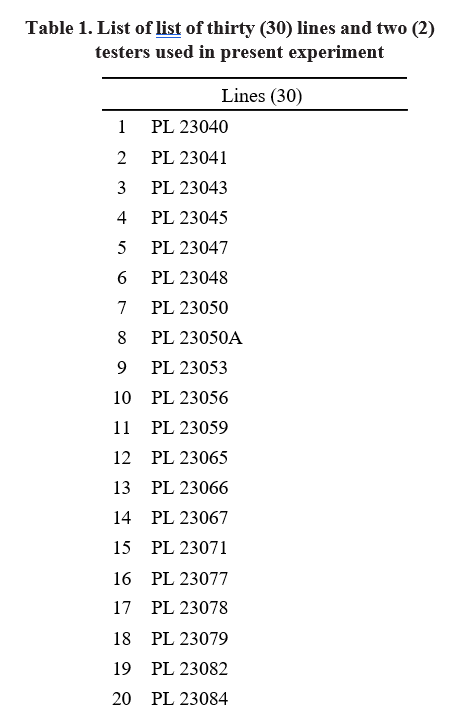
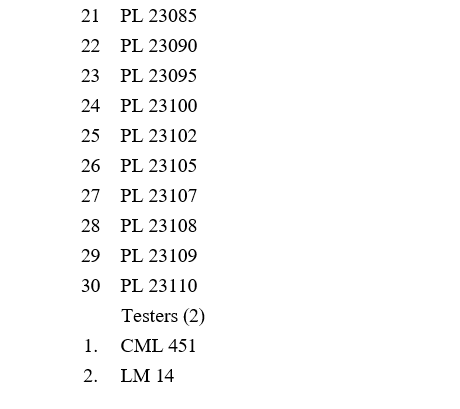
The 60 F1 hybrids and their 32 parents (30 lines, 2 testers) and 4 checks were planted in separate 8 blocks with 2 replications in an alpha lattice design, during rabi, 2024-25, at wetland farm, S.V. Agricultural College, Tirupati (Table 1). Each genotype was planted in two row plots of 4 meter in length with a spacing of 60 cm between rows and 20 cm within rows. All management practices were followed as and when required to establish a good crop. Observations were recorded on 12 grain yield and its attributing traits viz., Days to 50 per cent Anthesis, Days to 50 per cent Silking, Anthesis-Silking Interval, Plant height (cm), Ear height (cm), Days to maturity, Ear length (cm), Ear girth (cm), Kernel rows ear-1, Number of kernels row-1, 100 kernel weight (g) and Grain yield plant-1 (g). Data from all the characters studied were exposed to analysis of variance technique on the basis of model proposed by Panse and Sukhatme (1961). The combining ability analysis was carried out according to the method suggested by Kempthorne (1957).
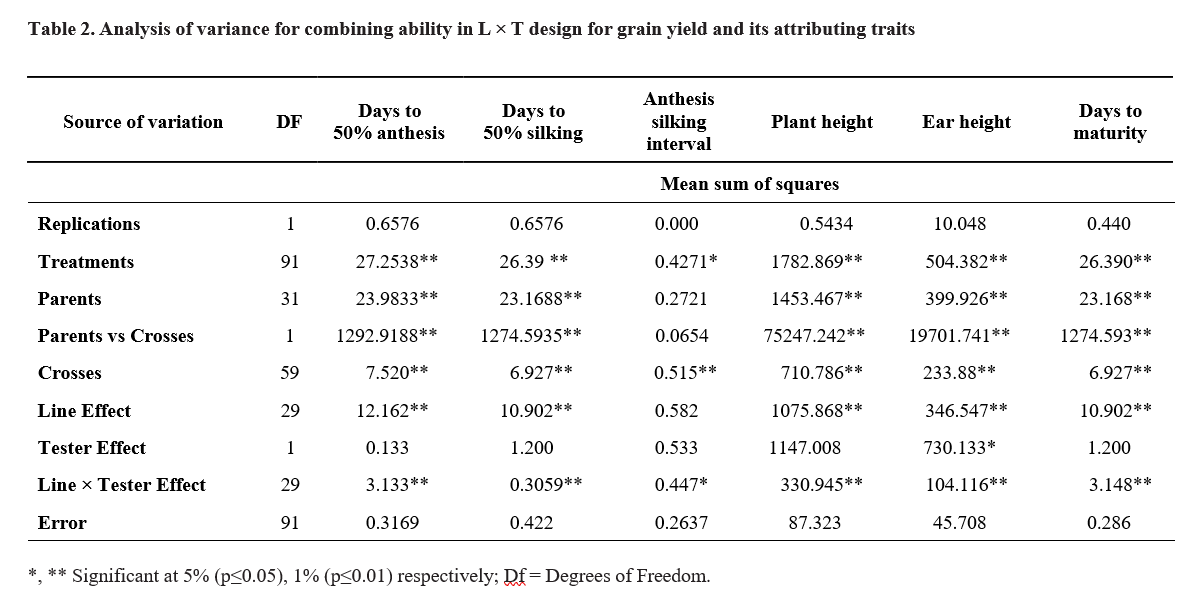
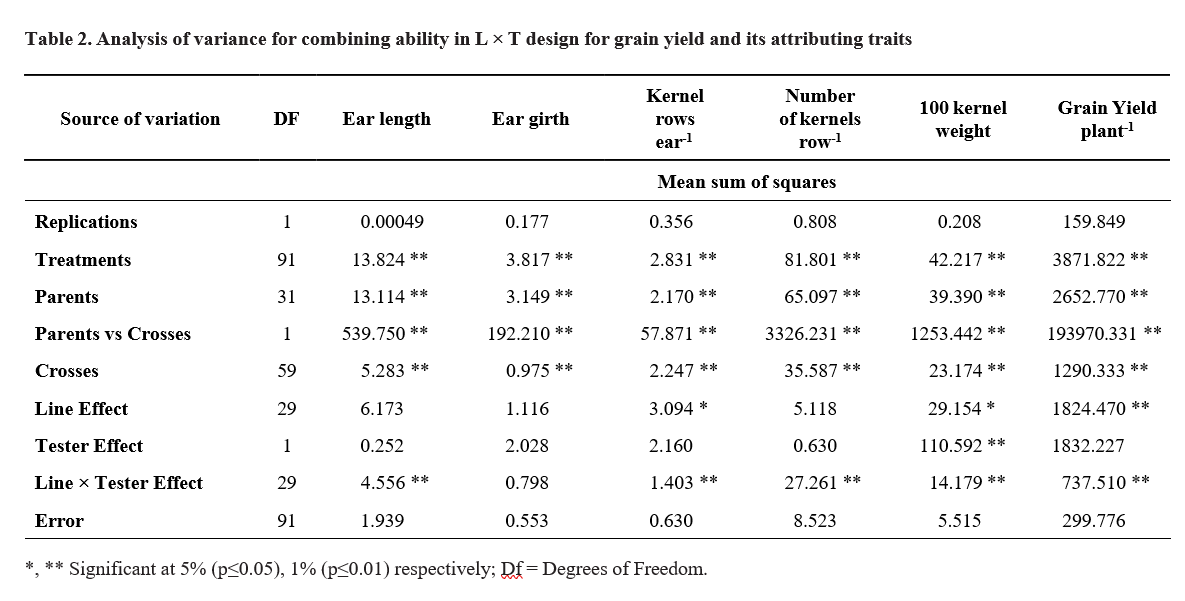
Analysis of variance for combining ability in a Line × Tester mating design for yield and yield components revealed that breeding material registered highly significant differences among themselves for all the characters.
The parents differed significantly for all the characters except for anthesis silking interval indicating the existence of sufficient variability in the material studied and also revealed that the mean sum of squares for parents vs crosses exhibited significant differences (p≤0.01) for all the traits except for kernel rows cob-1, revealing manifestation of differences among parents and their F1 crosses in all the characters. The crosses effects were partitioned into line effect, tester effect and line × tester effect. Mean sum of squares line effects exhibited significant differences (p≤0.01) for all the traits except for anthesis silking interval, ear length, ear girth and number of kernels per row, suggesting a larger contribution of lines towards general combining ability variance components for most of the traits. Mean sum of squares of testers are also significant (p≤0.01) for the traits ear height and 100 kernel weight, representing the presence of variability for these traits among testers. Crosses recorded significant differences(p≤0.01) for all the yield contributing characters. The interaction effects were significant for all the traits except for ear girth; significant interaction effects (p≤0.01) revealed the significant contribution of crosses for specific combining ability variance components (Table 2).
A perusal of the per se performance of parents for grain yield and yield components indicated that the lines, PL 23065, PL 23071, PL 23095, PL 23110 and PL 23066 registered superior performance for grain yield and most of the yield contributing characters. Among these, the lines PL 23065, PL 23095 and PL 23066 also exhibited superior performance for early maturity traits viz., days to 50 per cent anthesis, days to 50 per cent silking, anthesis silking interval and days to maturity. Hence, it is suggested that these lines could be utilized as parents in the development of hybrids possessing high yield coupled with earliness. Further, the hybrids PL 23110 × CML 451, PL 23043 × CML 451, PL 23043 × LM 14, PL 23077 × CML 451 and PL 23047 × CML 451 has shown superior per se performance for grain yield and most of the attributing traits when compared to the high yielding best check hybrid P3396 (151.8g). These outstanding hybrids could be exploited for commercial cultivation after verification of their performance in different locations and environments.
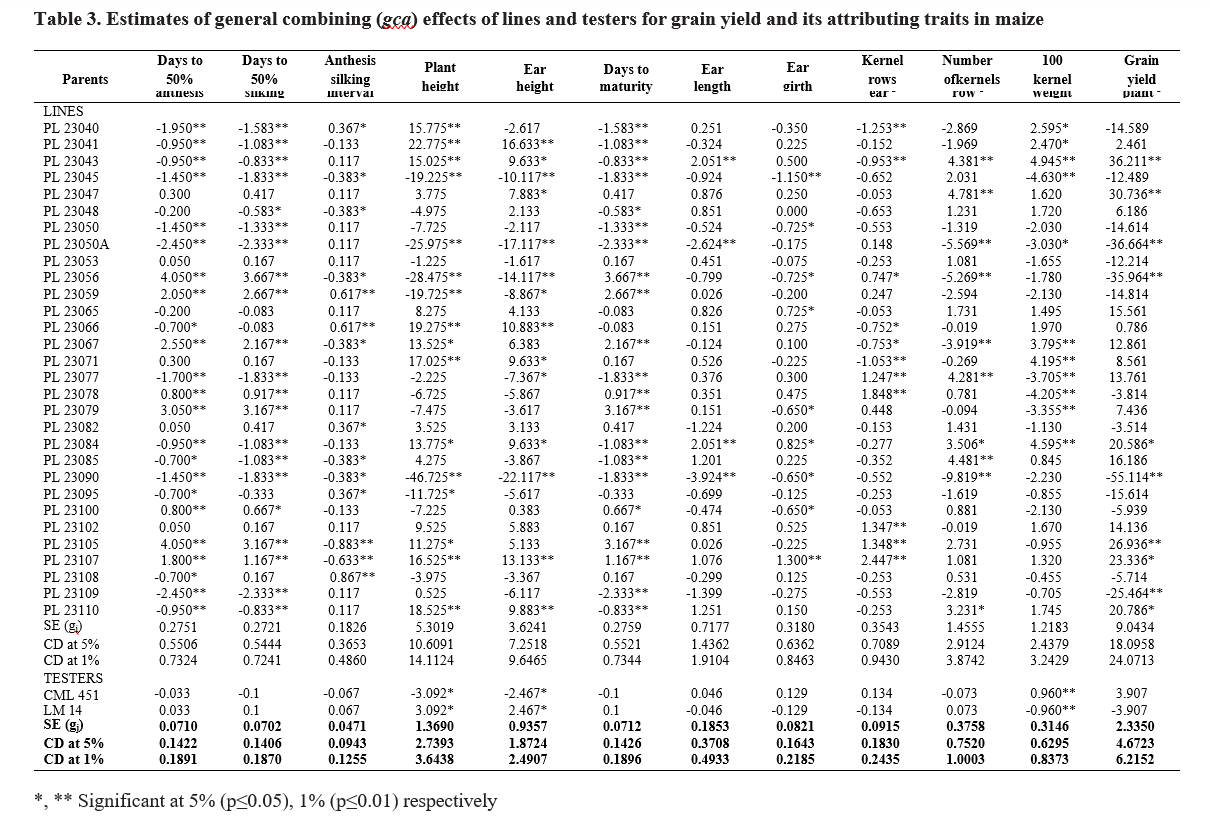
Six parents PL 23043, PL 23047, PL 23105, PL 23107, PL 23110 and PL 23084 shown positive significant gca effects for grain yield. Among these parents, the line PL 23084 recorded positive significant gca effects in desirable direction for ten traits viz., days to 50 per
cent anthesis, days to 50 per cent silking, plant height, ear height, days to maturity, ear length, ear girth, kernels row-1, hundred kernel weight and grain yield plant-1, whereas the line PL 23110 was identified as the best general combiner as it exhibited significant gca effects in desirable direction for Days to 50 per cent anthesis, Days to 50 per cent silking, Plant height, Ear height, Days to maturity, number of kernels row-1 and grain yield plant-1 and the line PL 23107 exhibited positive significant gca effects for anthesis silking interval, plant height, ear height, ear girth, kernel rows ear-1 and grain yield plant-1. Crosses involving these parents might produce heterotic hybrids with high per se performance for the respective traits. As gca effects are attributed to additive gene effects, the lines PL 23084 and PL 23110 might be considered as potential parents for maize improvement programmes aimed at earliness, yield and its contributing traits (Table 3).
Selection of parents based on either per se performance or gca effects would be misleading as per se performance of parents was not always associated with high gca effects. Hence, both gca effects and per se performance are to be given due importance while selecting parents for use in breeding programmes. Consideration of both per se performance and gca effects would result in the selection of the best parents possessing desirable genes (Singh and Harisingh, 1985). In the present investigation, among the 32 parents studied, based on per se performance and gca effects among parents, PL 23110 and PL 23105 were identified as the best parents for grain yield and most of its contributing characters. Hence, these parents could be utilized in the development of the high yielding and early maturing hybrids in maize and also utilized in developing superior recombinants in further selection programmes for the improvement of yield parameters in maize (Table 5).
A perusal of sca effects recorded in the present investigation, out of 60 hybrids none of the cross combinations recorded significant sca effects in desirable direction for all the 12 traits studied. Hence, apart from sca effect of grain yield, the sca effects recorded by a hybrid for other yield components were also considered judiciously to identify a good specific combiner.
Among 60 hyrbids, three hybrids viz., the hybrid PL 23100 × LM 14, PL 23090 × CML 451 and PL 23059
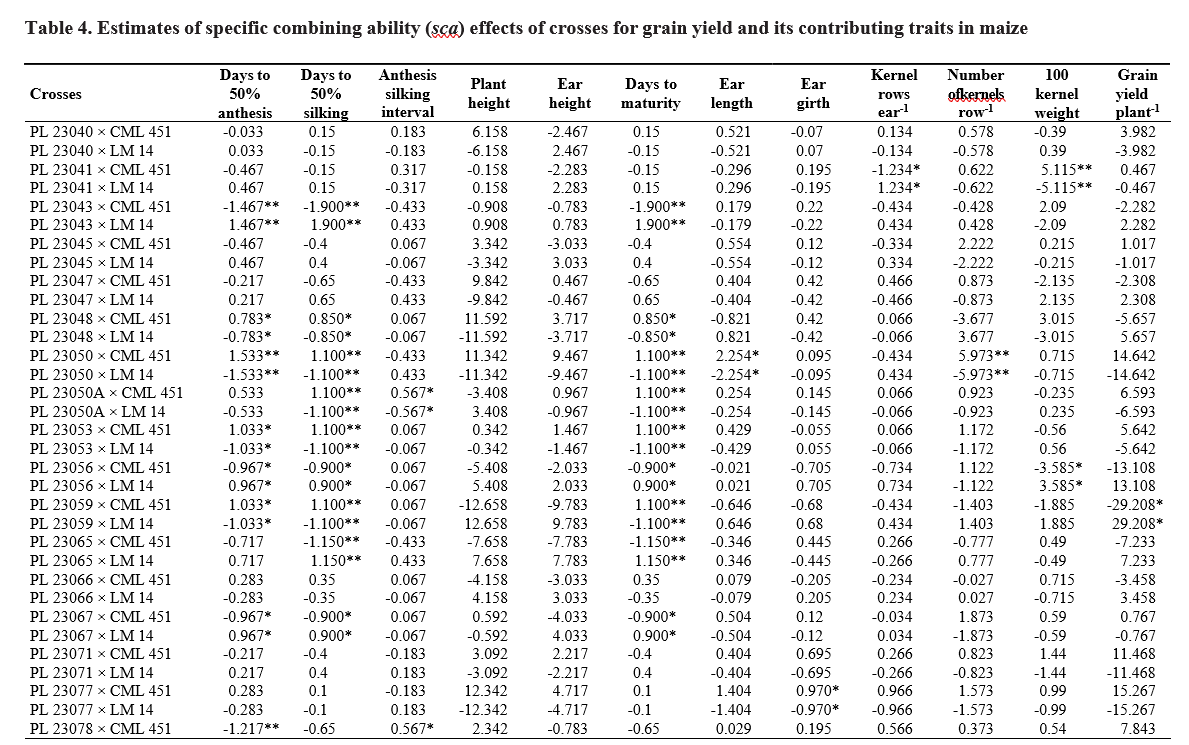
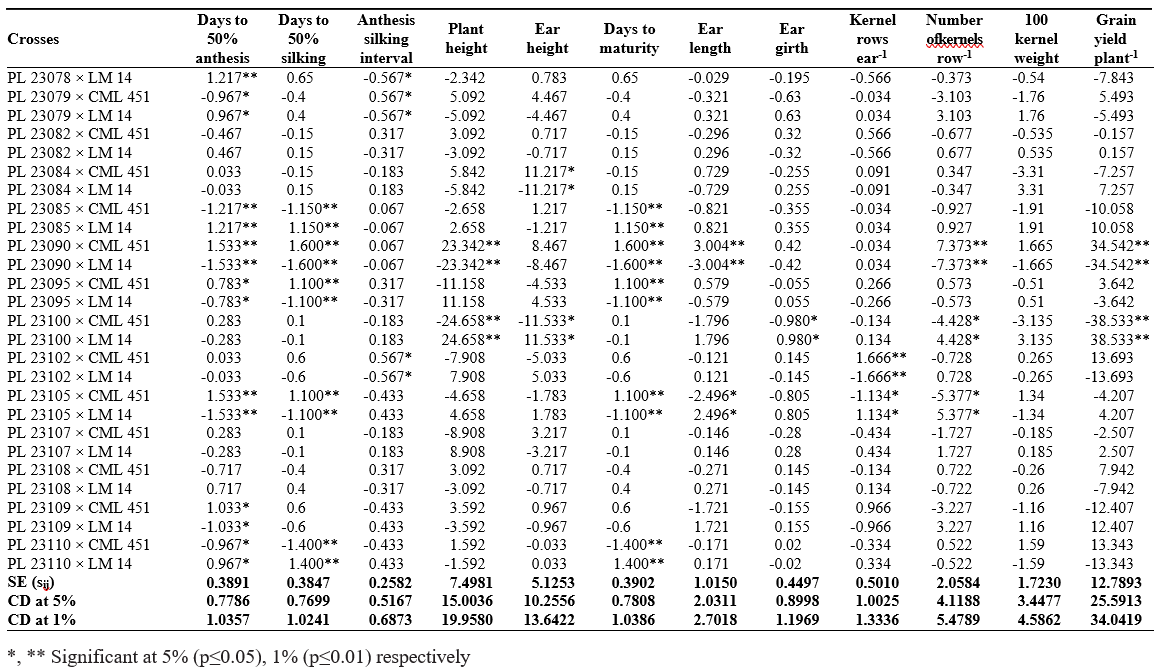
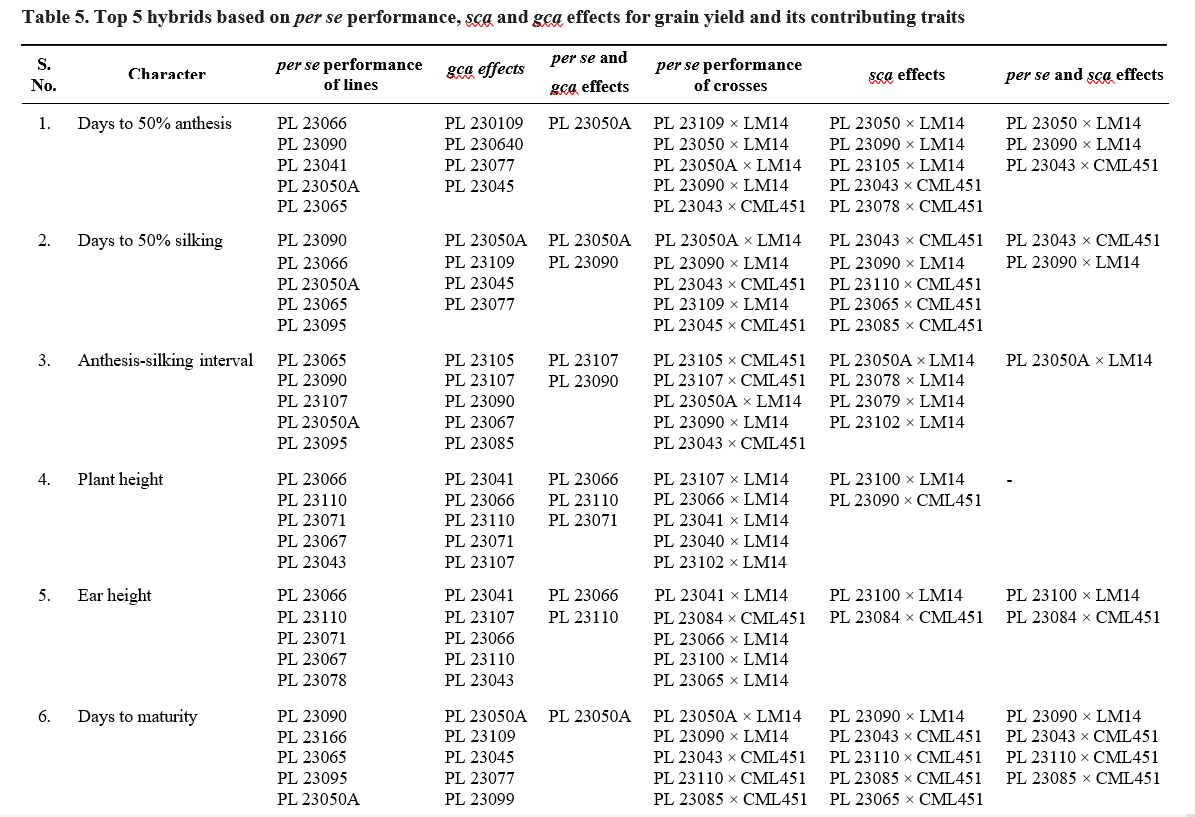
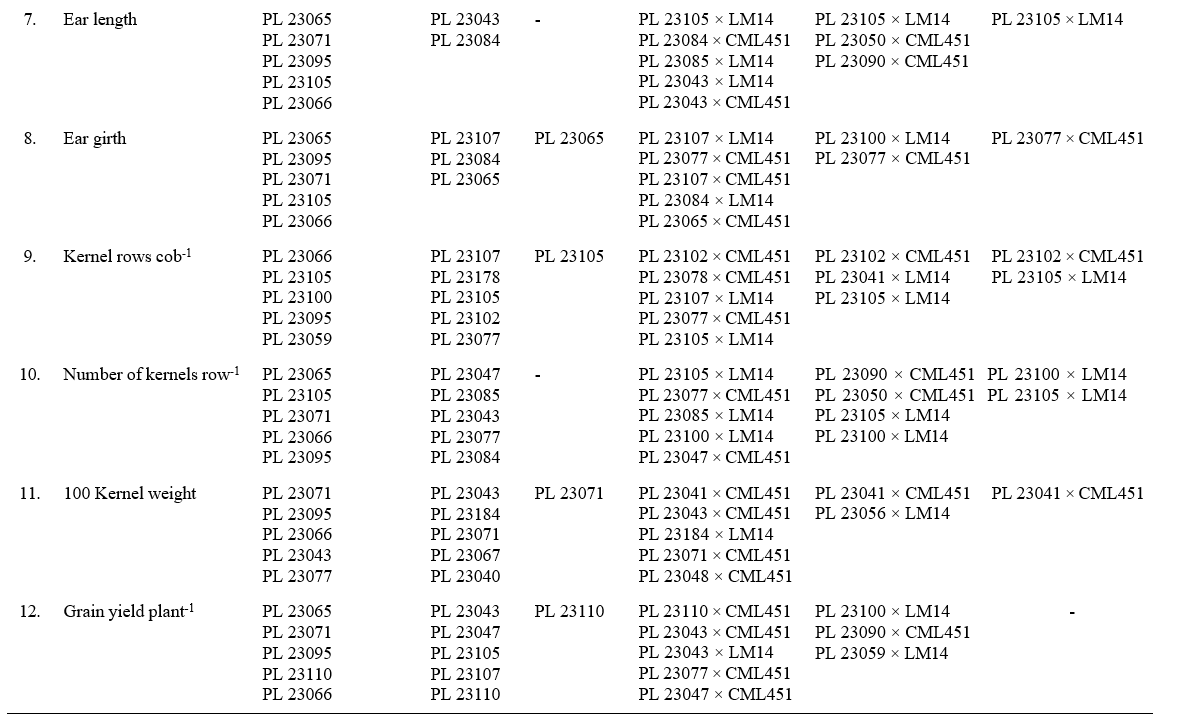
× LM 14 were exhibited significant positive sca effects for grain yield (Table 4). Among these three hybrids, the hybrid PL 23100 × LM 14 (poor × poor) and also PL 23059 × LM 14 (poor × poor) registered desirable and significant sca effects for other yield contributing traits. Hence, these hybrids could be considered after confirming from heterotic studies for further testing in multi-location trails (Table 5).
Similar results on combining ability i.e., significant positive gca and sca effects in desirable direction were obtained by Ahmad and Ansari (2017) and Sandesh et al. (2018), Rajesh et al. (2018), Sabitha et al. (2021) and Keerthana et al. (2023).
Among 60 hybrids, two crosses PL 23100 × LM 14 and PL 23059 × LM 14 were identified based on the per se performance and sca effects for grain yield. These crosses could be useful in development of high yielding hybrids in maize (Table 5).
Based on per se performance, the lines PL 23065 and PL 23095, PL 23066 and the crosses PL 23110 × CML 451 and PL 23043 × CML 451 exhibited higher grain yield coupled with earliness that indicates the usefulness of these crosses for earliness, so, they can be used in the development of the potential hybris with high yield and short duration that are useful in drought areas or low rainfall regions. Based on GCA effects, PL 23110 and PL 23105 were identified as the best parents for grain yield and most of its contributing characters. Hence, these parents could be utilized in the development of the high yielding and early maturing hybrids and also utilized in developing superior recombinants in further selection programmes for the improvement of yield parameters in maize. Based on SCA effects, two crosses PL 23100 × LM 14 and PL 23059 × LM 14 were identified based on the per se performance and sca effects for grain yield. These crosses could be useful in development of high yielding hybrids in maize. These hybrids need to be further evaluated across locations and over seasons to select best hybrids for commercial exploitation.
Ahmad, E and Ansari, A.M. 2017. Study of combining ability and heterosis analysis for yield traits in maize (Zea mays L.). Journal of Pharmacognosy and Phytochemistry. 6(6): 924-927.
Anonymous. 2023-24a. Advanced estimate of Directorate of Economics and Statistics (DES), Ministry of Agriculture and Farmers Welfare (MoA & FW), India. (https://desagri.gov.in).
Bhavana, P., Singh, R.P and Gadag, R.N. 2011. Gene action and heterosis for yield and yield components in maize (Zea mays L.). Indian Journal of Agricultural Sciences. 81(2): 163-166.
Bisen, P., Dadheech, A., Namrata, N., Kumar, A., Solanki, G and Dhakar, T.R. 2017. Combining ability analysis for yield and quality traits in single cross hybrids of quality protein maize (Zea mays L.) using diallel mating design. Journal of Applied and Natural Science. 9(3): 1760-1766.
Chiuta, N.E and Mutengwa, C.S. 2020. Combining ability of quality protein maize inbred lines for yield and morpho-agronomic traits under optimum as well as combined drought and heat-stressed conditions. Agronomy. 10(2) : 184.
Griffing, B. 1956. Concept of general and specific combining ability in relation to diallel crossing system. Aust. J. Biol. Sci. 9: 463-493
Hayman, B.I. 1954. The theory and analysis of diallelcrosses. Genetics, 39: 789-809
Keerthana, D., Haritha, T., Kumar, I.S and Ramesh, D. 2023. Combining ability and heterotic grouping of inbred lines for kernel yield in maize (Zea mays L.). Electronic Journal of Plant Breeding. 14 (4): 1395- 1404.
Kempthorne, O. 1957. An introduction to genetic statistics. John Wiley and Sons, Inc., New York. 222-240.
Kumawat, R., Meena, D and Choudhary, K. 2021. Estimation of combining ability and heterosis in maize (Zea mays L.) for yield and its components. Maize Journal of Crop Improvement. 25(4): 195- 206.
Lahane, S., Kadam, R. P and Salunke, M. P. 2014. Studies on combining ability in maize (Zea mays L.). Plant Archives. 14(1): 331-334.
Panse, V.G and Sukhatme, P.V. 1967. Statistical Methods for Agricultural Workers. ICAR Publication, New Delhi.145-152.
Rajesh, V., Sudheer Kumar, S., Narsimha Reddy, V and Siva Sankar, A. 2018. Combining ability and genetic action studies for yield and its related traits in maize (Zea mays L.). International Journal of Current Microbiology and Applied Sciences. 7(6):2645-2652.
Sabitha, N. 2021. Identification of favourable alleles for improvement of single cross hybrids and GGE biplot analysis in maize (Zea mays L.). Ph.D Thesis. Acharya N.G. Ranga Agricultural University, Guntur.
Sandesh, S., Singh, R. P and Kumari, S. 2018. Genetic parameters and heterosis in maize (Zea mays L.) hybrids for yield and quality traits. Journal of Plant Breeding and Crop Science. 10(1): 48-60.
Singh, N.B and Harisingh. 1985. Heterosis and combining ability for kernel size in Rice. Indian J. Genetics and Plant Breeding, 45(2): 181-185.
Vardhini, T.R., Kumar, I.S and Rajesh, A.P. 2024. Combining ability and heterosis analysis in maize: insights from line× tester hybridization. Journal of Advances in Biology & Biotechnology, 27(10): 1502-1515.
Vidadala, R., Kumar, V., Rout, S., Sil, P., Teja, V and Rahimi, M. 2025. Genetic analysis of quality protein maize (QPM): a review. Cereal Research Communications. 53(1);81-99.
Wang, H., Ren, H., Zhang, L., Zhao, Y., Liu, Y., He, Q., Li, G., Han, K., Zhang, J., Zhao, B and Ren, B. 2023. A sustainable approach to narrowing the summer maize yield gap experienced by smallholders in the North China Plain. Agricultural Systems. 204 :103541.