
0 Views
Department of Agricultural Extension Education, ANGRAU-S.V. Agricultural College,Tirupati-517 502.
The present study was conducted to assess the perception and willingness of farmers to adopt drone technology, with a specific focus on their socio-economic and psychological profiles in Tirupati district of Andhra Pradesh. A random sample of 120 farmers was selected for the study. The findings revealed that a majority (53.33%) of the farmers belonged to the middle-aged category, with 30.00 per cent having attained college-level education and above. Most farmers owned small- sized landholdings (33.33%) and had undergone training related to drone technology (65.83%). In terms of socio-psychological attributes, a significant proportion exhibited medium levels of annual income (84.17%), social participation (47.50%), and extension contact (66.67%), innovativeness (82.50%), achievement motivation (73.33%), economic orientation (76.67%), decision-making ability (85.00%), and scientific orientation (77.50%).
KEYWORDS: Adoption, drone technology, perception, profile and willingness.
The agricultural sector is embracing a technological shift, with drones (UAVs) emerging as a key tool for enhancing precision, efficiency, and sustainability. As global food demand rises, traditional practices often lead to resource waste and reduced productivity. In contrast, drones equipped with multispectral sensors and AI analytics provide real-time data on crop and soil health, enabling targeted use of water, fertilizers, and pesticides. They assist in mapping, disease detection, irrigation monitoring and precision spraying, helping farmers increase yields while reducing costs and environmental impact.
The study followed an exploratory research design to assess the profile of farmers adopting drone technology in Tirupati district, Andhra Pradesh, which was purposively selected as the researcher hails from the region. Among the 34 mandals, four with high drone usage were chosen purposively. From each mandal, two villages were selected, totaling eight villages. In each village, 15 farmers were selected using simple random sampling, resulting in a sample size of 120. Based on a literature review and expert input, 12 variables were identified. Data were collected through a structured interview schedule and analyzed using frequency, percentage, mean, and standard deviation for meaningful interpretation.
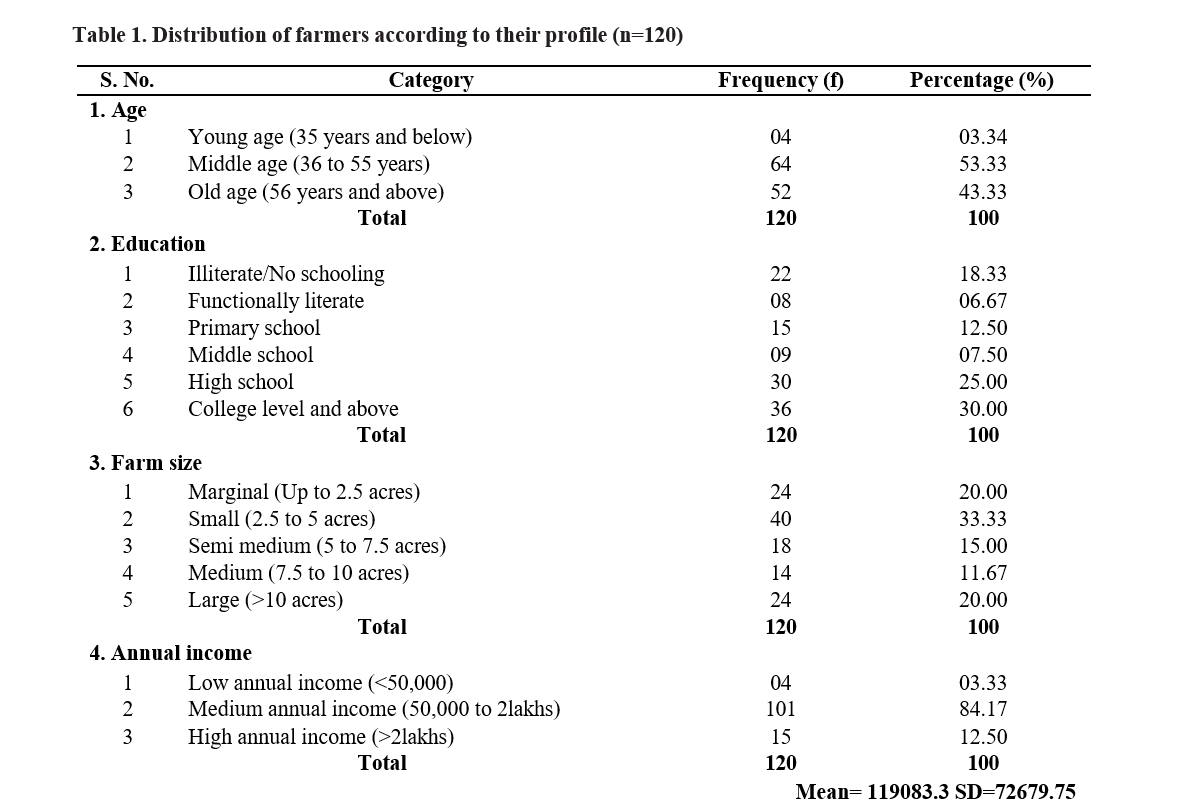
The farmers were distributed into different categories based on their selected profile characteristics and the results were presented in the table 1.
The results from table 1 revealed that majority (53.33%) of the drone farmers belonged to middle aged category followed by old aged (43.33%) and young age (3.34%) categories. The reason behind this was middle aged farmers have accumulated years of experience that allowed them to make informed decisions about technologies. This finding was in conformity with Burman et al. (2023).
The findings from table 1 showed that 30.00 per cent of the drone farmers had completed their college level education followed by high school (25.00%), illiterate (18.33%), primary school (12.50%), middle school (7.50%) and functionally literate (6.67%). This trend may be due to better access to nearby schools, colleges, and transport facilities in villages. This finding was in conformity with Vecchio et al. (2020).
The results furnished in table 1 stated that majority (33.33%) of the farmers were small farmers followed by marginal and large (20.00%), semi medium (15.00%) and medium (11.67%) farmers. This indicates a balanced land size, suitable for drone use and manageable for individual investment if supported by affordable services or schemes. The result was in accordance with the finding of Manjunath (2014).
From the table 1, it can be inferred that 84.17 per cent of the drone farmers had medium annual income followed by high (12.50%) and low (3.33%) levels of annual income. The predominance of medium-income farmers indicates a stable financial base, likely supported by diverse income sources, moderate landholdings, input access, and market participation. This finding was in conformity with Gabriel (2014).
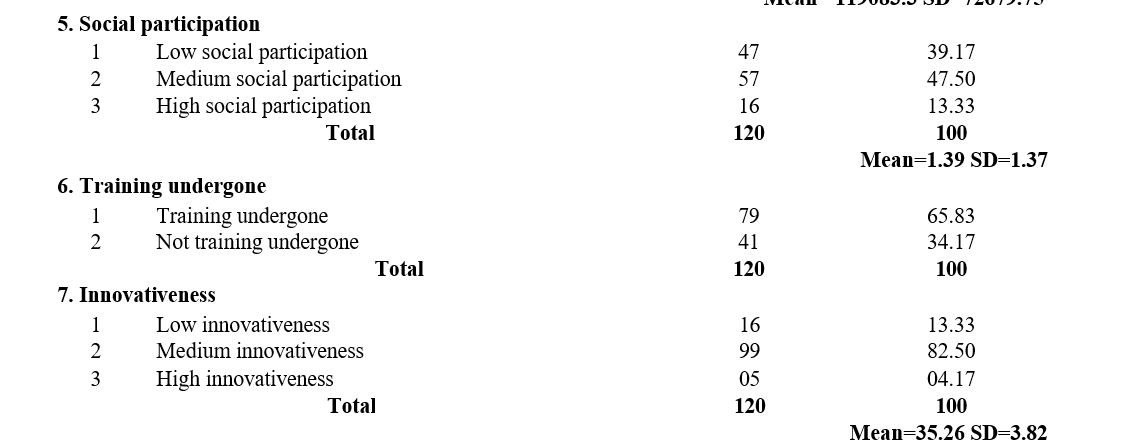
It could be understood from the table 1 that 47.50 per cent of the drone farmers had medium level of social participation followed by low (39.17%) and high (13.33%) levels of social participation. Few farmers were part of self-help groups or gram panchayats, while over half showed medium social participation. This reflects moderate community involvement, offering some benefits of networking, information exchange, and collective problem-solving. This finding was in conformity with Puri et al. (2017).
The results from the table 1 depicted that 65.83 per cent of the farmers had undergone training followed by 34.17 per cent of the farmers had not undergone training. The reason behind this was by the efforts of RASS- KVK officials, who conducted demonstrations on drone technology in various locations, thereby encouraging farmers to attend the training programs. The results were in line with the findings of Akhila (2023).
The findings from the table 1 showed that majority (82.50%) of the farmers had medium level of innovativeness followed by low (13.33%) and high (4.17%) levels of innovativeness. This trend may be due to farmers’ receptiveness to technological advancements for better returns, supported by their moderate education levels, enabling them to adopt innovations like drone technology. This finding was in conformity with Gogoi et al. (2016).
The findings on extension contact from table 1 projected that 66.67 per cent of the drone farmers had medium level of extension contact followed by low (20.00%) and high (13.33%) levels of extension contact. This moderate level of interaction is often due to periodic visits by extension personnel and village agricultural assistants, combined with a fair interest in agricultural advancements. The result was in accordance with the finding Kimani (2019).
It could be concluded from the table 1 that majority (73.33%) of the drone farmers had medium level of achievement motivation followed by high (17.50%) and low (9.17%) levels of achievement motivation The predominance of medium achievement motivation suggests that most of the drone farmers possess a fair degree of ambition and perseverance in their agricultural activities, which can contribute positively to productivity and openness to adopting new technologies. The result was in accordance with the finding Clothier et al. (2015).
It could be observed from table 1 that 76.67 per cent of the drone farmers had medium economic orientation followed by high (13.33%) and low (10.00%) levels of economic orientation. Farmers involved in the study on drone technology were driven by a common desire to improve their socio-economic status and enhance their standard of living through increased income. The result was in accordance with the findings of Clothier et al. (2015) and Puri et al. (2017).
The results of the decision-making ability from table 1 showed that majority (85.00%) of the drone farmers had medium level of decision-making ability followed by high (10.00%) and low (5.00%) levels of decision- making ability. This suggests that many farmers adopted a balanced and thoughtful approach when making decisions related to drone technology. The findings of the present study were similar to that of Puri et al. (2017).
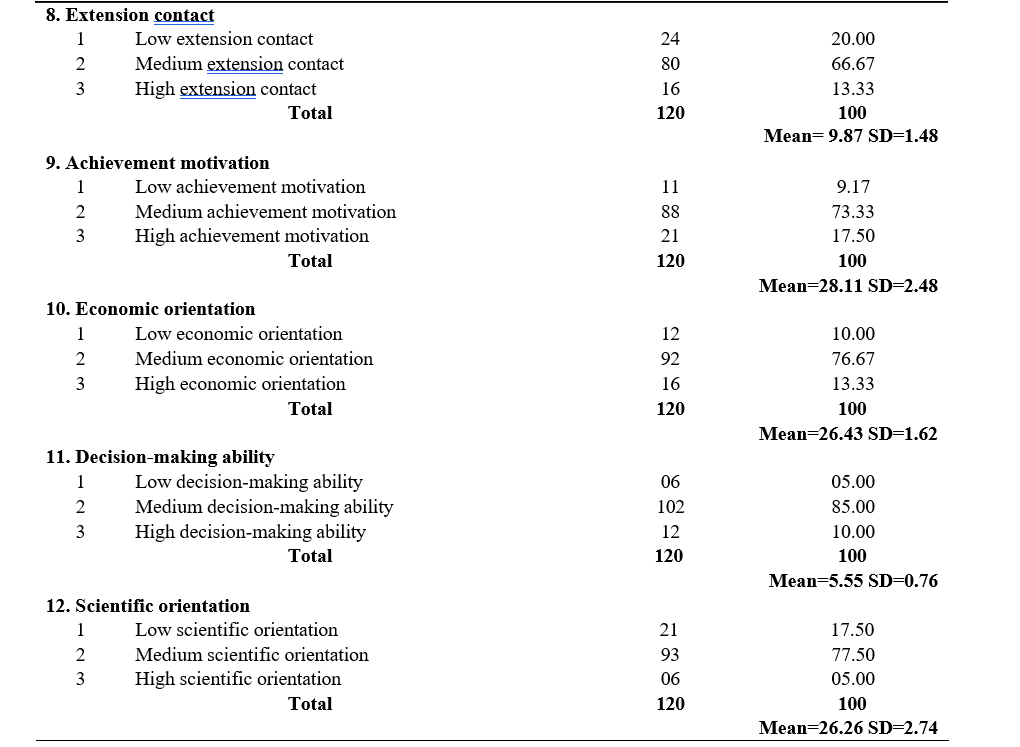
From the table 1, it could be interpreted that majority (77.50%) of the farmers had medium level of scientific orientation followed by low (17.50%) and high (5.00%) levels of scientific orientation. It reflects a moderate inclination towards acquiring new knowledge and embracing innovative farming practices. This moderate scientific mindset, supported by exposure to innovations through Krishi Vigyan Kendras (KVKs), private agencies and peer networks, helped farmers adopt drone technology and improve productivity. The findings of the present study was similar to that of Verma et al. (2023).
The present study was conducted in Tirupati district revealed that the majority of farmers belonged to the medium-to-high category for most of the variables viz., middle-aged, had completed college or higher education, owned small to medium landholdings, and had undergone prior training. Most exhibited moderate levels of annual income, social participation, contact with extension services, innovativeness, achievement motivation, economic orientation, decision-making ability, and scientific mindset. These characteristics suggest a strong foundation and considerable potential for adopting drone technology. To realize the full potential of drone adoption by farmers, it is essential to establish hands-on training workshops, field demonstrations through Farmer Producer Organizations or custom hiring centers, streamline subsidy access, foster partnerships with ICAR, KVKs, and local agricultural universities, and expand digital literacy programs to build farmer confidence in drone applications. Integrating these measures with awareness campaigns, institutional support, and robust policy frameworks will help reduce costs, minimize input waste, enhance agricultural sustainability, and improve both productivity and farmer livelihoods.
Akhila, P. 2023. Awareness and adoption of precision dairy farming in eastern Haryana. Ph.D Thesis. National Dairy Research Institute, Karnal.
Burman, R. R., Padaria, R. N., Mahra, G. S., Mallick, S., Mukherjee, S., Jha, S. K., Sheoran, P and Roy,
K. 2023. Perception, attitude, and knowledge of farmers towards agridrones: Case study on influence of Mann Ki Baat program. Journal of Community Mobilization and Sustainable Development. 18(1): 79–88.
Clothier, R. A., Greer, D. A., Greer, D. G and Mehta, A. M. 2015. Risk perception and the public acceptance of drones. Risk analysis. 35(6): 1167-1183. Retrieved from https://doi.org/10.1111/risa.12330.
Gabriel S.A. 2014. comparative analysis on precision farming technologies in selected crops of north eastern Karnataka. M.Sc. (Ag.) Thesis. College of Agriculture, University of Agricultural Sciences, Raichur.
Gogoi, N. K., Deka, B and Bora, L. C. 2016. Remote sensing and its use in detection and monitoring plant diseases: A review. Agricultural Reviews. 39(4): 307-313.
Kimani, S. 2019. Drones offer Ghana’s farmers’ hope of better yields and income. Retrieved from https:// scholar.google.com/scholar?hl=en&assdt=0%2S
Manjunath, B. K. 2014. A study on perception of precision farming by the farmers. M.Sc. Ag. Thesis. University of Agricultural Sciences, Dharwad.
Puri, V., Nayyar, A and Raja L. 2017. Agriculture drones: A modern breakthrough in precision agriculture. Journalof Statistics and Management Systems. 20(4): 507-518, DOI: 10.1080/09720510.2017.1395171.
Vecchio, Y., Agnusdei, G. P., Miglietta, P. P and Capitanio, 2020. Adoption of precision farming tools: The case of Italian farmers. International journal of environmental research and public health. 17(3): 869.
Verma, P. K., Varma, A and Yadav, A. K. R. P. K. 2023. Applications of agricultural drones. Chief Editor Dr. Anil Kumar Saxena. 1: 41.