
0 Views
Institute of Agribusiness Management, ANGRAU-S.V. Agricultural College,Tirupati-517 502.
This study investigates the problems faced by coir industries in Andhra Pradesh, focusing on production, manufacturing,
and marketing of coir fibre. The research explores constraints perceived by farmers and analyses their suggestions to address these issues and revive the coir industry. Ten respondents, selected through a random sampling procedure, provided insights into 10 identified problems categorized under production, manufacturing, marketing of coir fiber. Garrett’s ranking technique was employed to prioritize constraints in coir marketing. Inadequate/unavailability of raw material was identified as key concern with Garrett Mean Score of 78.2 followed by, shortage of labour (71.2), lack of finance (65.6) and lack of Government support (56.8). The least concerns were lack of training /motivation (26.6), lack of credit facilities by banks (23.5) and less adaptability of technology, heavy transportation cost, and lack of product innovation were also identified as prominent issues in coir industries. In coir marketing, inadequate prices were identified as key concerns. The study concludes with valuable suggestions from coir producers, marketers and manufacturers, emphasizing mechanization, technical guidance, and improved market information dissemination for sustainable development in the coconut and coir industries.
KEYWORDS: Coir fibre, rural industries, sustainability, constraints in production & marketing.
In India about two-third of rural income is now generated in non-agricultural activities through various small and micro level enterprises in rural areas. The fact that India is a country of villages and that about 70 per cent of its people reside in rural regions is well known in India can only set itself on the intended developmental road through a progressive, expanding and active rural society. In the unique environment of India, small-scale rural industries hold significant importance. About half of the gross value of production that originates in the manufacturing sector is contributed by them. Right now, it employs 14 million people and accounts for 40 per cent of the nation’s export earnings (Department of Science & Industrial Research).
Industrialization in rural areas plays a crucial role in balanced regional development by fulfilling several economic and social needs of rural areas by increasing employment opportunities, diversifying rural occupations, raising living standards besides reducing exodus to urban centres (Roy B. C, 1997). Hence, it is crucial to support and grow rural industry while taking into account its importance for the nation’s socio- economic landscape. Sustainable economic growth is significantly impacted by the rural or traditional industry, which is a sub-sector of small-scale industry (Nagesh A. R, 1990).
The coir industry in India has made progress in domestic as well as in international markets because of its eco-friendly and biodegradable products. The coir industry in India is one of the largest employments generated especially in rural areas across the coconut producing states. It is one of the few traditional or rural businesses that turn the waste material that is coconut husk into money (Chillar M, 2004). One of the unique features of the coir sector is that it offers agricultural labourers part-time work options and full-time employment to unskilled individuals. One way to help the impoverished in rural areas find gainful employment and money turnover through the industrialization of coir (Jeya B. J, 1989).
The major coconut-growing states and Union Territories rely heavily on the coir industry, a cottage industry of considerable importance. In this industry, almost 5.5 lakh people find work, primarily in part-time positions. This industry exports goods worth of about Rs.70 crores. The primary raw material used to make coir goods is coconut husk. Coir goods are made from around half of the available coir husk (Kumaraswamy Pillai M, 2005). Therefore, there is room for the coir industry to expand. For female artisans, specialised training programmes have been created. To boost employment and income, skilled women craftspeople will receive improved, contemporary treadle machines (Nair B, 1997). A focus has been placed on creating tools, machinery and equipment through research and development in order to lessen drudgery and increase coir worker’s output. The current development plans have their goals, the diversification of goods, quality enhancement and revitalization of coir cooperatives (Malik I. R, 1988). Additionally, efforts were made to investigate potential export markets for coir and its derivatives.
Andhra Pradesh occupies third position with 600 number of coir industries. But in terms of growth percentage Karnataka was the top position with 40.01 per cent growth. West Godavari District of A.P has more number of coir-based product manufacturing units. The units has a mixed past and is a traditional one with traditions and sometimes antiquated methods. The majority of coir labourers come from economically and socially disadvantaged backgrounds. Cooperatives, commercial, public, government, and unorganized production units are the main players in the coir industry (Senthil Kumar R, 2015). There observed a deceleration of coir industry especially after COVID because of reduced indents and exports with this backdrop the present research article is intended to identify the major constrains faced by the coir units and to analyse this suggestions put forth by the respondents.
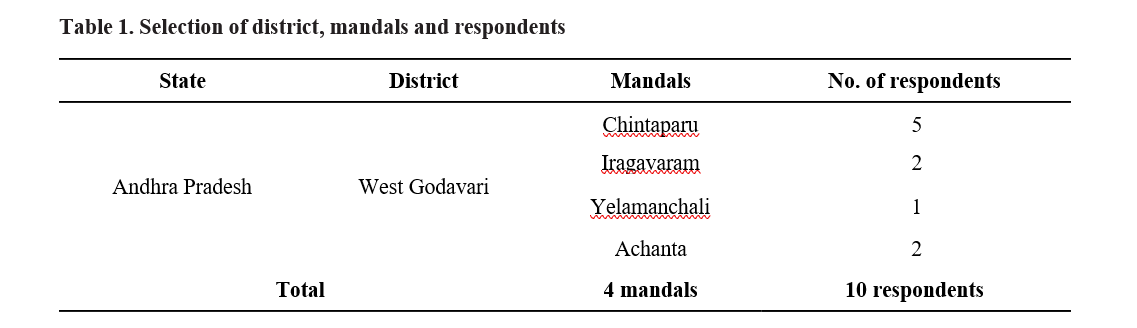
The study randomly was conducted in West Godavari district of Andhra Pradesh. Ten coir units which were established more than 5 years ago were selected randomly as the sample from four mandals. Marketing intermediaries were also taken as the sample to understand the existing marketing channel. The collected data was analysed with a range of tools and techniques.
The constraints of coir fibre industry problems were measured by applying Garrett ranking procedure. The order of merit given by the respondents was converted into rank by using the formula. To find out the most significant factor that associated with the respondent, Garrett’s ranking technique was used. As per this method, respondents have been asked to assign the rank for all factors and the outcomes of such ranking have been converted into score value with the help of the following formula:
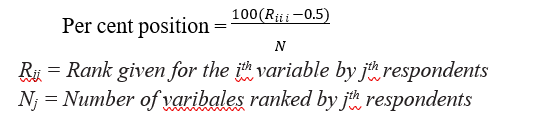
With the help of Garrett’s table, the per cent position estimated was converted into scores. Then for each factor, the scores of everyone were added and then total value of scores and mean values of score was calculated. The components having highest mean value was the most important factor.
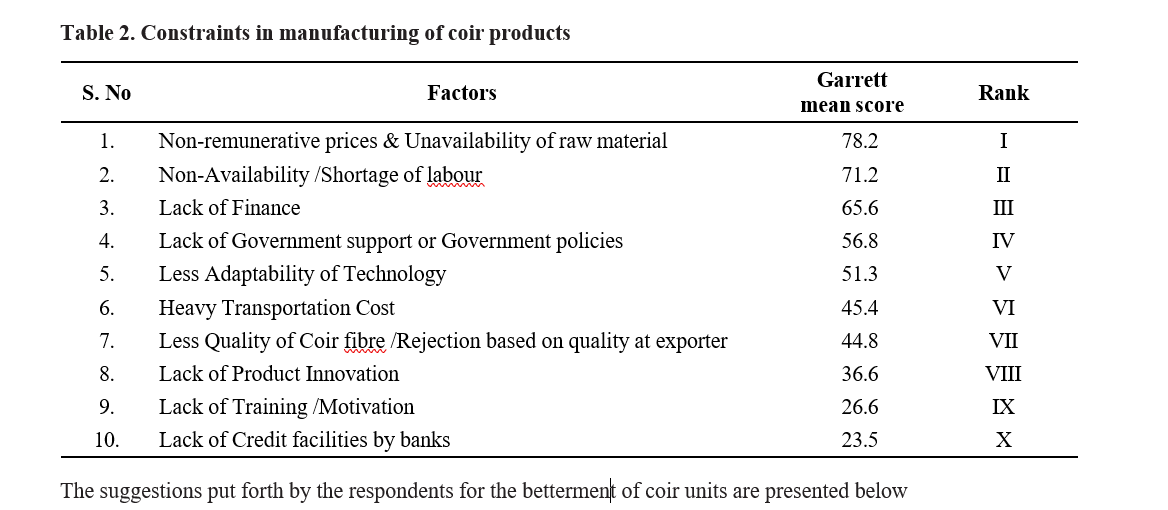
The identified problems were ranked by using the Garrett ranking technique and are presented in Table 2. Results revealed that, unavailability of raw material was identified as the major constraint faced by the manufacturers with a Garrett mean score as 78.2, which was attributed to uneven supply and increased competition for raw materials. This happened due to climate change and occurrence of diseases affecting coconut palm that lead to fluctuations in coconut production. The non availability of labour was ranked second with a Garrett score as 71.2. As labour is utilised during husk processing and manufacturing of coir in to various products and now-a-days due to shortage of labour automated technology is using. The absence of financing facilities was ranked third with 65.6 Garrett score. As credit allocation is entirely determined by the bank. A bank would never want to take a chance by approving a loan for a small business like the coir industry. These tiny village industries also experience high bank interest rates.
Lack of government support was identified as the fourth constraint with a Garrett mean score as 56.8. This can be attributed to the inappropriate government policies, as the proprietors of coir units stated that the main causes of their concerns were excessive taxes and export levies. The low adoption of technology (51.3) is the fifth constraint that can be described to expensive initial investment cost and a workforce that is primarily unorganized as this industry heavily relies
on conventional methods for converting husk into fibre. This is because there is a lack of information regarding the use of technology. Sixth constraint is the coir sector is greatly impacted by high transportation costs with a Garrett means score as 51.3, which has an effect on market dynamics and production. Due to its bulk and weight, coconut husk is difficult to transport, and the expense is increased by the fact that coir processing facilities are usually located in remote areas with sample raw materials.
Exporters rejection due to low quality was ranked seventh with 44.8 score. Occasionally the quality of coir fibre may be inadequate, resulting in exporters rejecting it as inappropriate retting. A fluctuation in the fibre’s moisture content was caused by inconsistent drying techniques, which will lower the quality. Coir fibre must adhere to certain specifications set by exporters, such as consistency in length, colour, and strength. The results are in line with the results of Gunasekarane J, 2006 .The coir sector has historically seen little in the way of new product innovation throughout time. Due to a lack of funding for research and development, a dearth of technological advancements, and a cautious approach to embracing new market trends, the industry has struggled to diversify its product line and modernise its production technology as it relates to sustainable and environmentally friendly materials. Hence, lack of product innovation was ranked eight with a Garrett means score (36.6). The lack of proper training for many workers in this industry about contemporary techniques and equipment results in inefficiencies and decreased output. Access to educational resources and development programmes catered to the unique requirements of the coir business is typically restricted, which exacerbates this training deficit. Garrett means score (26.6) revealed it as ninth constraint. Lack of credit facilities from banks, was ranked as 10th constraint because many coir firms are informal and there are perceived risks connected with changeable market conditions, banks are reluctant to provide loans to these businesses. As a result, the lack of operating capital causes coir manufacturers to suffer and restricts their ability to make investments in new equipment, raw materials, and employee growth. The livelihoods of those reliant on this traditional business are also impacted by this financial constraint, in addition to the productivity and profitability of coir enterprises. The results are in consistent with the results of Mohamed C, 2005 and Poornimadevi S, 2017).
Availability of raw material: Encourage the use of high-yielding coconut cultivars that yield more husks, which will increase the supply of coir. Establish well- run collection points where farmers can readily sell the husks of coconuts. As a result, there will be less waste and a consistent supply of raw materials. To increase productivity and efficiency, provide instruction on contemporary farming practices, pest management strategies, and coir extraction processes.
Automated machines: Introduce machines that are fully or partially automated for tasks including matting, spinning, weaving, and defibering. As a result, efficiency is increased and less physical labour is required. Develop multitasking skills in current employees to create a flexible workforce who can move to where they are most required. Invest in training programs that will improve employees’ abilities to operate sophisticated machinery and make sure they can handle more advanced equipment.
Providing institution finance liberally: Make the most use of the resources and raw materials that are available. Use inventory control strategies to cut down on waste and
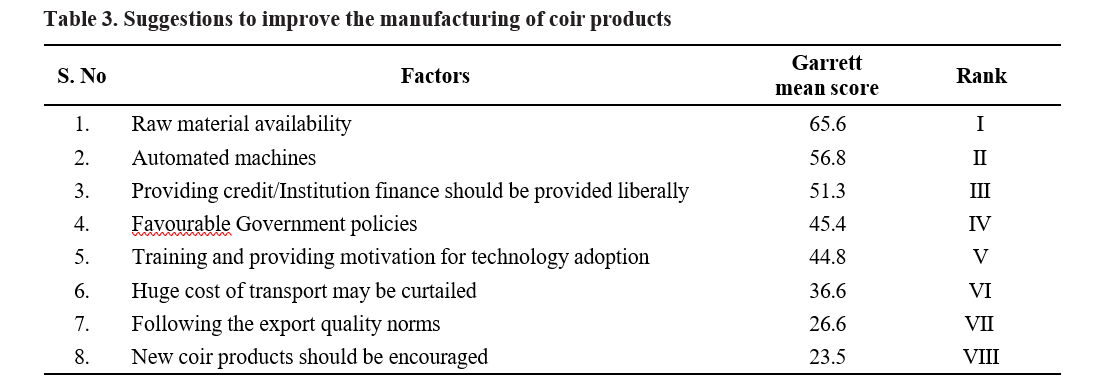
material expenses. Use lean manufacturing strategies to cut expenses, simplify operations, and get rid of waste. Get rid of stages that don’t offer value and concentrate on those that do process find inefficiencies and bottlenecks in your production processes to continuously improve them and cut costs without making a large financial commitment.
Favourable government policies: Investigate alternative product lines to coir ropes and mats. This could include furniture made of coir, environmentally friendly packaging, geotextiles, and bio-composite. To make coir goods more robust, long-lasting, and aesthetically pleasing, spend money on research and development. In this sense, cooperation with academic institutions or commercial research facilities may be beneficial. In order to guarantee consistency and high standards in product manufacture, implement contemporary quality control systems. Adopt green production techniques to lessen your influence on the environment and attract environmentally sensitive customers.
Training and providing motivation for technology adoption: Create devices that are simple to use and maintain, especially for people with little experience in technology. Include clear instructions and user-friendly interfaces. Provide employees specialised training to enable them to comprehend and utilise new technology. Incorporate practical experience and ongoing assistance. Improve workers’ digital literacy to aid in their
understanding of and ability to adjust to technology, particularly in rural locations.
Huge cost of transport may be curtailed: Create a number of smaller production facilities in closer proximity to important markets or sources of raw materials. This lowers the distance that coir goods must travel, resulting in lower transportation expenses. Make goods that can be put together when they get there. This enables more compact packaging, perhaps saving money on transportation. Utilise IoT to track shipments in real time and monitor conditions, which can improve planning and cut down on pointless travel.
Following the export quality norms: Start by locating husks in areas renowned for their superior coir fibre production. Build enduring connections with vendors who can reliably supply high-quality raw materials. At various production phases, do routine quality checks to identify flaws early on. When feasible, use automated systems to minimise human mistake.
New coir products should be encouraged: Invest in research and development to generate novel coir composites or blends with other natural or synthetic materials to produce goods with improved qualities (such as greater water resistance or durability). Provide coir goods that can be customised to meet unique customer needs, such as mats with custom designs or sizes for industrial applications. Obtain eco-certifications in order to attract customers who care about the environment. Make coir goods’ sustainability and biodegradability a major selling point.
Lack of training/motivation: Organise frequent workshops that cover both fundamental and sophisticated coir fabrication methods. Encourage employees to become familiar with various jobs in the manufacturing process as this can boost adaptability and cut down on downtime. Conduction of certification programs that allow employees who meet specific skill levels to be recognised and possibly advance in their careers. Establish an incentive program whereby employees receive bonuses or other rewards for meeting targets, being productive, or producing high-quality work.
Lack of credit facilities by banks: Coir producers can have more negotiating leverage if they organise cooperative societies or join existing ones. Cooperative groups are frequently granted credit by banks more readily than individual firms. Encouraging coir workers to form Self-Help Groups (SHGs) can facilitate resource pooling, microcredit access, and financial literacy enhancement. Make use of government programs that provide financing without requiring collateral, such as the financing Guarantee Fund Trust for Micro and Small Enterprises (CGTMSE). Spread the word about the Coir Udyami Yojana and other government grants and subsidies that are expressly intended for the coir business, and offer assistance in applying for them.
Problems in manufacturing and marketing of coir products have been studied. In manufacturing related constraints unavailability of raw material secured highest Ranking Based Quotient score of (78.2) Non availability of labour, lack of credit facility /finance, non-supportive Government policies, Less adaptability of technology, high transportation cost, poor quality of raw material are other problems faced by farmers in production of coir products in decreasing order of their importance. Among other restrictions connected to marketing, traders with intense competition had the highest R.B.Q. The following list of obstacles farmers face in the production of coir products is ranked in decreasing order of significance: high price fluctuations, long distance to markets, demand fluctuations, lack of coordination among market channel members, strict delivery deadlines, non-availability of credit, rejection based on quality, and recovery of credit.
Malik, I. R. 1988. Strengthening co-operatives in coir industry. Glimpses of Co-operatives. 3: 605-608.
Jeya, B. J. 1989. An economic study of the coir industry in Kanyakumari district. Ph. D Thesis. Madurai Kamaraj University, Madurai, India. 23-56.
Nair, B. 1997.Women’s health in a traditional sector. A study of coir yarn spinning industry in Kerala. Journal of Indian Association of social science Institution. 15(4): 115-124.
Roy, B. C. 1997. Growth and prospects of fruits and vegetables processing industry in India. The Bihar Journal of Agricultural Marketing. 5(4): 356-365.
Nagesh, A. R. 1990. Investment in production and marketing of cashew in Karnataka. An economic analysis. M.Sc. (Ag) Thesis. U. A. S. Dharwad.
Mohamed, C and Hameed, S. 2003. Indian coir industries challenges and future prospects. Journal of Southern economic Association. 42(1): 33-34.
Chillar, M. 2004. Sickness in Coir Industries in Tamil Nadu: A Scenario. Journal of Southern economic Association. 43(5): 8-10.
Kumarasamy Pillai. 2005. Towards Self-Reliance in Coir Fibre Production. Coir News. 15(6):37-39.
Gunasekarane, J. 2006. Implication of shortage of dried coir pith on exports. Coir industry in the Lakshadweep-a survey. Coir News. 32(7): 17-24.
Senthilkumar, R. 2015. Problems and prospects of coir industry. Asia Pacific Journal of Research. 1.
Poornimadevi, S. 2017. A Study on the problems and prospects of coir industry in Pollachi, Coimbatore District. International Journal of Advance Trends in engineering and Technology. 2(1): 87-92.
Department of Scientific and Industrial Research) https://