

0 Views
Department of Economics, Vijayanagara Srikrishnadevaraya University, Ballari-583105.
Groundnut (Arachis hypogaea L.) is a major oilseed crop in Karnataka, largely cultivated under rainfed conditions. This study examines the impact of climatic variability on groundnut cost of cultivation using district-level panel data for 1990–2023. A dynamic Arellano–Bond Generalized Method of Moments (GMM) estimator was employed to address endogeneity. Results show that rainfall significantly reduces production costs, whereas temperature increases costs beyond a threshold level. Higher wet-day frequency and positive SPI values raise costs, while moderate cloud cover lowers them. The findings highlight the sensitivity of groundnut production costs to climate variability in semi-arid regions.
KEYWORDS: Climate change, groundnut, cost of cultivation, generalized method of moments (GMM).
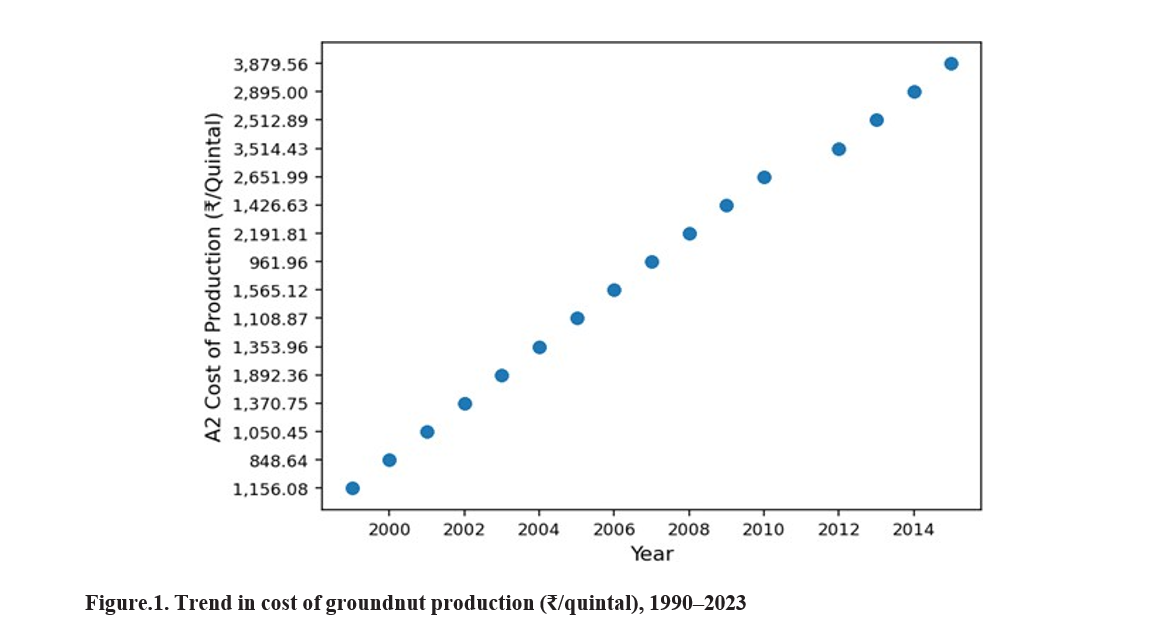
Groundnut (Arachis hypogaea L.) is an important oilseed crop in Karnataka which is predominantly grown in the northern dry regions of the State. In 2023, Karnataka contributed to around 5 percent of all production in India. Chitradurga, Tumkur, Raichur, Koppal and Yadgir are major producers in the region. Acreage in 2021-22 is around 4.5 lakh hectares in Karnataka. India is the world’s second largest groundnut oil producer (19.8% in 2022-23). Price of groundnut varies between ₹3685 to ₹6800 per quintal. The state witnessed a decline of about 2.1 per cent in the growth rate of acreage between the year 2017-18 to 2022-23. However, the yields increased by about 34 per cent. Costs of production (A2) in Karnataka vary between ₹3622 and ₹3700 per quintal. The cost of production shows an increasing trend, rising by about 9 per cent from 2021-22 to 2022-23 as shown in Figure 1. Costs of production depend on agronomic, economic and climatic conditions. Climatic change can trigger changes in agronomic and economic factors besides directly influencing the production. Optimal combinations of inputs would differ and production technology could itself change in response to these climatic variations.
Climatic conditions such as rainfall and temperature exhibit changes in trends and patterns in Karnataka. Rainfall shows increasing variability over time since the year 2000 (Pandey and Ponnaluru, 2021). There were around eight long-term drought incidents in the span of 31 years with four significant drought periods in years of 1999-2005, 2011-2014, 2015-2018 and 2018-2020. The intensity of drought increased in the last decade compared to previous decades. Temperatures (daily average Maximum and minimum) also exhibit increasing trends. Summer (March, April, May) temperature increased by 0.18°C to 0.61°C. Winter (December, January, February) minimum temperatures increased by 0.3°C to 0.65°C. Given the climatic changes over the study region, it is highly desirable to quantify the impact of climatic changes on crop production costs. This study quantifies the climatic impacts on cost of production by utilizing generalized method of moments estimators.
The previous studies in the domain of agriculture economics and climate change by Bantilan et al. (2013), Rao et al. (2013) and Acharya et al. (2011) assessed the impact of temperature change on crop revenues. Groundnut yields decreased by 2.3 to 42 per cent across India in response to climatic changes (Kadiyala et al. 2021). Climatic variability is a significant determinant affecting total cost of cultivation (Kashyap et al. 2024). Various crops responded differently to rising temperatures and this difference in response does not affect the crop patterns (Birthal et al. 2021). Increase in temperature reduces the profitability of groundnut (Sembene 2023). ENSO and Indian Ocean sea surface temperatures affected yields of crops including groundnut (Krishna Kumar et al. 2004). Climate variability affected technical efficiency besides crop acreage, yield and profitability(Singh and Jyoti, 2009). Farmer’s production decisions such as level of inputs, choice of crops etc depended on climatic variability and specific approaches are required for each crop (Gadgil et al. (2002). The climatic variables incorporated in this study are Temperature, Rainfall, Wet-Day Frequency, Cloud Cover and Precipitation levels.
Agronomic Data used in this study was obtained from the Directorate of Economics and Statistics (DES) and the reports of Commission for Agricultural Costs and Prices (CACP). The data set utilized in the study is a state level panel covering all the districts of Karnataka spanning over 33 years from 1990 to 2023. ICRISAT DLD provides coverage on agronomic and weather variables from the year 1990 to 2015 and DES covers the rest of period. The Data on costs of cultivation is obtained from Directorate of Economics and Statistics, Government of India. The Indian Meteorological Department (IMD) provided Climate data spanning over 100 years from 1900 to 2002. Data from all these sources is collated and organized into a SAS Database. SAS SQL, SAS IML and Base SAS routines were utilized for analysis.
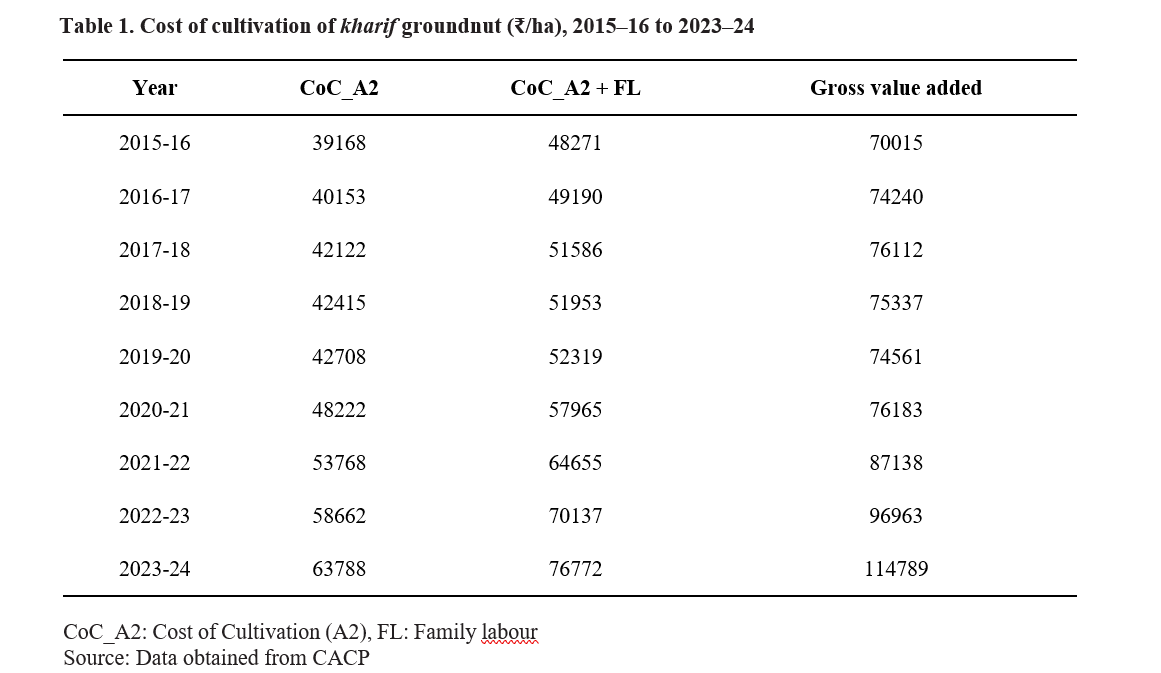
Dependent variable in the model is cost of production incurred from growing groundnut crop in a year. Revenue from a crop is calculated as a product of quantity produced in tons and the market price received in Rupees. Cost of cultivation is in Rupees and A2 component of cost is considered as per the CACP Methodology. A2 measures the costs of hired and owned labour(human, machine, bullock), value of seeds, pesticides, fertilizers, depreciation, irrigation charges, land revenues, Interest on working capital and miscellaneous expenses, and rent paid for leased in land. Figure 1 shows the trends and patterns in the cost of cultivation over time. An increasing trend can be observed over the study period. Cost varied between ₹849 per quintal in year 2000 and ₹3879 in 2015, with a standard deviation of ₹928. Cost data over time is presented in Table 1.
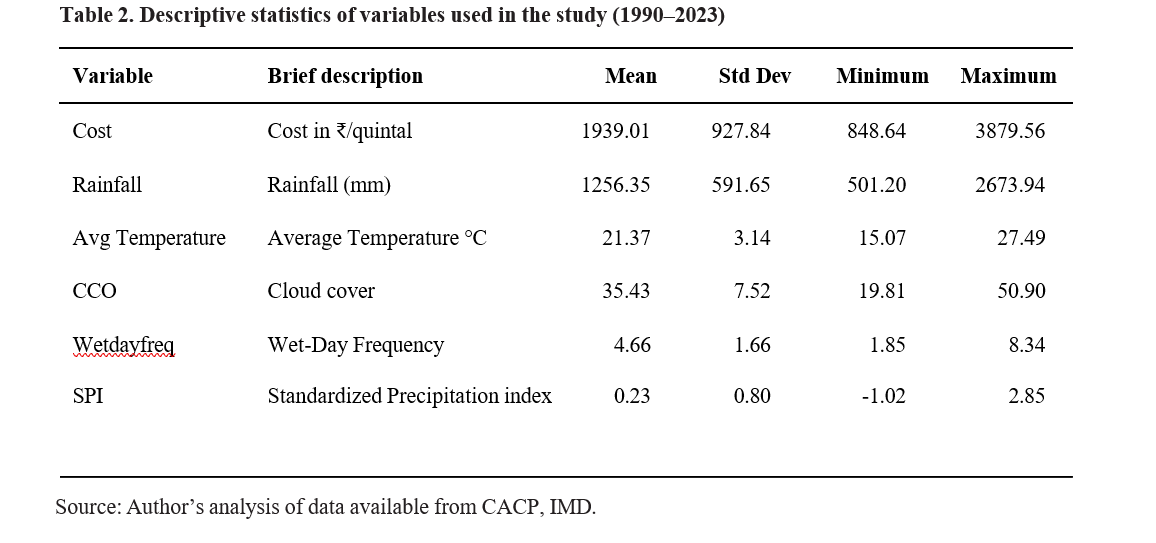
Climate data is constructed using weather data on each district. Climate normal for variables such as temperature, rainfall, and cloud cover are calculated as moving average of thirty years. For example, normal temperature for the year 2016 is an average of temperatures recorded for years 1986 through 2015. Similarly, normal temperature for the year 2017 is an average for the years 1987 through 2016. Period of thirty years is used for calculating climate normal from weather data as per the convention in the literature. Descriptive statistics for all the variables used in the estimation are presented in Table 2.
Climatic change (changes in temperature, rainfall, seasonality) increase the vulnerability of agriculture. Temperature and rainfall are specified as quadratic functions to capture the nonlinearity in the relation between costs realized and climate. Annual average temperatures (Maximum and Minimum) are considered. Summer temperature ranges between 23°C to 43 °C and winter varies 9°C to 27°C. Cloud cover is an important factor affecting production. Higher cloud cover with little rainfall could be disastrous for the crop. It could affect photosynthesis directly. Increased cloud cover in the early and mid-agricultural cropping season poses significant impacts on crop. Larger amount of cloud cover coupled with higher moisture levels could affect pest and disease incidence. An increase in cloud cover likely leads to vegetation growth. The Indian Meteorological Department reports cloud cover data in percentage units. Given the positive and negative impacts on crop growth, parameter estimate on cloud cover could be either positive or negative.
Southwest monsoon provides 80 per cent of annual rainfall and the rest is from Northeast Monsoon. Western ghats, coastal and southern Karnataka are on the windward side whereas the Kalyan Karnataka region is on the leeward side. This causes spatial variability in the rainfall across the districts. Given that the study area is predominantly semiarid and rainfed increase in rainfall could increase agricultural production and lower costs may be realized. Parameter estimate on rainfall is hypothesized to be negative. Wet-days are defined as the rainy days when the rainfall received is ≥2.5mm. The frequency of wet-days is measured in HPA (Heavy Precipitation Amount) units. Increase in wet-day frequency could lead to nonlinear increases crop growth. Parameter estimate on Wet-day frequency could either be positive or negative. Standardized Precipitation Index (SPI) captures the changes in the amount and variance of the rainfall during the crop growing season. SPI at various periodicity was calculated using monthly precipitation data. SPI values are measured in standard deviations and range between -3.0 (extremely dry) to 3.0(extremely wet condition). Significant correlation
between crop’s irrigation demand and the change in SPI values across different time scales. This study estimated SPI in 12-month scale. Average of SPI values in the State for 28 years ranged from 0 to 0.52. Parameter estimate on SPI is hypothesized to be positive.
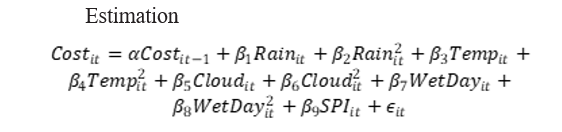
The cost function was estimated within a dynamic panel framework using the Arellano–Bond Generalized Method of Moments estimator. PROC PANEL procedure of SAS was utilized for estimating the model under dynamic framework. Arellano Bond dynamic estimator under Generalized Method of Moments framework is employed. Dynamically lagged dependent variable has been included in the panel data model of production costs. Arellano Bond Estimator uses lagged values of the dependent variable as instruments to control for the endogeneity from the included lagged dependent variable. Suitability of these lags as instruments was verified by Sargan test.
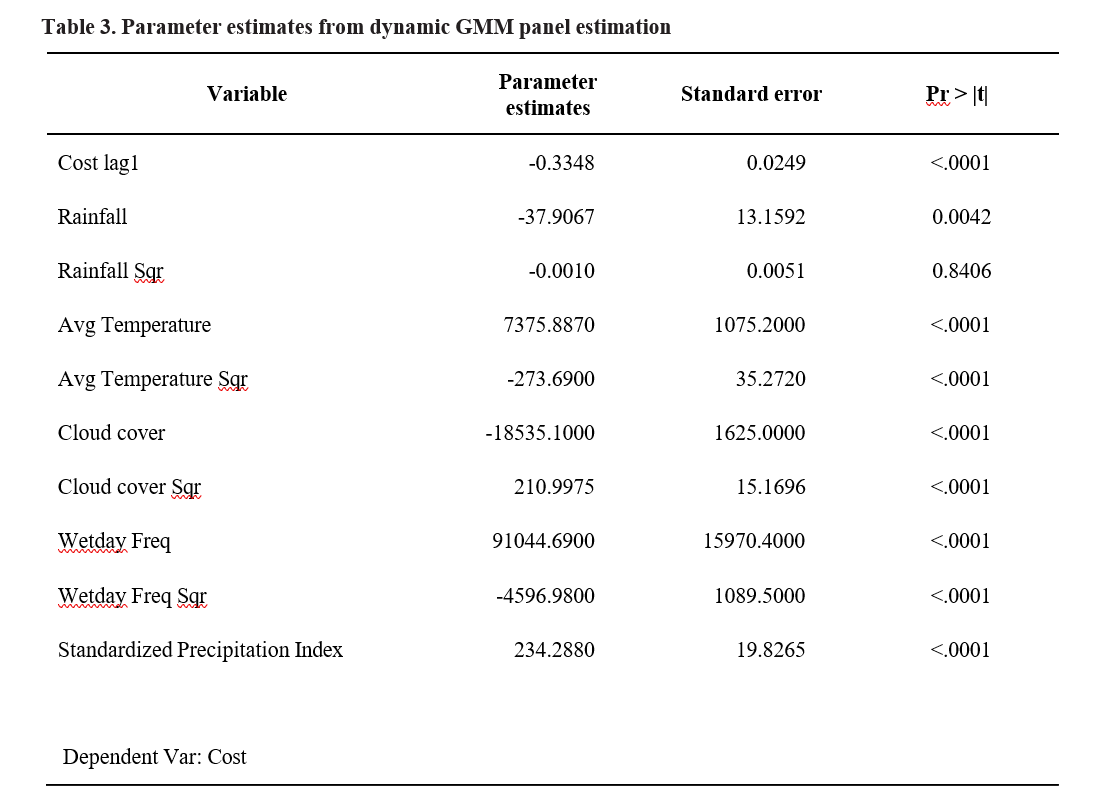
Results from the estimated model are presented in Table 3. Parameter estimate on lagged dependent variable is negative and statistically significant. Magnitude of the estimate (0.3348) is less than 1, indicating that the lagged effect dies down eventually. Parameter estimate on rainfall is negative and statistically significant (on linear
term and insignificant on the quadratic term) indicating that the costs decrease with increase in rainfall. A 1per cent increase in rainfall results in a 26.23 per cent decrease in costs. Given the rain-fed nature of the farming this result is consistent with the literature. Parameter estimate on temperature is negative (-273.69) on the quadratic term and positive on the linear term indicating that costs increase with increase in temperature but at a decreasing rate. a 1 per cent increase in temperature leads to a 75.25 per cent rise in costs. Parameter estimate on cloud cover is significant and positive on quadratic term and negative on the linear term. It indicates that more cloud cover percentage lowers the costs incurred.
Parameter estimate for wet-day frequency is statistically significant and negative on quadratic term, positive on linear term indicating that with the higher frequency of rainy days are associated with higher costs. This might be due to increase in the incidence of pest and diseases with increased number of rainy days. Parameter estimate on SPI is statistically significant and positive. It implies that the frequent drought incidence increases costs of production.
This study estimates the impact of climate variability on groundnut production costs in Karnataka using a dynamic panel GMM framework for 1990– 2023. Results indicate that temperature increases raise costs nonlinearly, while rainfall reduces costs in rainfed districts. Increased wet-day frequency and drought variability elevate production costs.
The dynamic nature of cost adjustment suggests that climatic shocks may have persistent effects. Adaptation strategies such as improved irrigation infrastructure, climate-resilient varieties and integrated pest management may help stabilize production costs.
Future research may incorporate spatial dependence across districts and explore climate–technology interaction effects.
This research was supported by ICSSR Major Research Grant No. G133. The author thanks ICSSR for funding, and ICRISAT, IMD, and CACP for data access.
Acharya, S. P., Basavaraja, H., Kunnal, L. B., Mahajanashetti, S. B., and Bhat, A. R. S. 2011. Crop diversification in Karnataka: An economic analysis. Agricultural Economics Research Review 24(2): 351–358.
Bantilan, C., Singh, N. P., Byjesh, K., and Ranganathan, C R. 2013. Quantifying economic impact of climate change on rice in semiarid tropics of India: Using Ricardian approach for the state of Andhra Pradesh. Asia Pacific Journal of Environment and Development 20: 41–45.
Birthal, P. S., Hazrana, J., Negi, D. S., and Bhan, S. 2021. Climate change and land-use in Indian agriculture. Land Use Policy 109: 105652. https:// doi.org/10.1016/j.landusepol.2021.105652
Gadgil, S., Rao, P. R. S., and Rao, K. N. 2002. Use of climate information for farm-level decision making: Rainfed groundnut in southern India. Agricultural Systems 74(3): 431–457. https://doi.org/10.1016/ S0308-521X(02)00049-5
Nelson, G. C., Rosegrant, M. W., Koo, J., Robertson, R., Sulser, T., Zhu, T., et al. 2009. Climate change: Impact on agriculture and costs of adaptation. Food Policy Report. International Food Policy Research Institute (IFPRI), Washington, DC. https://doi. org/10.2499/0896295354
Kadiyala, M. D. M., Nedumaran, S., Padmanabhan, J., Gumma, M. K., Gummadi, S., and Robertson, 2021. Modeling the potential impacts of climate change and adaptation strategies on groundnut production in India. Science of the Total Environment 776: 145–158.
Kashyap, N., Pawar, N., Malik, D. P., and Sumit. 2024. An economic analysis of production of groundnut in Haryana. International Journal of Farm Sciences 14(2). https://doi.org/10.5958/2250-0499.2024.00002.8
Krishna Kumar, K., Kumar, R. K., Ashrit, R. G., Deshpande, N. R., and Hansen, J. W. 2004. Climate impacts on Indian agriculture. International Journal of Climatology 24(11): 1375–1393.
Pandey, A., and Ponnaluru, S. 2021. Trends and patterns of dry spells in Karnataka. Journal of Research ANGRAU 49(4): 86–94.
Ponnaluru, S., and Pandey, A. 2021. Estimation of climate change impact on crop profitability in Karnataka. Journal of Research ANGRAU 49(2): 92–99.
Rao, R. C. A., Raju, B. M. K., Rao, A. V. M. S., Rao, K. V., Rao, V. U. M., Ramachandran, K., Venkateswarlu, B., and Sikka, A. K. 2013. Atlas on vulnerability of Indian agriculture to climate change. Central Research Institute for Dryland Agriculture (CRIDA), ICAR, Hyderabad.
Sembene, M. 2023. Economic costs of extreme heat on groundnut production in the Senegal groundnut basin. Ph.D. dissertation, Virginia Polytechnic Institute and State University, USA.
Singh, A. K., and Jyoti, B. 2019. Measuring the climate variability impact on cash crops farming in India: An empirical investigation. Agriculture and Food Sciences Research 6(2): 155–165.