
0 Views
Department of Agricultural Extension Education, ANGRAU-Datt Centre, Paderu-531 024.
The present investigation was conducted in Anakapalle district of Andhra Pradesh to study attitude of farmers towards use of information and communication technology on agricultural production. Three mandals from Anakapalle district of Andhra Pradesh state selected for the study. An Ex-post-facto research design was followed for the study. The constraints faced by respondents while using the ICT tools and techniques were, lack of awareness of proper functioning about ICT tools (69.33%), lack of training of the farmers towards use of different ICT tools (68.00%), inadequate internet supply (67.33%), lack of uninterrupted power supply (66.00%), difficulty in understanding the content language of ICT gadgets (66.67%), lack of local language in handling and understanding of software (66.67%), poor mobile/internet connectivity in rural areas (66.00%) and beyond this some other constraints also faced by farmers.
KEYWORDS: Utilization of ICT tools, constraints.
Information and Communication Technology (ICT) can revolutionize Indian farming sector and can benefit all farmers including small landholders. Over the years, digital agriculture in India has evolved from basic information and communication tools to more advanced and integrated systems. Today the focus is on real time monitoring, data driven planning, modern technologies, and strong decision support systems. ICT in agriculture provides farmers with vital information pertaining to sowing, crop protection, and improving soil fertility that enables them to improve agricultural productivity. Weather-related advisories and alerts help them prepare for sporadic events such as floods, drought, or even pest and disease outbreaks, thus preventing significant crop loss.
The increasing penetration of budget-friendly mobile phones and the internet is an added advantage for farmers living in remote areas in several emerging nations. Access to inexpensive mobile devices has now made it easier for them to acquire additional information and services that enable informed decision-making. ICT helps in growing demand for new approaches. It also helps in empowering the rural people by providing better access to natural resources, improved agricultural technologies, effective production strategies, markets, banking and financial services etc. to know the awareness of farmers on ICT and its impact on marketing and economic conditions in agriculture. The study was conducted with an objective of assessing profile characteristics of the respondents and also elicited the constraints faced and suggestions rendered by the respondents in utilization of ICT tools. (Jamdhade S.S.2015.)
Ex-post-facto” research approach was used for study. The present study was conducted in Anakapalle district of Andhra Pradesh state during 2022-2023. Three mandals from Anakapalle district and five villages from each mandal were selected randomly for the study. From each selected village, ten respondents were selected randomly, those having mobile phones with internet facilities and engaged in agricultural operations were selected, and a total of one hundred fifty respondents were considered for the present study. Data was gathered using a structured interview schedule designed for study. The collected data was analyzed, classified and tabulated. Statistical tools such as frequency, percentage and ranking were used to interpret findings and draw conclusions.
The findings indicate that respondents face multiple constraints in the use of ICT tools across socioeconomic, infrastructural, and technical dimensions. Among socioeconomic constraints, poor economic condition (67.33%) and difficulty in understanding content language (66.67%) emerged as the most critical issues, followed by lack of skills in using ICT tools (60.00%), high cost
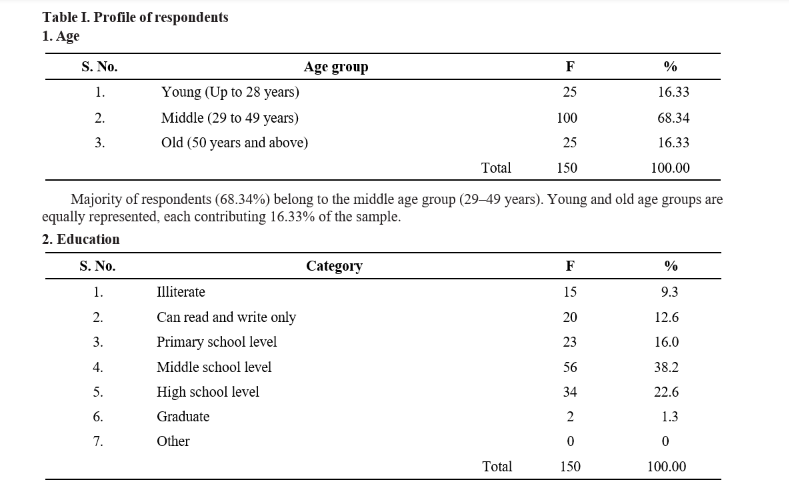
Majority of respondents have education up to middle school (24%) and high school (22%), indicating a moderate level of education. A smaller share includes primary level (16%), read and write only (12.67%), illiterate (9.33%), and very few graduates (16%), with none in the other category.
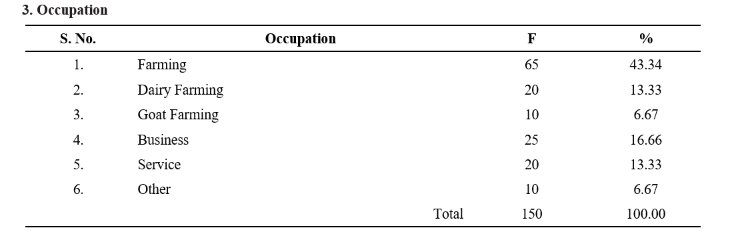
The majority of respondents are engaged in farming (34.67%), followed by service (18.67%) and business (18%). Smaller proportions are involved in dairy farming (13.33%), other activities (9.33%), and goat farming (6%), indicating agriculture as the main occupation.
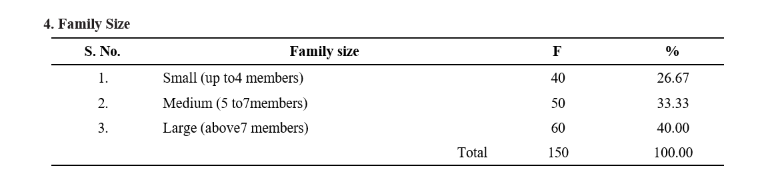
The majority of respondents belong to large families (40.00%), followed by medium families (33.33%). A smaller proportion comes from small families (26.67%), indicating a prevalence of bigger family sizes.
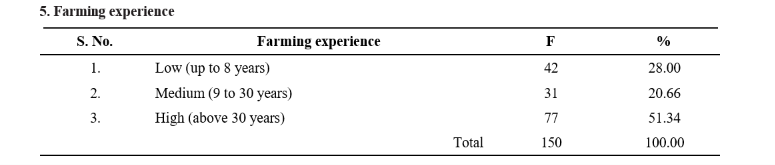
Majority (51.34%) of respondents have high experience (above 30 years) followed by low experience (28%) and medium experience (20.66%) categories.
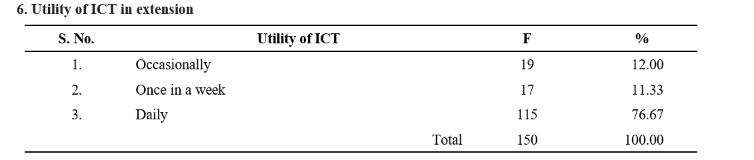
Most respondents use ICT daily (76.67%), indicating high utility in extension activities followed by occasionally (12%) and once a week (11.33%).
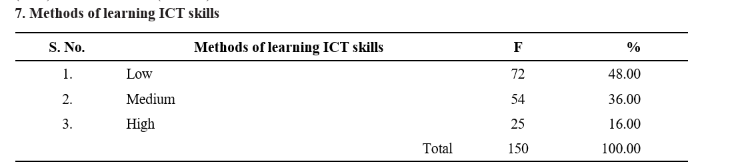
Most respondents have a low level of ICT learning skills (48.00%), followed by a medium level (36.00%). Only a small proportion (16.00%) have high ICT skills, indicating the need for improvement in ICT training.
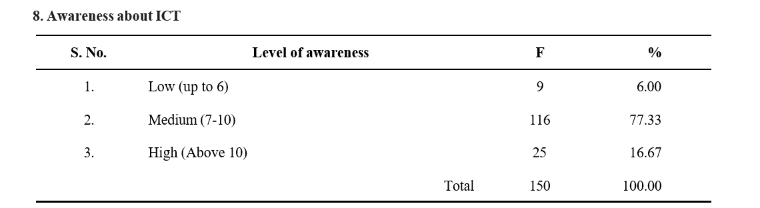
Majority of respondents fall under the medium category (77.33%). A smaller proportion are in the high category (16.67%), while only 6.00% are in the low category.
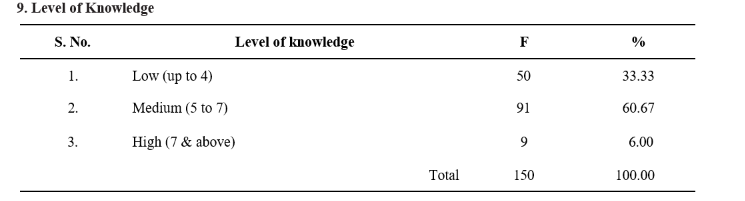
Majority of respondents have a medium level of knowledge (60.67%), followed by a low level (33.33%).
Only a small proportion (6.00%) possess a high level of knowledge.
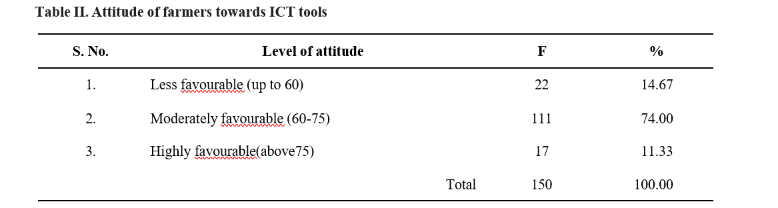
Majority of respondents have a moderately favourable attitude towards ICT tools (74.00%), followed by a less favourable attitude (14.67%). Only a small proportion (11.33%) exhibit a highly favourable attitude, indicating scope for improving perceptions towards ICT.
of devices (58.67%), and lack of belief in e-sources (57.33%). With respect to infrastructural constraints, lack of awareness about proper functioning of ICT tools (69.33%) ranked highest, followed by inadequate internet supply (67.33%), poor connectivity and power supply (66.00%), and insufficient maintenance facilities (62.67%). In terms of technical constraints, lack of training (68.00%) and absence of local language support (66.67%) were the major challenges, along with issues such as misleading information (66.00%), communication gaps (65.33%), and untrained operators (64.00%). Overall, these findings highlight the need for improving economic access, strengthening infrastructure, and enhancing technical training to promote effective utilization of ICT tools (Syiem R, Raj S. 2015).
The study concludes that farmers in the study area have a moderate level of awareness (77.33%), knowledge (60.67%), and attitude (74.00%) towards ICT tools, with a majority using ICTs daily (76.67%) for agricultural activities. However, the overall level of ICT learning skills remains low (48.00%), indicating that although farmers are exposed to ICTs, their capacity to effectively utilize these tools is still limited. The major constraints identified include poor economic conditions, lack of awareness and training, inadequate internet and power supply, and absence of local language support, which hinder optimal utilization of ICT tools.
Based on these findings, it is evident that there is a need to strengthen capacity-building programmes through regular training, demonstrations, and extension support to enhance farmers’ ICT skills. Efforts should be made to improve rural infrastructure, including reliable internet connectivity and power supply, along with promoting affordable ICT tools. Additionally, developing user-friendly and local language-based digital content, and increasing awareness about the proper use of ICT tools, can significantly improve adoption and effective utilization, thereby contributing to enhanced agricultural productivity and rural development.
Jamdhade S.S.2015. Information and Communication Technology (ICT) Tools used by orange growers (Master’s Thesis). Dr. Panjabrao Deshmukh Krishi Vidyapeeth, Akola.
Mittal S, Mehar M.2015. Socio-economic factors affecting adoption of modern ICT by farmers in India-Analysis using Multivariate Probit model. The Journal of Agricultural Education and Extension,22(2):199- 212.
Naik B.J.2018. A Study on ICT Tools Usage by the Farmersin Anantapur District of Andhra Pradesh (Master’s Thesis). Acharya N. G. Ranga Agricultural University, Guntur, Andhra Pradesh.
Syiem R, Raj S. 2015. Access and usage of ICTs for agriculture and rural development by the tribal farmers in Meghalaya state of North-East India. Agrar informatika. Journal of Agricultural Informatics.:6(3):24-41.