
0 Views
Department of Agricultural Extension Education, ANGRAU-S.V. Agricultural College, Tirupati-517 502.
This study sought to identify the job-oriented skillsets possessed by agricultural graduates acquired through academic curriculum. The study adopted exploratory research design. A total of 65 skills taken up for the study under three categories: personal, technical and other job-oriented skillsets based on the relevancy test. Data were collected from 120 agricultural graduates using a structured questionnaire. The skills were ranked based on their mean score value. Result revealed that among personal skills, learning skills (Rank I), interactive skill (Rank II), team working skill and presentation skill (Rank III) were highly acquired by graduates. Among technical skills, farm management skill (Rank I), irrigation management skill (Rank II), conservation agricultural skill, monitoring and evaluation skill (Rank III), need assessment skill and laboratory skill (Rank IV), soil health management skill and audio and video preparation skill (Rank V) were highly acquired and possessed by the agricultural graduates. In terms of other job- oriented skillsets, demonstration skill (Rank I), resource management skill (Rank II) and agri-business management skill (Rank III) were highly acquired by agricultural graduates through curriculum. The findings in this study will support universities in shaping their curriculum to better prepare the graduates in meeting the current demands of the labour market.
KEYWORDS: Agricultural graduates, job-oriented skills, personal skills, technical skills, other job-oriented skills, curriculum.
To prepare the graduates for tomorrow workforce, universities have increased their efforts to redesign curriculum and enhance academic programs, aiming to better impart the students with the job-oriented skillsets in the modern workplace. Though these updated curricula, graduates acquire a wide range of skillsets, which was crucial for employability in today’s job market (Adebakin et al., 2015). As for university graduates, in the face of rapidly changing environments, internationalization and globalization, employers expect them to be fully equipped with various professional skills and knowledge to deal with complex situations effectively and solve problems quickly (Murakami et al., 2009). Omar et al., (2012) indicates that both technical skills and soft skills are essential for employment, as technical skills enable individuals to perform specific job tasks, while soft skills facilitate obtaining, retaining, and advancing in a career; lacking either can limit employability and career progression. Although, graduates acquire these skills while they are undergoing during the degree programs. But they often fall short in acquiring skills from curriculum, indicating less prepared for industry demanding skills. Thus, the study aims to examine the skillsets possessed by agricultural graduates that were acquired through the undergraduate academic program in their B.Sc. (Hons) Agricultural Curriculum.
An Exploratory survey was conducted to assess the job-oriented skillsets possessed by agricultural graduates through academic curriculum. The study was conducted in the constituent colleges of Acharya N.G. Ranga Agricultural university, Andhra Pradesh, namely, S.V. Agricultural college, Tirupati and Agricultural College, Bapatla. The study sample comprised randomly selected 120 agricultural under graduated students (60 from S.V. Agricultural College, Tirupati and 60 from Agricultural College, Bapatla who completed their degree program in the past three years (2022-23, 2023-24 and 2024-25 passed out agri-graduates). From the B.Sc. (Agri.) Hons graduate course curriculum, all the skills taught by the graduated program were listed. The listed all the skills were categorized into three groups: (1) Personal skillsets, (2) Technical skillsets and (3) Other job-oriented skillets.
These identified skills were then subjected to a relevancy test by a panel of judges of 60 number, using a three-point continuum viz., Most Relevant-3, Relevant-2 and Less Relevant-1. Based on the result of relevancy test, a set 19 skills under personal skillsets category, 37 skills under technical skillsets category; and 9 skillsets under Other-Job oriented skills category were selected. The questionnaire was divided into three sections; (i) personal skill, (ii) technical skill (iii) other job-oriented skill acquired through undergraduate academic course curriculum. Students were asked to indicate their level of competence for each skill using a three-point continuum; viz., Highly competent-3, Competent-2, Less competent-1. A questionnaire was developed to collect the responses from the B.Sc. (Agril.) Hons graduates course completed students during last three academic years. The mean value was taken to rank the skills possessed by agricultural graduates that were acquired through the curriculum.
The result in Table 1 and Illustration 1 shows that the calculated mean values of personal skillsets possessed by agricultural graduates which acquired by undergoing B.Sc. (Agriculture) undergraduate course curriculum. The highly acquired and possessed skills were learning skills (Rank I), interactive skill (Rank II), team working and presentation skill (Rank III), e-learning skill and leadership skill (Rank IV), self- motivated skill, independent working skill and interpersonal skill (Rank V). Followed by comparatively lower possessed skills were time management and decision-making skill (Rank VI), communication skill (Rank VII), problem solving skill (Rank VIII), critical thinking skill (Rank IX), networking skill (Rank X), analytical skill (Rank XI), risk management skill (Rank XII), computer skill (Rank XIII) and negotiation skill (Rank XIV).
The rationale behind the highly possessed skills by agricultural graduates might be those skills were given more importance within the curriculum and imparted to the students during their graduation. The active involvement of graduates in project work, field task, continuous exposure in practical component such as participation in the Rural Agricultural Work Experience Program and Experiential Learning Program during their final year might be the possible reason for possessing these essential personal skills.
The least possessed skills due to the graduates might be lack of exposure on internships and job training programs. If the graduates not received any training or internship programs during their academic period, they feel struggle to adapt to workplace demands and handle real world challenges.
The study consistent with the findings of Morgan and Rucker (2013). Sarin (2019), Colclasure (2020), Cenzia et al. (2021) and Olowa et al. (2023)
The data depicted in table 2 and Illustration 2 showed the mean score value of technical skillsets possessed by agricultural graduates, which were acquired through academic curriculum as follows: farm management skill (Rank I), irrigation management skill(Rank II), conservation agricultural and monitoring and evaluation skill (Rank III), need assessment skill and laboratory skill (Rank IV), soil health management skill and audio & video preparation skill (Rank V), project proposal writing skill (Rank VI), nursey management skill and market intelligence skill (Rank VII), biocontrol management skill and farm advisory skill (Rank VIII), pest management skill (Rank IX), disease management skill (Rank X), nutrient media preparation skill, integrated nutrient management skill and waste management skill (Rank XI), greenhouse management skill(Rank XII), plant propagation skill (Rank XIII), agroforestry system management skill(Rank XIV), seed production skill and climate smart agricultural planning skill (Rank XV), watershed management skill and landscape designing skill (Rank XVI), weather observation skill (Rank XVII), biofertilizer production skill (Rank XVIII), precision agricultural skill (Rank XIX),food nutrient analysis skill (Rank XX), food preservation technique skill (Rank XXI), bee keeping management skill (Rank XXII), Silkworm rearing skill (Rank XXIII), plant tissue culture skill and livestock management skill (Rank XXIV), crop breeding skill (Rank XXV), surveying and topography skill (Rank XXVI) and biogas production skill (Rank XXVII).
Based on the analysis, farm management skill, irrigation management skill, conservation agricultural skill, monitoring and evaluation skill, need assessment skill and laboratory skill, soil health management skill and audio and video preparation skill were highly possessed by the graduates. This reflected that the curriculum strongly focused on agricultural operation in academic program that were highly required by the
I Personal skillsets possessed by agricultural graduates acquired through academic curriculum
Table 1. Personal skillsets possessed by agricultural graduates acquired through academic curriculum (n=120)
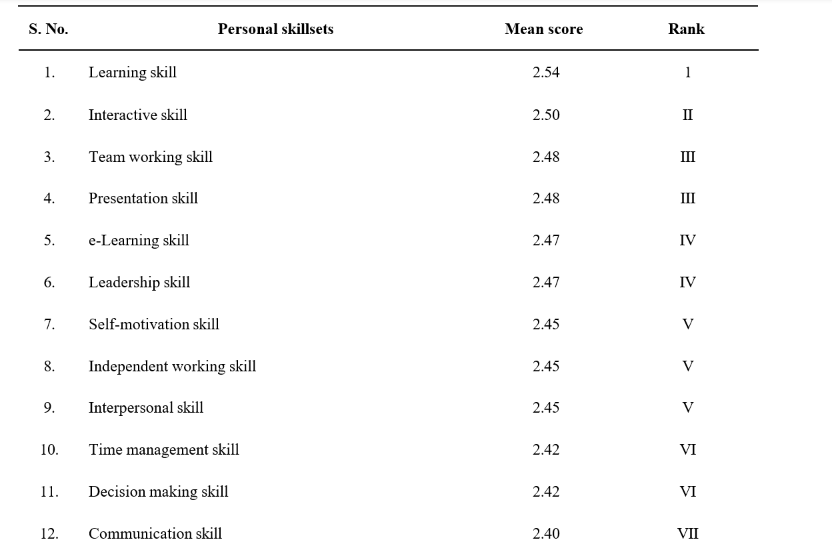
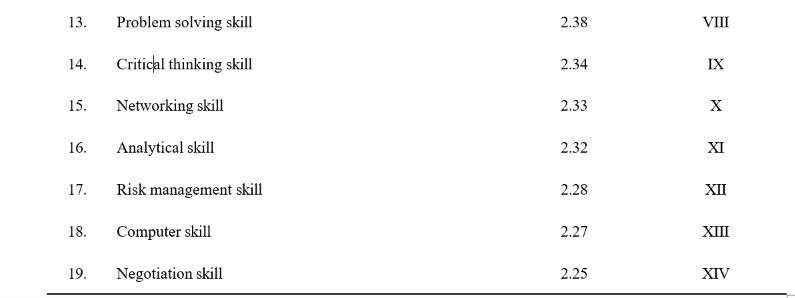
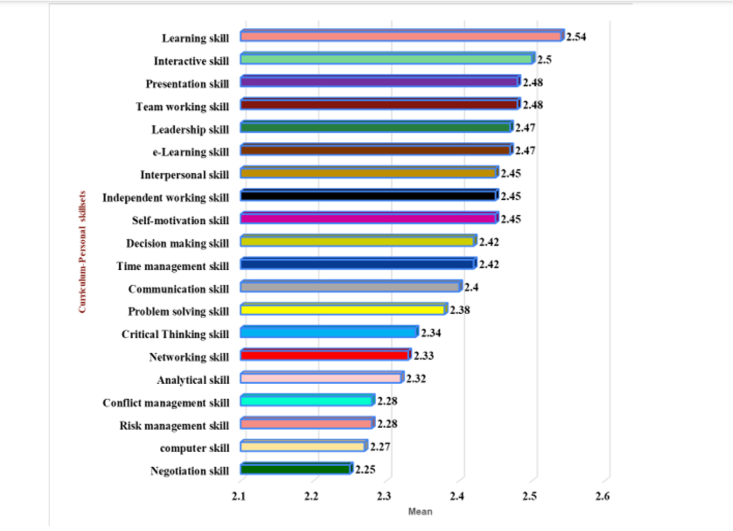
Illustration 1. Personal skillsets possessed by agricultural graduates acquired through curriculum
industry sector, which might be the possible reason for the strong possession of these skills.
Conversely, precision agricultural skill, food nutrient analysis skill, food preservation techniques skills, bee keeping management skill, silkworm rearing skill, plant tissue culture skill, livestock management skill, crop breeding skills surveying and topography skill and biogas production skill received lower ranks. Agricultural graduates did not perceive these skills as highly essential for broader agricultural industry sector, delivery of these skills often remains theoretical in curriculum and the short duration of practical session, which might be the possible reason for less possession of these technical skills.
The result of the study well aligned with the findings of Movahedi and Nagel (2012) and Ramsey and Edwards (2011), Albritton and Roberts (2020)
The data depicted in Table 3 and Figure 3 showed the mean score value of other job-oriented skillsets possessed by agricultural graduates, which were acquired through academic curriculum as follows: demonstration skill (Rank I), resource management skill (Rank II), agri-business management skill (Rank III), entrepreneurship skill and project planning skill (Rank IV), budget management skill and reporting skill (Rank V), statistical data analysis skill (Rank VI) and quantitative skill (Rank VII).
Based on the analysis, demonstration skill, resource management skill, agri-business management skill, entrepreneurial skill and project planning skill were highly possessed by the graduates. This might be because students were more involved in extension activities during their academic program, such as RAWEP and Experiential Learning Program, indicating that these skills were highly emphasized in the academic curricula.
II Technical skillsets possessed by agricultural graduates acquired through academic curriculum
Table 2. Technical skillsets possessed by agricultural graduates acquired through academic curriculum (n=120)
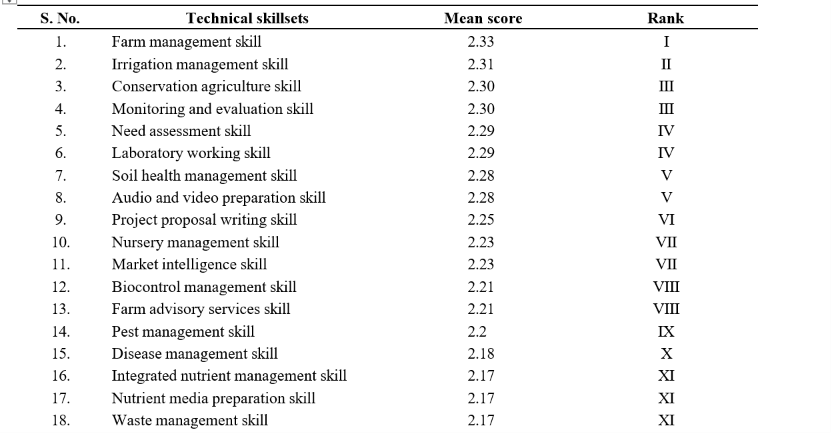
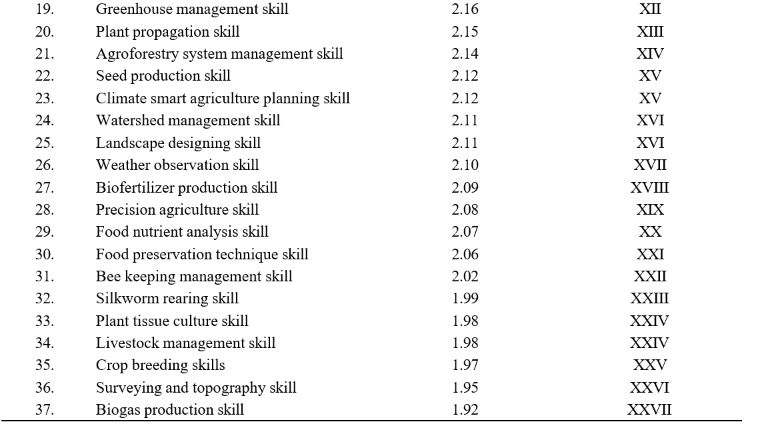
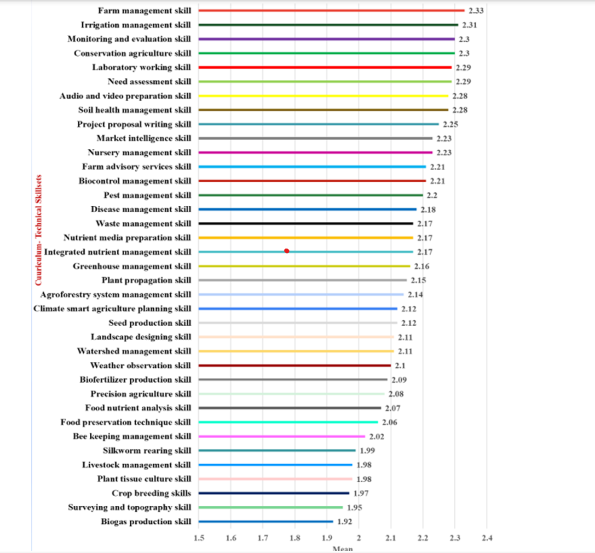
Illustration 2. Technical skillsets possessed by agricultural graduates acquired through curriculum
III Other Job-Oriented skillsets possessed by agricultural graduates acquired through academic curriculum
Table 3. Other job-oriented skillsets possessed by agricultural graduates acquired through academic curriculum (n=120)
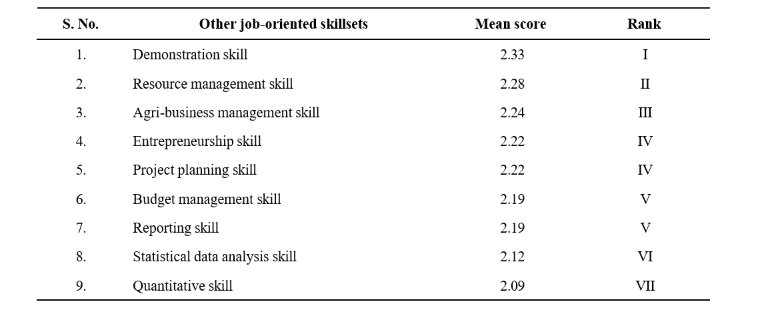
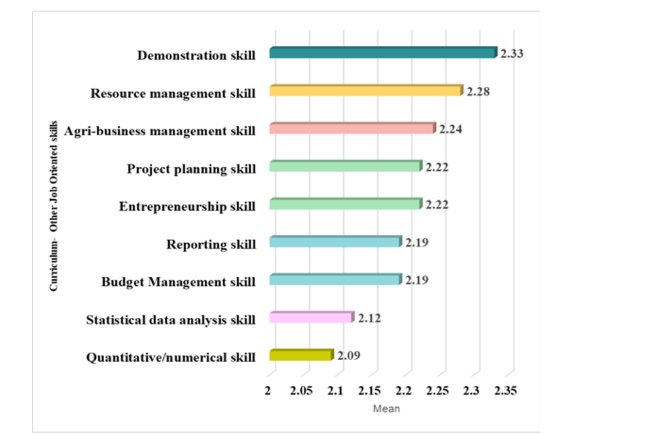
Illustration 3. Other job oriented skillsets possessed by agricultural graduates acquired through curriculum
Conversely, budget management skill and reporting skill were moderately possessed, while statistical data analysis skill and quantitative skills received low rankings, indicated these skills were the least possessed by agricultural graduates. This may be due to a lack of curiosity or motivation among graduates and limited hand-on- experience emphasized in curriculum, which might be a possible reason for their lower possession of these skills.
The results were in-line with the findings of Saikia (2014) who examined the agricultural competencies such as record keeping, financial management and business planning. Sarin (2019) emphasized the quantitative skill and resource planning skill needed in curriculum with industry requirement to bridge the gap.
In today complex world, universities face significant challenges in equipping graduates with necessary skills for workforce. Integrating core skillsets in curriculum requires strong collaboration between university and industries. As a result of the study revealed that graduates seem lack certain personal, technical and other job-oriented skills. Similarly, this study would be valuable for graduates, as it helps them to assess the level of skills they have acquired during academic programs. Based on the survey findings, it is recommended that, to prepare graduates to meet the industry expectations, university curriculum should integrate to knowledge application to real life problems, promote peer tutoring and encouraging interactive learning. Additionally, department should offer special courses along-side of university course to further enhance students’ skill development.
Adebakin, A. B., Ajadi, O. T and Subair, S. 2015. Required and possessed university graduates’ employability skills: Perceptions of the Nigerian employers. Nigerian Employers. African Higher Education Review.9 (1&2): 78-85
Albritton, M. C and Roberts, T. G. 2020. Agricultural technical skills needed by entry level agriculture teachers: A modified Delphi study. Journal of Agricultural Education. 61(1):140-151.
Ceniza, R. P., Alera, E. Q., Nicolas, H. J., Tejada, R. C and Mendoza, J. P. 2021. Agriculture graduates’ employment profile and feedback on curriculum. Journal of Agriculture and Technology Management. 24(1):28-40.
Colclasure, B. 2020. Entry-level workplace competencies needed by graduates of a community college agriculture program: a Midwest case study using the elphi technique. Journal of Research in Technical Careers. 4(2):3-23.
Morgan, A. C and Rucker, K. Jill .2013. Competencies needed by agricultural communication undergraduates: An academic perspective. Journal of Applied Communications. 97(1):1-16
Movahedi, R and Nagel, U. J. 2012. Identifying required competencies for the agricultural extension and education undergraduates. Journal of Agricultural Science and Technology.14: 727-742.
Murakami, K., Murray, L., Sims, D and Chedzey, K. 2009. Learning on work placement: The narrative development of social competence. Journal of Adult Development.16(1): 13–24.
Olowa, O. W., Olowa, O. A., Umoru, J. I., Ayejuyo, S and Oko, S. M. 2023. Assessment of the Employability Skills of Agriculture Graduates in Tertiary Institutions in Ogun State. Akoka Journal of Vocational Education.13(1): 109-117.
Omar, M. K., Bakar, A. R and Rashid, A. M. 2012. Employability skill acquisition among Malaysian community college students. Journal of Social sciences. 8(3): 472-478.
Ramsey, J. W and Edwards, C. E. 2011. Entry-level technical skills that agricultural industry experts expected students to learn through their supervised agricultural experiences: A modified Delphi study. Journal of Agricultural Education. 52(2):82-94.
Saikia, S. R. 2014. Beyond academic curriculum: embedding employability skills in agricultural education in Assam Agricultural University. International Journal of Social Sciences and Entrepreneurship. 1(9):560-575.
Sarin, C. 2019. Analyzing skill gap between higher education and employability. Research Journal of Humanities and Social Sciences. 10(3):941-948.