

0 Views
Department of Genetics and Plant Breeding, ANGRAU-S.V. Agricultural College, Tirupati-517 502.
Fifty one sugarcane clones were evaluated in randomized block design with two replications at ARS, Perumallapalle, Tirupati, Andhra Pradesh to study the variability for cane yield and juice quality traits. The analysis of variance (ANOVA) revealed significant differences in the mean sum of squares for all the characters. The phenotypic coefficient of variance (PCV) is greater than the genotypic coefficient of variance (GCV) for all the traits under study. High heritability coupled with high genetic advance as per cent of mean was observed for tillers at 120 DAP, number of nodes per cane, sucrose per cent and CCS per cent at 10th month, top leaf weight, reducing sugars and leaf area index. High heritability coupled with moderate genetic advance as per cent of mean was observed for number of millable canes, cane length, brix per cent at 10th and 12th month, sucrose per cent and CCS per cent at 12th month and fibre per cent. High heritability and low genetic advance were observed for germination per cent at 30 DAP, purity per cent at 10th and 12th month.
KEYWORDS: ANOVA, heritability, GCV and PCV.
Sugarcane (Saccharum spp.) is an important commercial crop. Its Latin name Saccharum given by Carl Linne in 1753 derives from the words ‘Karkara’ and ‘Sakkara’ in Sanskrit and Prakrit. It grows as a tall perennial grass. It belongs to the order Poales, family Poaceae and sub family Panicoideae. It’s chromosome number ranging between 2n=80-120. Among all the regions worldwide, India stands out as a significant player in the sugarcane production and in sugar industry with an area of 5.648 M ha, producing 446.43 M t of cane, with a productivity of 79.03 t ha-1. The state of Andhra Pradesh contributes to the country’s output with an area of 0.027 M ha, producing 2.10 M t of cane and a productivity rate of 76.34 t ha-1. (Directorate of Sugarcane Development, 2024). In sugarcane cultivation, early and mid-late clones refer to different maturity groups. Sugarcane is a highly heterozygous and complex in terms of its genetic makeup, exhibits a tendency to give rise to significant variability. This variability is typically quantified through measures such as, PCV, GCV (phenotypic and genotypic coefficient of variation) and genetic advance as a per cent of the mean (GAM). Knowledge of the genetic variability and broad sense heritability of traits holds paramount importance to breeders, aiding them in executing effective selection among various clones.
The combination of the coefficient of variation with heritability, alongside GAM, facilitates the improvement of traits by providing insights into the attainment of specific objectives using the convenient resources.
The experimental material consists of fifty-one clones. All material was provided by Principal scientist and Head, Agricultural Research Station, Perumallapalle. The clones were planted in a Randomized Block Design with two replications during 2024-25 at ARS, Perumallapalle, Tirupati, Andhra Pradesh. Plot size was four rows (2 pairs with an interpair spacing of 1.5 m and interrow spacing of 0.6m) of 6 m row length. Four three-budded sets were planted per metre row length. Observations were recorded by randomly selecting five canes of each clone from each replication for component traits of cane yield and quality parameters viz., germination percent at 30 DAP, tillers at 120 DAP (‘000 ha-1), number of millable canes (‘000 ha-1), cane yield (t ha-1), single cane weight (kg), cane length (cm), cane diameter (cm), number of nodes per cane, top leaf weight (kg), fibre per cent, leaf area index, reducing sugars and CCS yield (t ha-1) at harvest. Juice analysis was done in both 10th and 12th month which includes brix per cent, sucrose per cent, purity per cent and CCS per cent. The genetic parameters i.e. phenotypic coefficient of variance
(PCV) and genotypic coefficient of variance (GCV), heritability (h2) in a broad sense and genetic advance as a per cent of mean were calculated as suggested by Burton (1952), Allard (1960) and Johnson et al. (1955). The data analysis was carried out with INDOSTAT software version 9.2.
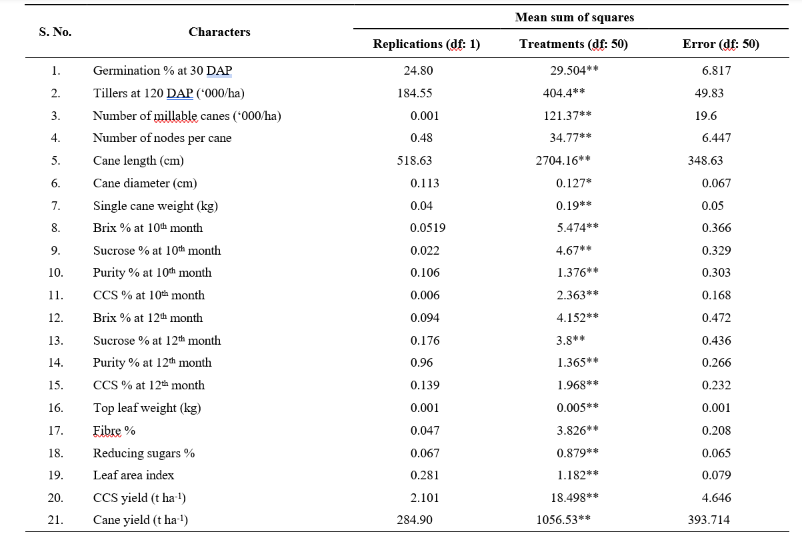
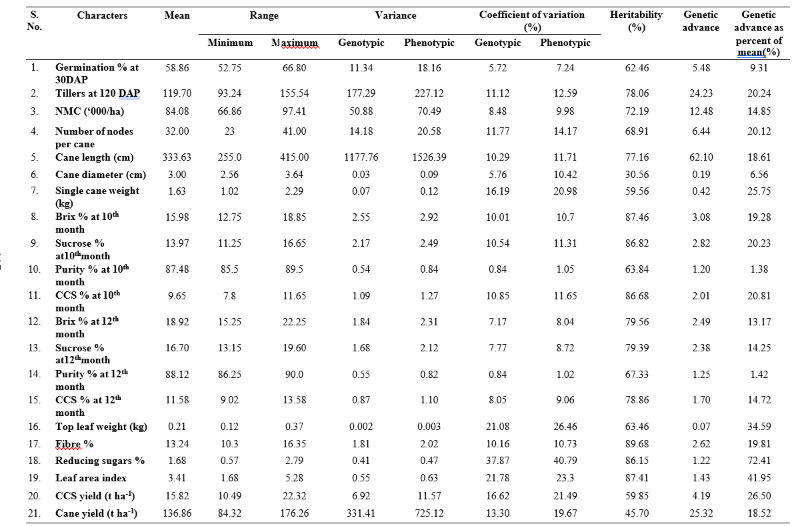
The results of analysis of variance (ANOVA) revealed significant differences among the genotypes for all the characters (table 1). The highest estimates of GCV and PCV were registered for top leaf weight, leaf area index, single cane weight, commercial cane sugar yield and reducing sugars per cent indicating greater variability. Moderate estimates of PCV and GCV were recorded for tillers at 120 DAP, number of nodes per cane, cane length, CCS yield, brix per cent and sucrose per cent at 10th month, fibre per cent and cane yield. Low estimates of GCV and PCV were recorded for the germination per cent at 30 DAP, cane diameter, number of millable canes and juice quality parameters like brix per cent, sucrose per cent, purity per cent, CCS per cent for 12th month and purity at 10th month. All the traits showed higher phenotypic coefficient of variation than genotypic coefficient of variation, indicating that environmental factors played a significant role in the inheritance of characters in sugarcane. These results are in accordance with the findings of Negi et al. (2017), Patil et al. (2023) and Navya et al. (2025) (table 2).
High heritability coupled with high genetic advance as per cent of mean was observed for tillers at 120 DAP, number of nodes per cane, sucrose per cent and CCS per cent at 10th month, top leaf weight, reducing sugars and leaf area index. This indicates that these characters are controlled by additive gene action. It was therefore suggested that preference should be given to the above characters in the selection programme to isolate superior lines for wholistic improvement in cane yield. A similar kind of gene action was reported by Gowda et al. (2016), Singh et al. (2020) and Navya et al. (2025). High heritability coupled with moderate genetic advance as per cent of mean was observed for number of millabile canes, cane length, brix per cent at 10th and 12th month, sucrose per cent and CCS per cent at 12th month and fibre per cent which indicates that the traits were controlled by both additive and non-additive gene action and these traits may respond favourably to selection and genetic improvement can be achieved through heterosis breeding. A similar kind of gene action was reported by Bora et al. (2014), Pandey et al. (2018) and Sailaja (2019). High heritability and low genetic advance was observed for germination per cent at 30 DAP, purity per cent at 10th and 12th month which indicates that the traits were controlled by non-additive gene action and selection for this trait is not effective. These results are in accordance with the findings of Ahmed et al. (2012) and Navya et al. (2025) (table 2).
The results of Analysis of variance (ANOVA) revealed significant difference in the mean sum of squares for all the characters under the study which indicates the presence of ample variability among all the clones. High heritability accompanied with high genetic advance as per cent of mean recorded for traits viz., tillers at 120 DAP, number of nodes per cane, sucrose per cent and CCS per cent at 10th month, top leaf weight, reducing sugars and leaf area index indicating the prevalence of additive gene action hence crop improvement could be achieved by simple selection of these traits.
Allard, R.W. 1960. Principles of Plant Breeding. John Wiley and Sons. Inc., New York. 485.
Bora, G.C., Goswami, P.K and Bordoloi, B.C. 2014. Studies on variability and character association in sugarcane (Saccharum spp.) under rainfed condition of North Eastern India. Direct Research Journal of Agriculture and Food Science. 2(5): 55-59.
Burton, G.W. 1952. Quantitative inheritance in grass. Proceedings of 6th International Grassland Congress. 1: 277-283.
Burton, GW., Devane, EH. 1953. Estimating heritability in tall fescue (Festuca arundinaceae) from replicated clonal material. Agronomy Journal. 45:478-481.
Anonymous. 2024. Report book of Agricultural statistics. Directorate of Economics and Statistics. Department of agriculture, Cooperation and Farmers welfare. New Delhi. 22-34.
Gowda S.N., Saravanan, K and Ravishankar, C.R. 2016. Correlation and path analysis for yield and quality attributes in Sugarcane. International Journal of Science Technology & Engineering. 3(2): 12-20.
Johnson, H.W., Robinson, H.F and Comstock, R.E. 1955a. Estimation of genetic and environmental variability in soybean. Agronomy Journal. 47: 314-318.
Navya, C., Sumathi, V., Tagore, K. R., & Vasanthi, R. P. (2025). A Study on Genetic Variability for Cane Yield and Its Component Characters in Mid-Late Clones of Sugarcane (Saccharum spp.). Journal of Advances in Biology & Biotechnology. 28(4): 10–19.
Negi, A.S., Sigh, S.P., Jeena, A.S and Talha, M. 2017. Estimation of variability parameters in early generation general collection progenies of sugarcane (Saccharum Species Complex). International Journal of Agriculture Innovations and Research.1(6): 2319-1473.
Pandey, V., Banerjee, N., Singh, A., Siraree, A., Singh, R and Kumar, S. 2018. Genetic diversity among popular varieties and promising genotypes of sugarcane (Saccharum spp. hybrid) using simple sequence repeat markers. Indian Technology. 33(02): 69-76.
Patil, P.P and Patel, D. 2017. Study of genetic variability and heritability in sugarcane (Saccharum spp. Complex). International Journal of Current Microbiology and Applied Sciences. 6(9): 3112-3117.
Sailaja, B. 2019. Genetic studies on early and midlate clones of sugarcane [Saccharum oficinarum L.] (Doctoral dissertation, Acharya NG Ranga Agricultural University, Guntur).
Singh, R., Kamat, D.N., Kumar, B., Kumari, P and Govindbhai, Z.R. 2020. Genetic Variability Analysis of Early Maturing Sugarcane (Saccharum oficinarum L.) Clones Using Morphological Characters. Current Journal of Applied Science and Technology. 39(26):105-112.