

0 Views
Department of Agronomy, ANGRAU-S.V. Agricultural College,Tirupati-517 502.
A field experiment was conducted during kharif 2024 at S.V. Agricultural College, Tirupati, to evaluate the yield and economic benefits of groundnut + millet intercropping systems. The experiment was laid out in randomized block design with ten treatments comprising of three millets viz., foxtail millet, finger millet and little millet with groundnut in the replacement series of 5:2 and 5:4 row proportion and their sole crops replicated thrice. Results showed that sole crop of groundnut recorded the highest pod (2295 kg ha⁻¹) and haulm yield (3016 kg ha⁻¹), while groundnut + finger millet (5:2) recorded the highest groundnut pod equivalent yield (2906 kg ha⁻¹) and economic returns (benefit: cost ratio of 2.76). Millet yields in intercropping systems were reduced due to competition, with the 5:4 row ratio yielding higher than the 5:2 ratio. The study concluded that groundnut + finger millet at 5:2 ratio is the most productive and economically viable intercropping system in Southern Agro- climatic zone of Andhra Pradesh.
KEYWORDS: Groundnut, foxtail millet, finger millet, little millet.
In the present day scenario, the greatest challenge is to meet the basic needs, such as food, fodder, fuel and fiber for the ever growing human and livestock population from the available land area. Agricultural production has to be increased to meet the expected demands for the world’s fast growing population. However, this increase must come from the existing cultivated land, as expansion opportunities are limited due to factors such as the conversion of farmland for non-agricultural uses, climate change and the decreasing availability of land for extensive agriculture. Given these constraints, the most viable solution lies in maximizing the use of time and space in agriculture through intensification and diversification strategies. These include practices such as relay cropping, crop rotation and intercropping of major crops with compatible species. Nevertheless, the success of intercropping depends on several factors, including seeding ratios, planting patterns, crop varieties, and the level of competition among component crops.
Intercropping mitigates agricultural risks by cultivating two or more crops simultaneously or within the same season in a single field, optimizing resource use compared to monocropping. The effectiveness of intercropping hinges on the choice of intercrops and their spatial arrangement, which influence productivity, competition, and nutrient absorption. Intercropping groundnut with fast growing, short duration crops like millets is a viable system that maximizes land, solar energy, and water use, ensuring profitability and stability while reducing crop failure risks. Legumes, with their deep root systems, access moisture and nutrients from deeper soil layers, avoiding competition with paired cereals. Additionally, groundnut fix nitrogen in the soil, sharing some with intercropped cereals, boosting growth even in nitrogen poor soils. Keeping the above facts in view, the present study was conducted to evaluate the yield and economic benefits of groundnut + millet intercropping system in the Southern Agro-climatic zone of Andhra Pradesh.
A field experiment was conducted at S. V. Agricultural College Dryland farm, Tirupati campus of Acharya N. G. Ranga Agricultural University, during kharif, 2024 to study the yield and economics of groundnut + millets intercropping system. The experimental site was loamy sand with soil pH (6.72), organic carbon (0.28 %), available nitrogen (183 kg ha-1), available phosphorus (28 kg ha-1) and available potassium (187 kg ha-1). The experiment was laid out in randomized block design comprising of three intercrops viz., foxtail millet (SiA-3159), finger millet (Vakula) and little millet (BL 6) with groundnut (Dharani) in 5:4 and 5:2 row proportion and their sole crops replicated thrice.
The treatments included in the experiment were T1 : Sole crop of groundnut, T2 : Sole crop of foxtail millet, T3 : Sole crop of finger millet, T4 : Sole crop of little millet, T5 : Groundnut + littlemillet (5:2), T6 : Groundnut + foxtail millet (5:2), T7 : Groundnut + finger millet (5:2), T8 : Groundnut + little millet (5:4) T9 : Groundnut + foxtail millet (5:4), T10 : Groundnut + finger millet (5:4).
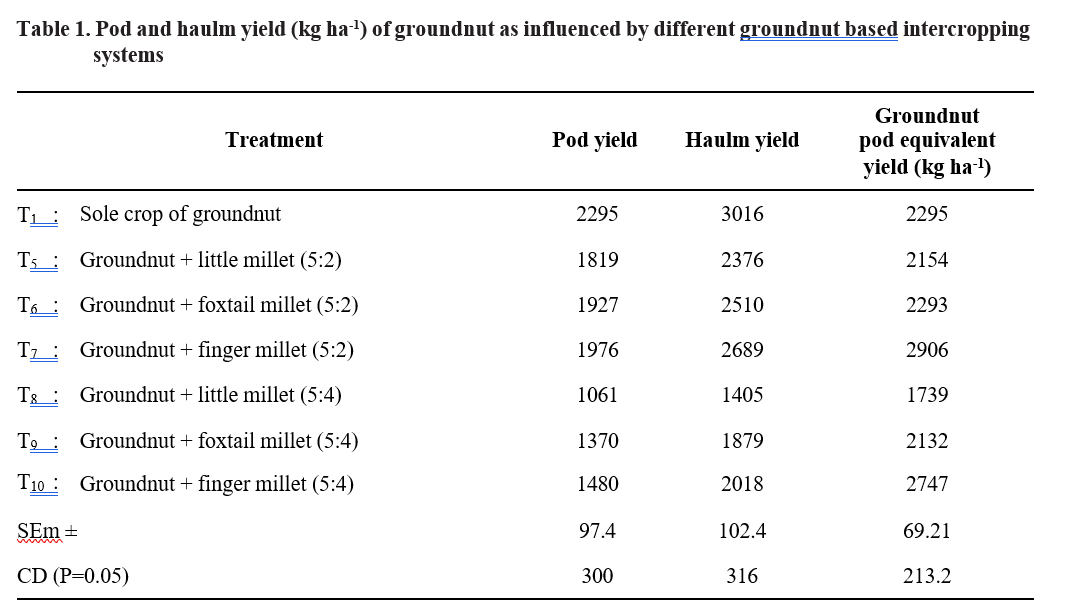
Significantly higher pod (2295 kg ha-1) and haulm yield (3016 kg ha-1) of groundnut was recorded in sole crop of groundnut (T1) compared to any other intercropping systems. This might be attributed to optimum plant densities and lower competition environment in sole crop compared to intercropping which have a positive and significant impact on growth parameters and yield attributes, that in turn increased the yield. These results were in conformity with the findings of Maitra et al. (2000), Shivaraj (2015), Shwethanjali et al. (2018), Lenka et al. (2023). Among the different intercropping systems, highest pod yield was obtained with groundnut + finger millet (1976 kg ha-1) at 5:2 row proportions, which was on par with groundnut + foxtail millet (1927 kg ha-1) at 5:2 row proportion and groundnut + little millet (1819 kg ha-1) at 5:2 row proportion. Among the different intercropping systems, highest haulm yield was obtained with groundnut + finger millet (2689 kg ha-1) at 5:2 row proportion, which was on par with groundnut + foxtail millet (2510 kg ha-1) at 5:2 row proportion and groundnut
+ little millet (2376 kg ha-1) at 5:2 row proportion (Table 1). This increase in the haulm yield could be attributed due to higher plant population maintained in the sole crop along with least competition offered, which have increased the vegetative growth in turn the haulm yield. The highest groundnut pod equivalent yield was recorded in the intercropping system of groundnut + finger millet (5:2) (T7) which is on par with groundnut + finger millet (5:4) (T10) due to the additional advantage of foxtail millet yield and higher groundnut yield along with intercrop due to better complementary relationship.
Whereas lower pod, haulm and groundnut pod equivalent yield was recorded in groundnut + little millet (5:4) (T8). The results corroborate the findings of Shivakumar and Yadahalli (1995), Maitra et al. (2000), Shwethanjali et al. (2018) and Lenka et al. (2023).
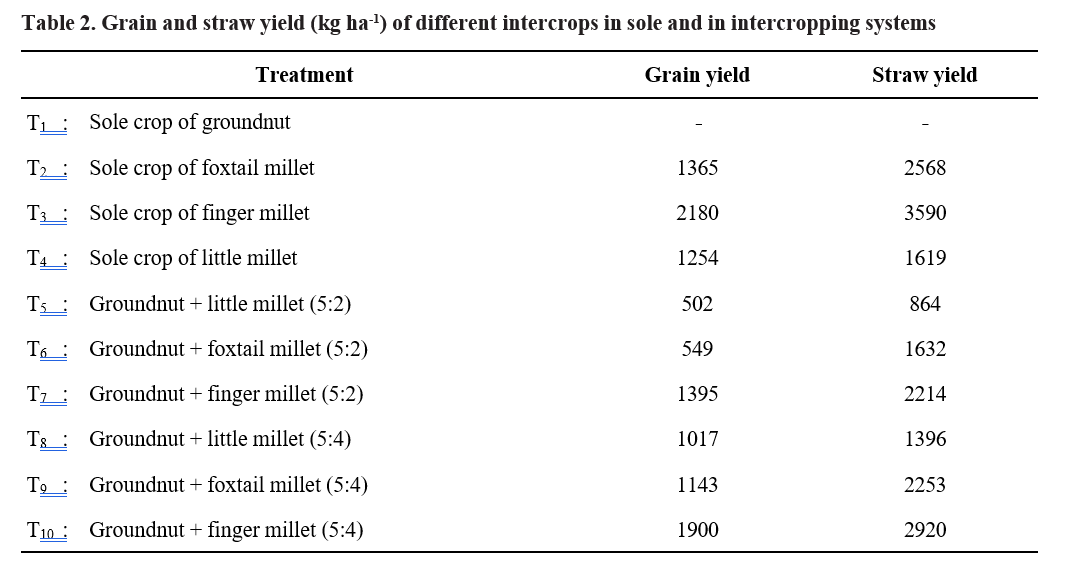
In the intercropping system, both grain and straw yields of millets were lower at both row ratios compared to sole cropping. Higher yields in sole cropping likely resulted from the absence of interspecific competition, with only intraspecific competition and a full plant population. Competition from groundnut for natural resources also hindered millet development in the intercropping system. Among the intercropping treatments, the 5:4 row ratio of groundnut + millets yielded higher grain and straw compared to the 5:2 ratio, primarily due to an additional millet row, greater spacing between millet rows, improved light availability, efficient resource use, and balanced intra and interspecific competition (Table 2). These factors enhanced yield attributing parameters, likely contributing to the increased yield. These results were in agreement with studies of Manjunath and Salakinkop (2017), Shwethanjali et al., (2018) and Lenka et al. (2023).
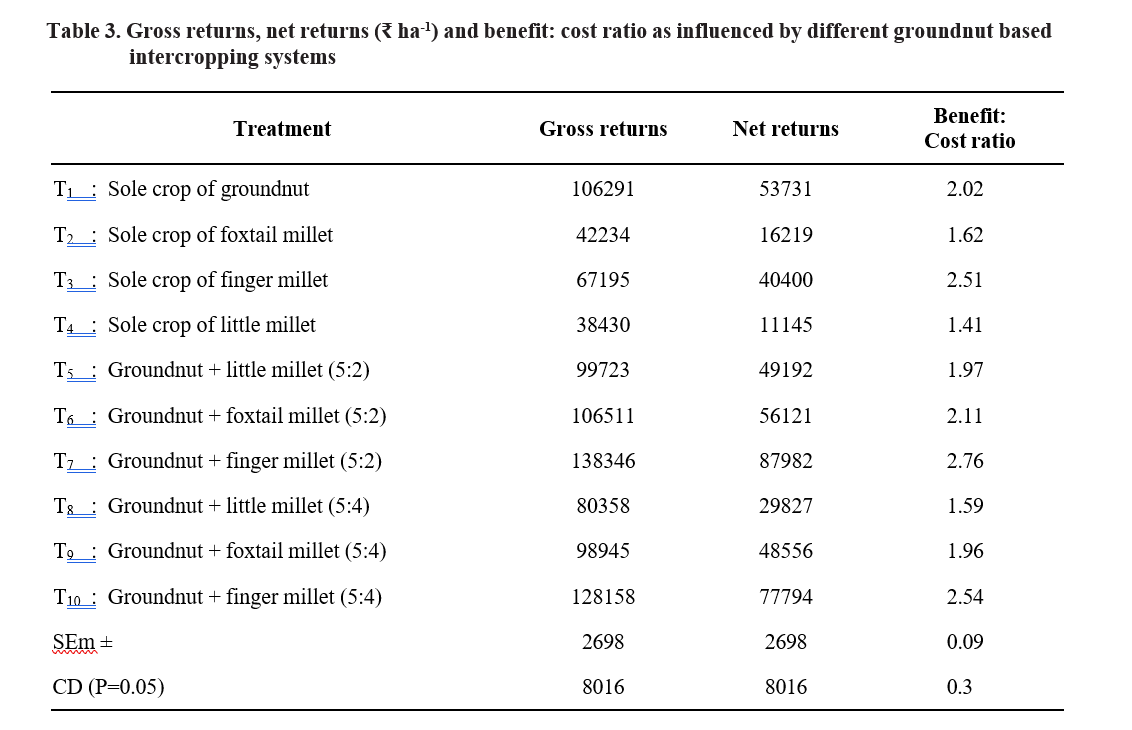
Among the different treatments, groundnut + finger millet (5:2) (T7) generated significantly higher gross and net returns, along with a superior benefit: cost ratio, followed by groundnut + finger millet (5:4) (T10). This was mainly due to higher price and yield of groundnut. While the sole crop of little millet (T4) registered the lowest gross returns, net returns, and benefit: cost ratio. These results were in agreement with studies of Manjunath and Salakinkop (2017), Shwethanjali et al., (2018) and Lenka et al. (2023).
The present study clearly indicates that intercropping of groundnut + finger millet at a 5:2 row proportion is found to be the best intercrop for getting higher yield and economic advantage in Southern Agro-climatic zone of Andhra Pradesh.
Shivakumar, B.G and Yadahalli, Y.H. 1995. Economics of intercropping in finger millet under late sown dryland conditions. Farming Systems. 1(1-2): 1-7.
Maitra, S., Ghosh, D.C., Sounda, G., Jana, P.K and Roy, D.K. 2000. Productivity, competition and economics of intercropping legumes in finger millet (Eleusine coracana) at different fertility levels. Indian Journal of Agricultural Sciences. 70(12): 824-828.
Shivaraj, D.H. 2015. Intercropping of groundnut with minor millets on alfisols of northern transition zone of Karnataka. M.Sc. (Ag.) Thesis. University of Agricultural Sciences, Dharwad, Karnataka.
Manjunath, M.G and Salakinkop, S.R. 2017. Growth and yield of soybean and millets in intercropping systems. Journal of Farm Sciences. 30 (3): 349-353.
Shwethanjali, K.V., Naik, A.H.K., Naik, T.B and Kumar, M.D. 2018. Effect of groundnut-based millets intercropping system on growth and yield of groundnut (Arachis hypogaea L.) under rainfed condition. International Journal of Agricultural Sciences. 10(17): 7033-7034.
Lenka, S., Swain, S.K and Pradhan, K.C. 2023. Performance of different groundnut (Arachis hypogaea L.) based intercropping systems with millets under rainfed condition of Odisha. Legume Research-An International Journal. 46(2): 154 159.