

0 Views
Institute of Agribusiness Management, ANGRAU-S.V. Agricultural College, Tirupati-517 502.
India’s edible oil sector has seen a paradigm shift in consumer preferences, particularly with increasing awareness about the health implications of chemically refined oils. Cold-pressed oils, retaining natural nutrients and processed without heat or chemicals are gaining popularity. This study examines the awareness levels and consumer preferences towards cold-pressed oils in Guntur district of Andhra Pradesh. Based on a primary survey of 120 respondents from Guntur and Tenali, the study analyzes socio-economic profiles, awareness sources, oil preferences and willingness to recommend or shift to cold-pressed oils. Results show that while awareness is high (100%), actual adoption remains limited (20.83%). Preferences are driven by perceived health benefits (70%), taste (41.67%) and traditional beliefs (35%). Key awareness sources include family (43.33%) and social media (21.66%). The study concludes that strategic awareness campaigns and affordable pricing could significantly improve consumer adoption of cold-pressed oils in semi-urban markets.
KEYWORDS: Cold-pressed oils, consumer awareness, preferences, health benefits, guntur, traditional oil use.
India is one of the major producers and consumers of edible oils, with a rich tradition of cultivating diverse oilseed crops and utilizing traditional extraction techniques Sridevi and Ranjani, (2022). In recent years, there has been a notable shift in consumer preferences from chemically refined oils to healthier alternatives such as cold-pressed oils Kanimozhi and Hariharan, (2023). Cold-pressed oils are extracted mechanically without the application of heat or chemicals, thereby retaining natural nutrients, antioxidants and the original aroma and flavor of the oil Krishnaveni et al., (2022). This has led to increasing consumer interest, especially among health-conscious individuals.
Despite the growing awareness regarding the nutritional benefits of cold-pressed oils, their consumption remains limited in many regions due to factors such as high price, limited availability, low brand visibility and lack of trust in unbranded products Devi and Rao, (2021); Kethavath et al., (2021). The Indian edible oil market is largely dominated by refined oils owing to their affordability, longer shelf life and strong market penetration Santhoshi and Kodali, (2022). Nevertheless, the demand for traditional, chemical free products is on the rise, especially in the post-pandemic period where food safety and immunity have gained importance Simhasanam et al., (2024).
Andhra Pradesh, particularly Guntur district, holds significant potential for the promotion of cold-pressed oils due to its substantial production of oilseeds such as groundnut and sesame. Government initiatives like the PMFME (Pradhan Mantri Formalisation of Micro Food Processing Enterprises Scheme) scheme and NABARD (National Bank for Agriculture and Rural Development)
-supported processing units have encouraged cold-pressed oil production in this region. However, the consumer base is still evolving and their preferences, awareness levels and behavioural patterns remain underexplored Kethavath et al., (2021).
Given this background, the present study was undertaken to assess consumer awareness and preferences, adoption behaviour and understand the barriers limiting the adoption of cold-pressed edible oils in Guntur district of Andhra Pradesh.
The study followed a descriptive research design to assess consumer awareness, preferences, adoption behaviour and constraints related to the adoption of cold-pressed edible oils in Guntur district of Andhra Pradesh.
The study was conducted in Guntur district, focusing on Guntur city and Tenali due to their active edible oil markets and presence of cold-pressed oil units under the PMFME scheme. Using simple random
sampling, 120 respondents were selected 60 from each town, based on their role in household oil purchases. Data were collected through structured, pre-tested interviews using a questionnaire with closed ended and Likert scale items. Secondary data from official sources supported the analysis Devi and Rao, (2021; Kanimozhi and Hariharan, (2023). Frequencies and percentages described socio-economic traits, while the Likert scale assessed consumer attitudes. Garrett’s ranking method identified key adoption barriers. Data were analyzed using Microsoft Excel.
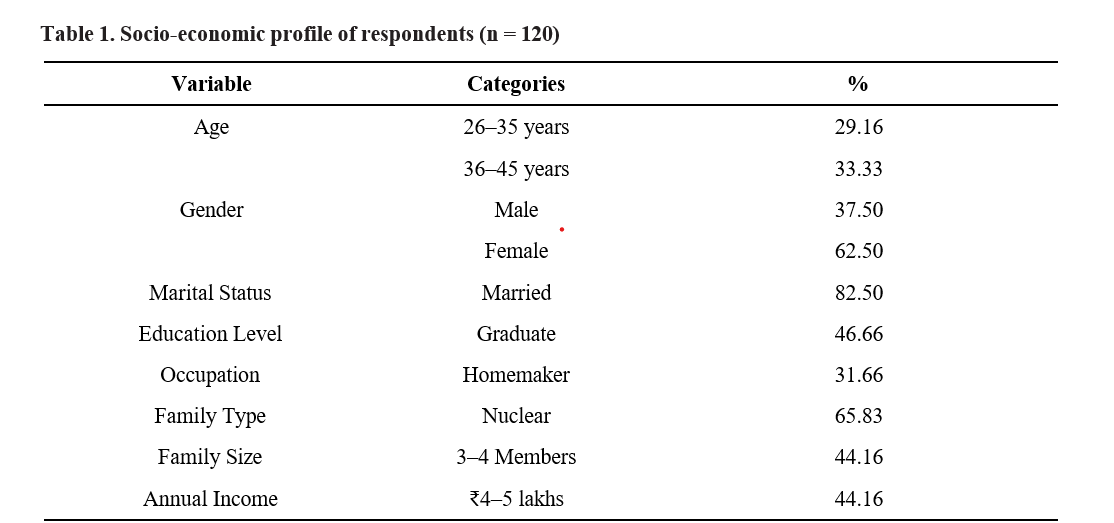
Table 1 presents the socioeconomic profile of respondents in Guntur district of Andhra Pradesh Santhoshi and Kodali, (2022); Simhasanam et al., (2024). Among the 120 respondents surveyed, the majority (33.33%) were aged between 36–45 years, followed by those aged 26–35 years (29.16%). Women comprised
62.5 per cent of the sample and most participants were married (82.5%). Educationally, 46.66 per cent were graduates and 12.51 per cent held postgraduate degrees, indicating a moderately educated consumer group.
Regarding occupation, 31.66 per cent were homemakers, followed by private employees (27.51%). The dominant family structure was nuclear (65.83%) and most households had 3–4 members (44.16%). In terms of income, 44.16 per cent of the respondents earned between ₹4–5 lakhs annually. These findings suggest that middle-income, educated women in nuclear families are central to household food decisions, making them key targets for health-oriented products like cold-pressed oils.
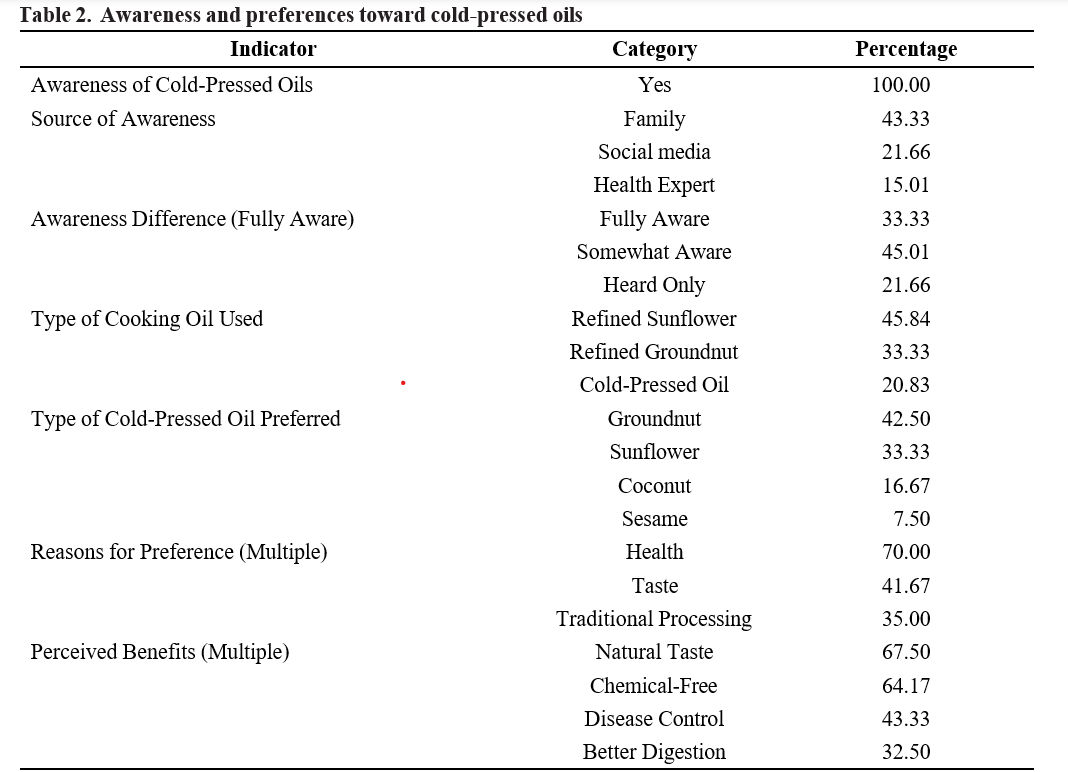
The details of awareness and preference levels of the respondents toward cold pressed oils are depicted in Table 2. It can be observed that all respondents were aware of cold-pressed oils, with family members (43.33%) and social media (21.66%) being the leading sources of information. However, only 20.83 per cent were current users. Awareness levels varied, with 33.33 per cent fully aware of the differences between refined and cold-pressed oils, 45.01 per cent somewhat aware and 21.66 per cent having only heard about them. The most commonly used cooking oil was refined sunflower oil (45.84%), followed by refined groundnut oil (33.33%). Among cold-pressed oil users, groundnut (42.5%) and sunflower (33.33%) were preferred, reflecting strong regional and cultural preferences. Health benefits (70%) emerged as the primary reason for choosing cold-pressed oils, followed by taste (41.67%) and belief in traditional processing methods (35%). Perceived benefits included natural taste (67.5%) and chemical-free composition (64.17%), while digestion improvement and disease control were also noted. These findings are consistent with those reported by Krishnaveni et al. (2022) and Simhasanam et al. (2024), who observed health and tradition as primary drivers for cold-pressed oil usage.
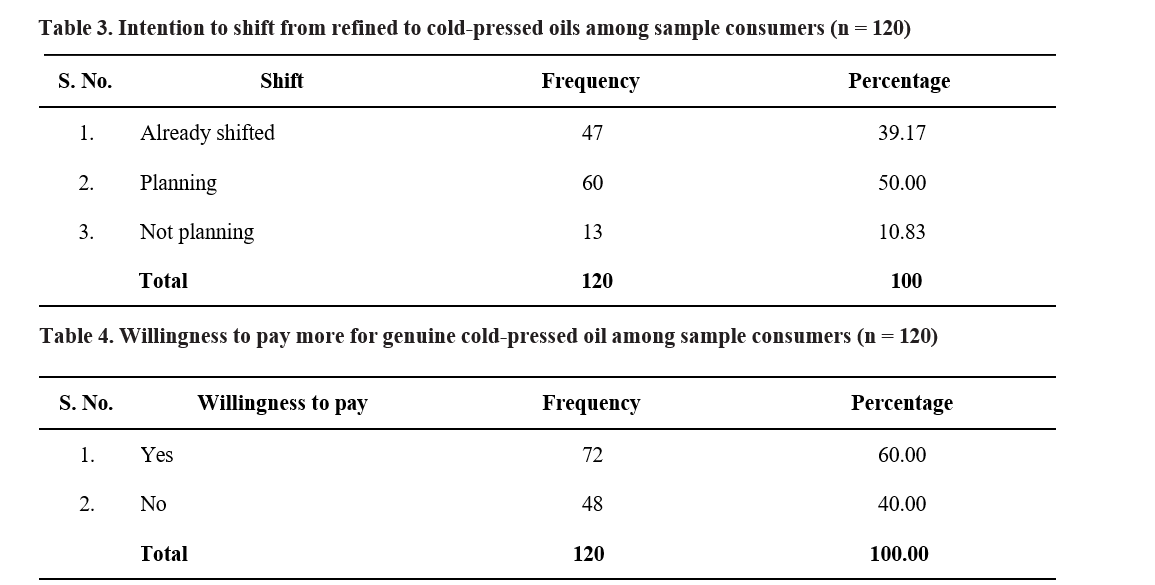
While 39.17 per cent had already shifted to cold-pressed oils, 50 per cent were planning to shift, indicating strong future potential as shown in Table 3. These results clearly suggest a positive consumer mindset and growing inclination towards adopting cold-pressed oils in the near future Simhasanam et al., (2024).
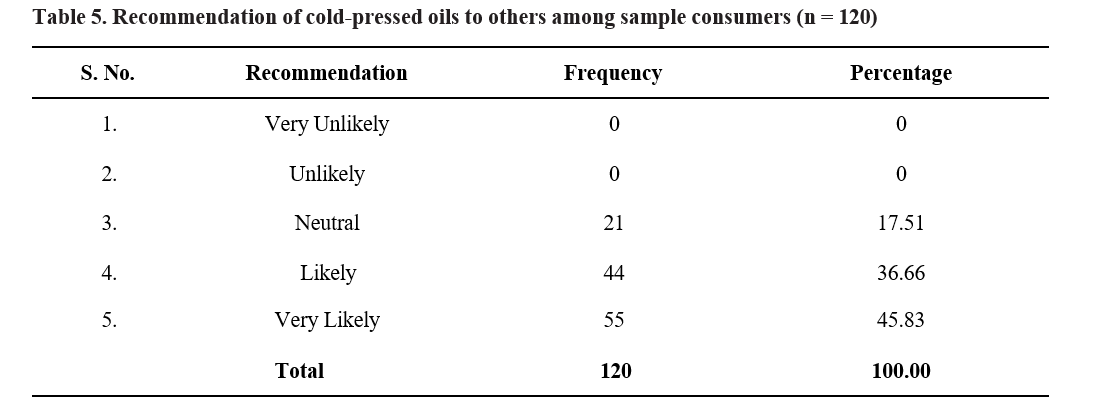
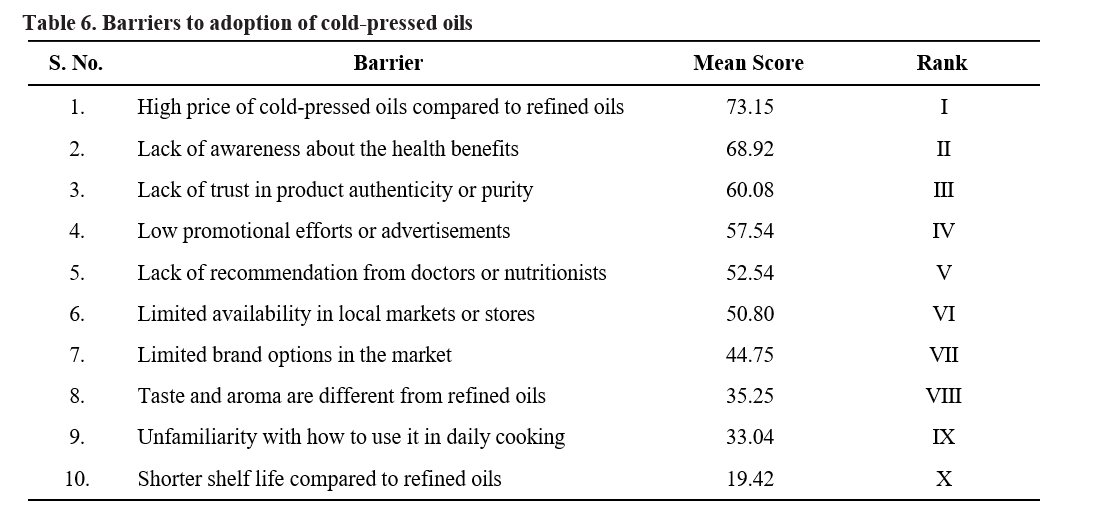
Additionally, 60 per cent of the respondents expressed a willingness to pay more for genuine, high-quality cold-pressed oils as in Table 4, reflecting a positive perception of the product’s health benefits and authenticity. Furthermore, 80 per cent were likely or very likely to recommend cold-pressed oils to others in Table 5, indicating a strong potential for word-of-mouth promotion. However, price remained a key concern, as indicated by its top rank in the Garrett ranking of adoption barriers in Table 6, suggesting it is perceived as the most significant constraint by consumers. These findings point to the need for pricing strategies, consumer education and smaller, affordable packaging to drive wider adoption.
Using Garrett’s ranking technique, ten key barriers were identified. High price emerged as the most significant constraint with a mean score of 73.15, followed by lack of awareness about health benefits (68.92) and low trust in product authenticity (60.08) Devi and Rao (2021) and Santhoshi and Kodali (2022). Other constraints included inadequate promotion, limited availability in local stores and lack of expert recommendations. Interestingly, factors such as taste, aroma and shorter shelf life were ranked lower, suggesting that consumers are more concerned with price, trust and information access than with product characteristics. This highlights the need for consumer education, affordable pricing strategies and quality assurance mechanisms to enhance adoption.
The study revealed that consumers in Guntur district have a fair level of awareness about cold-pressed oils, primarily influenced by family networks and social media. Despite this awareness, actual usage remains limited due to price sensitivity, partial knowledge of health benefits and doubts regarding product authenticity Devi and Rao, (2021; Kethavath et al., (2021). Educated, middle-income women in nuclear families emerged as the key decision-makers in edible oil purchases, indicating a focused target segment for market expansion.
Health consciousness and traditional processing methods were the major factors influencing preference towards cold-pressed oils. However, the high cost, inadequate promotion and limited market access continue to hinder wider adoption. The contradiction between perceived value and price resistance reflects the need for strategic interventions.
Devi, R and Rao, P. 2021. Consumer awareness and adoption patterns of cold-pressed oils in South India. South Indian Journal of Agricultural Economics, 9(2): 41–49.
Kanimozhi, A and Hariharan, R. 2023. Consumer awareness and preferences for cold-pressed oils in Indian households. Indian Journal of Agricultural Marketing, 37(1): 19–27.
Kethavath, P., Pagadala, R and Anuhya, B. 2021. Cold-pressed oils in semi-urban Andhra Pradesh: A consumer study. South Indian Journal of Agricultural Marketing, 10(3): 55–64.
Krishnaveni, A., Devi, V. and Ranjani, S. 2022. Nutritional and sensory perceptions of cold-pressed oils in southern India. Indian Journal of Traditional Knowledge, 21(4): 602–610.
Santhoshi, G and Kodali, R. 2022. Urban-rural divide in cold-pressed oil adoption. Journal of Agricultural Marketing Research, 13(1): 78–88.
Simhasanam, S., Pranitha, K. and Yamini, G. 2024. A study on consumer perception of cold-pressed oils in Hyderabad. Journal of Consumer Studies. 12(2): 88–95.
Sridevi, K. and Ranjani, S. 2022. Traditional oil use in Indian kitchens. Asian Journal of Home Science. 17(1): 25–30.