0 Views
Department of Agricultural Extension Education, ANGRAU-Datt Centre, Paderu-531 024.
The application of Information and Communication Technologies (ICTs) in agriculture has revolutionized information dissemination and decision-making among farmers and extension personnel. This study explores the role of mobile applications as digital tools in modern agriculture, with a special focus on the ANGRAU-DAATTC mobile app developed to deliver crop-specific best practices in English and Telugu. The increasing penetration of smartphones and mobile internet in rural India presents an opportunity to bridge information gap and improve farm productivity and livelihoods. Mobile technology is transferring access to information by many folds. New apps are also emerging as per the need and requirements of the user. It is very important to be selective in choosing the app ensuring its credibility and information source. Development and dissemination of agriculture mobile app should provide accurate, validated content and services across the globe. So, mobile app DAATTC is considered to be one of the important app for farmer, extension functionaries, scientists etc. It contains package of practices of field crops in english and telugu in word, audio and video formats for the benefit of farmers, extension functionaries, scientists etc. The information is compiled very well organized for the clientele without wasting of time. It can be downloaded from online store from any smartphone by typing ANGRAU-DAATTC.
KEYWORDS: Smartphone, ANGRAU-DAATTC, app, agriculture.
Agriculture, the backbone of India’s economy, faces several challenges including knowledge gaps, access to timely inputs, weather uncertainties, and market price volatility. ICTs have emerged as transformative tools, helping farmers access critical information in real-time. Among ICT tools, mobile phones especially smartphones have proven to be game changers. Their capabilities extend beyond voice communication to include internet browsing, multimedia sharing, GPS-based services, and mobile applications.
This paper explores the evolution of ICTs in agriculture, the growing relevance of mobile apps, and presents a case study on ANGRAU-DAATTC, an agricultural app developed to serve the information needs of farmers and stakeholders across Andhra Pradesh.
Information and Communication Technologies (ICTs) are playing a transformative role in agriculture, especially in disseminating timely and relevant information to farmers and extension personnel. ICTs have the potential to bridge the information gap in rural areas by providing advanced services related to inputs, weather forecasts, market trends, pest management, and more. Tools like mobile phones, information kiosks, Kisan Call Centres (KCC), Kisan TV, Common Service Centres (CSCs), computers, and precision farming technologies have made agricultural knowledge more accessible.
Mobility has become the most widely used method of data transfer, offering a powerful platform for voice communication, applications, and online services. Among these, mobile applications (apps) have emerged as one of the most effective tools for delivering information directly to end users. The agriculture sector is steadily moving towards digitalization—from sowing to harvesting, and even to the post-harvest stage. Mobile phones, especially smartphones, are rapidly evolving and proving to be invaluable in improving rural livelihoods by connecting previously unconnected populations.
Mobile apps have become essential tools for farmers, assisting them throughout the crop production cycle. These apps offer real-time updates on weather conditions, input availability, market prices, expert consultations, pest/disease alerts, and more. As a result, farmers are empowered to make informed decisions that enhance crop productivity, reduce cultivation costs, and improve their overall income and livelihoods.
Initially designed for basic computing tasks such as email and weather updates, mobile apps now serve diverse sectors like commerce, banking, tourism, and health. However, agriculture still lags behind other sectors in terms of mobile app development (Costopoulou et al., 2016).
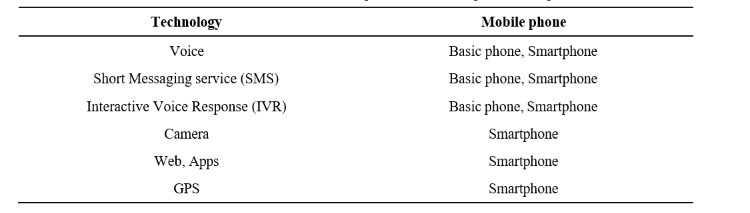
Mobile phones are two types viz., Basic phones and Smartphone. The following table illustrates the features of a mobile phone.
The ANGRAU-DAATTC app is available for free on the Google Play Store and is compatible with all Android smartphones. Upon downloading, users must register by providing their name, mobile number, village, mandal, and district. The content is offered in text, audio, and video formats, ensuring ease of access and understanding.
The app includes content related to crop management practices, soil requirements, pest control, water and
For effective agricultural communication, information must be accurate, timely, and reliable. While there are numerous agricultural apps, verifying the credibility and scientific validity of their content is essential.
To cater to the growing need for reliable agricultural information, the ANGRAU-DAATTC mobile application was developed. This app serves farmers, extension workers, scientists, NGOs, and other stakeholders by providing packages of practices for various crops in both english and telugu.
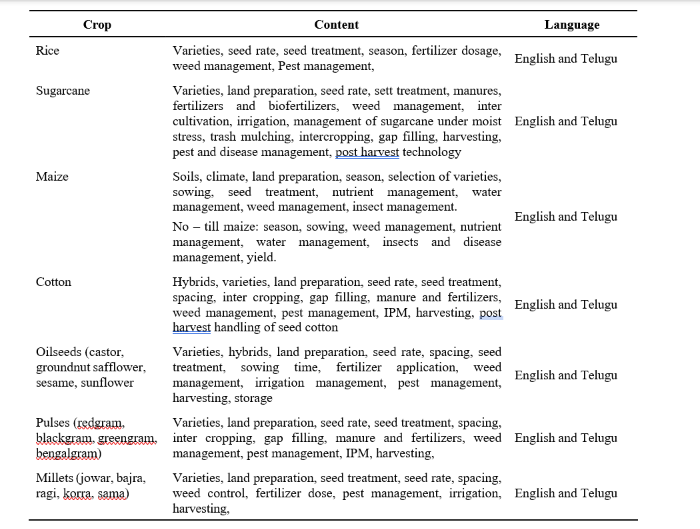
The ANGRAU-DAATTC mobile app was developed as a bilingual platform (English and Telugu) containing comprehensive packages of practices for major crops cultivated in Andhra Pradesh. The app includes content in text, audio, and video formats and can be downloaded from the Google Play Store. Upon installation, the user registers by entering personal and location-specific information.
fertilizer management, and harvesting techniques. The following table summarizes the content offered for key crops:
The app provides comprehensive information on crop management, soil and climate compatibility, rainfall patterns, and usage of farm machinery. Content is well-structured and easily accessible, ensuring farmers can retrieve the required information quickly and efficiently. Studies by Rossi et al. (2014) and Kirk et al. (2011) affirm that digital tools like ANGRAU-DAATTC facilitate evidence-based decision-making and reduce time spent searching for scattered information.
According to the Boston Consulting Group (2016), nearly 300 million rural Indian consumers were projected to be online by 2020, with more than half of them from rural areas. This highlights the importance of mobile platforms in reaching India’s farming communities. Furthermore, the World Bank (2012) emphasized the advantages of mobile phones in terms of affordability, widespread ownership, voice functionality, and efficient service delivery.
Accessibility: Easy download and registration
Content Diversity: Text, audio, and video formats for better understanding
Localization: Availability in regional language (Telugu)
User-Centric Design: Tailored for farmers, extension agents, NGOs, and scientists
Mobile applications have become a cornerstone of modern agricultural extension. ICTs, particularly mobile applications, are redefining agricultural extension and advisory services in India. Mobile apps like ANGRAU-DAATTC offer reliable, timely, and locally relevant information, empowering farmers to make data-driven decisions. With continued smartphone penetration and government support for digital agriculture, tools like ANGRAU-DAATTC can significantly enhance farm productivity and rural livelihoods.
Boston Consulting Group. (2016). The Rising Connected Consumer in Rural India.
Costopoulou, C., Ntaliani, M., & Karetsos, S. (2016). Mobile apps for agriculture. Journal of Agricultural Informatics.
Rossi, R., et al. (2014). Decision support systems for agriculture: A case study. Computers and Electronics in Agriculture.
World Bank. (2012). ICT in Agriculture: Connecting Smallholders to Knowledge, Networks, and Institutions.
Kirk, N., et al. (2011). Managing knowledge for agricultural innovation.