

0 Views
Institute of Agribusiness Management, ANGRAU-S.V. Agricultural College, Tirupati-517 502.
This study examined the satisfaction levels and adoption factors of tissue culture banana (TCB) cultivation among farmers in Annamaya and Nandyala districts of Andhra Pradesh. TCB is favored for its disease-free planting material, uniform growth and higher yield potential. Most farmers expressed high satisfaction with yield performance and fruit quality, though concerns remained regarding pest resistance and limited access to subsidies. Satisfaction was measured using a 5-point Likert scale and Principal Component Analysis (PCA) was applied to 20 key statements. The analysis revealed seven major components influencing adoption, accounting for (64.72%) of the total variance. Key factors included uniform harvest, disease resistance, economic viability and institutional facilitation. The findings indicate that while the technical benefits of TCB are strong motivators, adoption decisions are also significantly shaped by structural aspects such as training, market linkages and subsidy delivery. Farmers are more likely to continue with TCB when both agronomic and institutional supports are present. Therefore, a balanced approach combining technology with robust support systems is essential for the sustainable success of TCB cultivation.
KEYWORDS: Tissue culture banana, farmers satisfaction, adoption factors, likert scale, principal component analysis.
Banana (Musa spp.) is one of the most important fruit crops in India, contributing significantly to food security, nutrition and rural livelihoods. Andhra Pradesh is among the leading banana-growing states, where the crop serves as a major source of income for farming households. Traditionally, banana cultivation has relied on sucker propagation; however, this method often results in non-uniform growth, disease transmission and lower productivity.
Tissue culture banana (TCB) technology has emerged as an effective alternative by providing disease-free, genetically uniform and high-yielding planting material. Studies by (Anyango et al., 2010) and (Kabunga et al., 2012) reported that tissue culture banana cultivation improves productivity, fruit quality and farm income. Similarly, (Flarian et al., 2018) highlighted the role of tissue culture technology in enhancing banana production and profitability. Due to these advantages, the adoption of tissue culture banana has increased in several banana growing regions.
Despite its benefits, adoption of tissue culture banana is influenced by various socio-economic, institutional and technical factors. (Thuo et al., 2017) and (Omari et al., 2023) reported that education, extension support, market access and access to credit significantly affect adoption decisions. (Wanyama et al., 2016) emphasized the importance of quality planting material and institutional support, while (Mulugo et al., 2019) found that social influence and farmer innovativeness positively influence technology adoption. However, constraints such as high plantlet costs, inadequate technical knowledge and limited support services continue to hinder wider adoption (Shukla et al., 2018; Bairwa et al., 2015).
Although tissue culture banana cultivation is gaining popularity in Andhra Pradesh, limited information is available regarding farmers’ satisfaction and the factors influencing its adoption in the Rayalaseema region. Therefore, the present study was undertaken in Annamaya and Nandyala districts of Andhra Pradesh to assess farmers’ satisfaction with tissue culture banana cultivation and identify the key factors influencing its adoption.
The study was conducted in Annamaya and Nandyal districts of Andhra Pradesh, targeting 120 purposively selected farmers with experience in tissue culture banana (TCB) cultivation.
Data were collected through a structured interview schedule covering satisfaction levels and factors influencing TCB adoption. Satisfaction was measured using a 5-point Likert scale across seven key areas and Chi-square test was conducted to examine the association between the source of plantlets and satisfaction with the availability of plantlets
To identify adoption factors, Principal Component Analysis (PCA) was performed on 20 statements. KMO and Bartlett’s tests ensured data suitability and components with eigenvalues over 1 were retained using Varimax rotation.
This non-parametric test helps to determine whether a statistically significant relationship exists between two variables.

Where:
χ2 = Chi-Square statistic
O = Observed frequency (from your actual data)
E = Expected frequency r = number of rows
c = number of columns df = degrees of freedom
To identify the underlying various factors that impact farmers decisions to cultivate tissue culture banana, exploratory factor analysis was conducted. This technique grouped related variables into a smaller set of independent factors using Principal Component Analysis (PCA) with Varimax rotation. Only factors with eigenvalues greater than 1 were retained. Kaiser-Meyer-Olkin (KMO) and Bartlett’s test of sphericity were used to verify the adequacy of the sample for factor analysis.
Let
x1,x2,….,xp = observed variables
loadings suggest a stronger association of the variable with the respective factor.
Eigenvalues reflect the amount of variance in the data explained by each factor. Only factors with eigenvalues greater than 1 are usually retained for further analysis, as they represent substantial underlying patterns.
Factor rotation is the process of adjusting the factor axes to achieve a simpler and more interpretable structure. In this study, Varimax rotation, an orthogonal method, was used to obtain uncorrelated and distinct factors.
KMO measures the adequacy of the sample size for factor analysis. It ranges from 0 to 1, with values above
0.6 generally considered acceptable for proceeding with factor extraction.
This test checks whether the correlation matrix is significantly different from an identity matrix, which would imply that the variables are related and suitable for factor analysis. A significance level (p-value) less than 0.05 indicates that factor analysis is appropriate.
Communality refers to the proportion of each variable’s variance that can be explained by the extracted factors.
A correlation matrix shows the pairwise correlations between all the observed variables used in the analysis. It is the basis for identifying variables that can be grouped together under common factors.
Principal Component Analysis (PCA) is a multivariate statistical technique used for reducing the dimensionality of large datasets while preserving as much variability as possible.
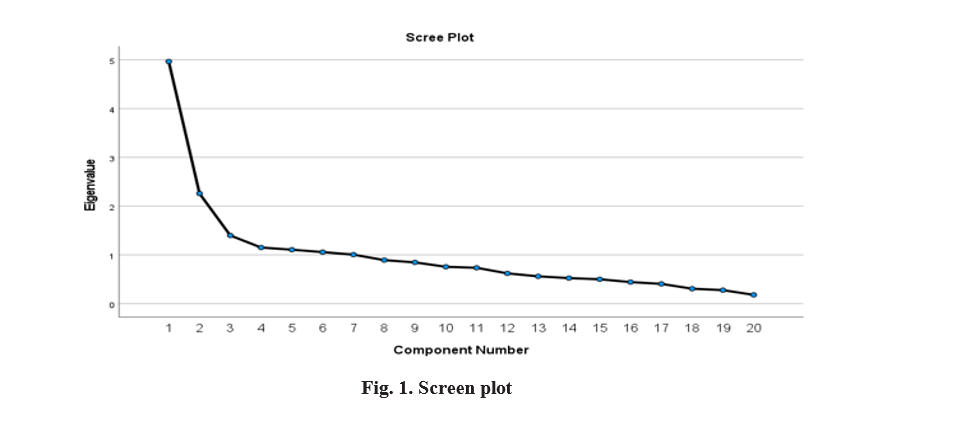
A scree plot visually represents the eigenvalues of each factor in descending order. It helps in determining the number of factors to retain by identifying the point where the curve flattens (the “elbow”).
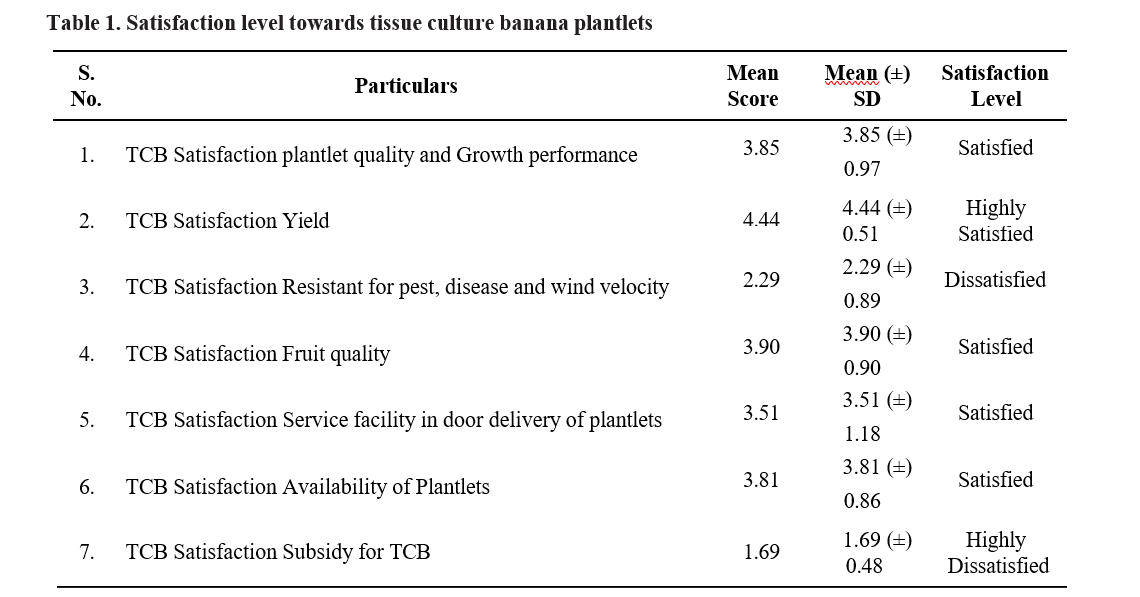
The respondents were asked to express their level of satisfaction on various aspects of tissue culture banana (TCB) plantlets using a 5-point Likert scale, Ranging from Highly Dissatisfied (1) to Highly Satisfied (5). The satisfaction scores were then averaged to determine the overall perception of farmers. The results were presented in Table 1. These findings are similar to the results of (Omari et al., 2024)
The results of the satisfaction analysis revealed a generally positive perception of TCB technology among the respondents. The highest satisfaction was recorded for yield performance (Mean score = 4.44), followed by fruit quality (3.90), plantlet quality and Growth performance (3.85), availability of plantlets (3.81), Service facility in door delivery of plantlets (3.51),
Resistant for pest, disease and wind velocity (2.29), Subsidy for TCB (1.69).
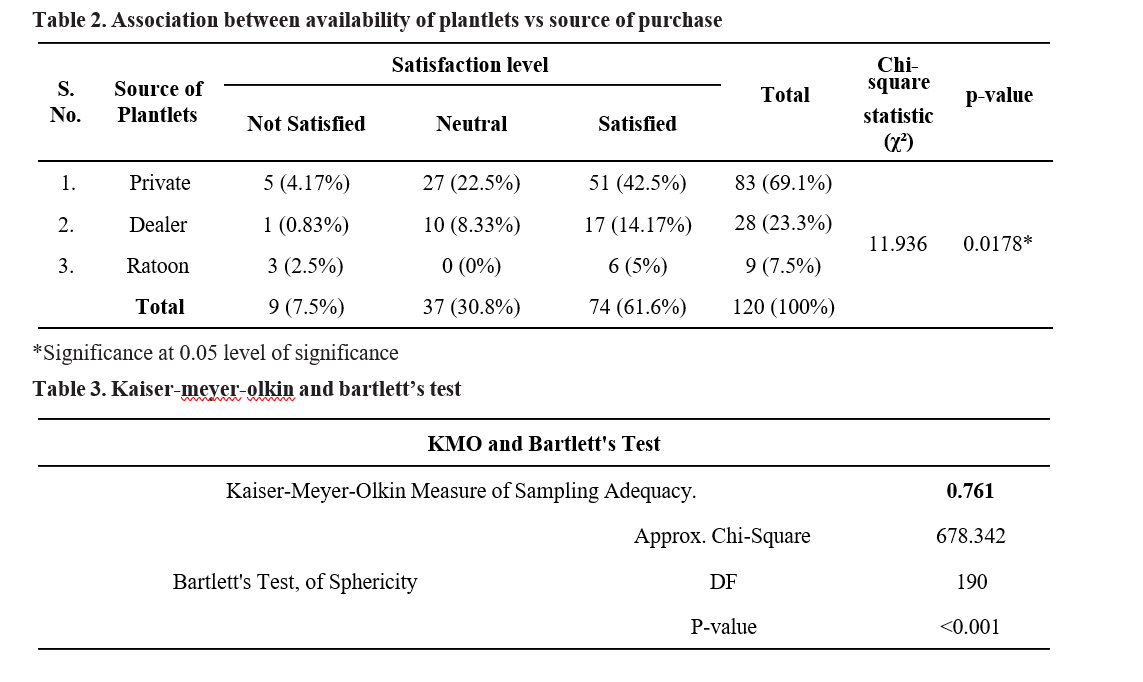
The chi-square test result showed in Table 2 indicated that p-value 0.0178 at 5 per cent level of significance suggest that satisfaction scores were significantly associated with variables such as availability of plantlets and source of plantlets, suggesting that external support mechanisms influence user experience.
From Table 3 The KMO value of 0.761 confirmed the adequacy of the sample for PCA. Bartlett’s Test of Sphericity was significant at 1 per cent level of significance, indicating that correlations among items were sufficient for dimensional reduction.
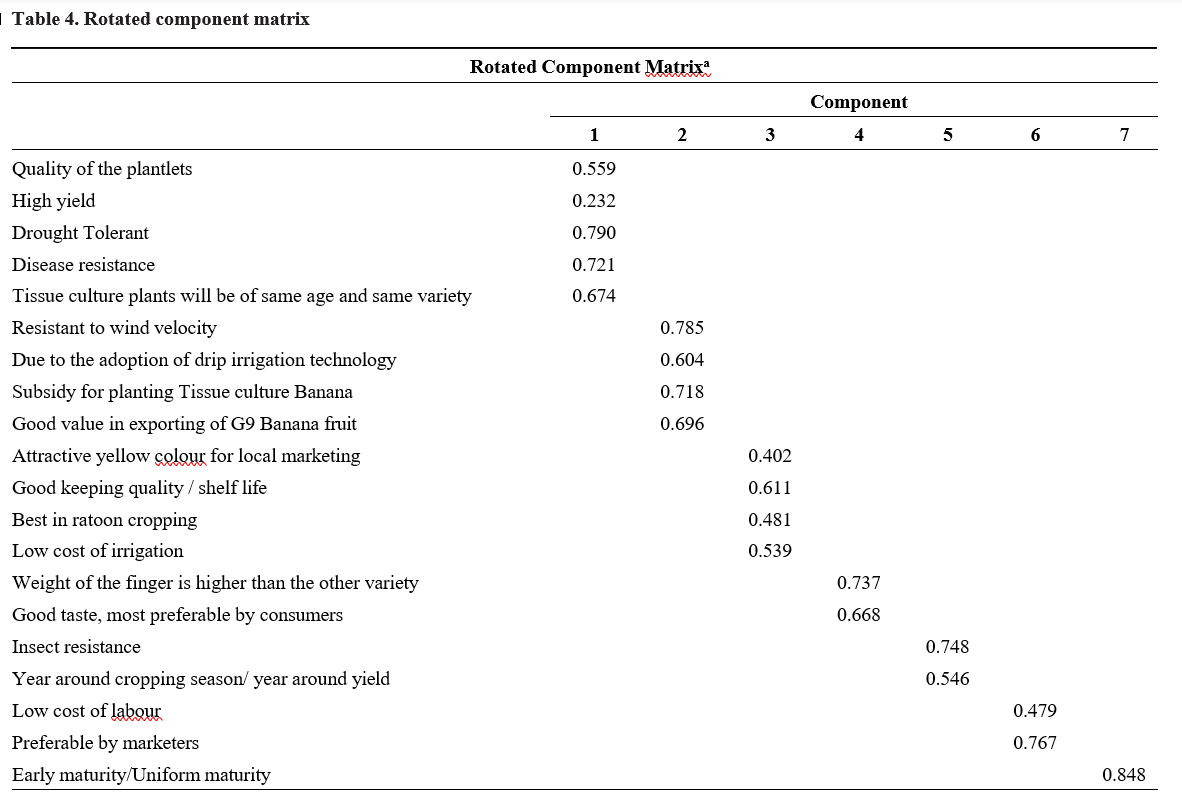
The rotated component matrix displays the loading values for each variable related to the factors influencing farmers’ decisions to grow tissue culture banana. Based on these factor loadings, the variables were grouped into seven distinct decision-driving categories, as illustrated in Table 4.
The variables extracted from each benefit column were grouped according to their factor loadings in Table5.
From The extracted seven factors benefits that are driven by farmers are ranked and listed in Table 6.
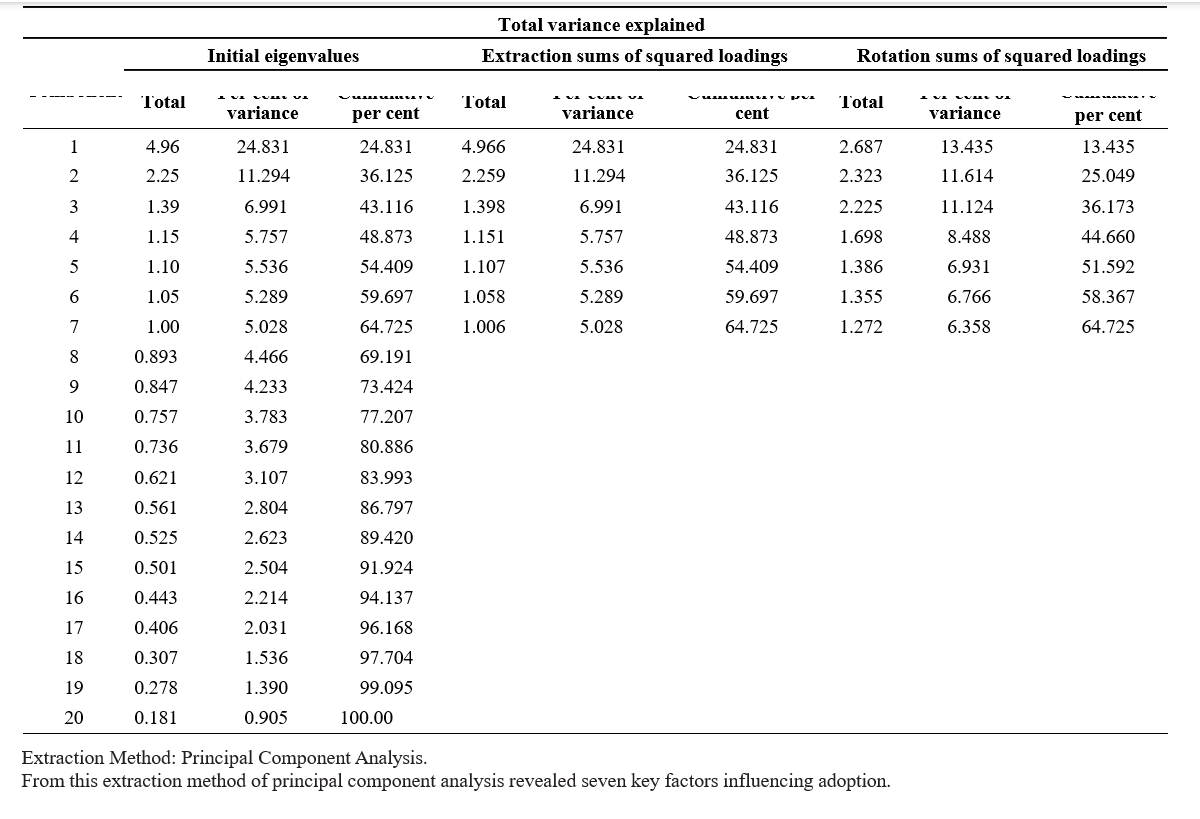
A total of seven principal components were extracted, explaining 64.72 per cent of the total cumulative variance.
Uniform and Early Harvest, with a mean score of 4.01 was identified as a major perceived benefit, indicating that farmers highly value the consistency in crop maturity and the ability to plan harvests and market sales more efficiently.
Crop Protection and Year-round Production, with a mean score of 3.79 emerged as another key benefit, highlighting farmers’ appreciation for stress tolerance, disease resistance, and the capability of the crop to produce across all seasons.
Extraction Method: Principal Component Analysis. Rotation Method: Varimax with Kaiser Normalization.a
According to Table 4, the rotated component matrix reveals seven key factors influencing farmers’ decisions to grow tissue culture banana.
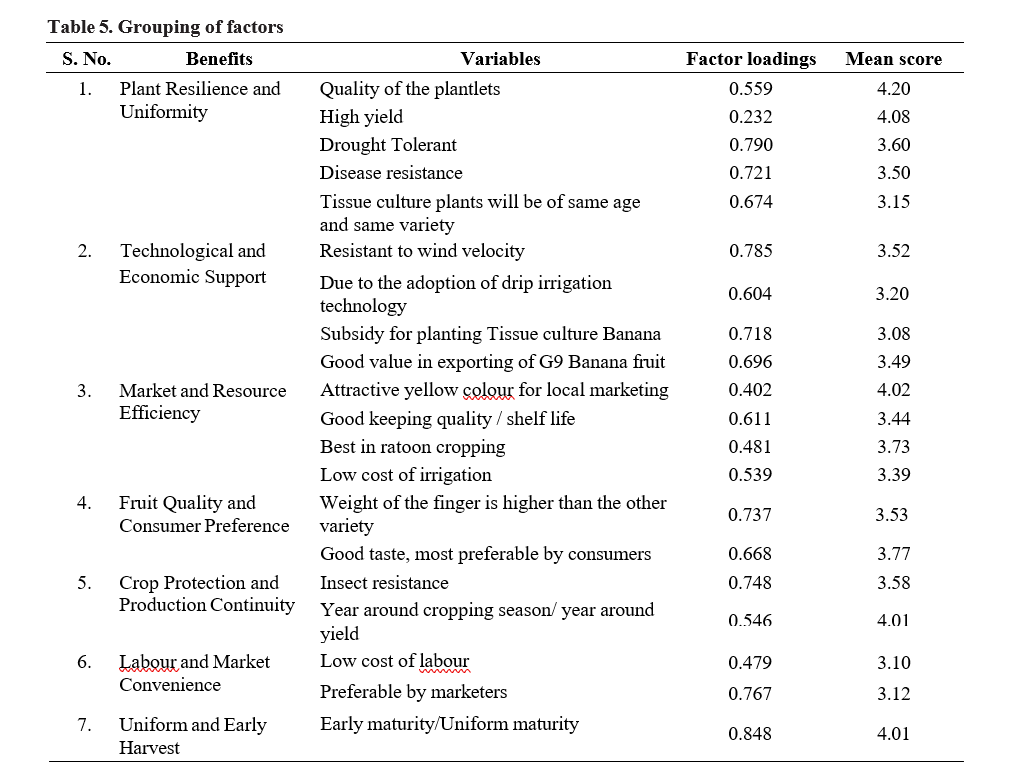
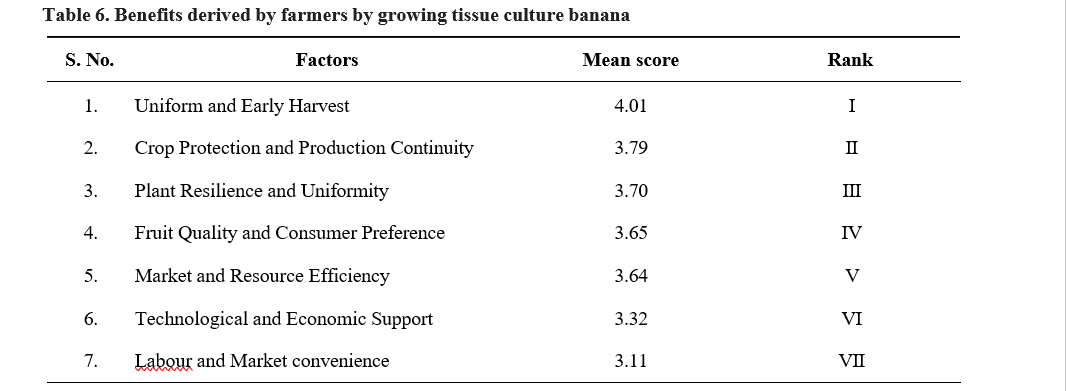
Table 7. Principal component analysis
Plant Resilience and Consistency, with a mean score of 3.70 reflects farmers’ recognition of the high quality of tissue culture plantlets, uniform growth patterns, and improved crop stand in the field.
Fruit Quality and Market Preference, which recorded a mean score of 3.65 captures the importance given to desirable physical traits such as fruit appearance, size, and overall consumer acceptability in the market.
Economic Viability and Input Efficiency, with a mean score of 3.64 highlights the perceived benefits related to reduced input needs, extended shelf life, potential for ratoon cropping, and enhanced overall profitability.
Institutional Support and Market Opportunities, scoring a mean of 3.32 represents the influence of factors such as access to government subsidies, linkage to export markets, integration with drip irrigation, and training support.
Labour and Distribution Ease, which had a mean score of 3.11 points to benefits related to reduced harvest labour, improved transportability, and better access to distribution and logistics channels.
Using SPSS software, Principal Component Analysis (PCA) was applied to extract underlying factors from 20 statements intended to identify key influences on the farmers decision to grow tissue culture banana. As shown in the Component Matrix, SPSS initially extracted all variables however, based on the eigenvalue criterion (greater than one), seven components were ultimately retained. The Extraction Sums of Squared Loadings column indicated that these seven components together explained around (64.72%) of the total variance values are presented in Table 7.
Scree plot was, used to determine the appropriate number of factors to retain. It serves as a visual representation eigenvalue versus all the benefits. The point of interest is a place where the curve begins to flatten and the graph plotted is explained in Fig.1.
It was clear from Fig.1. that the curve begins to flatten from seventh factor were 20 variables extracted were analyzed for further research.
The above findings show that while agronomic and economic factors play a dominant role in TCB adoption, institutional and logistical parameters are also crucial. Particularly, the factor “Institutional Support and Market Opportunities” scored lower, signalling a weak linkage between farmers and enabling institutions.
The study shows that farmers generally accept tissue culture banana (TCB) for its consistent yields, early harvests and good fruit quality. While most were satisfied with its agronomic benefits, challenges like pest issues, limited subsidies and weak extension support especially for marginal farmers remain concerns.
Principal Component Analysis revealed seven key factors influencing adoption, highlighting both biological performance and institutional support. For wider and sustained adoption, it’s essential to strengthen areas like pest management, timely input delivery and policy support. A balanced approach combining technology, infrastructure and government backing is crucial to expand TCB adoption across diverse regions.
Anyango, J.J., Wambugu, F.M., Nkanya, J., Kyalo, G., and Onyango, C. 2010. Introduction of tissue culture banana technologies and their impact on producer wellbeing. Acta Horticulturae. 87(9): 767–772.
Bairwa, K.C., Singh, A., Jhajaria, A., Singh, H., Goyam, B.K., Lata, M. and Singh, N. 2015. Conventional sucker with tissue culture banana production in Central India-A case study. African Journal of Agricultural Research. 10(14): 1751-1755.
Flarian, M.M., Frederick, A.O., Julius, M.T., & John, W. 2018. Farmer-based dynamics in tissue culture banana technology adoption: A socio-economic perspective among small holder farmers in Uganda. African Journal of Agricultural Research. 13(50): 2836-2854.
Kabunga, N. S., Dubois, T. and Qaim, M. 2012. Yield effects of tissue culture bananas in Kenya: accounting for selection bias and the role of complementary inputs. Journal of Agricultural Economics. 63(2): 444-464.
Mulugo, L., Birungi Kyazze, F., Kibwika, P., Kikulwe, E., Omondi, A. B. and Ajambo, S.2019. Unravelling technology acceptance factors influencing farmer use of banana tissue culture planting materials in Central Uganda. African Journal of Science, Technology, Innovation and Development. 12(4): 453–465.
Omari, E.N., Mucheru-Muna, M., Mburu, B.K., and Odawa, A.A. 2024. Assessing the advantages of tissue culture bananas technology production of banana farmers in Kisii County, Kenya. Environmental Challenges. 14: 100843.
Shukla. A.P., Patel. M.R and Chauhan. N.B. 2018. Constraints faced by the farmers and suggestions given by them to overcome constraints for adoption of tissue culture technology in banana. Gujarat Journal of Extension Education: 29(11).
Singh, O.P. 2024. Factors influencing adoption of tissue culture banana (TCB) technology among banana farmers in chitwan district, Nepal. NPI Journal of Science and Technology. 1(1): 2 – 13.
Thuo, C.N., Nguluu, S.N., and Kisangau, D.P. 2017. Socio-economics factors affecting adoption of tissue culture bananas in the semi-arid areas of lower eastern region of Kenya. International Journal of Life Sciences Research. 5(3): 164-172.
Tumaini, S., Ghahula, R., and Macha, S. 2024. The influence of observability on the adoption of tissue culture banana seedlings in Tanzania. ESI Preprints (European Scientific Journal, ESJ). 26: 305-305.
Wanyama, J.M., Obare, G.A., Owuor, G and Wasilwa, L. 2016. Assessing the determinants of tissue culture Banana adoption in Western Kenya. African Journal of Food, Agriculture, Nutrition and Development. 16(1): 10738-10760.