
0 Views
Department of Agricultural Extension Education, ANGRAU-S.V. Agricultural College,Tirupati-517 502.
The present study was carried out to assess the profile of farmers utilizing drone technology application in Anantapuramu and Nandyal districts of Rayalaseema region of Andhra Pradesh over a randomly drawn sample of 120 respondents. The results revealed that majority of farmers were in the middle age (61.67%), completed high school (33.33%), had small farm size (33.33%), medium level of annual income (79.17%), social participation (55.83%), extension contact (53.33%), mass media exposure (70.00%), innovativeness (64.17%) and scientific orientation (67.50%).
KEYWORDS: Profile, drone technology application.
Drones also known as Unmanned aerial vehicles (UAVs) have emerged as transformative tools in agriculture revolutionizing traditional farming practices by offering precision farming solutions. Drones have been considered to be part of the industry 4.0 ecosystem in India. According to industry estimates, currently over 3000 drones are being utilized in the Indian agriculture sector, which is expected to rise over 7000 by 2025. The Indian agricultural drone market is anticipated to achieve a value of US$ 14,237.6 million by 2033, with a market growth rate of 14.10 per cent CAGR during the forecasted period (Source: Fortune Business Insight, 2023) As agriculture faces challenges like climate change, labour shortage and increased food demand, there is need for incorporating novel technologies such as smart farming and precision agriculture. This study aims to investigate the profile of farmers in utilizing or adoption of drone technology application in agriculture.
The present study was conducted by following exploratory research design. Two districts viz., Anantapuramu and Nandyal districts of Rayalaseema region of Andhra Pradesh were selected based on the frequency and availability of drones. Two mandals were selected from each district thus making a total of four mandals i.e., Bukkarayasamudram, Singanmala, Banaganapalli and Nandikotkur where significant number of sprayings had been carried out by farmers in these areas. From each of the selected mandals three villages were selected through simple random sampling procedure thus making a total of twelve villages from two districts. From the twelve villages selected, 10 drone users from each village were selected by simple random sampling procedure thus making a total of 120 drone users. After a thorough review of literature and consultations with experts a set of 9 variables were selected. The data was collected through a structured interview schedule and analyzed using mean and standard deviation for drawing meaningful interpretations.
The respondents were distributed based on their selected profile characteristics and the results were presented in the Table.
The data in Table shows that the majority (61.67%) of drone users were from the middle age group, followed by old age (37.50%) and only a small proportion (0.83%) from the young age group. This trend can be attributed to middle-aged farmers’ greater experience, familiarity with technology and better access to resources, which help them make informed decisions about adopting drone technology. While some older farmers were open to new technologies, others faced challenges such as limited technological familiarity or resistance to change and some had already handed over their land to successors. The low percentage of young farmers may be due to their pursuit of diverse career opportunities outside agriculture. These findings align with those of Manjunath (2014).
It could be inferred from Table that (33.33%) of drone users were educated up to high school, followed by illiterate (28.33%), middle school (19.17%), college level and above (10.83%), primary school (7.50%) and functionally literate (0.83%). The table indicates that most of the respondents had attained high school education, with fewer pursuing college education. This trend may be attributed to improved educational facilities, better transport and increased access to schools in villages, enabling more individuals to pursue higher levels of education. Those with higher education are generally better equipped to understand and adopt advanced technologies like drones, as their background aids in grasping drone operations and integrating them into farming. Similar findings were reported by Manjunath (2014).
An outlook from the Table inferred that 33.33 per cent of the drone users had small farm size followed by marginal (20.00%), large (20.00%), semi medium (15.00%) and medium farm size (11.66%). This trend likely occurred because small farmers (2.5 to 5 acres) represented a middle ground where land size was sufficient to benefit from drone use, yet still manageable for individual investment, especially if supported by affordable services or government schemes. Both marginal farmers (up to 2.5 acres) and large farmers (above 10 acres) each made up 20.00 drone users of drone users, but their motivations differed. Similar findings were reported by Kamaraddi (2011) and Bharatkumar et al. (2024).
It is evident from the Table that 79.17 per cent of the drone users had medium annual income followed by low (10.83%) and high (10.00%). The predominance of medium-income farmers suggests a relatively stable financial base among respondents, likely supported by diversified income sources such as crop cultivation, livestock and off-farm employment. This group typically has moderate landholdings, better access to agricultural inputs and active market participation, allowing them to meet household needs and invest modestly in their operations. Similar findings were reported by Gabriel (2014).
An overview of Table indicated that 55.83 per cent of the drone users had medium level of social participation, followed by low (25.00%) and high (19.17%) levels of social participation. The table shows that social participation among drone users varies significantly, with over half falling into the medium category, indicating moderate involvement in community activities and benefiting from networking and information exchange. Less than one-third have low social participation, likely due to socio-economic constraints or limited interest in joining groups, with only a few involved in self-help groups or the gram panchayat. These results were in accordance with Puri et al. (2017) and Omega (2020).
It was clearly evident from Table that 53.33 per cent of the drone users had medium level of extension contact followed by high (24.17%) and low (22.50%) levels of extension contact. According to the data, most farmers (53.33%) reported a moderate level of contact with extension services, typically through occasional visits from extension officers and village agricultural assistants, as well as informal interactions with input dealers and peers. A smaller group (24.17%) had high extension contact, marked by active engagement, strong institutional connections and regular participation in activities at Krishi Vigyan Kendras. The results were in congruence with the findings of Thangaraja et al. (2008), Rakesh (2010) and Satish (2010).
It was clearly evident from Table that 70.00 per cent of the drone users had medium level of mass media exposure followed by low (18.33%) and high (11.67%) levels of mass media exposure. The study considered farmers’ exposure to various mass media sources such as radio, newspapers, television, farm publications and the internet. The majority (70.00%) of farmers had a medium level of mass media exposure, largely due to widespread smartphone ownership and active use of platforms like YouTube for agricultural information. Some continued to use traditional media like radio. Farmers with high mass media exposure (11.67%) typically had better resources, higher education, larger landholdings and greater access
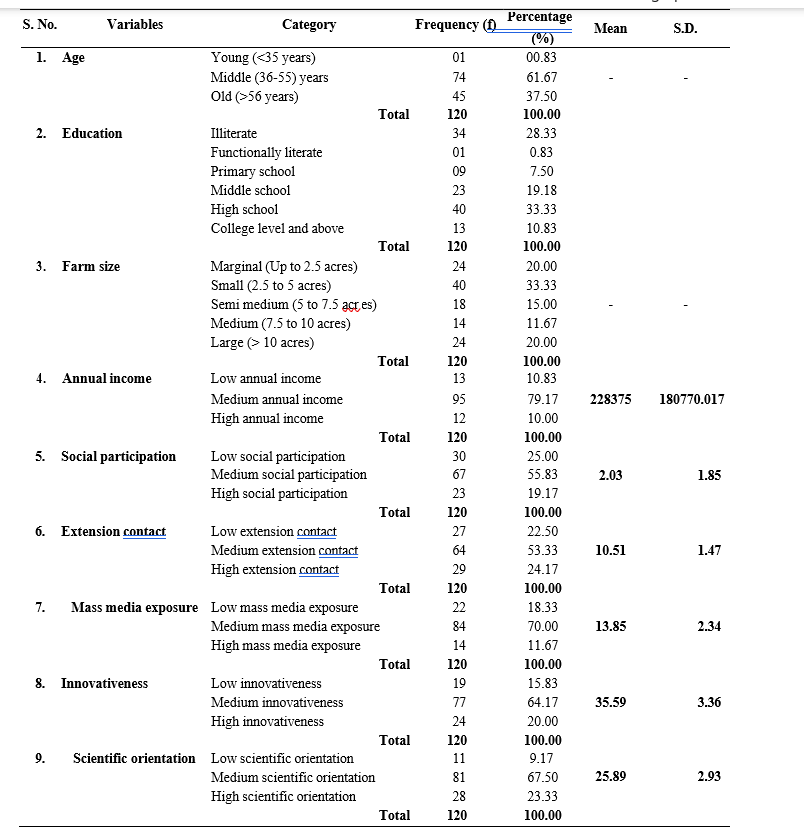
to digital platforms and extension services, enabling them to adopt modern practices more readily. Similar findings were reported by Kamaraddi (2011).
An overview of Table indicated that 64.17 per cent of the drone users had medium level of innovativeness, followed by high (20.00%) and low (15.83%) levels of innovativeness respectively. The study found that most drone users demonstrated a medium level of innovativeness, indicating moderate openness to new technologies, willingness to take calculated risks and the ability to update their knowledge and skills. This was likely due to their exposure to information, moderate social participation, and ability to balance traditional and modern practices. A smaller group of highly innovative farmers were early adopters, eager to use drone technology to improve their farming, while those with low innovativeness were often limited by insufficient resources, lack of awareness or low risk tolerance, making them less likely to adopt new technologies. Some users remained resistant to change, preferring traditional methods over new innovations. This finding was in agreement with the findings of Manjunath (2014).
An overview of Table indicated that 67.50 per cent of the drone users had medium level of scientific orientation, followed by high (23.33%) and low (9.17%) levels of scientific orientation respectively. Table shows that over half of the drone users had a medium level of scientific orientation, likely due to their educational background. This moderate scientific mindset, supported by exposure to innovations through Krishi Vigyan Kendras (KVKs), private agencies and peer networks, helped farmers adopt drone technology and improve productivity. Similar findings were reported by Puri et al. (2017) and Akhila (2023
The results revealed that the majority of the variables belonged to the middle to high-level category, indicating a moderate level of exposure to various factors that could influence adoption, utilization and also further promotion. Specifically, the study showed that most farmers were middle-aged, had attained a moderate level of education and possessed small to medium-sized farms. Moreover, the farmers exhibited medium levels of annual income, social participation, extension contact, mass media exposure, innovativeness and scientific orientation. These findings suggested that the farmers in the study area had a considerable potential for adopting drone technology application but required further training and support to enhance their skills and knowledge. To facilitate effective adoption the government support is crucial including subsidies for drone technology acquisition, practical demonstrations, hands-on training offer realistic and context-specific guidance on integrating drone technology application into existing agricultural practices and implement promotional initiatives to raise awareness about the benefits and potential of drone technology in agriculture.
Akhila, P. 2023. Awareness and adoption of precision dairy farming in eastern Haryana. Ph.D Thesis. National Dairy Research Institute, Karnal.
Bharathkumar, R., Selvanayaki, S., Deepa, N., Kannan, P and Prahadeeswaran, M. 2024. Impact of drone technology on agriculture: Farmers’ perception analysis. Plant Science Today. 11(4): 01–07.
Fortune Business Insight. 2023. “Agriculture drone market size, share and regional forecast, 2023-2030”. Retrieved from https://www.fortunebusinessinsights. com/agriculture-drones-market 102589.
Gabriel, S., A. 2014. comparative analysis on precision farming technologies in selected crops of north eastern Karnataka. M.Sc. (Ag.) Thesis. College of Agriculture, Raichur University of Agricultural Sciences.
Kamaraddi, P. 2011. Entrepreneurial behaviour of pomegranate growers in Koppal district of Karnataka. M.Sc. Thesis (Unpub.). Acharya N. G. Ranga Agricultural University, Hyderabad.
Manjunath, B. K. 2014. A study on perception of precision farming by the farmers. M.Sc. Ag. Thesis. University of Agricultural Sciences, Dharwad.
Omega, Selorm. 2020. Maize farmers acceptance and willingness to pay for drone services for the control of fall Armyworm in Northern Ghana. PhD Thesis., University of Cape Coast, 2020.
Puri, V., Nayyar, A and Raja L. 2017. Agriculture drones: A modern breakthrough in precision agriculture. Journalof StatisticsandManagementSystems.20(4): 507-518: DOI: 10.1080/09720510.2017.1395171.
Rakesh, K. 2010. Precision farming in sugarcane –A diagnostic Study. Unpub. M.Sc. (Ag.) Thesis. Agricultural College and Research Institute, Tamil Nadu Agricultural University, Madurai.
Satish, H., S. 2010, Farmers perceptions, preferences and utilization of Sri and Traditional paddy Straw for livestock, M. Sc. (Agri.) Thesis. University of Agricultural Sciences Dharwad, Karnataka (India).
Thangaraja, K., Sasikala, R., and Ravichandran, V. 2008. Perception on critical technology adopted by vegetable growers under precision on farming –An overview. Journal of Extension Education. 24(2): 4813-4818.