

0 Views
Department of Plant Pathology, ANGRAU-S.V. Agricultural College, Tirupati-517 502.
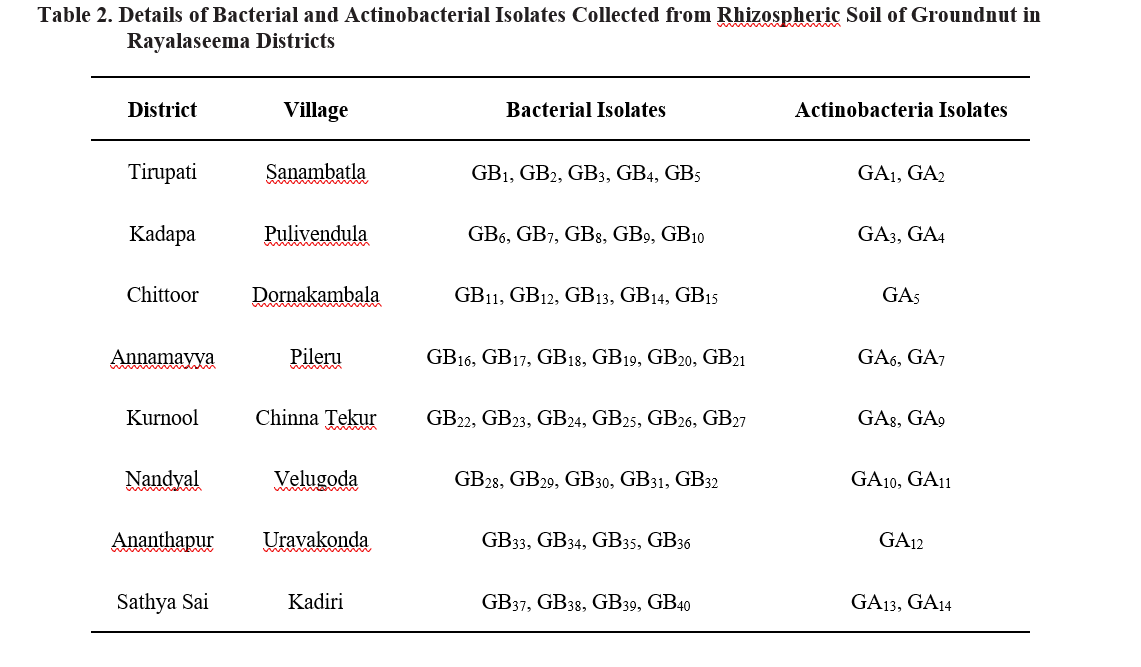
Groundnut (Arachis hypogaea L.) Stem rot disease of groundnut (Arachis hypogaea), caused by the fungus Sclerotium rolfsii Sacc., is one of the most destructive soilborne diseases affecting groundnut cultivation in the Rayalaseema region of Andhra Pradesh, India. A survey conducted across eight districts viz Tirupati, Kadapa, Chittoor, Annamayya, Kurnool, Nandyal, Ananthapur, and Sathya Sai revealed disease incidence ranging from 19.7 per cent to 31.2 per cent, with Kurnool recording the highest incidence (31.2%). In the present investigation, a total of 40 bacterial antagonists (GB1–GB40) and 14 actinobacterial isolates (GA1–GA14) were isolated from rhizospheric soil of healthy groundnut plants grown in these districts using serial dilution plating technique on Nutrient Agar (NA) medium and Starch Casein Agar (SCA) medium, respectively. All isolates were purified using the streak plate method. The pathogenicity of S. rolfsii was confirmed by proving Koch’s postulates, where in S. rolfsii inoculum grown on sorghum grains were used to artificially infest soil. After 10 days of inoculation, typical stem rot symptoms that includes yellowing, wilting and rotting of collar region along with occurrence of white cottony mycelial growth and brown sclerotia in inoculated plants, while uninoculated control plants remained healthy. The fungal pathogen was successfully re-isolated from infected plants, thereby satisfying Koch’s postulates. The collection of diverse antagonistic microorganisms from the rhizosphere of groundnut plants grown in Rayalaseema establishes a foundation for biocontrol-based integrated disease management strategies against groundnut stem rot.
KEYWORDS: Groundnut, stem rot, Sclerotium rolfsii, rhizosphere, bacterial antagonists, actinobacteria, biocontrol, rayalaseema, Andhra Pradesh.
Groundnut (Arachis hypogaea L.) is one of the most important oilseed crops in India, contributing significantly to food security, rural livelihoods, and edible oil production. India ranks second in global groundnut production, with Andhra Pradesh being one of the leading producing states. The Rayalaseema region of Andhra Pradesh – encompassing the districts of Tirupati, Kadapa, Chittoor, Annamayya, Kurnool, Nandyal, Ananthapur, and Sathya Sai – is a major groundnut-growing belt characterized by semi-arid climate and red sandy loam soils highly conducive to groundnut cultivation.
Despite its agronomic importance, groundnut production is severely limited by a wide array of fungal diseases. Among these, stem rot caused by the soilborne fungus Sclerotium rolfsii Sacc. is considered one of the most devastating diseases, capable of causing yield losses ranging from 25 per cent to 80 per cent under favorable environmental conditions (Kokalis-Burelle et al., 1997). The pathogen produces numerous sclerotia that can persist in soil for extended periods, making chemical management difficult and often economically unviable for small-scale farmers in dryland areas.
Biological control using rhizosphere-associated bacteria and actinobacteria has emerged as a promising, eco-friendlyalternativeformanagingsoilbornepathogens. The narrow soil zone of rhizosphere influenced by root exudates harbors a rich diversity of microorganisms with antagonistic potential against plant pathogens. Genera of bacteria such as Bacillus, Pseudomonas and actinobacterial genera including Streptomyces are well-documented for their efficacy against S. rolfsii through mechanisms like antibiosis, mycoparasitism, induced systemic resistance and competition for nutrients and space (Compant et al., 2005; Emmert and Handelsman, 1999).
The present study was therefore undertaken with the following objectives: (i) to assess the incidence of
stem rot disease in groundnut fields across Rayalaseema districts; (ii) to isolate and enumerate bacterial and actinobacterial antagonists from the rhizospheric soil of healthy groundnut plants; and (iii) to confirm the pathogenicity of S. rolfsii through Koch’s postulate experiments.
A roving survey was conducted during the kharif cropping season (2025–2026) across eight major groundnut-growing districts of Rayalaseema: Tirupati (Sanambatla), Kadapa (Pulivendula), Chittoor (Dornakambala), Annamayya (Pileru), Kurnool (Chinna Tekur), Nandyal (Velugoda), Ananthapur (Uravakonda), and Sathya Sai (Kadiri). In each district, five fields were randomly selected and disease incidence was assessed at the flowering to pegging stage. Five sampling points per field were chosen following the diagonal method, and 20 plants per sampling point were observed for visible stem rot symptoms (yellowing of foliage, wilting, rotting of collar region, white mycelial growth, and brown sclerotia). Disease incidence (%) was calculated as:
Disease Incidence (%) = (Number of infected plants / Total number of plants observed) × 100
Rhizospheric soil samples were collected from healthy groundnut plants from the same fields surveyed. Samples were taken from a soil depth of 5–15 cm around the root zone of healthy plants. Approximately 200 g of rhizospheric soil was collected per site by gently uprooting plants and shaking off loosely adhered soil; the tightly adhering soil was then carefully removed and pooled. Samples were placed in sterile polythene bags, labeled, and transported to the laboratory under ice-packed conditions for further processing within 24 hours of collection.
Bacterial antagonists were isolated from rhizosphere soil using the serial dilution plating technique. One gram of rhizosphere soil was suspended in 9 mL of sterile distilled water and vortexed for 2 minutes to prepare a 10-1 suspension. Serial dilutions were prepared up to 10-7. Aliquots of 0.1 mL from dilutions 10-4, 10-5, and 10-6 were plated on Nutrient Agar (NA) medium and
Starch Casein Agar (SCA) medium, incubated at 28 ± 2°C for 24–72 hours. After incubation, morphologically distinct bacterial colonies were selected based on colony characteristics such as size, shape, color, margin, surface texture, and elevation. Representative colonies were sub-cultured and purified by the streak plate method on fresh NA medium. Pure cultures were maintained on NA slants at 4°C for further studies.
Stem rot-infected groundnut plants exhibiting characteristic symptoms such as yellowing, wilting, collar region rotting, white fluffy mycelial growth, and brown sclerotia were collected from surveyed fields. Surface sterilization of infected stem tissue was performed with 0.1 per cent sodium hypochlorite for 1 minute followed by three washes in sterile distilled water. Tissue segments (4–5 mm) were placed on Potato Dextrose Agar (PDA) medium in Petri dishes and incubated at 28 ± 2°C. The white mycelial growth was identified as S. rolfsii based on morphological characteristics i.e., white cottony mycelium, and round to oval sclerotia measuring 0.5– 2.0 mm in diameter, initially white and turning to light brown on maturity. The pure cultures were maintained on PDA slants at 4°C for further use.
The pathogenicity of the isolated S. rolfsii was confirmed following Koch’s postulates. Sorghum grain inoculum was prepared by autoclaving pre-soaked sorghum grains (at 121°C, 15 psi for 20 minutes) and inoculating with actively growing mycelial discs (5 mm diameter) of S. rolfsii. The inoculated grains were incubated at 28°C for 15 days until fully colonized. Plastic pots (30 cm diameter) were filled with sterile sandy loam soil. The colonized sorghum grain inoculum was mixed thoroughly with the soil at the rate of 10 g/kg of soil at the time of sowing.
Five Plants per pot were sown and maintained under shade net conditions. Disease symptom development was observed daily from 7 days after sowing. At 10 days after inoculation, the inoculated plants were assessed for stem rot symptoms. The pathogen was re-isolated from symptomatic collar tissue and its identity was confirmed by morphological characteristics, thus completing Koch’s postulates.
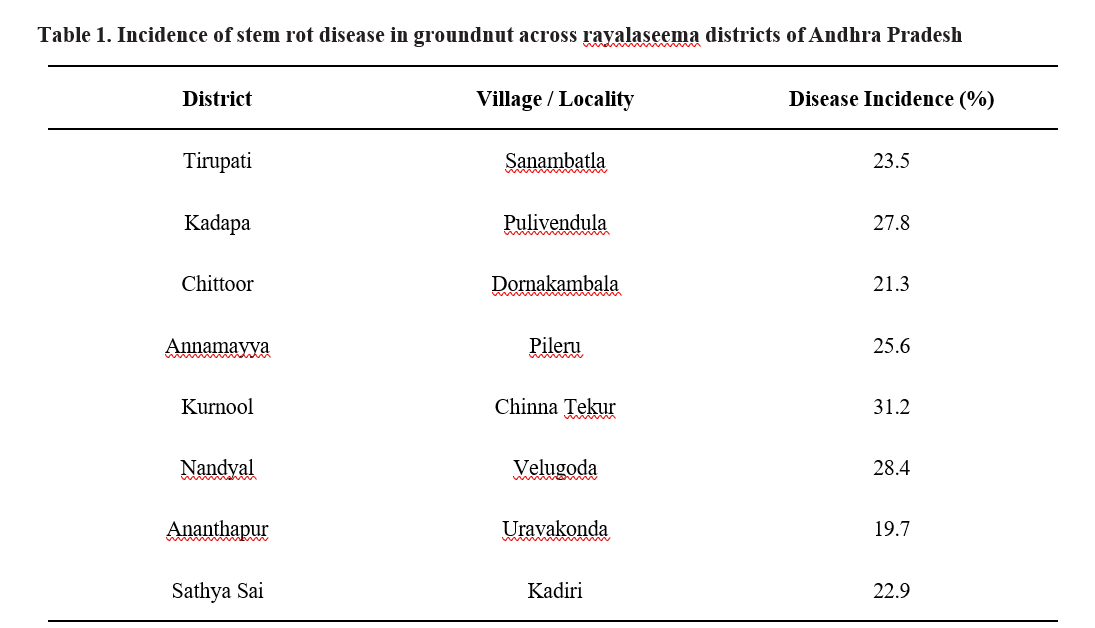
Incidence of Stem Rot Disease in Rayalaseema Districts
The survey for groundnut stem rot disease across the eight districts of Rayalaseema region of A.P revealed considerable variation in disease incidence (Table 1). The disease was recorded in all surveyed locations, confirming its widespread occurrence throughout the region. Kurnool district (Chinna Tekur village) recorded the highest disease incidence of 31.2 per cent, followed by Nandyal (Velugoda) at 28.4 per cent and Kadapa (Pulivendula) at 27.8 per cent. Annamayya (Pileru) recorded 25.6 per cent incidence, while Tirupati (Sanambatla), Sathya Sai (Kadiri), Chittoor (Dornakambala), and Ananthapur (Uravakonda) recorded incidences of 23.5 per cent, 22.9 per cent, 21.3 per cent and 19.7 per cent respectively.
Isolation of Bacterial and Actinobacterial Antagonists
A total of 40 bacterial isolates (GB1–GB40) were obtained from samples across the eight districts of Rayalaseema region of A.P. Colonies with characteristic actinobacterial morphology like chalky white, grey, or earthy-smelling colonies with powdery texture and substrate mycelia were selected, purified by the streak plate method, and maintained on SCA slants at 4°C. A total of 14 actinobacterial isolates (GA1–GA14) were obtained from the eight districts. Colonies of actinobacteria on SCA medium appeared after 7–14 days of incubation.
The pathogenicity test was conducted to confirm that the isolated fungus S. rolfsii was the causal organism of stem rot in groundnut. The fungus was multiplied on PDA medium and inoculated into soil using sorghum grain inoculum colonized by S. rolfsii. After 10 days of inoculation, inoculated plants exhibited typical stem rot symptoms, including yellowing and interveinal chlorosis of lower leaves, wilting of the entire plant, and browning and rotting of the collar region at the soil surface level. White cottony mycelial growth characteristic of S. rolfsii was clearly observed along the infected stem portions, along with brown to tan round sclerotia on the mycelial mass and soil surface adjacent to the plant base.
In sharp contrast, uninoculated control plants remained completely healthy throughout the observation period with no visible disease symptoms.The pathogen was successfully re-isolated; the re-isolated cultures exhibited identical morphological characteristics on PDA medium. The pathogenicity test confirmed that S. rolfsii was the causal organism of groundnut stem rot.
The results of the present survey confirm that stem rot disease caused by S. rolfsii is a serious and widespread constraint for groundnut cultivation in the Rayalaseema region of Andhra Pradesh. The overall mean disease incidence of 25.1 per cent recorded in the present study is consistent with earlier reports from different groundnut-growing regions of India. Kolte (1984) reported stem rot incidence ranging from 20–80 per cent in susceptible cultivars under favorable conditions, while Subrahmanyam et al. (1990) documented heavy losses in Andhra Pradesh due to soilborne pathogens. Kurnool district recording the highest incidence (31.2%) may be related to its black cotton soil with higher water retention capacity and slightly alkaline pH, both of which are known to favor sclerotia germination and mycelial growth of S. rolfsii (Purdy, 1979).
The pathogenicity test results conclusively established S. rolfsii as the causal organism of stem rot in groundnut in the Rayalaseema region. The appearance of symptoms at 10 days after inoculation is consistent with the typical incubation period of S. rolfsii under greenhouse conditions (Aycock, 1966). The use of sorghum grain inoculum has been widely validated as an effective method for soil infestation studies with S. rolfsii (Patel et al., 2008), as colonized grains provide both viable mycelium and sclerotia for efficient disease establishment. The complete absence of symptoms in uninoculated control plants confirmed the specificity of symptoms to the inoculated pathogen. Re-isolation of morphologically identical fungal cultures from inoculated plants completed Koch’s postulates. The characteristic white cottony mycelium and brown sclerotia observed on inoculated plants were identical to symptoms recorded in field surveys.The collection of 54 diverse antagonistic microbial isolates (40 bacterial and 14 actinobacterial) from the groundnut rhizosphere of Rayalaseema districts provides a valuable resource for subsequent in vitro and in vivo biocontrol screening against S. rolfsii.
The present study documented substantial incidence of S. rolfsii incited stem rot disease in groundnut across eight Rayalaseema districts of Andhra Pradesh, with overall mean incidence of 25.1 per cent (range: 19.7-31.2%). A total of 54 antagonistic microorganisms – 40 bacterial isolates (GB1–GB40) and 14 actinobacterial
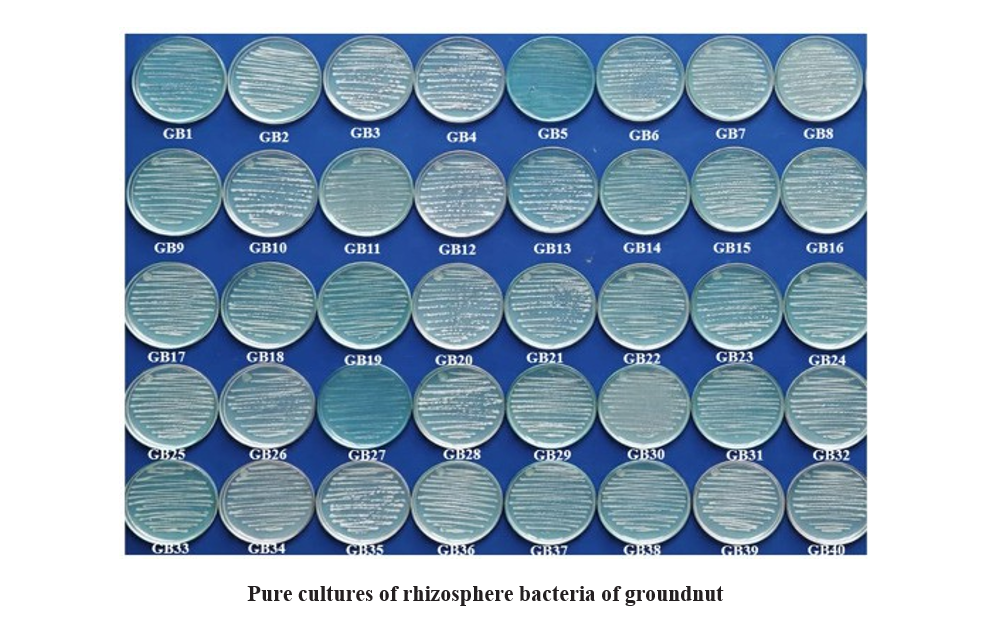
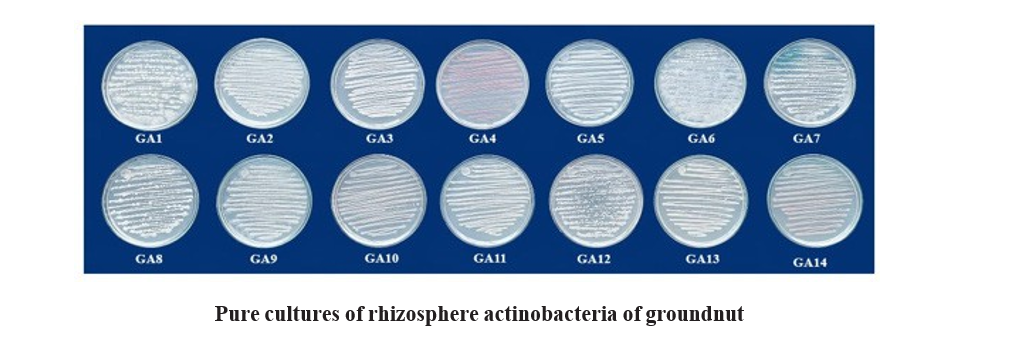
isolates (GA1–GA14) – were successfully isolated from the rhizospheric soil of healthy groundnut plants using NA and SCA selective media. Pathogenicity of the isolated S. rolfsii was confirmed by satisfying Koch’s postulates under shade net conditions, with clear stem rot symptoms appearing in inoculated plants (yellowing, wilting, collar rot, white mycelium, and sclerotia) while uninoculated controls remained healthy.
Aycock, R. 1966. Stem rot and other diseases caused by Sclerotium rolfsii. North Carolina Agricultural Experiment Station Technical Bulletin. 174: 1–202.
Compant, S., Duffy, B., Nowak, J., Clément, C and Barka, E.A. 2005. Use of plant growth-promoting bacteria for biocontrol of plant diseases: principles, mechanisms of action, and future prospects. Applied and Environmental Microbiology. 71(9): 4951–4959.
Emmert, E.A.B and Handelsman, J. 1999. Biocontrol of plant disease: a (gram-) positive perspective. FEMS Microbiology Letters. 171(1): 1–9.
Kokalis-Burelle, N., Porter, D.M., Rodriguez-Kabana, R., Smith, D. H and Subrahmanyam, P. 1997. Compendium of Peanut Diseases (2nd ed.). American Phytopathological Society.
Kolte, S.J. 1984. Diseases of annual edible oilseed crops, Volume II – groundnut diseases. CRC Press.
Patel, J.B., Patel, S.T., Patel, H.R and Patel, R.M. 2008. Influence of various soil amendments and methods of inoculation on incidence and severity of stem rot of groundnut. Journal of Mycology and Plant Pathology. 38(3): 546–550.
Purdy, L.H. 1979. Sclerotium rolfsii: history, diseases, and management. Plant Disease. 63: 524–528.
Subrahmanyam, P., McDonald, D., Waliyar, F., Reddy,L. J., Nigam, S.N., Gibbons, R.W., Ramanatha Rao, V., Singh, A.K., Pande, S., Reddy, P.M and Subba Rao, P.V. 1990. Screening methods and sources of resistance to rust and late leaf spot of groundnut. ICRISAT Information Bulletin. Patancheru, India.