

0 Views
Department of Agronomy, ANGRAU-S.V. Agricultural College, Tirupati-517 502.
A field experiment was conducted during rabi, 2024-25 at Wetland Farm, S.V. Agricultural College, Tirupati campus of Acharya N. G. Ranga Agricultural University, Andhra Pradesh, India to identify a suitable post-emergence herbicide for managing weeds and enhancing productivity of transplanted finger millet. Among the different weed management practices tried higher yield of transplanted finger millet and lower nutrient uptake by weeds was noticed with hand weeding twice at 15 and 30 DAT (T9), which was at par with post-emergence application of penoxsulam 20 g ha-1 (T7). Lower yield of transplanted finger millet and higher nutrient uptake by weeds was observed with post-emergence application of fenoxaprop-p-ethyl 42 g ha-1 (T6), which was at par with post-emergence application of penoxsulam + cyhalofop-butyl 67.6 g ha-1 (T4).
KEYWORDS: Herbicides, nutrient uptake, pre-emergence, post-emergence, transplanted finger millet.
Finger millet (Eleusine coracana L.) commonly known as ragi, holds a prominent position as a staple food crop in South India. India is the world’s leading producer of millets and the year 2023 was declared as the International year of millets, with major focus on enhancing the production and productivity of millets (Government of India, 2022). Out of all major millets produced, ragi accounts for about 85 per cent of the production in India (Sakamma et al., 2017). It is predominantly cultivated under rainfed situations. Due to its climate-resilient characteristics, it can be grown under limited irrigation conditions and poor soils, which makes it a leader among the millet family with high nutritional value and hence it is considered as nutri-cereal. It has a multi-dimensional utility as food for people and fodder for animals. In India ragi was cultivated in 1.16 M ha, with a production of 1.69 M t and productivity of 1450 kg ha-1 (Directorate of Millets Development, 2022-23). Pre-emergence herbicides, typically applied 0-3 days after sowing provide effective weed control for a certain period depending on the weed flora. However, since finger millet is a long-duration crop, pre-emergence herbicides alone may not offer complete weed control. New flushes of weeds often emerge after 20-25 days, particularly under irrigated conditions. To manage these late-emerging weeds, post-emergence herbicide application should be employed. In recent years, the development of new herbicide molecules has led to products that are highly effective even at low doses. These modern herbicides offer broad-spectrum weed control, shorter environmental persistence, low toxicity to mammals and significantly reduced chemical load due to their application in grams rather than kg ha-1. This makes them more environmentally sustainable. There is a need to have alternative herbicides with different modes of action for obtaining broad-spectrum weed control coupled with low dose and higher efficacy for control of mixed weed flora in transplanted finger millet. Hence, the present study was undertaken to assess the yield and nutrient uptake by transplanted finger millet as influenced by different weed management practices.
A field experiment was conducted during rabi, 2024-25 at wetland farm of S.V. Agricultural College, Tirupati campus of Acharya N.G. Ranga Agricultural University, Andhra Pradesh. The soil of experimental site was sandy clay loam in texture, neutral in reaction, low in available nitrogen, medium in organic carbon and potassium and high in available phosphorus. The experiment was laid out in a randomized block design with ten treatments and replicated thrice. The treatments consisted of early post-emergence application of bensulfuron methyl + pretilachlor 500 g ha-1 (T1), early post-emergence application of pretilachlor + pyrazosulfuron ethyl 460 g ha-1 (T2), post-emergence application of bispyribac-sodium + pyrazosulfuron ethyl 52.5 g ha-1 (T3), post-emergence application of penoxsulam + cyhalofop-butyl 67.6 g ha-1 (T4), post-emergence application of triafamone + ethoxysulfuron 30 g ha-1 (T5), post-emergence application of fenoxaprop-p-ethyl 42 g ha-1 (T6), post-emergence application of penoxsulam 20 g ha-1 (T7), post-emergence application of 2,4-D sodium salt 800 g ha-1 (T8), hand weeding twice at 15 and 30 DAT (T9) and weedy check (T10). Finger millet was transplanted at
22.5 cm x 10 cm spacing on 23th November, 2024. Early post-emergence and post-emergence herbicides were applied to transplanted finger millet at 8-10 DAT and 20 DAT respectively by using power operated knapsack sprayer fitted with flat fan nozzle and spray volume of 500 l ha-1. The crop was fertilized with 60 kg N, 30 kg P and 30 kg K ha-1. Nitrogen was applied in two splits, viz., half as basal and the remaining half as top dressing at 30 DAT and entire dose of phosphorous and potassium was applied as basal at the time of transplanting itself. Yield attributes, viz. productive tillers m2, weight of ear head and test weight were recorded at harvest from the randomly selected plants from net plot area. Grain and straw yield of transplanted finger millet were recorded based on the yield obtained from net plot.
Nitrogen content in dried plant was determined by Microkjeldahl distillation method after destroying the organic matter with H2SO4 and H2O2 (Piper, 1966). Nitrogen uptake by crop was calculated by multiplying the nitrogen content with the respective dry matter production and expressed in kg ha-1. Di-acid digested plant samples were analyzed for phosphorus content using vanado-molybdo phosphoric acid method (Piper,1966). The intensity of yellow colour developed was measured by using spectrophotometer. The uptake of phosphorus by crop was worked out by multiplying the phosphorus content with the respective dry matter production and expressed as kg ha-1. Potassium content was determined by using flame photometer (Piper, 1966) and the uptake of potassium by crop was estimated by multiplying the potassium content with the respective dry matter production and expressed as kg ha-1.
Among the weed management practices investigated, higher number of productive tillers m-2 was observed in hand weeding twice at 15 and 30 DAT (T9) (Table 1), which was at par with post-emergence application of penoxsulam 20 g ha-1 (T7) and both were significantly superior over post-emergence application of 2,4-D sodium salt 800 g ha-1 (T8). The higher number of productive tillers m-2 in the above treatments might be due to effective control of all categories of weeds during critical stages of crop, which in turn enhanced the availability of growth resources to crop and thereby produced higher number of productive tillers m-2. These results were in concord with findings of Ramadevi et al. (2021) and Guru et al. (2020).
The next best treatment was early post-emergence application of pretilachlor + pyrazosulfuron ethyl 460 g ha-1 (T2), which was in parity with early post-emergence application of bensulfuron methyl + pretilachlor 500 g ha-1 (T1) in the order of descent. Post-emergence application of triafamone + ethoxysulfuron 30 g ha-1 (T5) was comparable with post-emergence application of bispyribac-sodium + pyrazosulfuron ethyl 52.5 g ha-1 (T3) and significantly superior over weedy check (T10). Significantly lower number of productive tillers m-2 was observed with post-emergence application of fenoxaprop-p-ethyl 42 g ha-1 (T6), which was at par with post-emergence application of penoxsulam + cyhalofop-butyl 67.6 g ha-1 (T4). This is due to severe phytotoxicity of fenoxaprop-p-ethyl and cyhalofop-butyl on transplanted finger millet. Similar results were also documented by Pandey et al. (2018).
The highest test weight of transplanted finger millet was noticed with hand weeding twice at 15 and 30 DAT (T9), which was comparable with post-emergence application of penoxsulam 20 g ha-1 (T7), post-emergence application of 2,4-D sodium salt 800 g ha-1 (T8), early post-emergence application of pretilachlor + pyrazosulfuron ethyl 460 g ha-1 (T2), early post-emergence application of bensulfuron methyl + pretilachlor 500 g ha-1 (T1), post-emergence application of bispyribac-sodium + pyrazosulfuron ethyl 52.5 g ha-1 (T3), post-emergence application of triafamone + ethoxysulfuron 30 g ha-1 (T5) and weedy check (T10), in the order of descent. The test weight of finger millet mostly influenced by genetic makeup of the crop and less by the agronomic interactions. Significantly lower test weight was recorded with post-emergence application of fenoxaprop-p-ethyl 42 g ha-1 (T6), which was at par with post-emergence application of penoxsulam + cyhalofop-butyl 67.6 g ha-1
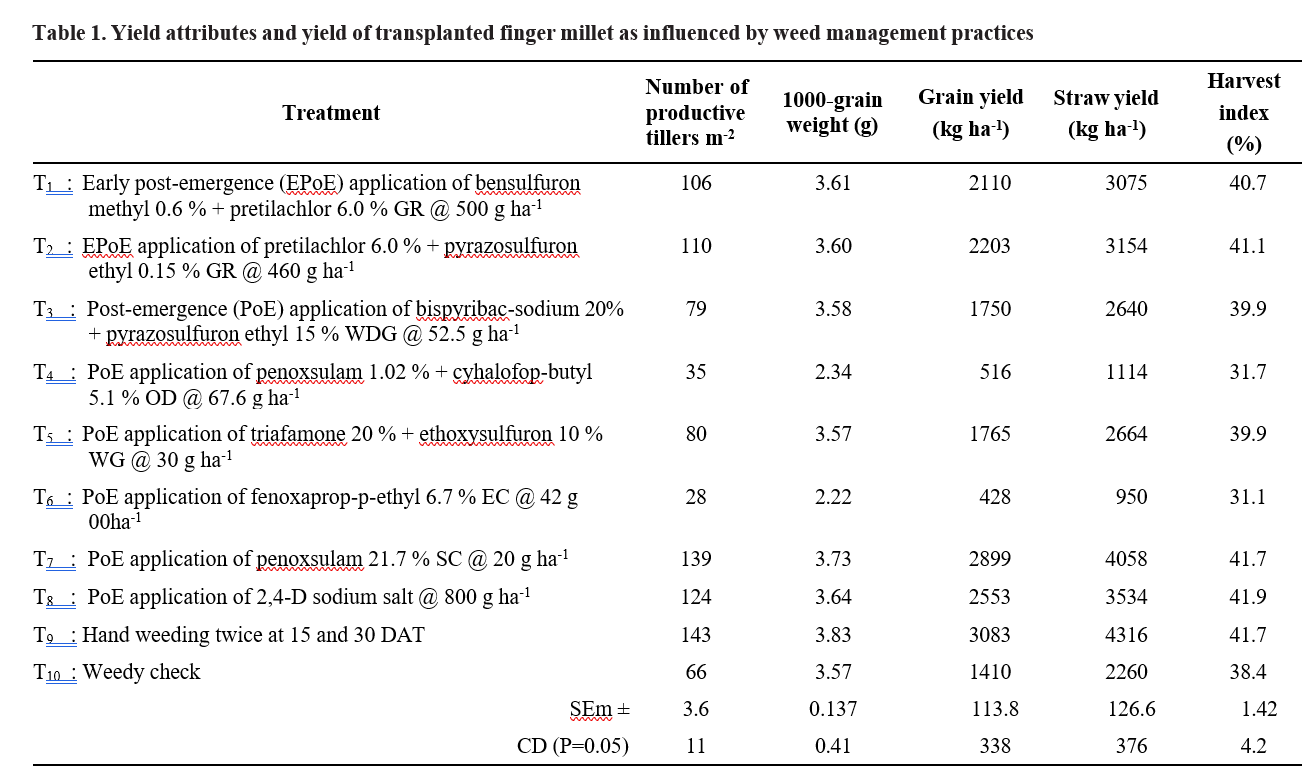
(T4), this is mainly due to severe phytotoxicity effect of herbicides on crop.
Among the weed management practices investigated, higher grain and straw yield was observed in hand weeding twice at 15 and 30 DAT (T9), which was in parity with post-emergence application of penoxsulam 20 g ha-1 (T7) and both were significantly superior over post-emergence application of 2,4-D sodium salt 800 g ha-1 (T8). This was mainly due to effective removal of weeds at critical period of crop-weed competition that led to increased availability of growth resources to crop, which in turn created favourable conditions for increased stature of vegetative growth and reproductive potential of the crop leading to increased grain yield. These results were in conformity with findings Shubhashree et al. (2023) and Ramadevi et al. (2021).
The next best treatment was early post-emergence application of pretilachlor + pyrazosulfuron ethyl 460 g ha-1 (T2), which was comparable with early post-emergence application of bensulfuron methyl + pretilachlor 500 g ha-1 (T1) in the order of descent. Post-emergence application of triafamone + ethoxysulfuron 30 g ha-1 (T5), which was in parity with post-emergence application of bispyribac-sodium + pyrazosulfuron ethyl 52.5 g ha-1 (T3) and significantly superior over weedy check (T10). This was mainly due to poor performance of transplanted finger millet as a result of mild phytotoxicity effect in (T5) and (T3) and heavy weed infestation in weedy check treatment. Significantly lowest grain yield of transplanted finger millet was obtained in post-emergence application of fenoxaprop-p-ethyl 42 g ha-1 (T6), which was at par with post-emergence application of penoxsulam + cyhalofop-butyl 67.6 g ha-1 (T4). This was mainly due to severe phytotoxicity effect of these herbicides on crop and also due to greater competition for the growth resources among the crop and weeds as evident by the lowest crop stature, yield attributes and yield of transplanted finger millet. These results were in line with Thanmai et al. (2018).
Higher harvest index was registered with post-emergence application of 2,4-D sodium salt 800 g ha-1 (T8), however it was statistically in parity with, post-emergence application of penoxsulam 20 g ha-1 (T7), hand weeding at 15 and 30 DAT (T9), early post-emergence application of pretilachlor + pyrazosulfuron ethyl 460 g ha-1 (T2), early post-emergence application of bensulfuron methyl + pretilachlor 500 g ha-1 (T1), post-emergence application of bispyribac-sodium + pyrazosulfuron ethyl 52.5 g ha-1 (T3), post-emergence application of triafamone + ethoxysulfuron 30 g ha-1 (T5) and weedy check (T10) in the order of descent.
Significantly lower harvest index was recorded with post-emergence application of fenoxaprop-p-ethyl 42 g ha-1 (T6), which was at par with post-emergence application of penoxsulam + cyhalofop-butyl 67.6 g ha-1 (T4), this was due to reduced grain and straw yields due to severe crop stand loss by severe phytotoxicity effect on crop plants.
Nutrient uptake viz., nitrogen, phosphorous and potassium by transplanted finger millet at harvest was significantly influenced by different weed management practices (Table 2). N, P and K uptake by plant followed similar trend.
Hand weeding twice at 15 and 30 DAT (T9), registered higher nutrient uptake, which was at par with post-emergence application of penoxsulam 20 g ha-1 (T7). The next best treatment was post-emergence application of 2,4-D sodium salt 800 g ha-1 (T8). This might be due to decreased crop weed competition, which concurrently increased the nutrient availability, better crop growth and higher crop biomass production coupled with more nutrient. These results were closely conformity with that of Sneha et al. (2024) and Ramadevi et al. (2021).
Early post-emergence application of pretilachlor + pyrazosulfuron ethyl 460 g ha-1 (T2), which was significantly comparable with early post-emergence application of bensulfuron methyl + pretilachlor 500 g ha-1 (T1).
Post-emergence application of triafamone + ethoxysulfuron 30 g ha-1 (T5), which was in parity with post-emergence application of bispyribac-sodium + pyrazosulfuron ethyl 52.5 g ha-1 (T3) and significantly superior over weedy check (T10).
Significantly lower nutrient i.e., nitrogen, phosphorous and potassium uptake was observed with post-emergence application of fenoxaprop-p-ethyl 42 g ha-1 (T6), which was at par with post-emergence application of penoxsulam + cyhalofop-butyl 67.6 g ha-1 (T4), due to phytotoxicity effect of fenoxaprop-p-ethyl and cyhalofop-butyl on crop, resulted in stunted growth coupled with reduced stature leading to decreased dry matter production and nutrient accumulation in the crop.
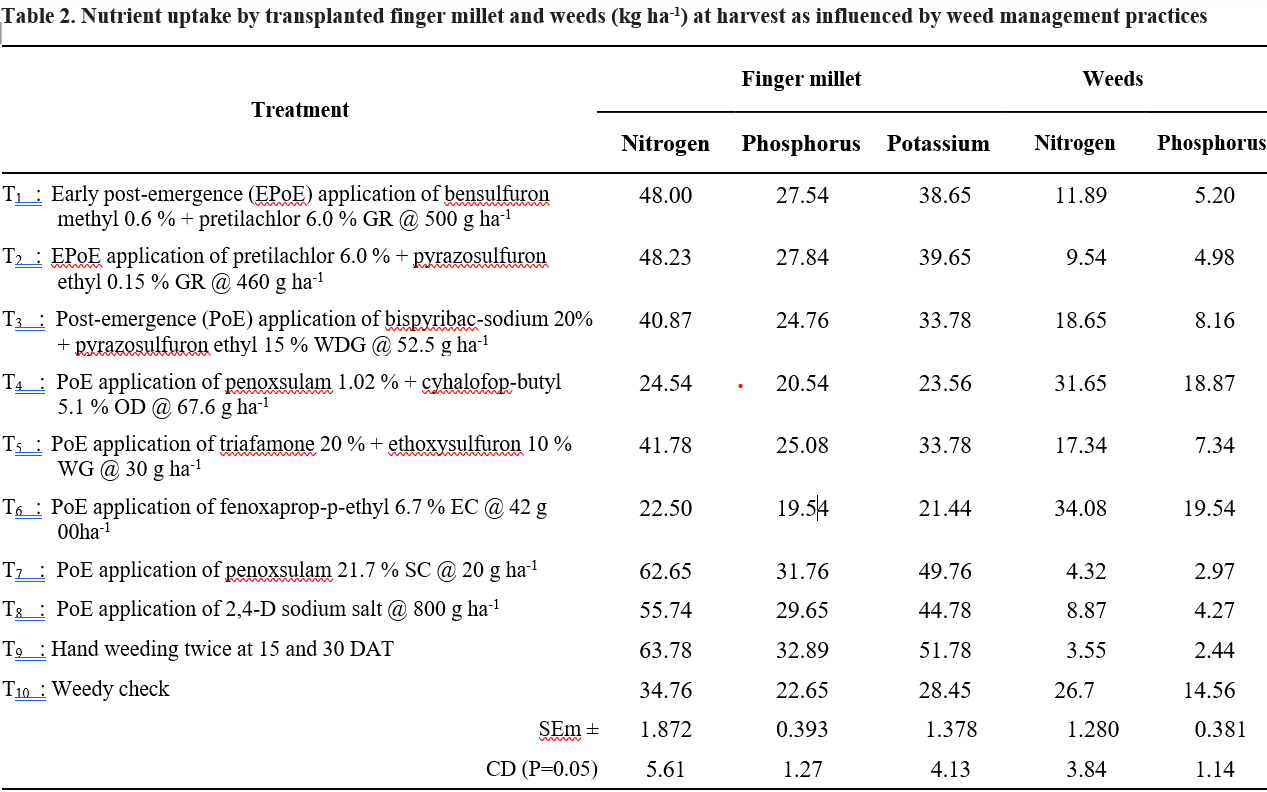
Nutrient uptake viz., nitrogen, phosphorous and potassium by weeds in transplanted finger millet at harvest was significantly altered by weed management practices (Table 1 and Fig. 2). N, P and K uptake by weeds followed similar trend.
Lower uptake of nutrients by weeds was reported with hand weeding twice at 15 and 30 DAT (T9), which was at par with post-emergence application of penoxsulam 20 g ha-1 (T7), due to effective control of all the categories of weeds, leading to reduced dry matter accumulation by weeds. It was evident that with effective control of weeds, significant loss of nutrients can be avoided and thereby increased the availability of nutrients to the crop. The results were corroborates with the findings of Ashok, (2024).
The next best treatment with lower nutrient uptake by weeds was noticed with post-emergence application of 2,4-D sodium salt 800 g ha-1 (T8), which was in parity with early post-emergence application of pretilachlor
+ pyrazosulfuron ethyl 460 g ha-1 (T2) and early post-emergence application of bensulfuron methyl + pretilachlor 500 g ha-1 (T1), in the order of ascent. Post-emergence application of triafamone + ethoxysulfuron 30 g ha-1 (T5) and post-emergence application of bispyribac-sodium + pyrazosulfuron ethyl 52.5 g ha-1 (T3) were comparable with each other and in turn superior over weedy check (T10).
Significantly higher nutrient uptake by weeds was reported with post-emergence application of fenoxaprop-p-ethyl 42 g ha-1 (T6), which was at par with post-emergence application of penoxsulam + cyhalofop-butyl 67.6 g ha-1 (T4). This was due to phytotoxicity of the herbicides on crop, the growth of finger millet was reduced which favoured the weeds to increase their number as well as biomass leading to higher nutrient uptake by weeds.
Among the treatments, hand weeding twice at 15 and 30 DAT (T9) and post-emergence application of penoxsulam 20 g ha-1 (T7) consistently resulted in higher nutrient uptake (N, P, K), reduced nutrient loss through weeds, improved productive tillers, higher test weight, grain, straw yield and better harvest index. These treatments effectively suppressed weed growth and minimized competition. Post-emergence application of fenoxaprop-p-ethyl (T6) and penoxsulam + cyhalofop-butyl (T4) showed phytotoxic effects on the crop, resulting in severe loss of crop stand, poor nutrient accumulation in the plant and the lowest yield.
Ashok, K.D. 2024. Evaluation of different weed management practices in finger millet (Eleusine coracana L.). M.Sc. (Ag.) Thesis. Maharana Pratap University of Agriculture and Technology, Udaipur, Rajasthan, India.
Directorate of millets development, 2022-23.
Government of India-2022.
Guru, R.K., Dwivedi, S.K., Khajanji, S.N and Jha, S.K. 2020. Efficacy of herbicides in managing weeds in direct-seeded rice. Indian Journal of Weed Science. 52(3): 222-226.
Pandey, S., Sonboir, H.L and Thawait, D. 2018. Evaluation of post-emergence herbicides on growth parameters of finger millet. International Journal of Current Microbiology and Applied Sciences. 7(3): 1126-1134.
Piper, C.S. 1966. Soil and Plant Analysis. Inter Science Publishers, New York. 47-49.
Ramadevi, S., Sagar, G.K., Subramanyam, D and Kumar, A.R. 2021. Weed management in transplanted finger millet with pre-and post-emergence herbicides. Indian Journal of Weed Science. 53(3): 297-299.
Sakamma, S., Umesh, K.B., Girish, M.R., Ravi, S. C., Satishkumar, M and Bellundagi, V. 2017. Finger millet (Eleusine coracana L. Gaertn.) production system: status, potential, constraints and implications for improving small farmer’s welfare. Journal of Agricultural Sciences. 10(1): 162.
Shubhashree, K.S., Keshavaiah, K.V., Shekar, B.G and Murthy, K.K. 2023. Effect of pre and post-emergence herbicide application on growth and yield of direct seeded finger millet (Eleusine coracana L.). Mysore Journal of Agricultural Sciences. 57 (2): 378-384.
Sneha, S.R., Raj, S.K., Jacob, D., Kavitha, G.V., Radhakrishnan, N.V and Pillai, S.P. 2024. Influence of integrated weed management practices on weeds, physiology, quality and yield of direct sown ragi (Eleusine coracana L. Gaertn). Indian Journal of Weed Science. 56 (2): 208-213.
Thanmai, L.P., Srinivasulu, K., Prasad, P.V.N and Babu, R.P. 2018. Evaluation of post-emergence herbicides in pearl millet (Pennisetum typhoides). International Journal of Chemical Studies. 6(3): 631-633.