

0 Views
Department of Genetics and Plant Breeding, ANGRAU-S.V. Agricultural College, Tirupati-517 502.
The genetic parameters namely, variability, heritability and genetic advance as per cent of mean, were estimated for 32 groundnut genotypes during Kharif, 2025. Among the 15 characters studied, the number of mature pods plant⁻¹ and pod yield plant⁻¹ exhibited high phenotypic coefficient of variation (PCV) and genotypic coefficient of variation (GCV), indicating the presence of substantial genetic variability for these traits. High heritability coupled with high genetic advance as percent of mean was observed for dry haulm yield plant⁻¹, number of mature pods plant⁻¹, pod yield plant⁻¹, kernel yield plant⁻¹, number of primary branches plant⁻¹ and harvest index. This suggests the predominance of additive gene action in the inheritance of these traits. Therefore, direct selection for these characters would be effective in improving pod yield plant⁻¹ in groundnut.
KEYWORDS: Genetic variability, groundnut, heritability, large-seeded and oilseed.
Groundnut (Arachis hypogaea L.) is one of the most important oilseed-cum-food legume crops cultivated in tropical and subtropical regions of the world. It is valued for its high nutritional content, with kernels containing approximately 45-50 per cent oil and 25-30 per cent protein, making it an important source of edible oil, food and livestock feed. In India, groundnut crop occupies about an area of 53.51 lakh hectares and a production of about 120.91 lakh tonnes, productivity of about 2260 kg hectare-1 (Indiastat 2026). Large seeded groundnut genotypes have gained considerable importance due to their superior market preference, higher kernel recovery and suitability for confectionery purposes. These genotypes generally possess greater 100-kernel weight and attractive pod characteristics, which fetch premium prices in domestic and international markets. Large-seeded varieties are particularly preferred by the food processing industry because of their better roasting quality, uniform kernel size, and enhanced consumer acceptability. Furthermore, the incorporation of large seed size into high-yielding cultivars has become an important objective in groundnut breeding programmes aimed at improving both productivity and market value.
The present investigation was carried out with the objective to estimate the genetic variability, heritability coupled with genetic advance as percent of mean for yield and yield component traits which can support the ongoing and future groundnut breeding programs.
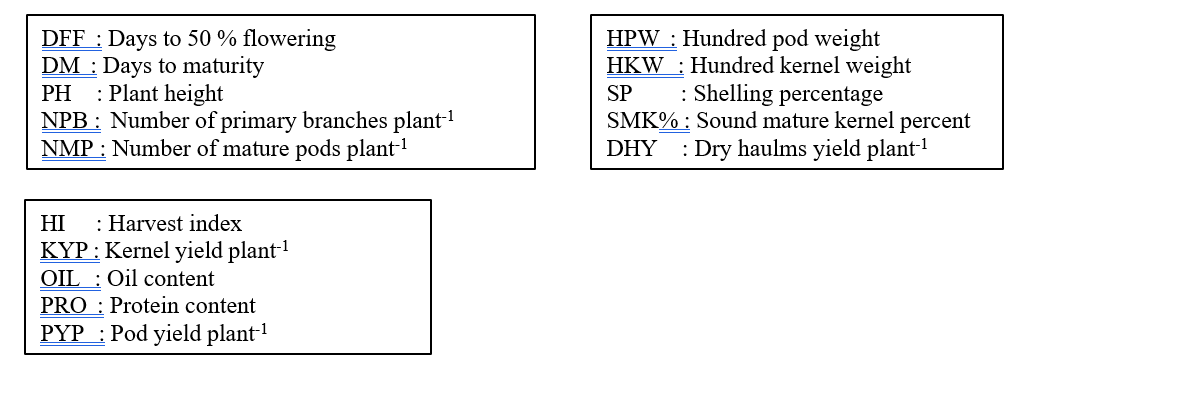
The material used for the present investigation comprised of 32 groundnut genotypes. This was evaluated in randomized block design with two replications at dryland farm of S.V. Agricultural college, Tirupati during rainy season (Kharif 2025). Each genotype was grown in three rows of 5 m length, with a spacing of 30 cm between rows and 10 cm between plants. Standard agronomic and plant protection practices were uniformly followed throughout the crop season to ensure a healthy crop. The five plants were randomly selected from each genotype in both replications. The randomly selected plants were used for recording the plant height, number of primary branches plant-1, number of mature pods plant-1, hundred pod weight, hundred kernel weight, shelling percentage, sound mature kernel per cent, dry haulms yield plant-1, harvest index, kernel yield plant-1, pod yield plant-1. Oil and protein content were estimated using the Near Infrared Spectroscopy. The analysis of variance (Panse and Sukhatme, 1967) was estimated using R software. The mean, range, genotypic coefficient of variation (GCV), phenotypic coefficient of variation (PCV) were calculated by the formula given by Burton (1952); heritability (%) in broad sense was worked out by using the formula of Lush (1940) and genetic advance as per cent of mean was estimated by the procedure given by Johnson et al. (1955).
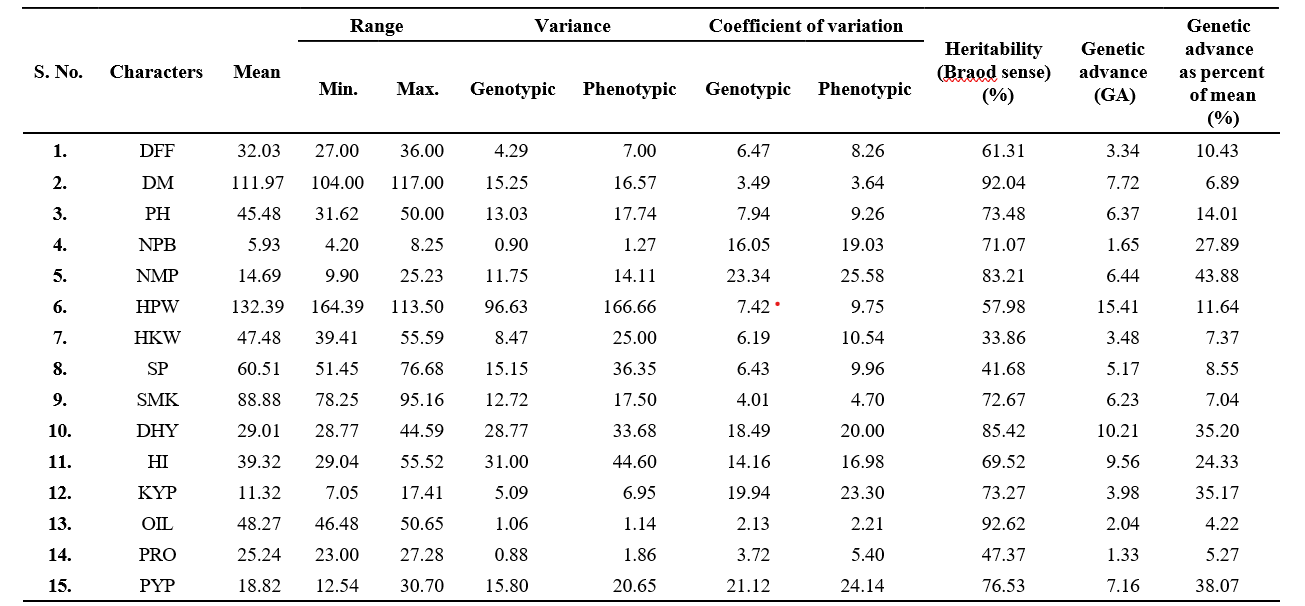
Analysis of variance revealed highly significant differences among genotypes for all the traits, indicating the presence of sufficient variability in the genotypes studied.
The phenotypic coefficient of variation (PCV) exceeded the genotypic coefficient of variation (GCV) for all the characters studied, suggesting that environmental factors contributed to the observed variation in the expression of these traits. High GCV and PCV estuimates were observed for the traits number of mature pods plant-1 and pod yield plant-1. These results were similar with the findings of Mane et al. (2024), Ragiri et al. (2023) and Bindu Sree et al. (2026). It indicates a good scope for yield improvement through phenotypic selection. Low GCV and PCV were recorded for days to 50 per cent flowering, days to maturity, hundred pod weight, shelling percentage, plant height, sound mature kernel percent, oil and protein content indicating the larger influence of environment on these traits.
High heritability coupled with genetic advance as percent of mean gives a very good indication of nature of inheritance and effectiveness of selection for a particular trait (Johnson et al. 1955). In present study, high heritability (>60%) and high genetic advance as percent of mean (>20% ) were recorded for dry haulms yield plant-1, number of mature pods plant-1, pod yield plant-1, kernel yield plant-1, number of primary branches plant-1and harvest index. These results were in accordance with the findings of Chavadhari et al. (2017), Mahesh et al. (2018), Bugati et al. (2020), Mane et al. (2024), Yami et al. (2025). The high heritability and genetic advance indicated the dominance of additive gene action, indicating that selection would be effective for these traits.
High heritability with moderate genetic advance as per cent of mean was exhibited by the characters viz., plant height, days to 50 per cent flowering. Moderate heritability coupled with moderate genetic advance as per cent of mean were recorded for hundred pod weight. Similar results for hundred pod weight were reported by Shinde et al. (2019). Hundred kernel weight, shelling percentage and protein content exhibited moderate heritability with low genetic advance as per cent of mean. Hampannavar et al. (2018) reported the same results for shelling percentage. Moderate heritability with low genetic advance for protein content and hundred kernel weight are in accordance with the findings of Patidar and Nadaf (2017) and Aruna kumari et al. (2019).
The study revealed the presence of considerable genetic variability among the 32 groundnut genotypes for yield and yield related traits. High GCV and PCV were observed for number of mature pods plant-1 and pod yield plant-1, indicating ample scope for improvement through selection. High heritability coupled with high genetic advance as per cent of mean was recorded for number of mature pods plant-1, dry haulm yield plant-1, kernel yield plant-1, pod yield plant-1, number of primary branches plant-1and harvest index, suggesting the predominance of additive gene action and the effectiveness of direct selection for these traits. Therefore, these characters can be considered as an important selection criterion for enhancing pod yield in groundnut breeding programmes.
Arunakumari, E., John, K., Reddy, D.M and Latha, P. 2019. Studies on genetic variability for yield, yield attributing traits, physiological and quality traits in groundnut (Arachis hypogaea L.). International Journal of Current Microbiology and Applied Sciences. 8 (7): 393-400.
Bindu Sree, K.S., Priyadarshini, S.K., Venkataravana, P., Ramesh, S and Shirisha, K.M. 2026. Organisation of genetic variability for quantitative traits in groundnut (Arachis hypogaea L.) germplasm accessions. Journal of Advances in Biology and Biotechnology. 29(1): 31–41.
Bugati, C.H and Savithramma, D.L. 2020. Genetic variability studies in F6 families and advance breeding lines derived from selected crosses for late leaf spot disease resistance, pod yield and its component traits in groundnut (Arachis hypogaea L.). Journal of Agricultural Sciences. 54(1): 129.
Burton, G.W. 1952. Quantitative inheritance in grasses. Proceedings of Sixth International Grassland Congress. 1: 277-283.
Chavadhari, R.M., Kachhadia, V.H., Vacchani, J.H and Virani, M.B. 2017. Genetic variability studies in groundnut (Arachis hypogaea L.) Electronic Journal of Plant Breeding. 8(4): 1288-1292.
Hampannavar, R.M and Khan, H. 2018. Analysis of genetic diversity of groundnut (Arachis hypogaea L.) genotypes collected from various parts of India. Journal of Pharmacognosy and Phytochemistry. 7(2): 1100-1103.
Johnson, H.W., Robinson, H.F and Comstock, R.E. 1955. Estimates of genetic and environmental variability in soybean. Agronomy Journal. 47: 413-418.
Lush, J.L. 1940. Inter size correlation and regression of offspring on dams as a method of estimating heritability of characters. Proceedings of American Society of Animal Production. 33: 293-301.
Mahesh, R.H., Hasan, K., Temburne, B.V., Janila, P and Amaregouda, A. 2018. Genetic variability, correlation and path analysis studies for yield and yield attributes in groundnut (Arachis hypogaea L.). Journal of Pharmacognosy and Phytochemistry. 7(1): 870-874.
Mane, V.P., Kumar, C.K.B., Veershetty, N., Jeevan, N., Daanakumara, T., Kumar, T.C.J., Kannihalli, S and Chandana, H.S. 2024. Assessment of genetic variability of F4 progenies for enhanced pod yield and component traits in groundnut. Journal of Advances in Biology and Biotechnology. 27(9): 689-697.
Omprakash, P and Nadaf, H.L. 2017. An assessment of genetic variability and traits association among high oleic advanced breeding lines for yield and quality traits in groundnut (Arachis hypogaea L.). Electronic Journal of Plant Breeding. 8(1): 201-205.
Panse V.G and Sukhatme P.V. 1967. Statistical method for agricultural workers (2nd Ed.) 1967, ICAR Publication, New Delhi: 259.
Ragiri, P.K., John, K., Tagore, K.R and Ramana, M.B. 2023. Assessment of genetic variability, heritability and genetic advance among advanced breeding lines of groundnut (Arachis hypogaea L.). Andhra Pradesh Journal of Agricultural Science. 9(1): 16-21.
Yami, A.S and Abtew, W.G. 2025. Assessment of genetic variability for yield and yield-contributing traits in groundnut (Arachis hypogaea L.) genotypes. Journal of Food Quality. 1: 1-14.
Ministry of Agriculture, Govt. of India. Indiastat. 2025-2026.WWW.Indiastatagri.com.