

0 Views
Department of Entomology, ANGRAU-S.V. Agricultural College, Tirupati-517 502.
Rice farmers in Andhra Pradesh rely substantially on chemical pesticides for management of insect pests and diseases.
A survey of 120 farmers from 24 villages across Krishna, NTR, Kakinada and East Godavari districts during rabi 2025–26 documented pesticide-use patterns, application practices and farmers’ knowledge. Pymetrozine (91.66%), triflumezopyrim (83.33%), tetraniliprole (79.16%), bifenthrin (74.16%) and acephate (70.83%) were the major insecticides, while azoxystrobin + tebuconazole (91.66%), tricyclazole (83.33%) and thifluzamide (80.66%) were the dominant fungicides. Calendar-based spraying and pesticide mixtures were common. Awareness of recommended pesticides, safe handling, residue management and personal protective equipment was limited. The study highlights the need for stronger extension services and integrated pest management.
KEYWORDS: Farmers’ knowledge, pesticide use, perception, pesticide safety, rice.
Rice (Oryza sativa L.) is a major staple crop of Andhra Pradesh and is cultivated extensively under intensive production systems. The occurrence of insect pests and diseases has resulted in considerable dependence on chemical pesticides for crop protection. The present study was conducted to document pesticide-use patterns and farmer practices in rice production across the Krishna and Godavari Agro-climatic Zones of Andhra Pradesh.
Indiscriminate and improper pesticide use can lead to environmental contamination, health risks and unnecessary chemical applications. Repeated use of pesticides may also contribute to the development of pesticide resistance, reducing their effectiveness and increasing dependence on chemical control. In the present survey, calendar-based spraying was common, with about 70 per cent of farmers following fixed spray schedules rather than applying pesticides based on pest or disease incidence.
Pesticide residues in harvested rice are another important concern associated with improper pesticide use. However, farmer awareness regarding residue regulations and safe pesticide practices was limited. Only 26.60 per cent of respondents were aware of pesticide residue regulations and export standards, while only 12.50 per cent were aware of the recommended waiting period before milling.
The survey recorded extensive use of pesticides, with 20 insecticides and 14 fungicides belonging to different chemical groups. Pymetrozine (91.66%), triflumezopyrim (83.33%), tetraniliprole (79.16%), bifenthrin (74.16%) and acephate (70.83%) were the major insecticides, while azoxystrobin + tebuconazole (91.66%), tricyclazole (83.33%) and thifluzamide (80.66%) were the prominent fungicides.
Despite extensive pesticide use, farmers showed limited knowledge of recommended and safe pesticide practices. Only 25 per cent were aware of registered pesticides recommended for rice, while knowledge of correct pesticide measurement, spray preparation, safe storage and container disposal was low. Only 38.33 per cent adopted minimum protective measures during spraying. Therefore, the present study was undertaken to document pesticide-use patterns, pesticide-selection practices, application frequency, residue awareness and occupational safety among rice farmers, with the aim of supporting improved extension services, integrated pest management, resistance management and safer pesticide use.
A roving survey was conducted during rabi 2025–26 to document pesticide use patterns in rice cultivation across the Krishna and Godavari Agro-climatic Zones of Andhra Pradesh, India. The survey covered four major rice-growing districts viz., Krishna, NTR, Kakinada and East Godavari selected based on their extensive rice cultivation and intensive pesticide use. Two mandals were selected from each district, followed by three villages from each mandal, resulting in a total of 24 villages. From each village, five rice farmers were selected through direct field visits, giving a total sample size of 120 farmers. Each farmer was considered an independent sampling unit. The study area represents one of the major irrigated rice ecosystems of Andhra Pradesh, characterized by fertile alluvial soils, favorable climatic conditions and intensive crop production.
Information was collected through personal interviews using a structured and pre-tested questionnaire covering information on farmer name, village, mandal, district, GPS location, rice variety, agronomic practices, major insect pests and diseases, pesticide usage, type of formulation, dosage, spray volume, no. of sprays, crop growth stage, source of technical information and pesticide combinations. Particular emphasis was placed on documenting the use of recently introduced insecticides and fungicides, spray frequency and pesticide selection criteria.
The survey documented the insecticides and fungicides used by farmers, frequency of pesticide application, commonly used pesticide mixtures, target pests and diseases and the major sources of technical advice influencing pesticide selection. The recorded pesticides were classified according to their chemical groups and mode of action to facilitate interpretation of pesticide-use trends under field conditions.
Frequency, percentage and mean were used as simple statistical tools for analysis. The data were processed using Microsoft Excel 2010 spreadsheet.
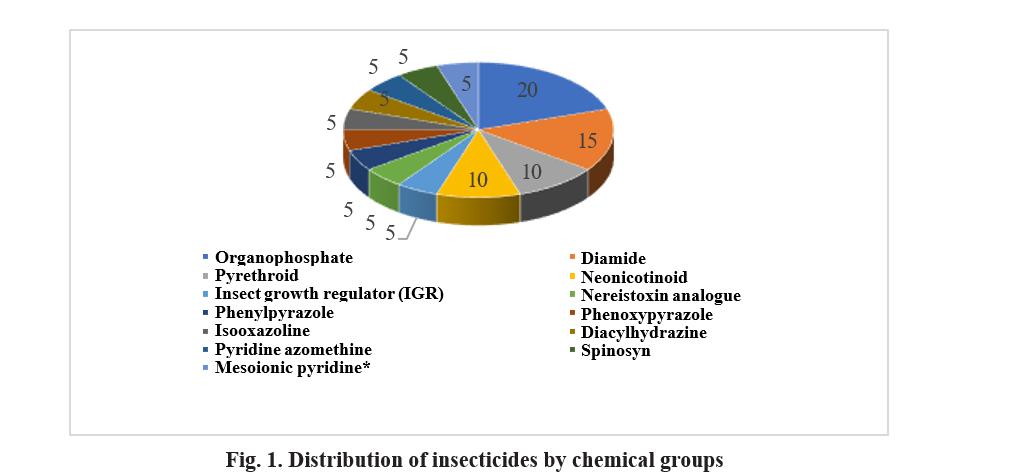
A total of 120 farmers were surveyed. A total of 20 insecticides and 14 fungicides belonging to different chemical groups were recorded during the survey conducted in the Krishna and Godavari Agro-climatic Zones during rabi 2025–26. (Fig.1) The insecticides belonged to organophosphates, neonicotinoids, pyrethroids, diamides, pyridine azomethines, mesoionic insecticides, phenylpyrazoles, isoxazolines, spinosyns, insect growth regulators and nereistoxin analogues, whereas the fungicides comprised triazoles, strobilurins, dithiocarbamates, benzimidazoles, carboxanilides and inorganic multi-site fungicides. The results indicated extensive use of multiple pesticide groups for the management of major insect pests and diseases in rice.
The use of diverse pesticide groups reflects the increasing dependence on chemical crop protection in intensive rice ecosystems. Adoption of newer pesticide molecules may be attributed to their higher efficacy and broader spectrum of activity against economically important pests and diseases.
Farmers used several insecticides for insect pest management, with pymetrozine (91.66%) being the most frequently adopted, followed by triflumezopyrim (83.33%), tetraniliprole (79.16%), bifenthrin (74.16%), acephate (70.83%), isocycloseram (66.66%) and profenofos (65.83%). Moderate adoption was observed for buprofezin, chlorantraniliprole, fipronil and imidacloprid, whereas fenpyroximate and temephos were comparatively less used.
The higher adoption of pymetrozine and triflumezopyrim indicates farmers’ preference for effective management of brown planthopper, while tetraniliprole and bifenthrin were mainly preferred for stem borer control. Similar trends have been reported in recent rice production systems where newer insecticides have gradually replaced conventional molecules because of their improved efficacy.
Among the fungicides, azoxystrobin + tebuconazole (91.66%) were the most widely used formulation, followed by tricyclazole (83.33%), thifluzamide
(80.66%) and propiconazole (61.66%). Carbendazim and copper oxychloride showed moderate adoption, whereas propineb, isoprothiolane and hexaconazole were less frequently used.
The greater adoption of azoxystrobin + tebuconazole indicates farmers’ preference for broad-spectrum fungicides capable of controlling multiple diseases. Tricyclazole and thifluzamide continue to be important fungicides for blast and sheath blight management, respectively.
Approximately 70 per cent of the respondents followed calendar-based pesticide application, whereas
30 per cent adopted need-based spraying based on pest or disease incidence. Similarly, 70.83 per cent of farmers applied pesticides based on recommendations from agricultural officers, pesticide dealers or fellow farmers, while 29.17 per cent relied mainly on field observations. The predominance of calendar-based spraying indicates that preventive pesticide application was widely practiced, highlighting the need to promote economic threshold-based spraying through extension programmes to optimize pesticide use and reduce unnecessary applications. Pesticide dealers were the primary source of technical information for nearly half of the surveyed farmers, while agricultural extension personnel, progressive farmers, fellow farmers, training programmes and mass media contributed to a lesser extent. More than half of the respondents discarded empty pesticide containers in agricultural fields, whereas others disposed of them in waste collection sites or by burning; only 10.00 per cent followed recommended disposal practices. Regarding occupational safety, only 38.33 per cent of farmers used minimum protective measures during pesticide application. Most farmers did not use adequate protective equipment because of discomfort, limited availability or additional cost. Although 70.00 per cent were aware of the adverse health effects of pesticides, this awareness was not consistently reflected in their field practices.
The present investigation revealed considerable dependence on chemical pesticides among rice farmers, with calendar-based spraying and reliance on recommendations from pesticide dealers, agricultural officers and fellow farmers being common practices. These findings are comparable with Reddy et al. (2023), who reported that all surveyed rice farmers in Andhra Pradesh used insecticides and fungicides for managing yellow stem borer and blast, while more than 71 per cent applied pesticides above the recommended dose. Similarly, Yogeshwari (2002) reported an average of 18 pesticide applications during the rice crop period, exceeding the recommended 11 applications, indicating a tendency towards frequent pesticide use.
The dependence on pesticide dealers and inadequate technical knowledge observed in the present study is consistent with Joshi et al. (2022), who reported that rice farmers in Nepal commonly relied on traditional knowledge and local dealers rather than scientific recommendations. Likewise, Shetty et al. (2010) found that 71 per cent of 1,039 farmers did not follow recommended pesticide dosages and frequently relied on pesticide dealers, resulting in inappropriate use of pesticide mixtures. Reddy et al. (2023) also reported that pesticide dealers were the major source of recommendations, with many farmers using approximate quantities while preparing spray solutions.
The present findings further indicate inadequate adoption of pesticide-safety measures. This agrees with Kumari and Reddy (2013), who observed a considerable gap between farmers’ knowledge and their actual implementation of recommended safety practices. Similarly, Sharifzadeh et al. (2018) reported that 84.9 per cent of farmers did not use protective clothing or safety equipment during pesticide handling and application. Sai et al. (2019) also reported that although 61 per cent of farmers were aware of the harmful effects of pesticides, 22 per cent mixed pesticides with bare hands and 26 per cent did not use protective clothing during spraying.
Unsafe pesticide handling and disposal practices observed in the present study are also supported by previous findings. Reddy et al. (2023) reported that most farmers disposed of empty pesticide containers in common trash, while Sai et al. (2019) found that 67 per cent of farmers disposed of left over pesticides carelessly in open fields. Ntow et al. (2006) similarly documented inadequate protective clothing, unsafe pesticide handling and disposal and indiscriminate pesticide mixing, which increased the potential risks to human health and the environment.
Limited understanding of pesticide labels and instructions may further contribute to these unsafe practices. Mekonnen and Agonafir (2002) reported that language barriers and low literacy levels affected farmers’ ability to understand pesticide labels and instructions.
The present investigation documented the pesticide-use pattern among rice farmers in the Krishna and Godavari Agro-climatic Zones of Andhra Pradesh. The survey revealed extensive dependence on chemical pesticides, with 20 insecticides and 14 fungicides belonging to different chemical groups being reported. Pymetrozine, triflumezopyrim, tetraniliprole, bifenthrin and acephate were among the commonly used insecticides, while azoxystrobin + tebuconazole, tricyclazole and thifluzamide were the major fungicides. The frequent use of pesticide combinations and calendar-based spraying indicated a tendency towards preventive and repeated pesticide application rather than need-based management.
The study also revealed considerable gaps in farmers’ knowledge and adoption of recommended pesticide-use practices. Dependence on pesticide dealers and other informal sources of information was common. Awareness regarding correct pesticide measurement, preparation of spray solutions, safe storage, container disposal, pesticide residues and recommended waiting periods was limited. Although many farmers were aware of the harmful effects of pesticides, adoption of personal protective measures during spraying remained inadequate. Improper disposal of empty containers and insufficient attention to residue-related precautions further indicated weaknesses in safe pesticide management.
These findings emphasize the need to strengthen farmer-oriented extension programmes, economic threshold-based pesticide application, safe handling practices, appropriate pesticide selection, resistance-management strategies and awareness regarding pesticide residues. Improved technical guidance and regular training can help reduce unnecessary pesticide applications while promoting safer and more sustainable pest-management practices in rice cultivation.
I am Likhitha, K. sincerely acknowledge the Department of Entomology, S.V. Agricultural College, Tirupati, Acharya N.G. Ranga Agricultural University, Andhra Pradesh, India, for providing the necessary facilities to conduct this research. I am also grateful to the Pesticide Residue Testing Laboratory, Institute of Frontier Technology (IFT), Regional Agricultural Research Station, Tirupati, for providing the analytical facilities formy research work. I sincerely thank the members of my advisory committee for their valuable guidance, constructive suggestions and constant encouragement throughout the course of this investigation. I am also grateful to the agricultural officers and rice farmers for their cooperation and for providing valuable information during the field survey, which greatly contributed to the successful completion of this study.
Joshi, H., Sapkota, P., Dhakal, S., Bhujel, P and Yadav, P. 2022. Chemical pesticide use pattern, status and farmer’s awareness in rice growing areas of khajura, nepal. Sustainability in Food and Agriculture. 3(2): 50-54.
Kumari, P.L and Reddy, K.G. 2013. Knowledge and practices of safety use of pesticides among farm workers. Journal of Agriculture and Veterinary Science. 6(2): 1-8.
Mekonnen, Y and Agonafir, T. 2002. Pesticide sprayers’ knowledge, attitude and practice of pesticide use on agricultural farms of Ethiopia. Occupational medicine. 52(6): 311-315.
Ntow, W.J., Gijzen, H.J., Kelderman, P and Drechsel, 2006. Farmer perceptions and pesticide use practices in vegetable production in Ghana. Pest Management Science. 62(4): 356-365.
Reddy, L.P.V., Rao, S.R.K., Krishna, T.M., Rao, C.S., Padmodaya, B and Naidu, G. M. 2023. Survey on the pesticide usage pattern in paddy crop grown in southern agro-climatic zone of Andhra Pradesh. International Journal of Chemistry and Chemical Engineering Systems. 8: 48-65.
Sai, M.V.S., Revati, G.D., Ramya, R., Swaroop, A.M., Maheswari, E and Kumar, M.M. 2019. Knowledge and perception of farmers regarding pesticide usage in a rural farming village, southern India. Indian Journal of Occupational and Environmental Medicine. 23(1): 32-36.
Sharifzadeh, M.S and Abdollahzadeh, G. 2021. The impact of different education strategies on rice farmers’ knowledge, attitude and practice (KAP) about pesticide use. Journal of the Saudi Society of Agricultural Sciences. 20(5): 312-323.
Shetty, P.K., Murugan, M., Hiremath, M.B and Sreeja, K.G. 2010. Farmers’ education and perception on pesticide use and crop economies in Indian agriculture. Journal of Experimental Sciences. 1(1): 3-8.
Yogeshwari, H. 2002. Economics and environmental implication of pesticide use in paddy, Shimoga district. M.Sc(Ag.) Thesis, University of Agricultural Sciences, Dharwad, India.