

0 Views
Department of Crop Physiology, ANGRAU-S.V. Agricultural College, Tirupati-517 502.
Drought stress limits finger millet (Eleusine coracana L.) production, particularly during germination and early seedling growth. Thirty genotypes were screened for drought tolerance using polyethylene glycol (PEG-6000) induced osmotic stress under five PEG concentrations. Substantial genotypic variability was observed. PPR-1279 recorded the highest germination (92.8 %) and shoot length (5.18 cm), while PPR-1332 showed the highest root length (6.06 cm). Lowest germination was observed in PPR-1330 (56.0 %) and PPR-1285 (57.0 %). Shoot length was lowest in PPR-1330 and PPR-1329 (1.80 cm), and root length in PPR-1206 (3.06 cm). PPR-1279 and PPR-1211 were drought tolerant, whereas PPR-1112 and PPR-1096 were susceptible.
KEYWORDS: Drought, finger millet, germination percentage, PEG-6000, shoot length, root length.
Finger millet (Eleusine coracana L. Gaertn.) is an important small millet cultivated predominantly in the semi-arid and arid regions of India, where it plays a vital role in food and nutritional security (Upadhyaya et al., 2007). The crop is valued for its superior nutritional composition, particularly its high calcium content, dietary fibre, iron and essential amino acids, making it an important component of climate-resilient agriculture (Antony Ceasar et al., 2018). Despite its adaptability to marginal environments, finger millet productivity remains constrained by abiotic stresses, among which drought stress is the most widespread and severe under rainfed conditions (Boyer, 1982).
Drought stress limits water availability to plants and disrupts key physiological, biochemical and metabolic processes, leading to reduced growth, poor establishment and yield losses. Boyer (1982) reported that drought reduces plant productivity by restricting water availability and associated physiological processes, while Passioura (2007) emphasized that drought induced environmental constraints adversely affect plant growth and yield through complex physical and biological interactions. The germination and early seedling stages are particularly sensitive to moisture deficit, as inadequate water supply during these phases results in poor germination, reduced seedling vigour and weak crop stand establishment (Naveena and Mehta, 2015). Therefore, identification of drought-tolerant genotypes at early growth stages is essential for enhancing crop resilience and stabilizing productivity in water-limited environments (Mukami et al., 2019).
Laboratory based screening techniques are widely employed for preliminary evaluation of large numbers of genotypes under controlled conditions. Among these methods, polyethylene glycol (PEG) induced osmotic stress is a well-established approach to simulate drought stress during germination by reducing the osmotic potential of the germination medium (Michel and Kaufmann, 1973).
Polyethylene glycol, particularly PEG-6000, is a high molecular weight, inert and non-ionic compound that does not penetrate plant tissues, thereby inducing water deficit conditions similar to soil drought without causing toxic effects (Michel and Kaufmann, 1973). PEG-induced drought stress has been effectively used to evaluate germination and seedling growth responses in finger millet, enabling the classification of genotypes into drought-tolerant and drought-susceptible categories (Gupta et al., 2014; Naveena and Mehta, 2015).
In the present study, thirty finger millet genotypes were screened for drought tolerance at the germination stage using PEG-induced osmotic stress. The objectives were to assess genotypic variability for germination percentage, shoot length and root length under different PEG stress levels, and to identify contrasting drought-tolerant and drought-susceptible genotypes. Such contrasting material is valuable for further physiological, molecular and field-level evaluation and can serve as
potential parental lines in breeding programmes aimed at improving drought tolerance in finger millet (Gupta et al., 2014; Mukami et al., 2019).
The experiment was conducted at the Department of crop physiology, Tirupati, using polyethylene glycol (PEG) induced drought stress technique. Thirty finger millet (Eleusine coracana L.) genotypes, were obtained from the Millet Breeder, Agricultural Research Station, Perumallapalle, Tirupati, Andhra Pradesh, and were screened to identify contrasting genotypes for drought tolerance. The genotypes used in the experiment included
(1) Vakula, (2) KOPN-942, (3) Tirumala, (4) KMR-206, (5) PPR-1170, (6) PPR-1296, (7) PPR-1329, (8) PPR- 1279, (9) PPR-1211, (10) PPR-1300, (11) PPR-2187, (12) PPR-1330, (13) GPU-67, (14) PPR-1332, (15) PPR- 1333, (16) PPR-1205, (17) PPR-1160, (18) PPR-1222, (19) PPR-1206, (20) PPR-1209, (21) PPR-1339, (22) PPR-1216, (23) PPR-1170 (24) PPR-1252, (25) PPR- 2773, (26) PPR-1112, (27) PPR-1096, (28) PPR-1152, (29) PPR-1285 and (30) PPR-1280.
Healthy and uniform seeds of each finger millet genotype were selected for the experiment. The seeds were surface sterilized by treating them with 1 per cent sodium hypochlorite solution for three minutes, followed by rinsing with 70 per cent ethanol. Subsequently, the seeds were thoroughly washed several times with distilled water to remove any traces of sterilants, and then surface-dried using Whatman filter paper. Twenty seeds of each genotype for each treatment were placed for germination on filter paper lined in nine-centimetre-diameter Petri dishes.
PEG-6000 was used to impose drought stress at the germination stage by creating osmotic stress conditions, following the procedure described by Naveena and Mehta (2015). Five levels of PEG concentration were maintained, namely distilled water as control, and 5 per cent, 10 per cent, 12 per cent and 15 per cent PEG solutions. A quantity of 10ml of the respective PEG solution was added to each petri dish to moisten the filter paper uniformly.
The experiment was laid out in a completely randomized design (CRD) with five replications for each treatment and genotype. Germination was carried out under controlled laboratory conditions by maintaining the temperature at 25 ± 1 °C and relative humidity at approximately 70 per cent. The petri dishes were regularly monitored, and the respective PEG solutions were added as required to compensate for moisture loss due to evaporation and to maintain consistent osmotic stress levels throughout the experimental period.
Seeds were considered germinated when the radicle protrusion reached a minimum length of two milli metres. Observations on germination and seedling growth were recorded at four and nine days after treatment application. Shoot length and root length were measured in centi metres from randomly selected seedlings in each replication using a standard measuring scale.
After the final count, the final germination percentage (FGP) was calculated by dividing the number of seeds germinated by the total number of seeds sown and expressing the value as a percentage. This methodology was employed to assess the relative drought tolerance of finger millet genotypes under PEG-induced osmotic stress conditions.

Polyethylene glycol (PEG)-induced drought stress proved to be an effective laboratory screening method for evaluating drought tolerance in finger millet genotypes, as it simulates soil moisture deficit by reducing the osmotic potential of the germination medium. This approach enabled uniform and controlled imposition of drought stress across treatments and facilitated rapid discrimination among genotypes based on germination and early seedling growth responses. Similar effectiveness of PEG as an osmotic agent has been earlier reported by Michel and Kaufmann (1973), who demonstrated clear physiological differences among seedlings exposed to PEG-induced stress. These results were included in Table.1.
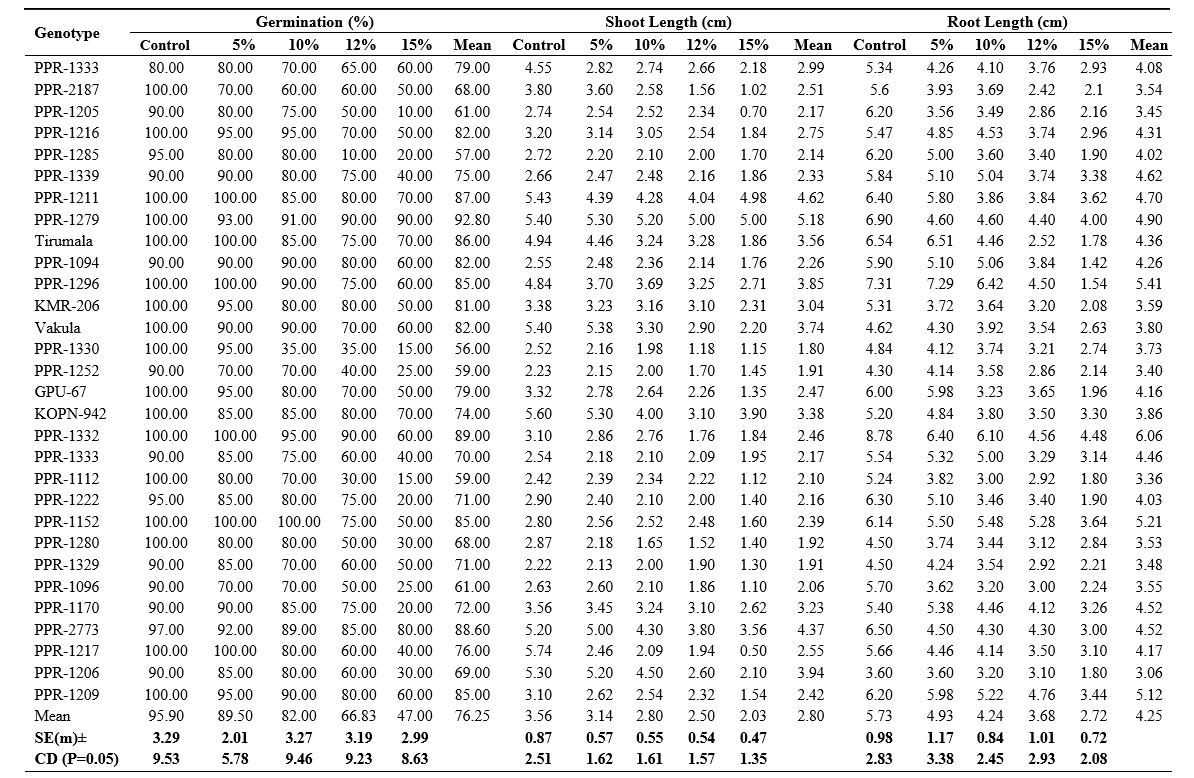
Polyethylene glycol (PEG)-induced drought stress effectively differentiated finger millet genotypes based on their germination response under moisture stress. Substantial genotypic variability was observed for final germination percentage across PEG concentrations. Under control conditions, several genotypes recorded 100 per cent germination, indicating good seed viability. With increasing PEG concentration, germination declined progressively, indicating a clear osmotic stress effect. At 5 per cent PEG, germination was relatively high (70 – 100%). At 10 per cent PEG, it decreased sharply, while at 12 per cent PEG a further reduction was observed, reaching as low as 10 per cent in some cases. At the highest stress level of 15 per cent PEG, germination was most severely affected, with values ranging from 10 per cent to 90 per cent. Among all genotypes, PPR-1279 (92.80 %), PPR-2773 (88.60
%) recorded the highest mean germination percentage across PEG levels, whereas PPR-1330 (56.00 %), PPR-1285 (57.00 %) recorded the lowest. The decline in germination with increasing osmotic stress agrees with earlier reports in finger millet and other crops under PEG-6000 induced drought conditions. Sreelatha et al. (2019) and Gupta et al. (2015) reported similar reduction in germination percentage, shoot length, root length, and seedling vigor with higher PEG concentration in finger millet. Comparable findings were also observed in maize (Majid et al., 2020), barley (Davidson-Willis et al., 2024), where higher PEG-induced osmotic stress significantly inhibited seed germination and early seedling growth. These studies support the present findings that increasing PEG-6000 concentration adversely affects germination and seedling traits, while tolerant genotypes maintain better growth under stress conditions.
Shoot length showed a consistent and progressive reduction with increasing PEG concentration, indicating the inhibitory effect of drought stress on seedling growth. Under control conditions, the highest shoot length was recorded in PPR-1217 (5.74 cm), followed by KOPN-942 (5.60 cm) and PPR-1279 (5.40 cm), whereas the lowest values were observed in PPR-1329 (2.22 cm), PPR-1252 (2.23 cm). At 5 per cent PEG, Vakula (5.38 cm), maintained maximum shoot length, while PPR-1329 recorded minimum values. Under 10% PEG, PPR-1279 (5.20 cm), PPR-1206 (4.50 cm) showed superior
shoot elongation, whereas PPR-1280 (1.65 cm), PPR-1330 (1.98 cm) and PPR-1329 (2.00 cm) exhibited poor growth. At 15 per cent PEG, PPR-1279 (5.00 cm) and PPR-1211 (4.98 cm) consistently retained higher shoot length, while PPR-1217 (0.50 cm), PPR-1205 (0.70 cm) and PPR-1330 (1.18 cm) showed severe growth inhibition. The mean shoot length across PEG levels was highest in PPR-1279 (5.18 cm), followed by PPR-1211 (4.62 cm), whereas PPR-1330 (1.80 cm) and PPR-1329 recorded the lowest mean shoot length (1.91 cm). The decrease in shoot length shows that cell expansion is limited by osmotic pressure, along with reduced leaf turgor and lower metabolic activity due to drought stress caused by PEG. (Sreelatha et al., 2019; Mude et al., 2022) confirming the effectiveness of PEG-6000 for screening drought-tolerant finger millet genotypes. Recent studies in barley have also confirmed similar reduction in shoot length under PEG-induced osmotic stress. They found that higher levels of PEG significantly hindered seedling shoot growth, indicating that shoot length is one of the most sensitive traits for drought screening (Davidson-Willis et al., 2024).
Root length also showed marked reduction with increasing PEG concentration, with mean values ranging from 3.06 cm to 6.06 cm; the highest mean root length was recorded in PPR-1332 (6.06 cm) followed by PPR-1296 (5.41 cm), whereas PPR-1206 (3.06 cm) and PPR-1333 (3.36 cm) recorded the lowest. This reduction in root length is consistent with the general inhibitory effect of PEG-mediated drought stress on root system development, where increasing PEG concentrations significantly restrict cell elongation, root meristem activity, and water uptake capacity. Similar results have been reported in recent studies on finger millet, where root length declined progressively with increasing PEG-6000 levels, with susceptible genotypes showing greater reductions than tolerant ones (Sreelatha et al., 2019). Comparable findings in cereals such as wheat also confirm that PEG-induced osmotic stress markedly reduces primary root length and overall root architecture, making root traits reliable indicators for drought screening (Davidson-Willis et al., 2024).
PEG-induceddrought stress effectivelydistinguished finger millet genotypes for drought tolerance. The genotypes PPR-1279 and PPR-1211 showed better germination, shoot, and root growth under stress. In
contrast, PPR-1096 and PPR-1112 were very sensitive, confirming PEG-6000 as a trustworthy screening tool. These findings show the potential of using PEG-induced stress tests for early-stage selection of drought-tolerant genotypes. Utilization of these genotypes in breeding programs may enhance resilience and productivity under water-limited conditions, thereby promoting sustainable finger millet cultivation.
Antony Ceasar, S.A., Maharajan, T., Ajeesh Krishna, T.P., Ramakrishnan, M and Ignacimuthu, S. 2018. Finger millet [Eleusine coracana (L.) Gaertn.] improvement: Current status and future interventions of whole genome sequence. Frontiers in Plant Science. 9: 1054.
Boyer, J.S. 1982. Plant productivity and environment. Science. 218: 443–448.
Davidson-Willis, M., Wen, G., Samanfar, B and Khanal, 2024. Barley seed germination and seedling growth responses to polyethylene glycol (PEG)-induced drought stress. International Journal of Plant Biology. 15(4): 1353-1359.
Gupta, S., Garg, R., Kumar, S and Sengar, R.S. 2014. Assessment of finger millet (Eleusine coracana L.) genotypes for drought tolerance at early seedling growth stages. Vegetos. 27: 227–230.
Gupta, S., Ramesh, B and Naik, R.M. 2015. Assessment of finger millet (Eleusine coracana L.) genotypes for drought tolerance at early seedling growth stages. Vegetos, 27(3): 227-230.
Majid, A., Dar, Z. A., Zaffar, G., Lone, F. A., Kumar, I. S., Sofi, P. A., Lone, A.A., Islam, N. ul and Rashid, M. 2020. Effect of PEG-6000 induced drought stress on seed germination in maize (Zea mays). SKUAST Journal of Research. 22(1): 40–44.
Michel, B.E and Kaufmann, M.R. 1973. The osmotic potential of polyethylene glycol 6000. Plant Physiology. 51: 914-916.
Mude, R., Kumar, R., Singh, S and Yadav, A. 2022. Screening of finger millet (Eleusine coracana L.) genotypes for drought tolerance using polyethylene glycol-induced stress. Proceedings of the National Academy of Sciences, India Section B: Biological Sciences. 92(3): 519–531.
Mukami, A., Ngetich, A., Mweu, C., Oduor, R.O., Muthangya, M and Mbinda, W.M. 2019. Differential physiological and biochemical responses of finger millet varieties under drought stress. Physiology and Molecular Biology of Plants. 25: 837-846.
Naveena, S.R and Mehta, P. 2015. Effect of PEG-induced drought stress on germination of finger millet varieties. Journal of Chemical, Biological and Physical Sciences. 5: 3042–3048.
Passioura, J.B. 2007. The drought environment: physical, biological and agricultural perspectives. Journal of Experimental Botany. 58: 113–117.
Sreelatha, D., Reddy, D.M., Reddy, B.R and Reddy, P.V. 2019. Screening of finger millet genotypes for drought tolerance under laboratory conditions. International Journal of Current Microbiology and Applied Sciences. 8(6): 2567–2574.
Upadhyaya, H.D., Gowda, C.L.L., Reddy, V.G and Singh, S. 2007. Phenotypic diversity in finger millet (Eleusine coracana L.) germplasm from southern India. Genetic Resources and Crop Evolution. 54: 165–173.