

0 Views
Department of Crop Physiology, ANGRAU-S.V. Agricultural College, Tirupati-517 502.
An experiment was conducted at S.V. Agricultural College, Tirupati, to evaluate the effect of moisture levels, genotypes and growth regulating chemicals on the morphophysiological parameters of groundnut (Arachis hypogea L.). The study revealed significant variations among moisture treatments for plant height, leaf area, total dry matter and crop growth rate (CGR). The treatment with 50 per cent above field capacity (M3) recorded the highest values for most of the parameters, followed by field capacity (M2), whereas the control treatment (need-based irrigation) showed comparatively lower values. However, SCMR values where not significantly influenced by moisture levels. Groundnut genotypes also differed significantly in their morphophysiological performance. Genotype (K6) recorded higher plant height and total dry matter, genotype K9 exhibited superior leaf area, SCMR and CGR values. Application of growth regulating chemicals at 40 and 30 days before harvest significantly influenced the growth parameters of groundnut. Among the chemicals tested, maleic hydrazide at 2000 ppm markedly reduced plant height, leaf area, total dry matter and CGR, followed by CCC at 2000ppm. The highest values for these traits were observed in the untreated control. SCMR values, however, did not show significant variation due to chemical treatments. A significant interaction effect between moisture levels and genotypes (MxG) was observed for leaf area at harvest.
KEYWORDS: Seed dormancy, field capacity, moisture level, groundnut, growth regulating chemicals.
Groundnut (Arachis hypogea L.) is one of the most important oilseed crops cultivated widely in tropical and subtropical regions of the world. It plays a significant role in the agricultural economy due to its high oil and protein content and its adaptability to diverse agro-climatic conditions. In India, groundnut is cultivated extensively under rainfed as well as irrigated conditions and contributes substantially to edible oil production. However, productivity of groundnut is often affected by several environmental and physiological constraints, among which soil moisture stress and pre harvest sprouting are major concerns.
Spanish bunch type groundnut cultivars generally lack fresh seed dormancy, which results in rapid germination of seeds immediately after physiological maturity when rainfall coincides with harvest. Increased soil moisture during crop maturity leads to field sprouting, deterioration of seed quality, reduction of seed viability and poor market value. Such conditions adversely affect the post-harvest quality and storage life of seeds. Therefore, development of strategies to induce temporary seed dormancy without affecting yield and quality is highly essential. Moisture availability is one of the most critical factors influencing plant growth and development. Soil moisture regulates several physiological and biochemical processes such as photosynthesis, nutrient uptake, translocation of assimilates, cell expansion and enzyme activity. Both excess and deficit moisture conditions can significantly alter morphophysiological characteristics including plant height, leaf area, chlorophyll content, dry matter accumulation and crop growth rate. Adequate moisture availability generally promotes vegetative growth and biomass production, whereas moisture stress restricts growth by reducing cell turgor, stomatal conductance and photosynthetic efficiency.
Apart from moisture management, genetic variability among groundnut genotypes also plays an important role in determining crop performance under varying environmental conditions. Different genotypes exhibit variations in growth pattern, physiological efficiency, dry matter partitioning and tolerance to moisture stress. Identification of suitable genotypes with superior morphophysiological traits is therefore important for improving productivity and adaptability of groundnut under different moisture regimes.
Application of plant growth regulating chemicals has emerged as an effective approach to manipulate plant growth and induce seed dormancy. Growth retardants such as maleic hydrazide (MH), cycocel or chlormequat chloride (CCC) are known to supress excessive vegetative growth, modify physiological activities and enhance assimilate partitioning. Maleic hydrazide acts by inhibiting cell division and elongation, while CCC reduces gibberellins biosynthesis, thereby controlling plant height and growth rate. These chemicals have also been reported to induce fresh seed dormancy and reduce pre-harvest sprouting in several crops. However, their influence on morphophysiological parameters and yield characteristics of groundnut under different moisture conditions requires further investigation.
Considering the importance of moisture management, genotype selection and growth regulating chemicals in improving groundnut productivity and seed quality, the present study was undertaken to evaluate the influence of different moisture levels. Genotypes and growth regulating chemicals on morphophysiological parameters of groundnut. The study aimed to understand their individual as well as interactive effects on plant growth, physiological efficiency and yield performance under varying soil moisture conditions.
The experiment was laid out in a split-split design with 3 replications. Effect of three factors viz., moisture levels, genotypes and growth regulating chemicals were studied on morphophysiological parameters of groundnut in rabi season of 2019/2020. Wherein main plot treatments comprised of moisture levels (M1: need based irrigation, M2: soil moisture content at field capacity and M3: soil moisture content at 50 per cent above field capacity) measured using TDR 350 starting at 20 DBH, sub plot treatments (G1: K6, G2: K9 and G3: TAG-24) and sub-sub plot treatments (C1: Control, C2: Maleic hydrazide @ 2000 ppm at 40 and 30 DBH and C3: CCC @ 2000 ppm at 40 and 30 DBH).
Pre harvest chemical treatment sprays were applied at 40 and 30 days before harvest. The chemicals sprayed were growth retardants Maleic Hydrazide and CCC both applied at 2000 ppm. In order to prepare 2000 ppm of Maleic hydrazide 8g of MH was diluted in NaOH to aid in dissolving the chemical. It was then added to 4L of water. To achieve 2000 ppm of CCC solution 8g of CCC was dissolved in 4L water.
The height in cms of the five randomly selected and tagged plants in each plot was measured at 30, 60, 90 DAS and also at harvest. The plant height was measured from the base of the plant to the growing point of the plant.
Leaf area was worked out for the three plants selected for destructive analysis at different stages of sampling i.e. at 30, 60, 90 DAS and at harvest. It was measured by using Leaf Area Meter (Li-COR model LI 3000) and the average was expressed as leaf area plant-1 in cm2.
The total dry matter accumulation and its partitioning was estimated from the three randomly selected plants sampled from each treatment in three replications. They were then separated into roots, shoots and pods. The plant parts were dried to a constant weight in hot air oven at 800C for two days and the dry weights were recorded and expressed in g plant-1. The following growth characteristics were computed using the data recorded on leaf area and dry matter.
The CGR is the rate of dry matter production per unit ground area per unit time. It is used for the estimation of production efficiency of crop. The CGR was calculated adopting the formula as suggested by Watson et al. (1952).

Where,
W1= Dry weight (g) of the plants at time T1
W2= Dry weight (g) of plants at time T2
P = Unit land area occupied by the plant (m2)
Chlorophyll content was measured with SPAD Chlorophyll Meter Readings (SCMR) following the method of Turner and Jund (1991) at 30 days interval up
to 90 DAS and also at harvest. SCMR data were recorded on matured exposed leaf from top of each representative plant, between 8.00 a.m. and 9.00 a.m. of the day.
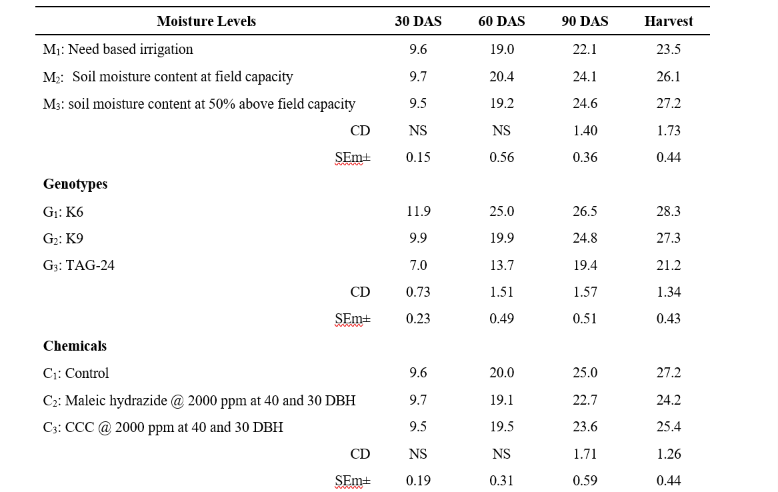
A significant difference was observed in plant height with respect to moisture levels, genotypes and growth regulating chemicals.
With respect to moisture levels, plant height did not differ significantly at 30 and 60 DAS as the imposition of the moisture treatments was given from twenty days before harvest only.
Plant height differed significantly at 90 DAS and at harvest. M3 (50% above field capacity) recorded significantly higher plant height (24.6 cm) which was at par with M2 (field capacity) (24.1 cm). The least plant height was observed in M1 (need based irrigation) (22.1 cm) at 90 DAS.
A similar trend was observed at harvest. This increase could be due to the positive influence of water on turgor related growth processes. Ross (2007) reported that high moisture was directly proportional to plant height in groundnut.
A significant difference in plant height was observed among the genotypes at all the growth stages.
At 30 DAS K6 recorded significantly higher plant height (11.9 cm) followed by K9 (9.9 cm) and TAG-24 (7.03 cm). Almost a similar trend was observed at all growth stages. This could be due to the difference in crop phenology. Plant height is influenced by the interaction of environmental conditions and genetic constitution of the plant.
Patra et al. (1981) also reported that genotypes ICGV-8614, ICGS-44, JL-24 and TG-24 recorded
higher plant height and dry matter accumulation due to the difference in phenologies and pattern of assimilate partitioning between vegetative and reproductive components.
As the treatments were imposed at 40 and 30 days before harvesting, plant height differences among the treatments were not observed at 30 and 60 DAS. However, plant height differed significantly at 90 DAS and at harvest with respect to growth regulating chemicals.
C2 (MH @ 2000 ppm) significantly reduced the plant height (22.7 cm) followed by C3 (CCC @ 2000 ppm) (23.6 cm) and control (25.0).
MH is involved in reduction of cell division, whereas CCC retards stem extension without any physiological aberration. Similar results of reduction in plant height with MH and CCC were also reported by Mukund (2004) in groundnut with MH treatments and Jare (1994). Wherein, application of CCC at 2000 ppm reduced the plant height of the groundnut variety ICGS-44 . This was attributed to the slowdown of cell division and reduced cell elongation.
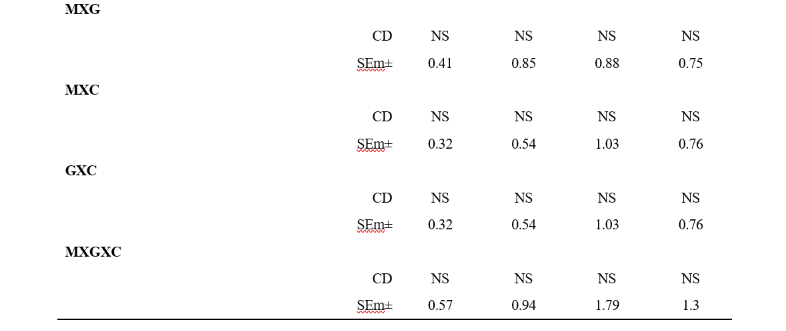
There was no interaction observed
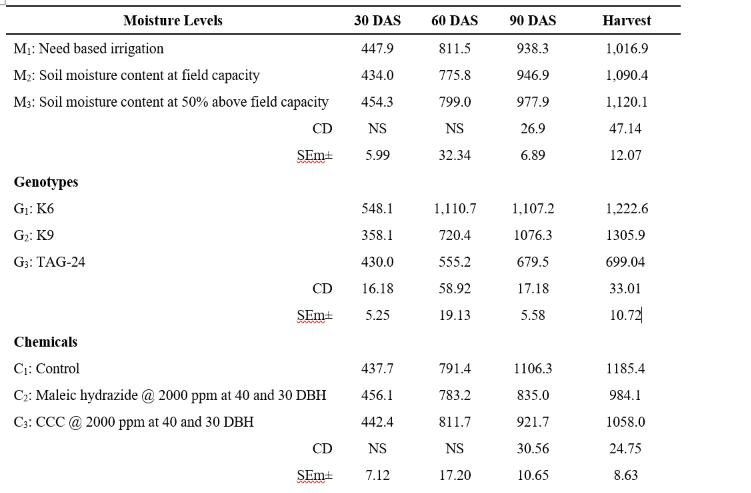
The results revealed a significant difference in leaf area with respect to moisture levels, genotypes and growth regulating chemicals.
In this study the moisture treatment was imposed 20 days before harvesting. Hence there was no significant difference on leaf area at 30 DAS and 60 DAS with respect to different levels of moisture. However, leaf area differed significantly at 90 DAS and at harvest.
Significantly higher leaf area was recorded in M3 (50% above field capacity) (977.9 cm2) followed by M2 (field capacity) (946.9 cm2) which was on par with M1 (need based irrigation) (938.3 cm2) at 90 DAS. However, at harvest significantly higher leaf area was recorded in M3 (50% above field capacity) (1120.1 cm2) which was on par with M2 (field capacity) (1090.4 cm2) and M1 (need based irrigation) (1016.9 cm2) recorded significantly lowest leaf area.
The results are in agreement with Hosseini et al. (2009) who reported that the leaf area declined with reduced moisture contents in chickpea. According to them the highest leaf area was recorded with 100 per cent field capacity while lowest was with 25 per cent field capacity.
There was significant difference observed in leaf area among genotypes in all growth stages.
At 30 DAS, K6 recorded significantly highest leaf area (548.1 cm2) followed by TAG-24 (430.0 cm2) and significantly lowest was recorded in K9 (358.1 cm2). At 60 and 90 DAS K6 recorded significantly highest leaf area (1110.7 and 1107.2 cm2) followed by K9 (720.4 and
1076.3 cm2). Whereas, the lowest leaf area was recorded with TAG-24 (555.2 and 679.5 cm2). However, at harvest, K9 (1305.9 cm2) recorded significantly highest leaf area, followed by K6 (1222.6 cm2) and the lowest significant leaf area was recorded by TAG-24 (699.0 cm2).
Similar results showing genotypic variation were reported by Dharanguttikar and Bokar (2014) with genotype TPG-41 maintaining higher leaf area (24.69 dm2) followed by ICG-8401 (22.19 dm2) and ICG-8444 (22.98 dm2).
Leaf area differed significantly at 90 DAS and at harvest. Among the different growth regulating chemical treatments at 90 DAS, significantly lowest leaf area was recorded in C2 (MH @ 2000 ppm) (835.0 cm2) followed by C3 (CCC @ 2000 ppm) with (921.7 cm2) and highest leaf area was recorded in C1 (control) with (1106.3 cm2). A similar trend was observed at harvest.
Khandagale (2011) also reported that MH @ 1500 ppm applied at 60 and 90 DAS recorded the lowest leaf area over all treatments at various stages of growth in groundnut variety TLG-45.
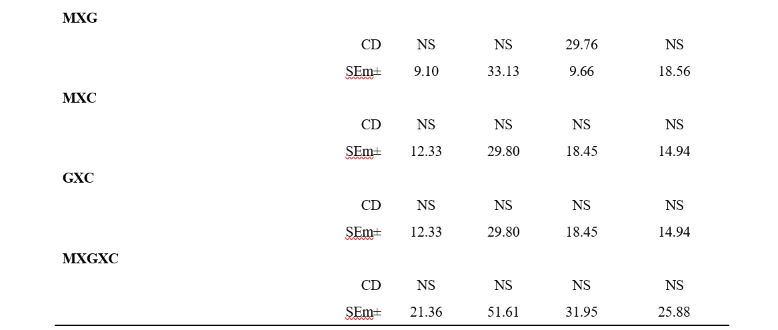
A significant interaction was recorded at 90 DAS between moisture treatments and genotypes wherein K6 (G1) at field capacity (M2) recorded significantly highest leaf area and significantly lowest leaf area was recorded in TAG-24 (G3) at need-based irrigation (M1). The short stature and comparatively less moisture content availability could be the reason for this.
The data pertaining to the influence of moisture levels, genotypes and growth regulating chemicals on SCMR values of groundnut was presented in Fig 1.
SCMR values differed significantly with the genotypes whereas the influence of moisture levels and growth regulating chemicals was observed to be non-significant.
At 30 DAS K9 recorded significantly highest SCMR values (48.4) followed by TAG-24 (44.8) which was at par with K6 (43.6). A similar trend was observed throughout the crop growth stages. SCMR values increased up to 60 DAS and were observed to be more or less stable later on.
These results are in agreement with Pallas (1982) wherein significant genotypic variation for photosynthetic rate and chlorophyll content in groundnut was reported. The mean values of SCMR among genotypes during Kharif, 2017 ranged from 40.13 (Narayani) to 48.48 (K9) with a general mean of 43.98. There was no interaction observed.
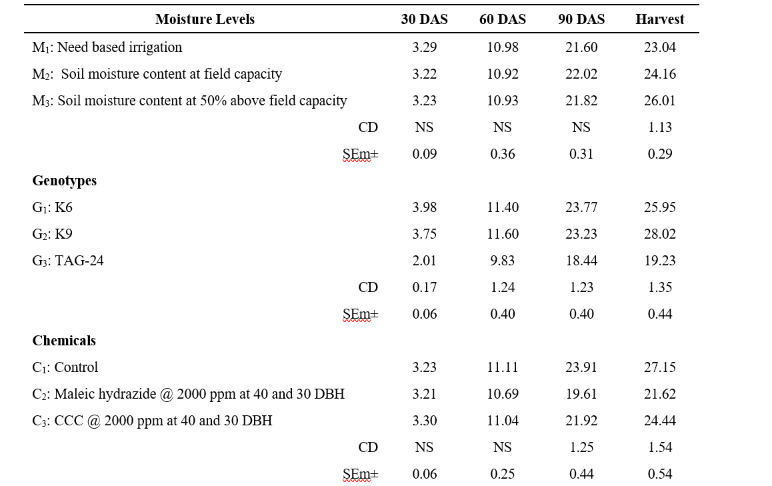
The data on total dry matter of groundnut as influenced by moisture levels, genotypes and growth regulating chemicals was presented in Table 3. Total dry matter showed a significant increase as the growth progressed. However, the increase was drastic between 30-60 DAS and 60-90 DAS, after that the total dry matter stabilized.
A significant difference in total dry matter was observed only at harvest. M3 (50% above field capacity) recorded significantly highest total dry matter (26.01 g plant-1) followed by M2 (field capacity) (24.16 g plant-1) which was on par with M1 (need based irrigation) (23.04 g plant-1).
The influence of moisture level on total dry matter was also suggested by Nageswara Rao et al. (1985). According to them the amount of dry matter accumulated by a crop was closely related to the water transpired.
Total dry matter differed significantly among all the genotypes at all the growth stages. K6 recorded significantly highest total dry matter at 90 DAS (23.77 g plant-1) which was on par with K9 (23.23 g plant-1). However, K9 recorded significantly highest total dry matter (28.02 g plant-1) followed by K6 (26.67 g plant-1) and TAG-24 (19.23 g plant-1) at harvest.
The results were in line with Dharanguttikar and Bokar (2014). They reported that dry matter production and its distribution in component parts of plant increased progressively with the advancing age of the groundnut crop.
Total dry matter differed significantly at 90 DAS and harvest with respect to application of growth regulating chemicals.
At 90 DAS, C2 (MH @ 2000 ppm) (19.61 g plant-1) recorded the lowest total dry matter followed by C3 (CCC @ 2000 ppm) (21.92 g plant-1) and C1 (control) (23.91 g plant-1). A similar trend was also observed at harvest. By the time of harvesting C2 (MH @ 2000 ppm) and C3 (CCC @ 2000 ppm) reduced the total dry matter by 22 and 12.2 per cent respectively compared to the control.
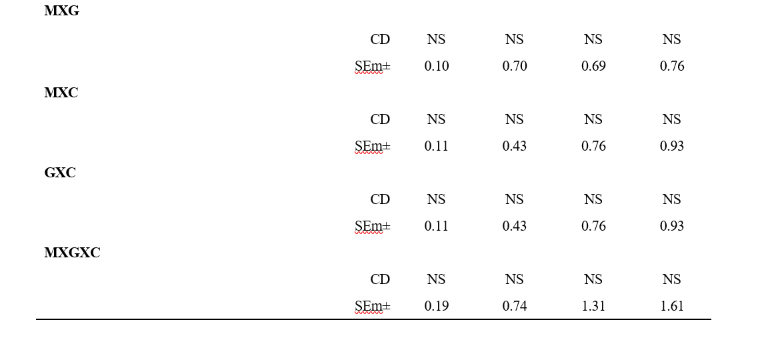
Pradhan (1993) also suggested similar results. Wherein the dry matter production showed a decline with increased number of sprays of maleic hydrazide in groundnut. There was no interaction effect observed.
Thus, the results showed that among moisture levels M3 (50% above field capacity) (26.01 g plant-1), among genotypes K9 (28.02 g plant-1) recorded highest total dry matter at harvest. Whereas C2 (MH @ 2000 ppm) reduced the total dry matter significantly (21.62 g plant-1) compared to control (27.15 g plant-1) at harvest.
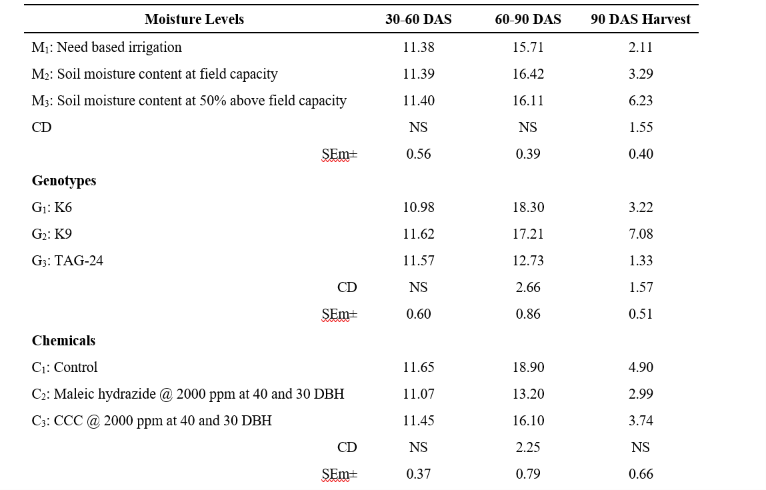
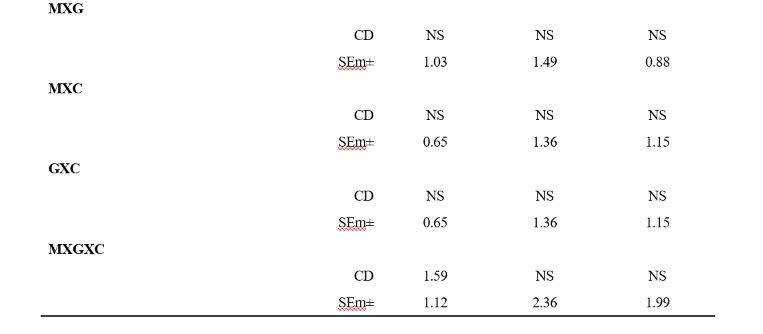
The data (Table 4) revealed that the crop growth rate increased from 30-60 DAS to 60-90 DAS and later on showed a decreasing trend. Significant differences in CGR was observed at 60-90 DAS and 90 DAS to harvest period.
The effect of moisture levels on crop growth rate were found to be significant “90 DAS-Harvest” moisture levels differed significantly, wherein M3 (50% above field capacity) recorded significantly higher CGR (6.23 g dm-2 day-1) followed by M2 (field capacity) (3.29 g dm-2 day-1) and M1 (need based irrigation) (2.11 g dm-2 day-1).
As the moisture treatments were imposed from 20 days before harvest the availability of higher moisture might have caused more crop growth rate. Pranusha (2011) also found out that increased CGR and NAR values were maintained up to 55-75 DAS and declined thereafter in groundnut genotypes.
CGR did not differ significantly among the genotypes at 30-60 DAS. However, at 60-90 DAS, K6 recorded significantly highest CGR (18.3 g dm-2 day-1) which was at par with K9 (17.2 g dm-2 day-1) followed by TAG-24 (12.7 g dm-2 day-1). However, at ‘90-harvest’ K9 recorded significantly highest CGR (7.08 g dm-2 day-1) followed by K6 (3.22 g dm-2 day-1) and the lowest CGR was observed with TAG-24 (1.33 g dm-2 day-1). This could be due to the differences in crop duration. The duration of K9 was 115 days whereas TAG-24 was harvested at 95 DAS.
The results are in concurrence with Nautiyal et al. (2002) who reported a significant difference among the genotypes with respect to CGR at different stages of crop growth, yield and its component characters.
The data revealed that the influence of growth regulating chemicals on CGR was only at 60-90 DAS, wherein significantly highest CGR was recorded with control (18.9 g dm-2 day-1). CGR was decreased by 30.6 per cent with MH @ 2000 ppm (C2) and by 15.3 per cent with CCC @ 2000 ppm (C3).
The results therefore showed the influence of growth regulating chemicals in reducing the crop growth rate.
Influence of moisture levels, genotypes and growth regulating chemicals was observed in all morphophysiological parameters. Significant increase due to moisture levels was observed in plant height, leaf area, total dry matter and crop growth rate. Whereas there was no significant difference with respect to SCMR. Variation between genotypes was observed wherein K9 recorded highest plant height, leaf area, SCMR and CGR values and Total dry matter followed by K6 and TAG 24 . Growth regulating chemicals significantly reduced morphophysiological parameters. The reduction being attributed to C2 (MH @ 2000 ppm) and C3 (CCC @ 2000 ppm). No drastic effect was observed due to treatments therefore it can be concluded that growth regulating chemicals can be used to arrest fresh seed dormancy without causing adverse effects.
Dharanguttikar, V.M., Borkar, V.H. 2014. Physiological analysis of groundnut (Arachis hypogaea L.) genotypes. International Journal of Scientific and Research Publications. 4(1):1-9.
Hosseini, N. M., Siddique, K. H. M., Palta, J. A. and Berger, J. 2009. Effect of Soil Moisture Content on Seedling Emergence and Early Growth of Some Chickpea (Cicer arietinum L.) Genotypes. Journal of Agricultural Science and Technology.11: 401-411.
Jare, S.P. 1994. Effect of land layouts and cycocel on growth and yield of summer groundnut (Arachis hypogaea L.) var. ICGS-44. M.Sc. (Ag.) Thesis. Vasantrao Naik Marathwada Krishi Vidyapeeth, Parbhani, India.
Khandagale, V. N. 2011. Effect of maleic hydrazide on growth, yield and seed quality of groundnut (Var. TLG-45). M.Sc. Thesis. Vasantrao Naik Marathwada Krishi Vidyapeeth, Parbhani.
Mukund. 2004. Physiological basis of induction of dormancy in groundnut (Arachis hypogaea L.). M.Sc. (Ag.) Thesis. University of Agricultural Sciences, GKVK, Bangalore.
Nageswara Rao, R.C., Sardar Singh., Siva Kumar, M.V.K., Srivastava, K.L and Williams, J.H. 1985. Effect of water deficit at different growth phases of peanut I. Yield responses. Agronomy Journal. 77: 782-785.
Nautiyal, P.C., Bhanushali, T.B and Vijay Prakash. 2002. Performance of groundnut germplasm at high temperatures during the reproductive phase in Rajasthan, India. International Arachis Newsletter. 22: 18-22.
Pallas, J.E. 1982. Photosynthetic traits of selected peanut genotypes. Peanut Science. 9: 14-17.
Patra, G.J., Ram, S and Sahoo, B.K. 1981. Response of newly developed “OG” groundnut varieties to dates of planting under irrigated conditions. The Andhra Agricultural Journal. 28(5&6): 260-262.
Pradhan, M.K. 1993. Studies on The Induction of Dormancy in Groundnut (Arachis hypogaea L.) by Maleic Hydrazide. M.Sc. (Agri.) Thesis. Orissa University of Agriculture and Technology, Bhubaneswar, India.
Pranusha, P. 2011. Evaluation of pre-release groundnut (Arachis hypogaea L.) genotypes for high water use efficiency, temperature tolerance and root mining traits. M.Sc. Thesis. Acharya N G Ranga Agricultural University, Hyderabad.
Ross, B.B. 2007. Peanut Irrigation. Peanut Production Guide. 64-67.
Turner, F. T and Jund, M. F. 1991. Chlorophyll meter to predict nitrogen top dress requirement for semi dwarf rice. Agronomy Journal. 83: 926-928.
Watson, D.J. 1952. The physiological basis of variations in yield. Advances in Agronomy. 6: 103-109.