

0 Views
Institute of Agribusiness Management, ANGRAU-S.V. Agricultural College, Tirupati-517 502.
This study assessed the economic impact of Warehouse Receipt Finance (WHRF) on red chilli farmers in the Guntur district of Andhra Pradesh and identified the key constraints hindering its adoption. A purposive cum random sampling method was employed to select 144 farmers and were categorized into non-users, cold storage users and WHRF users. Primary data was collected for the agricultural year 2024–25, covering aspects such as cultivation costs, yield, storage expenses, credit access and net returns. The findings revealed that WHRF users achieved significantly higher average selling prices (₹11,857.41/ quintal) and net returns (₹3,025.93/quintal) compared to non-users and cold storage users. The Benefit-Cost Ratio was also highest among WHRF users (1.34), indicating superior profitability. Constraints affecting WHRF adoption were analysed using the Garrett Ranking Technique. The most critical issues identified were insufficient quantum of finance, high interest rates from informal lenders and high warehouse storage costs. Procedural delays, inadequate storage infrastructure and lack of institutional support also emerged as notable barriers. The study concluded that while WHRF offered substantial economic benefits, its wider adoption depends on improved financial, institutional and infrastructural support for smallholder farmers.
KEYWORDS: Benefit-cost ratio, profitability, institutional support, red chilli and warehouse receipt finance.
Agriculture remains a foundational pillar of the Indian economy, contributing 16 per cent to GDP and supporting nearly 46 per cent of the population (Economic Survey, 2024–25). However, it is dominated by small and marginal farmers who often struggle with limited resources, post-harvest losses and volatile markets. Red chilli plays a vital role in India, as it is the world’s largest producer, contributing over 36 per cent to global output (Agmarknet, 2023). Andhra Pradesh leads in national production, with the Krishna-Guntur region being a key chilli-growing belt (Chilli Outlook Report, ANGRAU, 2023–24).
Red chilli cultivation is majorly done in kharif season, with peak harvests from December to March. This results in heavy market arrivals during a short period, causing price crashes and forcing farmers particularly those lacking access to storage and credit to sell at lower prices leading to distress sales. Price volatility, coupled with weak bargaining power and poor market access, significantly reduces farm incomes and discourages long-term sustainability in chilli farming.
Awell-developed Warehouse Receipt System (WRS) is expected to provide the growers with adequate storage conditions and liquidity allowing them to wait for higher prices rather than selling their produce at unfavourable terms right after the harvest (Shwartz, 2024). WRS can significantly enhance agricultural financing by serving as reliable and credible collateral for securing agricultural credit (Mahanta, 2012). Warehouse Receipt Finance (WHRF) has emerged as a viable institutional intervention to address these challenges. By allowing farmers to store their produce in accredited warehouses and use receipts as collateral for credit, WHRF enables them to delay sales until market conditions improve. Recognized by banks and commodity exchanges, negotiable warehouse receipts (NWRs), also called transferable warehouse receipts help to improve liquidity, reduce market risks and enhance price realization. In volatile crop markets like red chilli, WHRF holds the potential to stabilize farmer incomes (Chitra, 2014).
Despite its advantages, WHRF adoption remains limited due to structural and institutional barriers such as poor rural warehousing infrastructure, low awareness, regulatory gaps and distrust in the system. Many smallholders continue to rely on informal credit and face exploitation due to urgent post-harvest sales (Varangis and Larson, 1996). Strengthening the Warehouse Receipt System (WRS), expanding storage capacity and
promoting trust and accessibility can enhance financial inclusion and post-harvest resilience. This article evaluated the impact of WHRF on red chilli farmers and explored the challenges and opportunities for its wider adoption in erstwhile Guntur District of Andhra Pradesh.
The study was undertaken in the erstwhile Guntur District of Andhra Pradesh, a prominent red chilli-growing region. Purposive cum random sampling method was employed to select four major red chilli-producing mandals viz., Gurazala, Dachepalle, Macherla and Medikonduru based on chilli cultivation area. From each mandal, three villages were purposively selected with high red chilli cultivation and 12 red chilli farmers were randomly chosen from each village, resulting in a total sample of 144 respondents. Primary data were collected for the agricultural year 2024–25 using a structured and pre-tested interview schedule.
The respondents were categorized into three groups: WHRF users, cold storage users and immediate sellers (non-users). Data related to socio-economic characteristics, yield, cost of cultivation, storage and finance costs, price realization, credit access and constraints related to WHRF adoption were collected. Descriptive statistics and comparative analysis were used to assess the economic impact of WHRF. To identify key constraints to avail WHRF adoption, Garrett Ranking Technique was employed, wherein farmers ranked major issues, which were then converted into scores to determine their severity. This approach enabled a comprehensive understanding of WHRF’s economic implications and adoption challenges in the region.
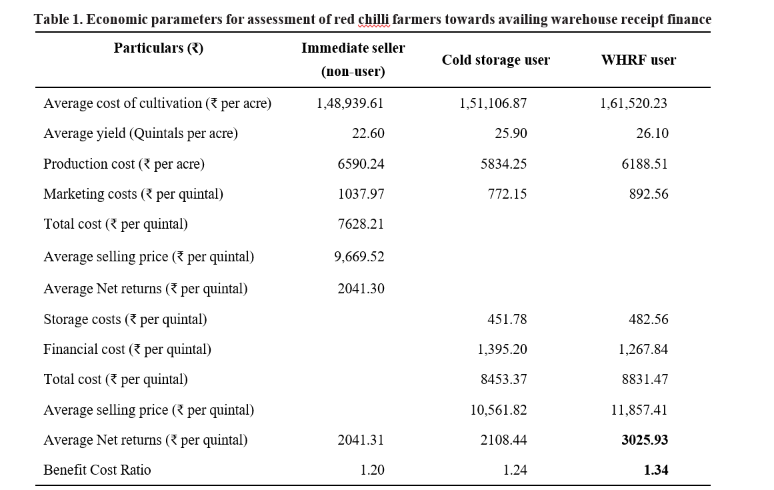
This section aims to assess the economic impact on red chilli farmers through availing warehouse receipt finance (WHRF) in the study area. The information regarding key economic indicators such as cost of cultivation (₹ per acre), yield levels (quintal/acre), marketing expenses (₹ per bag), warehouse storage charges (₹ per bag), interest charges, selling price (₹), etc. were collected from sample respondents. By comparing these parameters across three categories of farmers (immediate sellers, cold storage users and WHRF users) the financial advantages associated with availing WHRF can be studied. The details of the same were presented in Table 1.
The comparative analysis of economic parameters across three farmer categories viz., immediate sellers, cold storage users without WHRF and WHRF users indicated that WHRF offered significant economic benefits. WHRF users recorded the highest average cost of cultivation at ₹1,61,520.23 per acre, compared to ₹1,51,106.87 for cold storage users and ₹1,48,939.61 for immediate sellers. Despite higher cultivation costs, WHRF users achieved better productivity (26.10 quintals/acre), slightly above that of cold storage users (25.90) and notably higher than immediate sellers (22.60).
Marketing and post-harvest expenses further distinguished the three groups. Immediate sellers incurred the highest marketing costs at ₹1,037.97 per quintal, reflecting urgent sales and lower bargaining power. WHRF users, by contrast, managed more efficient marketing at ₹892.56 per quintal, aided by access to structured financing and storage. Although WHRF users faced slightly higher storage costs (₹482.56 per quintal) than cold storage users (₹451.78), their access to formal credit reduced financial costs (₹1,267.84 per quintal) compared to the heavy burden of informal loans for cold storage users (₹1,395.20).
The financial outcomes were striking. WHRF users realized the highest average selling price of ₹11,857.41 per quintal, followed by ₹10,561.82 for cold storage users and ₹9,669.52 for non-users. As a result, WHRF users achieved the highest net return of ₹3,025.93 per quintal, significantly above the returns for cold storage users (₹2,108.44) and non-users (₹2,041.30). This improvement was further reinforced by a higher Benefit-Cost (B:C) ratio of 1.34 for WHRF users, compared to 1.24 and 1.20 for cold storage users and immediate sellers respectively. These outcomes underline the potential of WHRF in enhancing income security by reducing the need for distress sales and enabling better price realization through strategic market timing.
To understand the constraints of red chilli farmers for the adoption of warehouse receipt finance Garrett
ranking was employed. Nine constraints were identified that include higher interest rate by informal sources, delayed loan processing, insufficient quantum of finance, inadequate storage facilities, lack of logistic facilities, higher warehouse storage cost, lack of support from lending institutions, awareness for warehouse receipt finance and fear of produce damage. And the sample respondents were asked to rank the challenges. The details were presented in the Table 2.
The outcome of garret ranking is shown in Table 2. It can be seen that the most severe constraint identified was insufficient quantum of finance, which secured the highest mean score of 63.99 and was ranked I. This indicates that the loan amount sanctioned under warehouse receipt finance schemes does not adequately meet the working capital requirements of farmers. As a result, farmers are unable to fully benefit from the scheme, particularly during post-harvest periods when liquidity needs are high. The second major constraint was higher interest rate charged by informal sources, with a mean score of 62.61 and was ranked II. This suggests that despite the availability of warehouse receipt finance, farmers continue to rely on informal credit sources due to accessibility and flexibility, even though such sources charge higher interest rates. This dependency increases their cost of borrowing and reduces net returns.
Higher warehouse storage cost was ranked III with a mean score of 57.09, indicating that the expenses associated with storage, including rent and maintenance charges, discourage farmers from storing produce for price realization. High storage costs reduce the economic advantage of postponing sales. The constraint delayed loan processing and documentation obtained a mean score of 53.09 and was ranked IV. This reflects procedural complexities, lengthy documentation requirements and administrative delays that prevent farmers from accessing timely credit, especially during urgent financial needs.
Inadequate storage facilities secured Rank V with a mean score of 50.49, highlighting infrastructural gaps such as insufficient warehouse capacity, poor quality storage infrastructure and limited accessibility in rural areas. Then, Lack of support from lending institutions was ranked V with a mean score of 47.97, indicating insufficient guidance, follow-up services and institutional encouragement for farmers to adopt WHRF.
Further, lack of logistic facilities was placed in Rank VII with a mean score of 35.03, suggesting transportation difficulties and handling constraints that add to operational challenges. And fear of produce damage ranked VIII with a mean score of 34.09, reflecting farmers’ concerns about quality deterioration, pest infestation or spoilage during storage.
Finally, awareness about warehouse receipt finance was ranked IX with the lowest mean score of 31.77, implying that awareness exists to some extent among respondents and is relatively less severe compared to financial and infrastructural constraints. Thus, the Garrett ranking analysis clearly highlighted that, issues related to inadequate loan amounts, high interest rates and procedural delays significantly limited farmers’ access to timely and affordable credit. Additionally, infrastructural and logistical shortcomings, coupled with limited awareness and institutional support, further constrained the adoption of WHRF. Addressing these challenges through policy interventions, would improve financial outreach and enhanced infrastructure is essential to strengthen farmers’ participation in warehouse-based financing systems.
The study aligned with the results of Jairath et al. (2016) who in their study also identified that high interest rate, insufficient quantum of finance and delayed loan processing and documentation were constraints faced by red chilli growers.
The study evaluated the economic impact of WHRF and identified barriers to its adoption among red chilli farmers in Guntur District. The analysis revealed that WHRF users realized a significantly higher average price of ₹13,297 per quintal, compared to ₹12,365 for cold storage users and ₹10,479 for immediate sellers (non-users). Net returns per acre were also notably higher for WHRF users at ₹1,77,299, followed by ₹1,43,830 for cold storage users and ₹1,00,452 for non-users. Furthermore, the benefit-cost ratio was most favourable for WHRF users at 1.34, compared to 1.24 and 1.20 for the other groups respectively. These differences highlight the profitability and risk-mitigating potential of WHRF. The Garret ranking analysis revealed that insufficient quantum of finance was the most critical constraint faced by red chilli farmers in adopting warehouse receipt finance (WHRF), with the highest mean score of 63.99. This indicates that the sanctioned loan amounts were often inadequate to meet actual financial requirements.
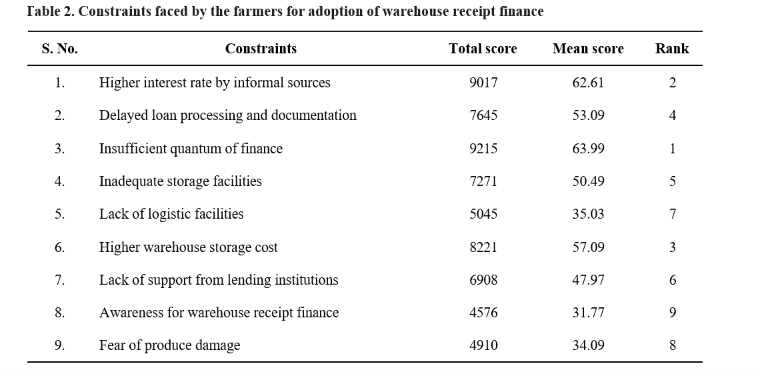
It was followed by the high interest rates from informal sources (62.61) and high warehouse storage costs (57.09), both of which discouraged farmers from using WHRF. Delayed loan processing and documentation ranked fourth (53.09), pointing to procedural delays. Inadequate storage facilities (50.49) and lack of support from lending institutions (47.97) reflected infrastructural and institutional gaps. Logistic challenges (35.03), fear of produce damage (34.09) and limited awareness about WHRF (31.77) were ranked lower, suggesting these were less critical but still notable concerns.
Acharya N.G. Ranga Agricultural University. 2023. Chilli Outlook Report: June to May 2023–24. Agricultural Market Intelligence Centre, ANGRAU, Guntur. Accessed from: https://angrau.ac.in/downloads/ AMIC/OutlookReports/2023_24/chillis%20 outlook-June-july-2023-24.pdf
Agmarknet. 2023. Market arrivals and prices of agricultural commodities. Ministry of Agriculture & Farmers Welfare, Government of India. Accessed from: https://agmarknet.gov.in
Chitra, P.S. 2014. Factors influencing the use of warehouse receipts as a financial instrument in Kenya. M.B.A Thesis submitted to University of Nairobi.
Government of India, Ministry of Finance. 2025. Economic Survey 2024–25. Accessed from: https:// www.indiabudget.gov.in/economicsurvey.
Itin-Shwartz, B and Kimhi, A. 2024. The effect of warehouse receipt finance on farmers’ terms of trade: Evidence from India. Working Paper. 2024-04.
Jairath, M.S., Haque, E and Anu, P.V. 2016. Issues limiting the progress in negotiable warehouse receipt (NWR) financing in India. Agricultural Economics Research Review. 29(1): 53-59.
Lacroix, R and P. Varangis 1996. Using warehouse receipts in developing and transition economies. Finance and Development. 33(3): 36-39.
Mahanta, D. 2012. Review of warehouse receipt as an instrument for financing in India. International Journal of Scientific and Technology Research. 1(9): 42-45.