

0 Views
Department of Entomology, ANGRAU-S.V. Agricultural College,Tirupati-517 502.
A field survey was conducted in Madurai and Virudhunagar districts of Tamil Nadu for the collection of aphidophagous coccinellids associated with pulses and oilseed crop ecosystems. A total of ten coccinellids were identified from both pulses and oilseed crop ecosystems. Out of which eight species viz., Coccinella septempunctata (Linnaeus), Coccinella transversalis (Fabricius), Cheilomenes sexmaculata (Fabricius), Scymnus nubulis (Mulsant), Illeis cincta (Fabricius), Micraspis discolor (Fabricius), Anegleis cardoni (Weise), Harmonia octomaculata (Fabricius) were identified from pulse crop ecosystems and ten species viz., Coccinella septempunctata (Linnaeus), Coccinella transversalis (Fabricius), Cheilomenes sexmaculata (Fabricius), Scymnus nubulis (Mulsant), Illeis cincta (Fabricius), Micraspis discolor (Fabricius), Anegleis cardoni (Weise), Harmonia octomaculata (Fabricius), Brumoides suturalis (Fabricius) and Paraexochomus nigripennis (Erichson) were identified from oilseed crop ecosystems. Out of this, Paraexochomus nigripennis was reported for the first time from Tamil Nadu.
KEYWORDS: Aphidophagous, coccinellids, pulses, oilseeds.
Ladybird beetles (family Coccinellidae) belong to the superfamily Cucujoidea, suborder Polyphaga and order Coleoptera. The family Coccinellidae comprises of several subfamilies, viz., Chilocorinae, Coccinellinae, Coccidulinae, Scymninae, Sticholotidinae, and Epilachninae. Of these, all except Epilachninae are predominantly predatory, while Epilachninae is phytophagous. Approximately 6,000 species of coccinellids are recorded worldwide (Vandenberg, 2000). Nearly 90 per cent of the species are insect predators, mainly targeting members of Sternorrhyncha. Tribes viz., Scymnini, Hyperaspini, and Aspidimerini specialize in aphid predation. The subfamily Coccinellinae are largely aphidophagous, though some feed on coccids and each taxonomic group shows prey specificity. Studying the diversity of coccinellids in any crop ecosystem offers insights into sustainable insect pest management. The present study focused on documenting the aphidophagous coccinellid diversity in pulse and oilseed crop ecosystems of Tamil Nadu.
The present investigation was undertaken during 2024–25 at the Department of Entomology, S.V. Agricultural College, Tirupati. Systematic surveys were conducted in Madurai and Virudhunagar districts of Tamil Nadu to collect coccinellid beetles from pulse and oilseed crops. Specimens were collected by using sweep net and hand picking methods. The collected beetles were euthanized using ethyl acetate and subsequently dried in a hot air oven at 45–50°C for 5–6 hours. Dried specimens were preserved in screw-capped glass vials with appropriate labels indicating crop and date of collection.
Coccinellid specimens were placed dorsally on a China clay block, and abdomens were separated under a binocular microscope. The abdomens were treated with freshly prepared 10 per cent KOH to digest soft tissues, either overnight at room temperature or heated at 50–60°C. Digestion time varied with specimen condition. Post-digestion, abdomens were washed in distilled water and softened tissues were removed using blunt needles. Cleared abdomens were mounted in glycerin for dissection. Male genitalia were dissected and examined under a Stereozoom binocular microscope for detailed observation. Morphological characterization was carried out following the terminology proposed by Sasaji (1971) and Poorani (2002).
A total of 10 coccinellid species belonging to 9 genera under 3 tribes of family Coccinellidae were identified from the pulses and oilseeds crop ecosystems in Tamil Nadu. The coccinellid species viz., Coccinella septempunctata (Linnaeus), Coccinella transversalis (Fabricius), Cheilomenes sexmaculata (Fabricius), Scymnus nubulis (Mulsant), Illeis cincta (Fabricius), Micraspis discolor (Fabricius), Anegleis cardoni (Weise), Harmonia octomaculata (Fabricius) were identified from pulse crop ecosystems and the species viz., Coccinella septempunctata (Linnaeus), Coccinella transversalis (Fabricius), Cheilomenes sexmaculata (Fabricius), Scymnus nubulis (Mulsant), Illeis cincta (Fabricius), Micraspis discolor (Fabricius), Anegleis cardoni (Weise), Harmonia octomaculata (Fabricius), Brumoides suturalis (Fabricius) and Paraexochomus nigripennis (Erichson) were identified from oilseed crop ecosystems.
Key taxonomic and morphological features of the identified species are summarized below for confirmation.
The following two species are belongs to the Subfamily: Chilocorinae; Tribe: Chilocorini
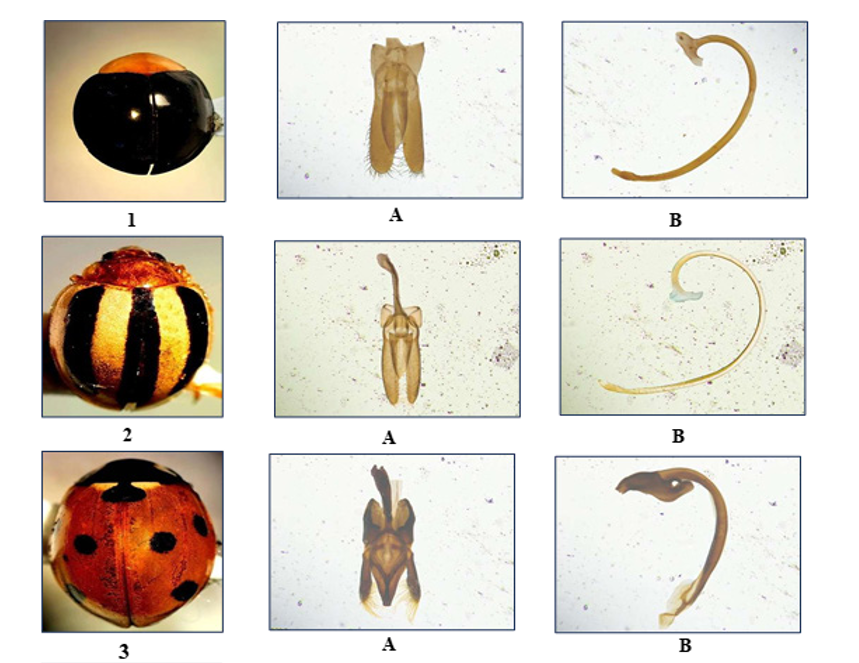
Body oval, dorsum moderately convex and glabrous. Head and pronotum yellowish; elytra black, shiny. Tegmen asymmetrical, parameres elongate and apically incurved. Aedeagus broad basally, tapering to a pointed apex. Sipho slender, slightly curved; spermatheca sclerotized, bulbous at base with coiled duct.
Head, antennae, pronotum, and thorax reddish brown; eyes black. Elytra yellowish brown with two longitudinal black stripes. Legs brown; venter brown to dark brown. Ninth abdominal apophysis broad basally, bifid apically. Sipho curved, T-shaped basally, with broadened apex. Siphonal capsule elongate, quadrate, with slender inner process. Spermatheca robust, strongly curved, with a distinct W-shaped inner margin.
The following 7 species belongs to Subfamily: Coccinellinae; Tribe: Coccinellini
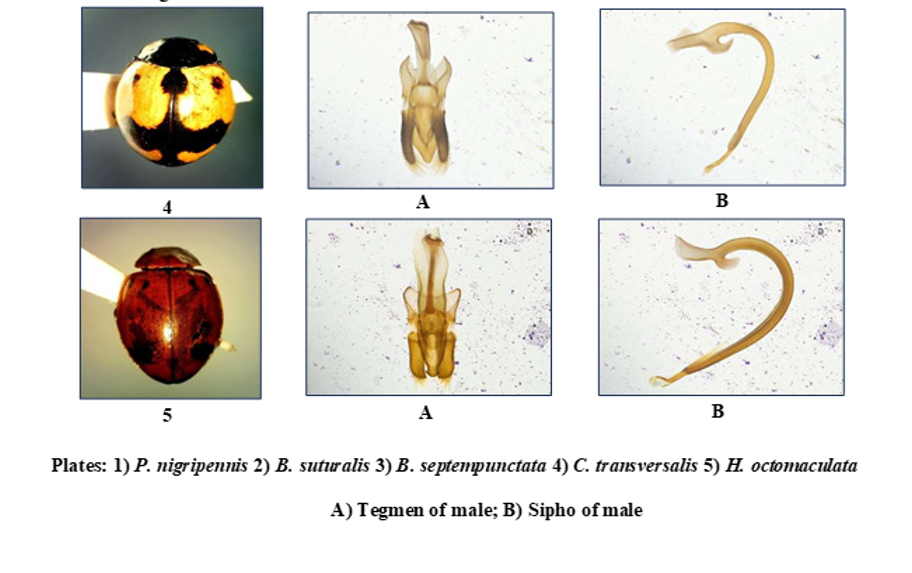
Head black with brown eyes, yellow spots near eye margins; antennae dark brown. Pronotum black with yellow lateral spots; elytra with seven black spots. Legs black, simple; tarsi cryptotetramerous; claws paired. Sipho short with bilobed membranous apex; tegmen short with tapered median lobe. Spermatheca strongly hooked with distinct nodulus and ramus; infundibulum elongate.
Body oval, glabrous, dorsum moderately convex. Head black with yellow spots; pronotum black with yellow-orange anterolateral areas. Elytra with variable black markings and black commissural line; venter and legs black. Tegmen asymmetrical; parameres elongate, apically incurved. Aedeagus broad at base, tapering; sipho slender, curved; spermatheca sclerotized with coiled duct.
Head orange to pale brown; eyes black; antennae and mouthparts reddish brown. Pronotum and elytra reddish brown with black posterior maculae; venter dark brown with whitish abdominal spots. Tegmen with short lateral lobes and shorter, distinct median lobe. Sipho basally curved, apically straight with spoon-shaped membranous apex; capsule processes hooked and broadened. Spermatheca broadly V-shaped with uniform width.
Head yellowish with black eyes; antennae and mouthparts yellowish to brown. Pronotum transparent yellow with black posterior spots; elytra pale yellow, shiny. Venter brown; legs yellowish to brown. Tegmen with elongate, densely setose lateral lobes; median lobe longer. Sipho C-shaped with spatulate apex; spermatheca long, strongly curved.
Head yellow; eyes black; mouthparts and antennae brown. Pronotum pale yellow with basal black markings; elytra orange with black commissural line. Female bright orange, male paler with half-moon black marking on pronotum. Tegmen with elongate setose lateral lobes; median lobe shorter, apically pointed. Sipho curved basally with hooked capsule processes; spermatheca C-shaped with Y-shaped infundibulum.
Head pale yellow with possible black triangular mark on frons; eyes black; antennae and mouthparts brown. Pronotum yellow to orange with black markings; elytra with variable black zigzag patterns and a posterior spot. Sipho basally curved, thread-like apically; capsule
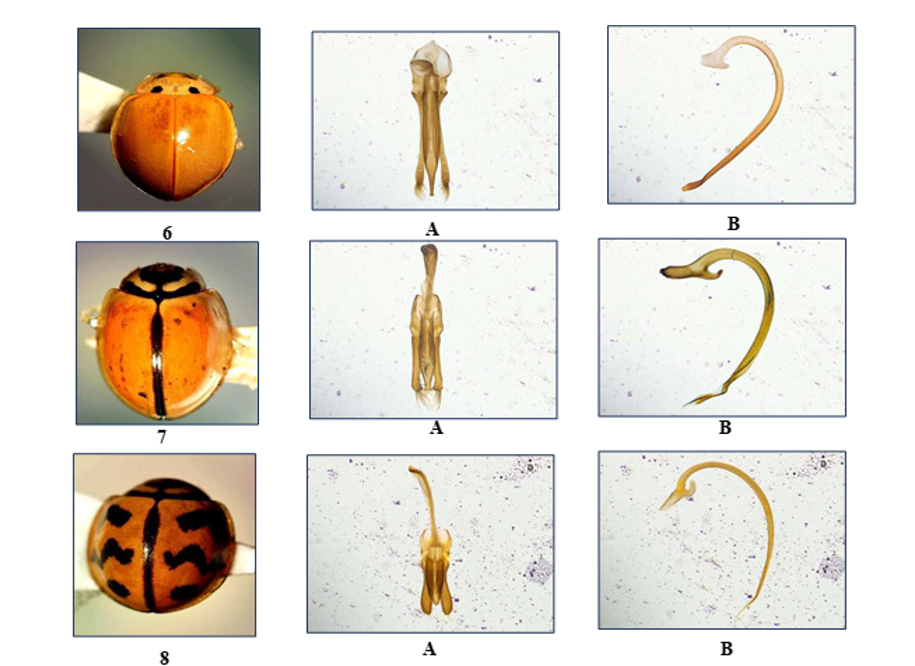
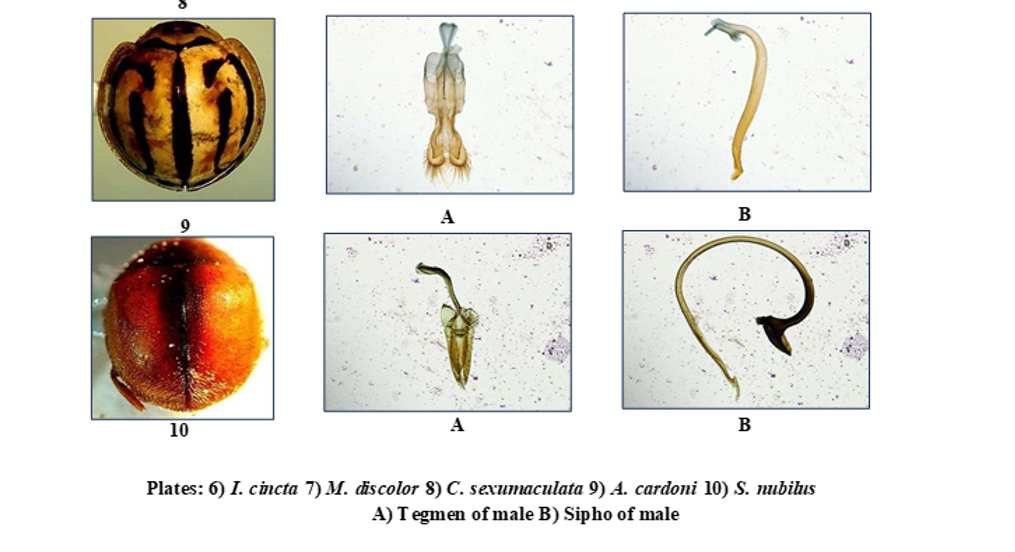
with rounded inner and pointed outer processes. Tegmen with broad median lobe; lateral lobes setose, equal in length. Spermatheca short, stout, kidney-shaped, joined to infundibulum by thread-like process.
Head yellowish brown; eyes black; mouthparts dark brown. Pronotum orange-yellow with two discal spots and posterior black band; elytra orange-yellow with J-shaped stripes and piceous margins. Venter and legs brown. Sipho slightly curved, with bilobed membranous apex and curved inner process. Tegmen with long lateral lobes; median lobe flattened, broadened apically. Spermatheca finger-like, broad at base.
Body very small. Head and pronotum dark brown; pronotum with W-shaped posterior margin, punctate and pubescent; elytra dark brown with black commissural patch, densely pubescent. Venter dark brown; legs brown. Tegmen with short median lobe; lateral lobes elongate, sparsely setose. Sipho basally curved, thread-like apically; capsule with narrow inner and broad outer processes. Spermatheca curved, digitiform.
A comprehensive attempt to aphidophagous coccinellids associated with pulses and oilseed crop ecosystems in Tamil Nadu was not made so far.
Goswami et al. (2016) reported three species viz.,
The results obtained are in compliance with the Vasista et al., 2019 who reported 10 species of coccinellids from pulses and groundnut crop ecosystem in Andhra Pradesh. Sudharani et al. (2017) reported
6 species of Coccinellids viz., C. sexmaculata, C. transversalis, H. octomaculata, B. suturalis, M. discolor and Scymnus (Pullus) coccivora (Ayyar) from pulse crop ecosystems. Rekha et al. (2009) reported three species viz., C. transversalis, M. sexmaculatus , and B. suturalis from pulse crop ecosystems in Madurai district of Tamil Nadu. These findings are also is in accordance with the present findings.
A total of ten coccinellids belonging to 9 genera under the 3 tribes of family Coccinellidae were identified from the pulses and oilseed crop ecosystems which are found predacious on aphids in Tamil Nadu. Out of which eight species of Coccinellids viz., C. septempunctata,
Goswami, T.N., Anil, Chandran, N. 2016. Lady bird beetles in major rabi oil seeds and pulse crops at Sabour, Bihar. International Journal of Science, Environment and Technology. 5(4): 2382–2386
Poorani, J. 2002. An annotated checklist of the Coccinellidae (Coleoptera) (excluding Epilachninae) of the Indian subregion. Oriental Insects. 36: 307-383.
Rani, U. 2016. Taxonomic studies of predaceous Coccin ellid species on pulses in Guntur district. Thesis submitted to ANGRAU. Guntur.
Rekha, B.S., Raguraman, S., Kandibane, M and Swamiappan, M. 2007. Diversity of predatory coccinellids in fruit crops in Madurai and Periyakulam districts of southern Tamil Nadu. The Madras Agricultural Journal. 94(6): 69-75.
Sasaji, H. 1971. Larval Characters of Asian species of the genus Harmonia. Memoirs of the Faculty of Education, Fukui University. Series 2. Natural science. 27(1):1-17.
Sudha Rani, C., Sandhya Rani, C., Krishnayya, P. V and Manoj Kumar, V. 2017. Survey on Predacious Coccinellids of Pulse Crops Cultivating in Guntur District, Andhra Pradesh. The Andhra Agricultural journal. 64 (3): 615-622.
Vandenberg, N.J. 2000. Coccinellidae Latreille. 1807. In: Arnett, R.H., Thomas, M.C., Skelley, P.E and Frank, J.H. (Ed.) American beetles. CRC Press, Boca Raton, FL. 2: 371-389.
Vasista, T., Chalam, M.S.V., Hari prasad, K.V and Mohan Naidu, G. 2019. Species composition of predaceous coccinellids in pulses and groundnut Crop ecosystems of chittoor district, Andhra Pradesh. Andhra Pradesh Journal of Agricultural Sciences. 5(3): 216-221.