

0 Views
Institute of Agribusiness Management, ANGRAU-S.V. Agricultural College,Tirupati-517 502.
The present study was carried out in 2024 to explore the challenges and opportunities of rural women in agripreneurship. It was purposively conducted in Palnadu district of Andhra Pradesh, India. The sample size of respondents taken was 90, who were randomly selected from six randomly selected villages. Data was collected through pre-structured interview schedule to gauge constraints and opportunities of the women entrepreneurs. Frequency and percentage analysis is the statistical tool employed to analyse the data. The empirical findings of the study revealed that constraints faced by the rural women entrepreneurs showed that Socio-cultural constraints ranked first (96.67%) followed by Marketing constraints second (94.44%), constraints in finance ranked third (87.78%), constraints in raw materials ranked fourth (82.22%), constraints in power ranked fifth (68.89%), entrepreneurial constraints ranked sixth (64.44%) and constraints in labour ranked seventh (53.33%). Opportunities for rural women in agri-preneurship perceived by the respondents were ranked by their importance according to the perception of sample respondents. Employment generation emerged as the top opportunity, with a mean score of 58.93, indicating its significant role in empowering rural women.
KEYWORDS: Women agripreneurship, challenges, opportunities.
Women agripreneurship refers to the entrepreneurial activities undertaken by women in rural areas within the agricultural sector. This includes a wide range of enterprises such as crop production, livestock farming, agro-processing, and value-added agricultural activities. Rural women agripreneurs are key players in the local and national economies, driving innovation, ensuring food security, and contributing to poverty alleviation. Their involvement in agripreneurship not only provides them with income but also enhances their decision- making power within their households and communities, fostering greater gender equality. Hence, involvement of women in income generating activities helps to empower them economically (Mubeena et. al., 2017).
Despite their significant contributions, rural women face multiple challenges that limit their entrepreneurial potential. These challenges often stem from socio-cultural norms that restrict women’s roles, limited access to financial resources, inadequate infrastructure, and lack of training and education in modern agricultural practices. Additionally, rural women agripreneurs frequently encounter difficulties in accessing markets and technology, which further hampers the growth of their enterprises. Devi et. al. (2023) highlighted the challenges faced by women agri startups in Manipur such as lack of funding, poor transportation, non-availability of skilled workers or weavers, limited market access, and lack of guidance and technical assistance. They indicated that business in value addition has great scope and with the aid of incubators, the women’s startup can achieve tremendous growth. Jebadurai (2013) explored the issues faced by rural entrepreneurs such as finance shortages, raw material scarcity, purchasing power of rural populations, and competition and suggested educating the rural population about entrepreneurship, providing low-interest finance, and government support for new ventures. Roy et. al., (2025) explored factors such as education, socio-cultural norms, access to resources, and psychological barriers that influence their involvement in agripreneurship and suggested implementing targeted policies and interventions focused on continued investments in education, financial inclusion, capacity building, and infrastructure development. Rural women need capacity building and training in functional areas such as finance, literacy skills, marketing, production, and managerial skills to enhance their ability to run an entrepreneurial business (Charitha et. al. 2023).
The agripreneurship offers numerous opportunities for rural women. It provides a pathway for economic empowerment, allowing women to diversify their income sources and invest in their families’ futures. Sehrawat et. al., (2025) in their study highlighted the status of the women Agri-entrepreneurs, their importance and the problems and obstacles faced by them in terms of opportunities and challenges faced with a view to improve their contribution to the economy and for true inclusive growth. Mari Selvam (2024) in his study discussed the challenges and sustainable development opportunities available to women entrepreneurs in the agricultural sector. Agripreneurship promotes sustainable agricultural practices, which are crucial for long-term food security and environmental conservation. By identifying and addressing the specific challenges faced by rural women in agripreneurship, there is a potential to unlock these opportunities, leading to more resilient and prosperous rural communities.
Purposive and multistage random sampling technique was employed for the selection of sample in the present study. Three mandals with good number of women entrepreneurs were selected randomly in Palnadu district. Similarly, following the same criteria, two villages in each mandal were selected. From each village, 15 women agripreneurs were selected randomly making a total of 90 respondents. Based on exhaustive review of literature and expert’s opinion a pre-structured interview schedule was developed to collect the primary data from respondents and then analysed using frequency and percentage analysis for constraints and Garett ranking technique for analyzing opportunities.
To find out the major constraints faced by the farmers; Garrett’s ranking technique was used. The prime advantage of this technique over simple frequency distribution is that the constraints were arranged based on their severity from the point of view of respondents. Hence, the same number of respondents on two or more constraints may have been given different rank. Garrett’s formula for converting ranks into percent is:
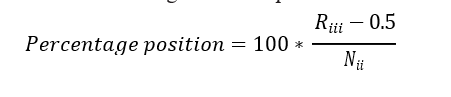
Where,
Rij = Rank given for ith factor by jth individual
Nj = Number of variables ranked by the jth individual With the help of Garrett ranking table given
by Garret and Woodworth (1969), the per cent position estimated is converted into scores. Then for each constraint, the scores of each individual were added and then the total value of scores and mean values of score was calculated. The constraints having the highest mean value was considered to be the major constraint. The final ranking of the constraints in order to fix their relative priority was done on the basis of their mean score.
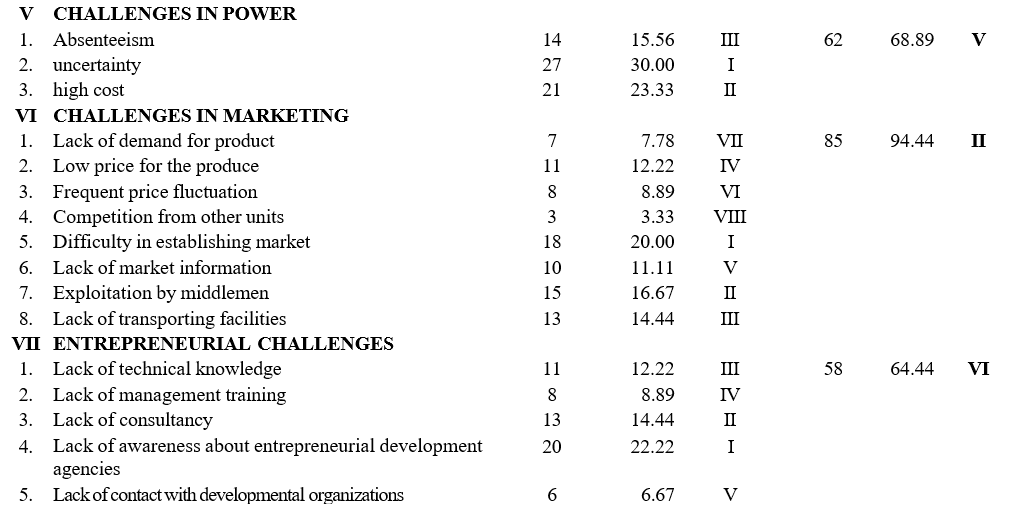
From the table 1, among the challenges faced by the rural women entrepreneurs, Socio-cultural challenges ranked I (96.67%) followed by marketing challenges II (94.44%), challenges in finance III (87.78%), challenges in raw materials IV (82.22%), challenges in power V (68.89%), entrepreneurial challenges VI (64.44%) and challenges in labour ranked VII (53.33%).
Challenges in raw materials ranked Ⅳ was conceived as the fourth main problem (table 1) in which high prices (30.00%), transportation problem (25.56%), scarcity (14.44%), low quality (12.22%), were the major challenges with respect to raw material availability.
Challenges in finance ranked Ⅲ was conceived as the third main problem (table 1) in which shortage of in-hand finance for fixed and working capital (34.44 %) was viewed as the main problem followed by high rate of interest (23.33 %), low benefit-cost ratio (17.78 %), lack of financial assistance from banks and government agencies (8.89 %), lack of knowledge regarding financial scheme (3.33 %) were the major problems under challenges in accessing finance.
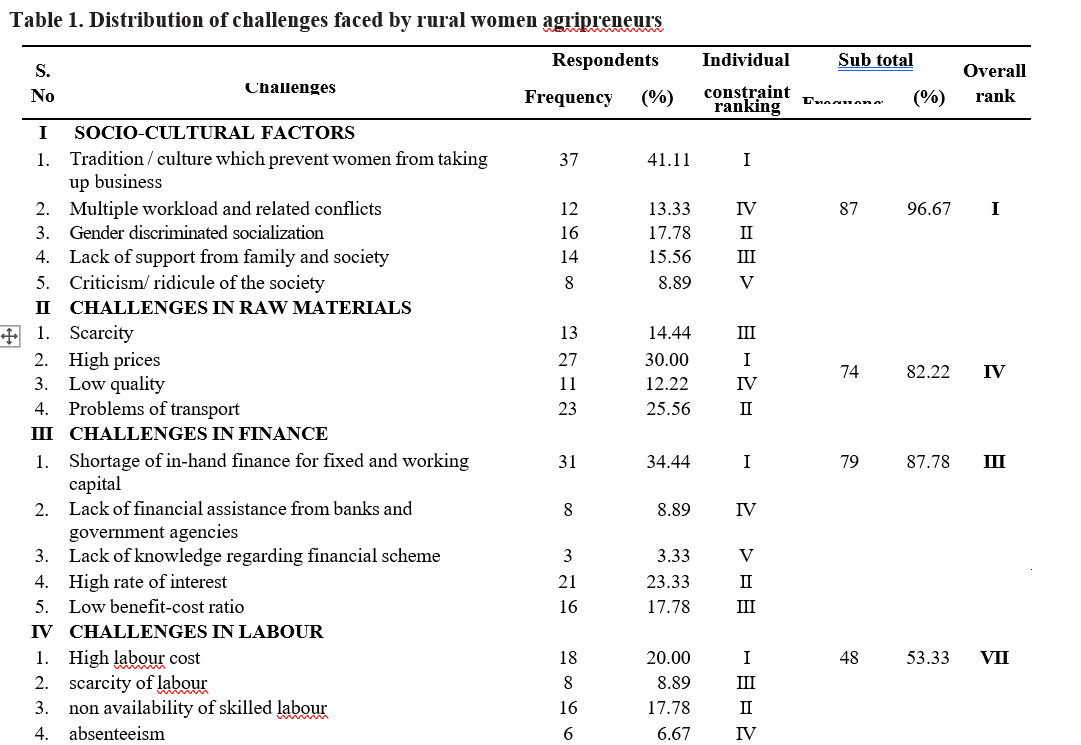
Challenges in case of labour which was ranked VII was conceived as the seventh main problem (table 1) in which high labour cost (20.00 %), non-availability of skilled labour (17.78 %), scarcity of labour (8.89 %), absenteeism (6.67 %) were the major challenges.
Challenges in power which was ranked V was conceived as the fifth main problem (table 1) in which uncertainty (30.00%), high cost (23.33%), absenteeism (15.56%), were the major challenges.
Challenges in marketing which was ranked II was conceived as the second major problem (table 1) in which difficulty in establishing market (20.00%), exploitation by middlemen (16.67%), lack of transporting facilities (14.44%), low price for the produce (12.22%), lack of market information (11.11%), frequent price fluctuation (8.89%), lack of demand for product (7.78%), competition from other units (3.33%) were the major marketing challenges.
Entrepreneurial challenges which were ranked VI was conceived as the sixth main problem (table 1) in which lack of awareness about entrepreneurial development agencies (22.22%), lack of consultancy (14.44 %), lack of technical knowledge (12.22%), lack of management training (8.89 %), lack of contact with developmental organizations (6.67 %) were the major entrepreneurial challenges.
Among all challenges, the socio-cultural factors were overall ranked I was conceived as the main problem (table 1) in which tradition / culture prevent women from taking up business found to be the major constraint (41.11%) followed by gender discriminated socialization (17.78%), lack of support from family and society (15.56%), multiple workload and related conflicts (13.33%) and criticism/ ridicule of the society (8.89%) were the main socio-cultural factors faced by the respondents. Similar results were obtained by Pharm and Sritharan (2013) wherein the key challenges faced by women entrepreneurs in rural settings include social barriers, lack of financial support, and issues with training and skill development. Similar study was conducted by Mubeena et. al. (2017) which revealed that marketing constraints, technical constraints, economic constraints, social constraints were the major constraints faced by rural women entrepreneurs in Kurnool district.
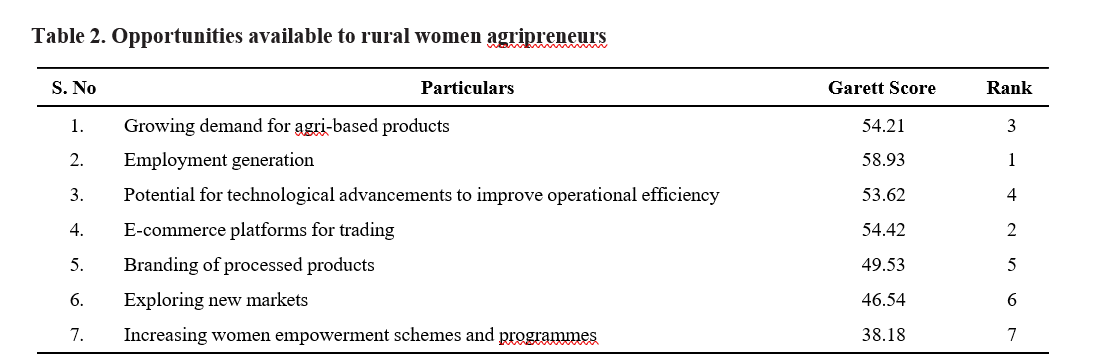
Ramesh (2020) reviewed agri-entrepreneurial opportunities across various sectors, including inputs, bio-pesticides, bio-fertilizers, vermicomposting, soil testing and modification, organic farming, balanced use of fertilizers and pesticides, agrochemicals, and crop rotation. From table 2, it reveals that there are several key opportunities for rural women in agri-preneurship, which are ranked by their importance according to the perception of sample respondents. Employment generation emerges as the top opportunity, with a mean score of 58.93, indicating its significant role in empowering rural women. E-commerce platforms for trading follow closely as the second-ranked opportunity,
with a mean score of 54.42, highlighting the growing importance of digital avenues for expanding market reach. The increasing demand for agri-based products is the third-ranked opportunity, with a mean score of 54.21, reflecting the potential for rural women to capitalize on this trend. Technological advancements to improve operational efficiency ranked fourth, with a mean score of 53.62, showing the potential opportunity for innovation to enhance productivity. Branding of processed products is the fifth-ranked opportunity, scoring 49.53, which emphasizes the value of differentiating products in the market. Exploring new markets ranked sixth, with a mean score of 46.54, indicating the importance of expanding beyond traditional markets. Finally, increasing women empowerment schemes and programs ranked seventh, with a mean score of 38.18, highlighting the ongoing efforts to support and empower women in the agricultural sector. Similar results were found in the studies of Gautam and Mishra (2016) and Jayabal and Soundarya (2016) which emphasized that supporting rural women entrepreneurs with needed assistance from government bodies, family, male colleagues, and financial agencies could significantly boost rural economic development. Similarly, Siddiqui (2012) in his paper stated that the problems of women entrepreneurs can be eradicated by appropriate training, incentives, encouragement and motivation, social recognition of their entrepreneurial abilities, and family’s moral support.
Rural women agripreneurs in Palnadu district face significant challenges, with socio-cultural barriers being the most critical, followed by marketing and financial difficulties. Challenges in accessing raw materials, labor, and power further complicate their efforts. Despite these hurdles, there are substantial opportunities, such as employment generation, e-commerce platforms, and growing demand for agri-products. Technological advancements, branding, market exploration, and increased support through women empowerment schemes offer pathways for overcoming obstacles and achieving entrepreneurial success.
Charitha, S., Kumari, V. and Shukla, P. 2023. Documentation of Women leaders as Farmers/ Entrepreneurs, Women-led Agri start-ups and FPOs. Manage Center for Gender in Agriculture, Nutritional Security and Urban Agriculture. National Institute of Agricultural Extension Management (MANAGE), Hyderabad, Telangana, India
Devi, H.N., Halim, R.A., Deka, N. and Naresh, H. 2023. Economic Analysis of Women Agri Startups in Manipur. Economic Affairs. 68(4): 1911-1919
Gautam, R.K. and Mishra, K. 2016. Study on rural women entrepreneurship in India: Issues and Challenges. International Journal of Applied Research. 2(2): 33-36.
Garret, H.E. and Woodworth, R.S. 1969. Statistics in Psychology and Education. Vakils, Feffer and Simons Pvt. Ltd., Bombay. 329
Jayabal, G. and Soundarya, M. 2016. Opportunities and Challenges of Rural Entrepreneurship in India. Asia Pacific Journal of Research, I(XLI). 33-36.
Jebadurai. D. J. 2013. An Overview of Problems of Rural Entrepreneurs in India. International Journal of Advanced Research in Management and Social Sciences. 2(7): 202-208.
Khare, S.K. and Gautam, L. 2014. Rural Women Entrepreneurship in India: Challenges and Opportunities. African Journal of Business Management. 8(7): 235-237.
Mari Selvam. 2024.Agricultural challenges and sustainable development towards women agripreneurs. 13: 118- 125.
Mubeena, Md., Lakshmi, T., Prasad, S.V and Sunitha, 2017. Problems and Suggestions from members of Podupu Laxmi Ikya Sangam. Bulletin Environmental Pharmacology and Life Sciences. 6 (1): 01-04.
Pharm, A., and Sritharan, R. 2013. Problems Being Faced by Women Entrepreneurs in Rural Areas. The International Journal of Engineering and Science. 2(9).
Roy, S., Kumari, C., Kumari, A., and Kumari, P. 2025. A comprehensive review of agripreneurship among farm women in Bihar. International Journal of Agriculture Extension and Social Development. 8: 410-413. 10.33545/26180723.2025.v8.i4f.1799.
Sehrawat, G., Bhardwaj, K. and Bishnoi, D. 2025. Problems and Prospects of Women Agri- Entrepreneurs. Sustainable Entrepreneurship and Family Business for Women’s Empowerment. 337-
Siddiqui, A.B., 2012. Problems Encountered by Women Entrepreneurs in India. International Journal of Applied Research & Studies. 1(1).