

0 Views
Institute of Agribusiness Management, ANGRAU-S.V. Agricultural College, Tirupati-517 502.
The aim of the study, “Market Channel Dynamics of the Fast-Moving Consumer Goods Sector: A Study Premise to Nellore District of Andhra Pradesh”, is to explore the various marketing channels available in the region of Nellore, Andhra Pradesh, the key factors influencing retailers in selecting these channels, the performance efficiency of each, and the nature of cooperation, conflict, and competition among them. Nellore was selected as the focal area due to its unique blend of urban and semi-urban demographics, emerging market infrastructure, and increasing integration of digital and traditional trade formats.
A total of 120 retailers participated in the study, of whom 66.7 per cent were male and 33.3 per cent female. The majority of respondents were middle-aged with considerable experience in FMCG retailing. A structured questionnaire was Prepared to gather socio-economic data, preferences, and perceptions related to different market channels such as wholesalers, manufacturers, carry forward agents, credit agents, and online platforms. The study employed analytical techniques such as percentage analysis, Likert scale, Garrett’s ranking method, and factor analysis to derive key insights into the efficiency and challenges of existing market distribution systems.
This study established demographic patterns influencing channel preference particularly that middle-aged, more experienced retailers strongly favour wholesalers and manufacturers, while younger retailers are more open to exploring online options. Furthermore, the research emphasized that market saturation, inventory management, and fluctuating consumer demand are key constraints hampering channel efficiency.
KEYWORDS: FMCG, marketing channel, effectiveness, factor analysis, retailers, operational efficiency.
The structure and operation of market channels in the FMCG sector play a vital role in ensuring the efficient distribution of a wide variety of products, including food, beverages, personal care items, and household goods. These channels are shaped by India’s distinct socio-economic and demographic landscape. Several factors impact trading conditions within this sector, including product durability, perishability (shelf life), price volatility, profit margins per unit, average customer sales volume, and purchase frequency. FMCG products are typically fast-moving, generate low profit margins per unit, but compensate through high sales volumes. The majority of these products are considered non-durable because of their limited shelf life (Fareniuk, 2022).
The effectiveness of marketing channels is critical to the overall performance of the FMCG sector, especially in rapidly growing markets like India. Efficient channels ensure timely delivery, cost-effective distribution, and increased customer satisfaction. Multiple factors ranging from logistics to marketing support influence this effectiveness (Patel et al., 2025). As consumer demands evolve and competition increases, retailers seek more responsive and dependable marketing systems (Tsey, 2022). This study was undertaken to identify the primary factors affecting marketing channel performance in Nellore district.
The study was conducted using primary data collected from 120 randomly selected FMCG retailers across Nellore district. A structured questionnaire captured retailer perceptions of ten variables related to channel performance. Responses were rated on a 5-point Likert scale ranging from Strongly Disagree (1) to Strongly Agree (5). Factor analysis was used to reduce the data into meaningful components. Prior to analysis, data adequacy was assessed using the Kaiser-Meyer-Olkin (KMO) measure and Bartlett’s Test of Sphericity. The application of factor analysis for identifying underlying dimensions of marketing channel performance has been widely adopted in marketing research (Patel et al., 2025).
The Kaiser-Meyer-Olkin (KMO) measure of sampling adequacy was 0.635, indicating a satisfactory sample size.
Bartlett’s Test of Sphericity was statistically significant (p < 0.001), confirming the appropriateness of factor analysis.
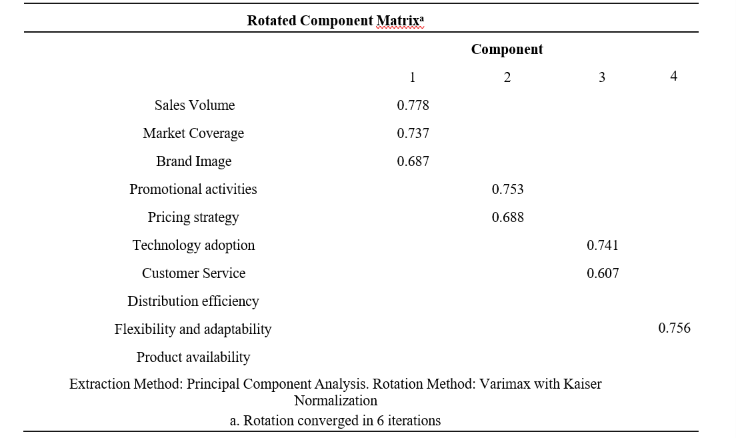
Out of the ten studied variables, four principal components were extracted with eigenvalues greater than one, together explaining 57.73 per cent of the total variance. These components are discussed below:
(Explained Variance: 21.48%)
Sales Volume (0.778)
Market Coverage (0.737)
Brand Image (0.687)
This factor reflects the commercial impact of a marketing channel. High sales volumes and broader market coverage directly translate to better channel effectiveness. Retailers also indicated that products with strong brand recognition tend to move faster and attract more customers. A positive brand image supports demand creation and builds long-term consumer trust, making this component essential for marketing success (Fareniuk, 2022).
(Explained Variance: 13.99%)
Promotional Activities (0.753)
Pricing Strategy (0.688)
Retailers emphasized that attractive promotional campaigns (discounts, bundling, advertising) boost consumer engagement. Equally important is pricing flexibility—FMCG channels that allow margin-based pricing or offer price protection during demand fluctuations are preferred. Effective use of promotional tools and strategic pricing enhances channel competitiveness (Fareniuk, 2022; Patel et al., 2025). Component 3: Technology and Service-Oriented Efficiency (Explained Variance: 12.18%)
Technology Adoption (0.741)
Customer Service (0.607)
The ability of retailers and suppliers to integrate technologies such as inventory tracking, automated billing, and supply forecasting plays a key role in operational efficiency. In addition, after-sales service and grievance redressal mechanisms contribute to customer satisfaction, reinforcing channel loyalty (Tsey, 2022).
(Explained Variance: 10.07%) Flexibility and Adaptability (0.756)
This standalone factor relates to how agile and responsive a channel is to changing market conditions, such as demand shifts, new product introductions, or supply disruptions. Retailers favoured channels that allowed for order revisions, credit adjustments, or switching SKUs based on customer preferences (Tsey, 2022).
Two variables Distribution Efficiency and Product Availability did not load strongly onto any single factor. However, they were consistently mentioned by retailers as necessary baseline requirements. While these may not differentiate channel effectiveness significantly, their absence leads to outright dissatisfaction. Similar observations regarding distribution constraints and product accessibility have been reported in both rural and emerging retail markets (Sarkar & Pareek, 2016; Siddiqui, 2017).
The effectiveness of marketing channels in the FMCG sector is a multi-dimensional construct influenced by factors ranging from tangible performance metrics (sales, coverage) to intangible traits like adaptability and trust. This study highlights that brand presence, promotional strategy, pricing flexibility, technological readiness, and customer service are among the most critical drivers of channel performance in Nellore district.
Retailers operating in this transitional market space prefer channels that are efficient yet adaptable, digital yet
relationship-driven. Thus, manufacturers, wholesalers, and logistics players must recognize these preferences and align their operations accordingly. Policymakers and industry stakeholders should also invest in building capacity through digital infrastructure, retailer training, and regulatory support.
Fareniuk, A. 2022. Strategic Optimization in the FMCG Market. Global Business Review. 21(4): 119-132.
Patel, A., Sharma, N., & Gupta, R. 2025. Distribution Efficiency in FMCG: An Empirical Review. Journal of Marketing Systems. 43(1): 34-48
Sarkar, P. & Pareek, M. 2016. Wholesale Challenges in Rural India. Asian Journal of Retail. 12(1): 40-49.
Siddiqui, M. 2017. Rural Channel Preferences and Distribution Constraints. International Journal of Rural Marketing. 9(2): 22-33.
5Tsey, E. 2022. Multi-Channel Distribution in Retail: Ghana’s FMCG Sector. African Journal of Trade and Logistics. 17(3): 67-79.