

0 Views
Institute of Agribusiness Management, ANGRAU-S.V. Agricultural College, Tirupati-517 502.
The present study aimed to examine the trends in cotton arrivals and prices in five major markets across Andhra Pradesh and Telangana namely Adoni, Jammikunta, Karimnagar, Khammam, and Warangal using secondary monthly data from 2014 to 2024. Linear trend analysis and seasonal index methods were employed to identify temporal patterns in market behavior. Results revealed a significant upward trend in cotton arrivals in Adoni, while the Telangana markets experienced notable declines, potentially due to changing cropping patterns, profitability concerns, and market inefficiencies. Seasonal indices showed peak arrivals during the post-harvest period of October to January, with lean periods from June to September. Conversely, prices across all markets exhibited a consistent and statistically significant upward trend, indicating strong market demand and possible influence of policy support. These findings highlight a contrasting pattern of rising prices amidst declining arrivals, suggesting the need for strategic interventions to stabilize cotton production and enhance market efficiency in the region.
KEYWORDS: Market arrivals, Price trends, Seasonal indices, Trend analysis.
The trends in cotton arrivals and prices is critical for evaluating market efficiency in Andhra Pradesh and Telangana, two major cotton-producing states in India. Cotton markets exhibit notable seasonal and temporal variations due to factors such as harvesting cycles, climatic conditions, policy interventions, and market infrastructure. Previous studies on agricultural commodities like rice, pulses, maize, castor, etc those by Govardhana et. al (2014) and Pandit et. al (2012) revealed that arrivals tend to peak after harvest, causing temporary price drops. Kakde et. al (2013) also reported lower prices during peak arrival months for pulses. Such seasonal price behavior underscores the importance of timely sales and improved storage facilities. Studying these trends enables policymakers and farmers to make better decisions regarding procurement and sales. In the cotton sector, researchers like Naidu Mohan (2014) and Kumar et. al (2015) identified rising trends in both arrivals and prices in select Andhra Pradesh markets. Mahesh et. al (2018) and Kumar et. al (2023) found stable price growth across Haryana markets, although arrivals declined due to shifts in crop preferences. Nagaraja et. al (2023) applied time-series models to analyze arrival trends, demonstrating the effectiveness of statistical tools in forecasting market behavior. These studies collectively highlight the need for region-specific trend assessments. The present study focuses on five major markets Adoni, Jammikunta, Karimnagar, Khammam, and Warangal from 2014 to 2024. It uses linear trend equations and seasonal indices to evaluate variations in cotton arrivals and prices. The insights gained will aid in enhancing marketing strategies, procurement planning, and overall market stability.
The study was conducted to analyze the trends in cotton arrivals and prices in selected major markets of Andhra Pradesh and Telangana, namely Adoni, Jammikunta, Karimnagar, Khammam, and Warangal. These markets were purposively selected based on their significance in cotton trade and consistent data availability. The study utilized secondary monthly data on cotton arrivals (in tonnes) and modal prices (₹/quintal) spanning the period from 2014 to 2024. The required data were collected from authenticated sources such as AGMARKNET, Cotton Corporation of India (CCI), and Indiastat. This secondary dataset enabled an objective and systematic assessment of long-term movements in market arrivals and price levels of cotton across the chosen regions.
To fulfill the first objective of the study, trend analysis was performed using a linear regression model Y=a+bt, where Y is the arrival or price, a is the intercept, b is the slope coefficient, and t is the time variable in months. This model helped determine the direction and magnitude of change in cotton arrivals and prices over the study period. Seasonal variations were examined using the ratio-to-moving-average method to compute seasonal indices, which helped identify the months of peak and lean market activity. A 9-month centered moving average was applied to smooth out fluctuations and isolate seasonal effects. All calculations and graphical analyses were carried out using Microsoft Excel, providing clear insights into the temporal behavior of cotton markets in the selected regions.
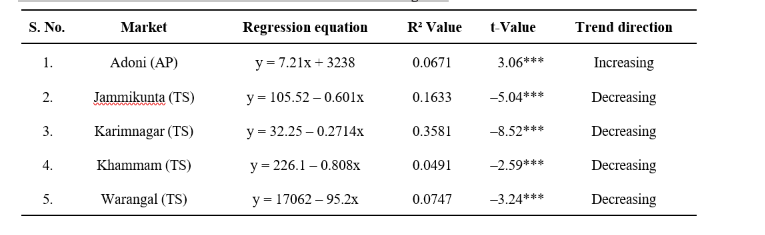
The analysis of cotton arrivals and prices from 2014 to 2024 across major markets in Andhra Pradesh and Telangana revealed significant trends and patterns. The analysis of cotton arrivals across markets in Andhra Pradesh and Telangana in Table 1. reveals mixed trends. Adoni market in Andhra Pradesh showed a significant increasing trend (R² = 0.0671, t = 3.06***), indicating a gradual rise in arrivals. Conversely, markets in Telangana exhibited significant decreasing trends, with Karimnagar (R² = 0.3581, t = –8.52***) and Jammikunta (R² = 0.1633, t = –5.04***) showing strong declines. Khammam and Warangal also recorded notable reductions, though with lower R² values. These trends suggest regional variations in cotton production or market dynamics, potentially influenced by climate, policy, or farmer preferences. Targeted interventions are required to address declining trends in Telangana. The results obtained are similar to findings of Naidu (2014) a significant rise in arrivals in Karimnagar during 2001–2012. However, the current study contrasts this by showing a reversal in trend, indicating possible recent shifts in cropping patterns or market conditions. This suggests a need for updated regional interventions to sustain cotton production.
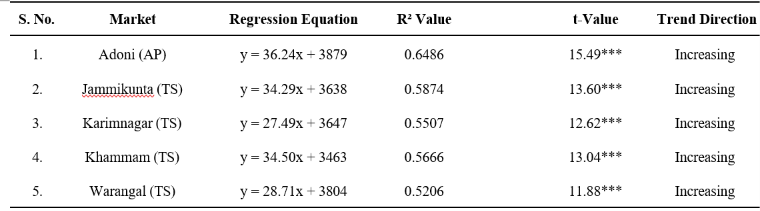
As observed from Table 2, the analysis of cotton prices across five markets in Andhra Pradesh and Telangana reveals a consistent increasing trend. Adoni (AP) shows the strongest trend with the highest R² value (0.6486) and t-value (15.49***), suggesting a robust upward price movement. Among Telangana markets, Jammikunta and Khammam exhibit significant positive trends with high coefficients and strong t-values. Although Karimnagar and Warangal have slightly lower R² values, their trends remain statistically significant. The overall positive slopes confirm a steady increase in cotton prices over time. This upward trend may reflect growing demand, improved market access, or inflationary effects in the region. The results obtained are similar to findings of Mahesh et. al (2018) observed a significant rise in cotton prices across Haryana markets over a decade. Both studies indicate price stability with minimal seasonal fluctuations. Such trends suggest improved price realization and market efficiency over time.
From Table 3, the analysis of seasonal indices for cotton prices across major markets Adoni in Andhra Pradesh, Jammikunta, Karimnagar, Khammam, and Warangal in Telangana reveals significant seasonal variation, with prices typically peaking during the winter months (October to January) and reaching their lowest during the monsoon season (July to September). Adoni
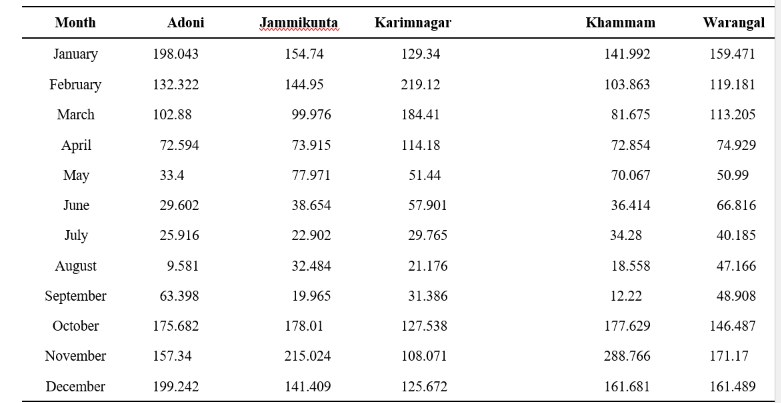
and Khammam showed particularly high indices in December and November, respectively, with Khammam recording thehighestseasonal index of 285.8 in November, indicating that prices in these months are nearly triple the annual average. Conversely, all markets experience price dips during August and July, where indices fall as low as 9.2 (Adoni) and 12.1 (Khammam). These trends align with the cotton crop cycle, where harvesting begins in October, leading to increased supply and market activity. Understanding these seasonal patterns is crucial for farmers, traders, and policymakers to optimize market timing, plan storage, and improve forecasting models for cotton pricing in the region. The results obtained are similar to findings of Kumar et. al (2015) in the Khammam market, where maximum arrivals occurred in November, and the lowest in September. Both studies confirm a strong seasonal pattern in arrivals linked to post-monsoon harvesting. This similarity validates the consistency of arrival behavior across different cotton markets in Andhra Pradesh.
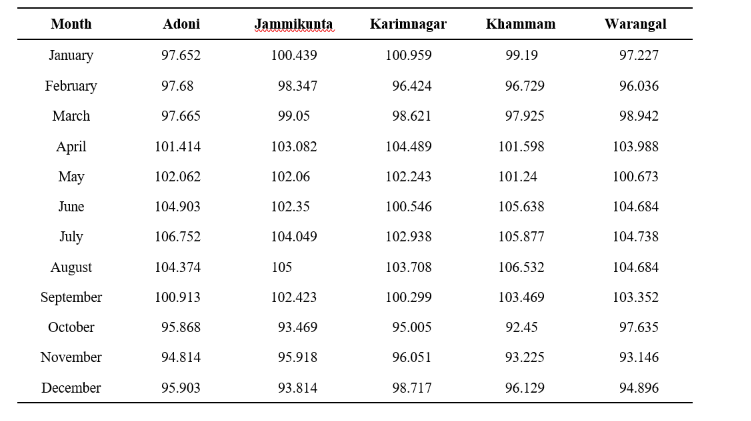
Table 4 depicts, the seasonal indices of cotton prices across major markets in Andhra Pradesh and Telangana. The results revealed distinct monthly price variations, with higher indices observed from April to August and lower indices from October to December. For instance, Adoni reached its peak in July (106.752), while Karimnagar and Jammikunta also showed elevated indices in April (104.489 and 103.082 respectively), indicating stronger prices during the post-harvest and procurement phases. Conversely, markets experienced significant price drops in October and November, with Khammam recording the lowest index in October (92.450), likely due to increased supply from new arrivals. These seasonal trends suggest that farmers could benefit by storing produce and targeting high-index months for sales, while policymakers may consider market interventions during low-price periods to protect farmer incomes. The results obtained are similar to findings of Kumar et. al (2015) in the Khammam market, where seasonal indices of prices remained steady with no significant seasonal spikes. Both studies suggest efficient price transmission and low intra-year volatility. This consistency benefits farmers by reducing market risk during sales.
The analysis of trends in cotton arrivals and prices across selected markets in Andhra Pradesh and Telangana from 2014 to 2024 revealed contrasting patterns. While the Adoni market in Andhra Pradesh showed a statistically significant upward trend in cotton arrivals, the Telangana markets Jammikunta, Karimnagar, Khammam, and Warangal experienced notable declines, possibly due to crop diversification, reduced profitability, or market inefficiencies. Seasonal indices confirmed peak arrivals during the period from October to January, aligning with the harvest season. In contrast to fluctuating arrivals, all markets exhibited a consistent and significant upward trend in cotton prices, indicating robust demand and effective price support mechanisms. This divergence between declining arrivals and rising prices, particularly in Telangana, signals potential supply-side vulnerabilities. These findings highlight the need for targeted policy interventions to strengthen marketing infrastructure, support cotton cultivation, and enhance farmer profitability in the region.
Govardhana, R. G., Solmonrajupaul, K., Vishnu Sankarrao, D and Dayakar, G. 2014. Seasonal variations and forecasting in wholesale prices of rice (paddy). Guntur District of Andhra Pradesh. International Journal of Development Research. 4(11): 2418-2422.
Kakde, S. J., Khobarkar, V and Khule, G. W. 2013. Performance of pulses in Akola District. PKV Research Journal. 37 (1&2): 97-101.
Kumar, G. C., Naidu, G. M., Reddy, B. R and Devi, I. B. 2015. Trends and variations in arrivals and prices of cotton. Andhra Pradesh Journal of Agricultural Sciences. 1: 19–23.
Kumar, R., Bishnoi, D. K., Rathi, A and Prakash, S. 2016. Marketing and price behaviors of onion in Haryana. Indian Journal of Economics and Development. 12(1a): 7-11.
Kumar, V., Goyal, S. K., Kumar, N and Baskaur. 2023. A study on behaviour of arrivals and prices of cotton in different markets of Haryana. Economic Affairs. 68(1): 89–94.
Mahesh, V., Grover, R. K and Geetha, R. S. 2018. Market arrival and price behaviour of cotton in Haryana. Asian Journal of Agricultural Extension Economy and Sociology. 28(4): 1-9.
Naidu Mohan, G. 2014. A statistical study on arrivals and prices of cotton in Karimnagar district of Andhra Pradesh. International Journal Agricultural Statistical Sciences. 10(2): 321-324.
Nagaraja, Y., Jahnavi, A. P., Vinay, H. T and Sushma. 2023. Analysis of Trend in Cotton Arrivals in Vijayapura, Haveri, Raichur and Ranibennur Markets of Karnataka, India. Asian Journal of Agricultural Extension, Economics & Sociology. 41(2): 31–37.
DOI: https://doi.org/10.9734/ajaees/2023/v41i21845
Pandit, A., Samal, P and Mishra, J. R. 2012. An analysis of price behavior of rice in Eastern Indian markets. Indian Journal of Agricultural Marketing. 26(2): 102-109.