

0 Views
Department of Agronomy, ANGRAU-S.V. Agricultural College, Tirupati-517 502.
A field experiment was conducted during rabi, 2024–25 on dryland farm of S.V. Agricultural College, Tirupati, to evaluate the effect of graded levels of phosphorus (0, 20, 40 and 60 kg P₂O₅ ha⁻¹) and zinc (0, 25 and 50 kg ZnSO₄ ha⁻¹) on green fodder yield and economics of fodder cowpea (Vigna unguiculata L.). Present study revealed that higher green and dry fodder yield of fodder cowpea was recorded with the soil application of 60 kg P2O5 ha-1 along with 25 ZnSO4 ha-1 with remunerative returns.
KEYWORDS: Fodder cowpea, green fodder, phosphorus nutrition and zinc nutrition.
Fodder cowpea (Vigna unguiculata L.) is a vital leguminous forage crop valued for its high biomass and protein content under dryland conditions. Phosphorus is critical for energy transfer, root development and reproductive growth, while zinc acts as a cofactor for key enzymes like tryptophan synthetase and superoxide dismutase influences auxin synthesis, photosynthesis and stress tolerance. Integrated phosphorus and zinc fertilization can enhance green fodder yield, nutrient uptake and soil fertility, yet optimal rates remain under-studied. The present investigates the combined effects of phosphorus and zinc application on the productivity and profitability of fodder cowpea.
A field experiment was conducted during rabi, 2024-25 at dryland farm of S.V. Agricultural College, Tirupati. The experimental soil was sandy loam in texture, neutral in soil reaction (pH 7.0), low in organic carbon (0.27 per cent), available nitrogen (230 kg ha-1), medium in available phosphorus (22.7 kg ha-1) and medium in available potassium (235 kg ha-1) and medium in available zinc (2.2 mg kg-1). The experiment was laid out in randomized block design with factorial concept with four levels of Factor-I and three levels of Factor-II and replicated thrice.
The treatments comprise of four phosphors levels viz., 0 kg P2O5 ha-1 (P0), 20 kg P2O5 ha-1 (P1), 40 kg P2O5 ha-1 (P2) and 60 kg P2O5 ha-1 (P3) allotted to Factor-I and three zinc levels viz., 0 kg ZnSO4 ha-1 (Z0), 25 kg ZnSO4 ha-1 (Z1) and 50 kg ZnSO4 ha-1 (Z2) allotted to Factor-II. The test variety of fodder cowpea used in the present experiment was MFC-09, released from Mandya Research Station, Karnataka, India. The recommended basal dose of 25 kg N ha-1, 20 kg K2O ha-1 was applied uniformly as common dose to all the treatments and P2O5 was applied as per the treatments. Fertilizer nitrogen was applied in two equal splits i.e., 50 per cent as basal and 50 per cent at 30 DAS. Entire dose of phosphorus and potassium were applied as basal at the time of sowing. Soil application of zinc sulphate at 20 kg ha-1 was done at 10 DAS as per the treatments. The crop was harvested for green fodder purpose by cutting the plants close to the ground at 50 per cent flowering. The total cost of cultivation of fodder cowpea (₹ ha-1) was calculated for each treatment on the basis of inputs used. Gross returns (₹ ha-1) were computed by considering the prevailing market price of the output. Net returns (₹ ha-1) were arrived at by deducting the cost of cultivation of respective treatments from gross returns for the corresponding treatments. Benefit-cost ratio was calculated by using the following formula.

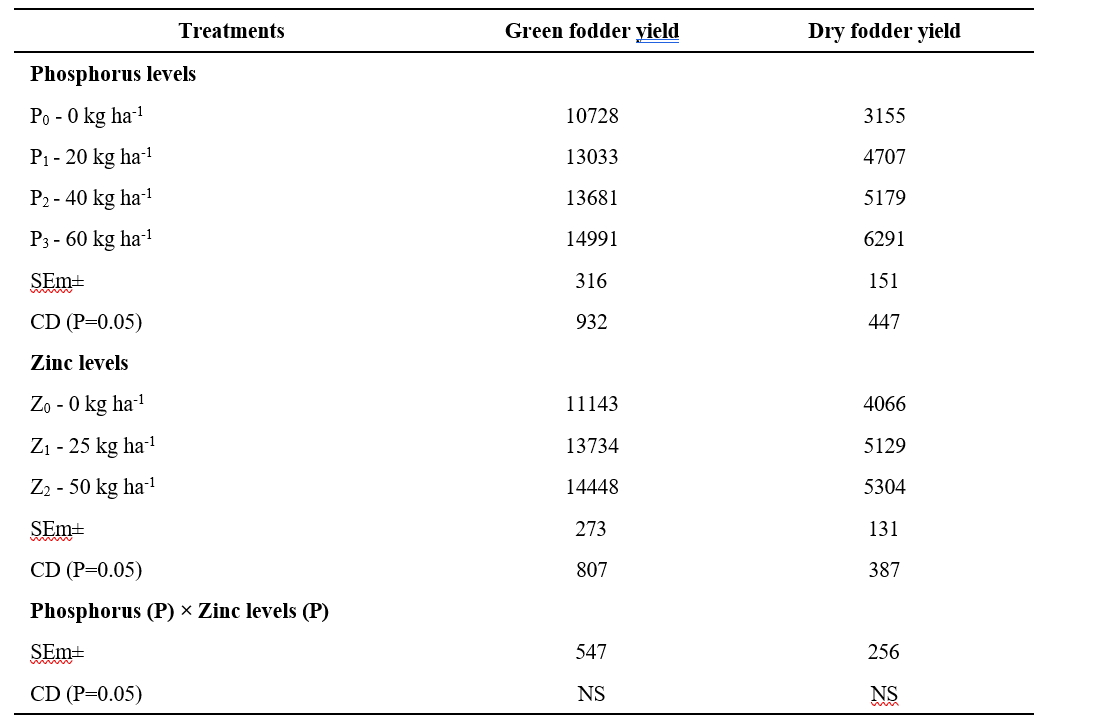
Green and dry fodder yield of cowpea was significantly influenced by different levels of phosphorus and zinc, but interaction effect was found to be non-significant (Table 1).
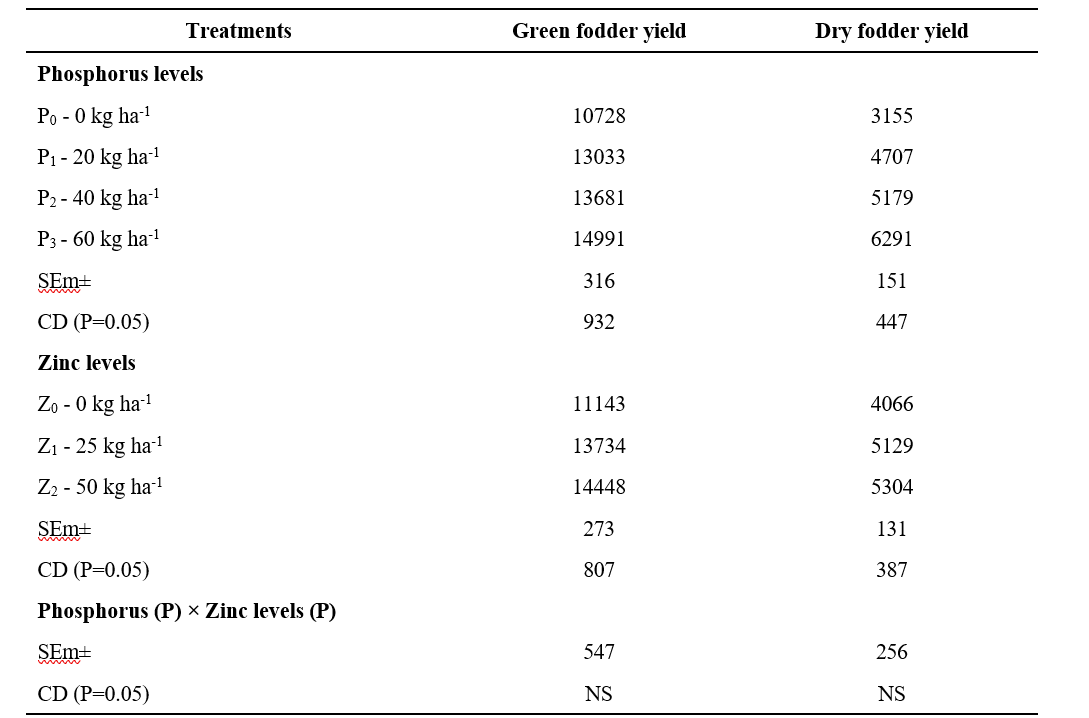
Application of phosphorus significantly influenced the green and dry fodder yield. Higher green (14991 kg ha-1) and dry fodder (6291 kg ha-1) yields were recorded with application of 60 kg P₂O₅ ha-1 (P₃), which was followed by 40 kg P₂O₅ ha-1 (P₂) and it was on par with 20 kg P₂O₅ ha⁻¹ (P₁). Lower green (10728 kg ha-1) and dry (3155 kg ha-1) yields were observed in control (P₀). The improvement in green and dry fodder yield with increasing levels of phosphorus can be attributed to better root development, leading to improved uptake and utilization of nutrients. Phosphorus plays a crucial role in root growth, energy transfer and overall plant vigour, which likely contributed to increased plant height, leaf area, number of leaves plant-1 and number of branches plant-1. These findings were in accordance with the results reported by Bhilare (2003), Shekara . (2012), Dixit et al. (2014) and Mobeena et al. (2020).
Application of 50 kg ZnSO₄ ha-1 (Z2) recorded significantly higher green (14448 kg ha-1) and dry fodder
(5304 kg ha-1) yields of cowpea compared to control (Z0) and 25 kg ZnSO4 ha-1. Which was statistically on par with 25 kg ha-1 (Z1). Significantly lower green (11143 kg ha-1) and dry fodder (4066 kg ha-1) yields were recorded in control (Z0). This enhancement in green and dry fodder yield with application of zinc can be attributed to several physiological and biochemical roles of zinc in plant growth and development. Zinc acts as a cofactor for enzymes and proteins involved in cell division, nucleic acid metabolism and protein synthesis (Marschner, 1986). It also plays a critical role in carbohydrate metabolism and is essential for the biosynthesis of tryptophan, a precursor to indole-3-acetic acid (IAA), which regulates plant growth and development (Oosterhuis et al., 1996). Positive responses of cowpea yield to zinc application have also been reported by Mohan and Singh (2014), Pandey et al. (2019) and Manisha (2021).
The higher gross returns (59966 ₹ ha-1), net returns (34920 ₹ ha-1) and benefit-cost ratio (2.38) of fodder
| cowpea were obtained with the application | of 60 kg The present study concluded that higher green and |
P₂O₅ ha-1 (P3), which was significantly superior to those obtained with 40 kg P₂O₅ ha-1 (P2) and 20 kg P₂O₅ ha-1 (P1), while the lower gross returns (42910 ₹ ha-1) and net returns (18551 ₹ ha-1) and benefit-cost ratio (1.76) were noticed under the control (P0). Higher economic returns with application of 60 kg P2O5 ha-1 was due to higher yield. These results were in agreed with the findings of Kumawat and Khinchi (2017), Mobeena et al. (2020) and Nanda et al. (2023).
Cowpea supplied with 50 kg ZnSO₄ ha-1 (Z2) recorded the maximum gross (57794 ₹ ha-1), net returns (31341 ₹ ha-1), which was statistically on par to 25 kg ZnSO₄ ha-1 (Z1), lower net returns (21617 ₹ ha-1) were obtained from control (Z0). Maximum benefit-cost ratio was recorded with 25 kg ZnSO4 ha-1 (2.22), which was statistically at par with 50 kg ZnSO4 ha-1 (2.18), while the lowest benefit-cost ratio was recorded under control (Z0). These results were supported by Arvind et al. (2020) and Manisha (2021).
dry fodder yield with remunerative returns in fodder cowpea can be realized with the soil application of 60 kg P2O5 ha-1 along with 25 kg ZnSO4 ha-1 on sandy loam soils of Tirupati during rabi.
Arvind B.P., Sanjeev K.G and Sborna R.C. 2020. Enhancing prodctivity and quality of fodder maize through nitrogen and zinc application levels. International Journal of Chemistry Studies. 8(6): 540-545.
Bhilare, R.L., 2003. Effect of phosphorous levels on forage yield of cowpea varietes. Madras Agricultural Journal. 90: 41-43.
Dixit, A.K., Kumar, S., Rai, A.K and Palsaniya, D.R.2014 . Productivity and profitability of fodder sorghum + cowpea – chickpea cropping system as influenced by organic manure, phosphorus and sulphur application in central India. Range Management and Agroforestry. 35(1): 66-72.
Kumawat, S.M and Khinchi, V. 2017. Effect of phosphorus levels on forage yield of promising multicut genotypes of berseem (Trifolium alexandrium L.). Forage Research. 43(3): 223-226.
Manisha. 2021. Evaluation of fodder cowpea varieties under different zinc management practices. M.Sc Thesis. Icar-National Dairy Research Institute, Haryana, India.
Marschner, H. 1986. Functions of mineral nutrients: macronutrients. In: Haynes RJ, editor. Mineral Nutrition of Higher Plants. Academic Press, Orlando, FL. 195–267.
Mobeena, S., Nagamani, C., Reddy, G.P and Umamahesh, 2020. Effect of sowing window and phosphorus levels on growth and yield of summer fodder cowpea. Legume Research – An International Journal. 48(1). 172-175.
Nanda, G., Nilanjaya and Yadav, K.S.A. 2023. Response of forage cowpea genotypes to graded doses of phosphorus application. Forage Research. 48(4): 470-473.
Oosterhuis, D. Hake, K., Burmester, C. 1996. Foliar feeding cotton. Cotton Physiology Today. National Cotton Council of America. 2: 1–7.
Pandey, A.K., Singh, M., Kumar, S., Meena, V. K., Onte, S and Kushwaha, M. 2019. Influence of stage of harvesting and zinc application on yield and zinc uptake in cluster bean [Cyamopsis tetragonoloba (L.) TAUB]. Legume Research-An International Journal. 42(5): 661-665.
Shekara, B.G., Sowmyalatha, B.S and Bharatkumar, C. 2012. Effect of phosphorus levels on forage yield of forage cowpea. Journal of Horticulture Letters. 2(1): 12-13.