

0 Views
Institute of Agribusiness Management, ANGRAU-S.V. Agricultural College, Tirupati-517 502.
Pesticides play a vital role in protecting crops from pest infestations and ensuring food security, particularly in cotton growing regions such as Kadapa district, Andhra Pradesh. where pest attacks are frequent and severe. This study, titled “Preference Patterns of Farmers Towards Pesticide Brands in Cotton Cultivation in Kadapa District,” aimed to identify key information sources, factors influencing brand preference and problems faced by cotton farmers. Four mandals were purposively selected based on the extent of cotton cultivation. From each mandal, three villages were randomly selected, resulting in a total of twelve villages. From each village, ten cotton farmers were randomly selected, accounting for 120 farmer respondents in total. Data were collected through structured interviews and focus group discussions and analyzed using Garrett’s Ranking Technique.
Most influential source of information was fellow farmers and progressive farmers (mean score 71.32, Rank 1), followed by television/radio (64.92, Rank 2) and demonstrations/field days (60.03, Rank 3). Regarding brand preference, previous product experiences ranked highest (mean score 72.75), followed by cost and affordability (64.13) and dealer’s influence (59.03) were the factors influencing. The major problems reported by farmers in using pesticide brands were high price of pesticides (mean score 72.28, Rank 1), poor after sales service (65.02, Rank 2) and presence of spurious products (58.97, Rank 3). The study emphasizes the importance of experiential learning, affordability and dealer networks were influencing farmer decisions, while also highlighting the need for better extension services, credit access and stricter regulation to address key challenges in pesticide usage.
KEYWORDS: Pesticide brand preference, factors influencing, problems, cotton.
Pesticides are indispensable in modern agriculture as they protect crops from pests, diseases and weeds, thereby enhancing yield and ensuring food security. In India, agriculture remains the primary source of livelihood for nearly half of the population and the demand for crop protection chemicals has been rising steadily since the Green Revolution. The Indian pesticide industry, valued at around USD 11.2 billion in 2024-25, ranks fourth globally and is projected to grow annually at about 9 per cent (Rubix Data Sciences, 2025). Despite this growth, pesticide usage patterns vary across crops and regions depending on pest pressure, farmer awareness and brand availability.
Cotton a major commercial crop in India, is particularly vulnerable to pest infestations such as bollworms and sucking pests, which can cause severe yield losses if not effectively managed. Consequently, pesticide use in cotton is higher compared to many other crops. Andhra Pradesh is one of the leading cotton producing states in the country, with about 4.27 lakh hectares under cotton cultivation during 2023- 24 (Directorate of Economics and Statistics, 2024). Kadapa is one of the significant cotton growing districts in the state, leading to greater dependence on pesticide applications.
The availability of a wide range of pesticide brands from national and multinational companies offers farmers multiple options but also makes their decision making complex. Farmers’ brand preferences are shaped by several interrelated factors such as product efficacy, affordability, availability, dealer advice and promotional efforts. Understanding these preference patterns is essential for agrochemical companies to formulate effective marketing strategies and for policymakers to strengthen awareness programmes that encourage the safe and judicious use of pesticides.
The study was conducted in Kadapa district of Andhra Pradesh. Kadapa district was purposively selected due to its significant area under cotton cultivation and the widespread use of pesticide brands by farmers. Four mandals, namely Proddatur, Rajupalem, Mylavaram and Vempalli, were purposively selected based on the extent of cotton cultivation. From each mandal, three villages were randomly selected, making a total of twelve villages. Ten cotton farmers were randomly selected from each village, resulting in a total of 120 respondents.
Primary data were collected through structured interview schedules, personal interviews and focus group discussions, while secondary data were obtained from the Agriculture Department, published reports, pesticide company websites and relevant government portals. Garrett’s Ranking Technique was employed to analyze the market share and preference patterns by converting rank data into scores for prioritization.
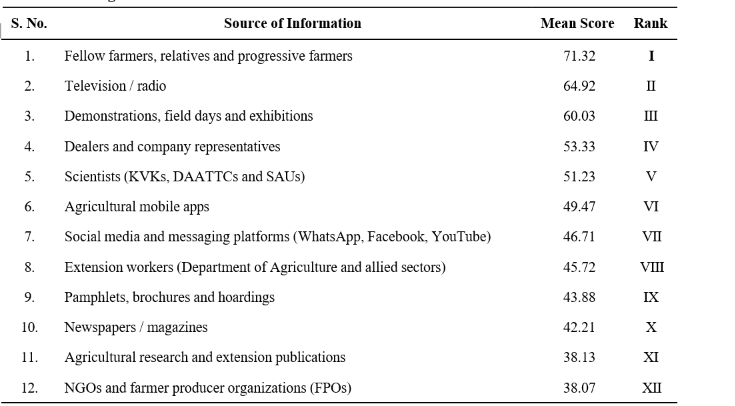
Farmers in the study area accessed pesticide brand information from a variety of sources including fellow farmers, mass media, dealers, institutional experts, mobile apps and social media. Table 1 presents the classification and ranking of different sources of pesticide related information based on farmers’ responses. The data were analyzed using Garrett’s Ranking Technique to assess the relative influence of each source.
Table 1 reveals that the most influential source of information was fellow farmers, relatives and progressive farmers (71.32 mean score), followed by television/ radio (64.92), demonstrations, field days and exhibitions (60.03), dealers and company representatives (53.33) and scientists from KVKs, DAATTCs and SAUs (51.23). These top five sources played a key role in influencing pesticide usage decisions among cotton farmers. Patel and Singh (2020), also reported that interpersonal communication and mass media were the most trusted sources of agricultural information. In contrast, sources such as pamphlets, brochures, extension workers, newspapers and NGOs/FPOs ranked lower, suggesting a limited role in information dissemination.
Farmers were asked to indicate the major factors influencing their selection of a particular pesticide brand. The responses were analyzed using Garrett’s Ranking Technique and are presented in Table 2.
It was found that previous experience with the product was the most influential factor, with the highest mean score of 72.75, ranked first. This clearly indicates that farmers place significant trust in the performance of pesticides they have already used and found effective. A product that has consistently delivered desired results in the past creates a sense of reliability, reducing the risk associated with trying new brands.
The second most important factor was cost and affordability, scoring 64.13 and ranked second. This highlights the economic sensitivity of farmers, especially smallholders, for whom pesticide expenditure forms a substantial part of the total cost of cultivation. The preference for reasonably priced products indicates that affordability plays a crucial role in decision making, particularly in rainfed or financially constrained regions.
Dealer’s influence and advice emerged as the third most important factor, with a mean score of 59.03 and ranked third. This reflects the dominant role of dealers as key intermediaries in the agro-input supply chain. Their personal rapport with farmers, accessibility and practical knowledge often make them a trusted source of guidance, particularly when farmers are unsure or choosing between similar products.
Other notable factors included credit availability (mean score 55.55, rank fourth), which is especially important for farmers operating on tight budgets or during cash strapped periods like pre-harvest seasons.
The long term positive effects on crops (mean 50.25, rank fifth) and sales and promotional activities (mean 50.00, rank sixth) also had noticeable influence, showing that visible crop benefits and company outreach strategies do shape perceptions and preferences to a certain extent. Factors like brand image and company reputation (mean 46.29, rank seventh), timely availability and packaging (mean 44.93, rank eighth) and quality and effectiveness (mean 43.48, rank ninth) had moderate impact, suggesting that while these are considered, they are often secondary to more immediate concerns like cost and familiarity.
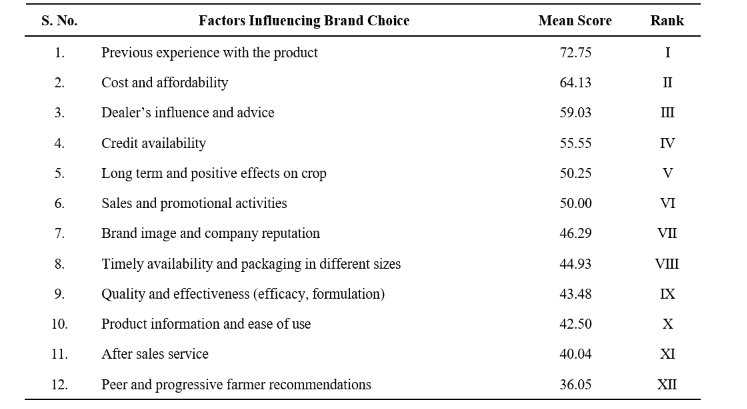
Relatively lower importance was given to product information and ease of use (mean 42.50, rank tenth), after sales service (mean 40.04, rank eleventh) and peer and progressive farmer recommendations (mean 36.05, rank twelfth). This indicates that social referrals and technical clarity, although helpful, are not the primary drivers of brand selection in the study area.
These findings align with earlier studies, such as Paghadar and Thakkar (2023), also reported that past product experience, dealer advice and brand reputation were key determinants in farmers’ pesticide brand choices. The consistency of these patterns across different regions emphasizes the need for companies to focus on building long term trust, offering cost effective solutions and leveraging dealer networks to maintain brand loyalty among farmers. Bhalodiya and Thakkar (2024) also reported that dealers’ influence and advice were the third most important factors shaping farmers’ pesticide purchase decisions.
The problems faced by farmers in the purchase and use of pesticide brands were assessed using Garrett’s ranking technique, which converts respondent rankings into mean scores. As shown in Table 3, high price of pesticides was identified as the most significant constraint, with the highest mean score of 72.28, indicating that affordability remains the foremost concern for farmers. This was followed by poor after sales service, which scored 65.02 and ranked second, highlighting issues related to support and service quality. The presence of spurious or imitation products was ranked third with a mean score of 58.97, reflecting farmers’ worries about product authenticity and reliability.
Other important constraints included lack of credit facilities (mean score 55.08) and fear of adulteration (mean score 50.31), both indicating financial limitations and concerns about product quality. Moderate mean scores were observed for factors such as lack of knowledge about recommended usage and neglect of Integrated Pest Management (IPM) practices (48.96), inappropriate package sizes (47.43) and poor quality of pesticides (44.81), suggesting a need for enhanced farmer education and better product standardization. Less critical yet relevant issues were environmental pollution and pest resistance (43.48), timely availability of pesticides (42.66), wrong advice by dealers (39.99) and inadequate extension services and farmer support, which had the lowest mean score of 36.02. These lower scores imply that while these problems exist, they have comparatively less impact on farmers’ pesticide purchase decisions than economic and service related constraints
The findings of Singh and Verma (2023) match the results of the present study. They found that high pesticide prices were a big problem for farmers, making it hard for them to buy enough for their crops. They also mentioned the issue of fake or adulterated products, which lowers farmers’ trust. Likewise, Gupta and Sharma (2022) found that poor after sales service made farmers unhappy and led them to switch brands. They also noted that many farmers lacked proper knowledge about how to use pesticides and follow IPM practices.
In conclusion, the study effectively brought out the brand preference patterns of cotton farmers in Kadapa district. The most influential factors driving brand preference were previous experience with the product, cost and affordability and dealer’s influence. These findings indicate that farmers place high trust in brands they have used before and weigh economic feasibility and dealer recommendations heavily in their decision making process.
Fellow farmers, relatives and progressive farmers emerged as the most trusted sources of information, followed by television and radio, emphasizing the importance of interpersonal networks and mass media in shaping farmer awareness. On the other hand, traditional sources such as pamphlets, newspapers and NGOs had limited impact on brand awareness and selection.
The major constraints faced by farmers included the high price of pesticides, poor after sales service and the presence of spurious products, reflecting significant challenges in affordability, service reliability and product authenticity. Lesser but still relevant issues such as lack of credit, inadequate knowledge and improper packaging also affected the purchase decisions.
Therefore, agrochemical companies and policymakers should tailor their strategies to address the practical concerns of farmers. Enhancing after sales service, ensuring product authenticity, offering credit options and leveraging dealer networks and farmer testimonials can greatly improve brand trust and market penetration. Moreover, strengthening extension services
and regulatory oversight will ensure that farmers make informed and safe pesticide choices, ultimately contributing to more effective and sustainable pest management in cotton cultivation.
Bhalodiya, J and Thakkar, M.G. 2024. Brand preferences and satisfaction level of farmers and dealers’ preferences for cotton pesticides in Rajkot district of Gujarat. Biological Forum – An International Journal. 16(9): 85-91.
Directorate of Economics and Statistics. 2024. Season and Crop Report of Andhra Pradesh. 2024. https:// des.ap.gov.in
Gupta, R and Sharma, S. 2022. Challenges in pesticide use and marketing in Indian agriculture. Green Journal of Environmental and Earth Sciences. 9(1): 12-20.
Paghadar, R and Thakkar, M.G. 2023. Factors influencing farmers’ preference for pesticide brands: Emphasis on past experience, dealer recommendation and brand image. The Pharma Innovation Journal. 12(9S): 2337-2341
Patel, S and Singh, M. 2020. Role of mass media in enhancing farmer knowledge on pest management. International Journal of Rural Development. 12(1): 45-52.
Rubix Data Sciences. Indian crop protection industry growth and market forecast. 2025. https://www. rubixds.com
Sharma, R and Thapa, P. 2019. Influence of peer networks on pesticide use behavior among Nepali cotton farmers. Journal of Agricultural Extension. 25(3): 210-218.
Singh, P and Verma, A. 2023. Farmer perceptions of pesticide quality and access constraints: A study from northern India. Journal of Rural and Agricultural Research. 23(1): 18-24.