

0 Views
Institute of Agribusiness Management, ANGRAU-S.V. Agricultural College, Tirupati-517 502.
The present study titled “Marketing Efficiency of Cocoa Crop in West Godavari District of Andhra Pradesh” was conducted to evaluate the marketing system of cocoa with specific focus on identifying marketing channels, assessing their efficiency, and identifying constraints faced by farmers. A multistage purposive sampling technique was employed to select 120 cocoa farmers and 40 intermediaries from six villages across three major mandals of the district. Four key marketing channels were identified:
Channel I (Farmers → Cadbury Agent),
Channel II (Farmers → Heritage Agent),
Channel III (Farmers → Village Trader → Cadbury Agent),
Channel IV (Farmers → Village Trader → Heritage Agent).
The most preferred marketing channel was Channel I, used by 48.3 percent of farmers. Marketing efficiency was highest in Channels I and II, both with a perfect efficiency score of 1.0, attributed to direct company procurement and absence of intermediaries. Producer’s share in consumer rupee was also 100 percent in these channels. Major constraints identified through Kendall’s Coefficient of Concordance were non-remunerative prices, price fluctuation, lack of market information, inadequate storage, and absence of regulated markets. Findings suggest strengthening regulated markets and farmer collectives like FPOs to improve marketing outcomes and farmer income.
KEYWORDS: Cocoa, marketing efficiency, marketing channels and constraints.
The cocoa tree (Theobroma cacao L.), native to the tropical regions of Central and South America, has gained prominence as a valuable commercial crop globally, particularly for its seeds used in the production of chocolate, beverages, and cosmetics. Cocoa cultivation is gradually expanding in India due to increasing demand for chocolate-based products and its suitability as an intercrop in plantations like coconut and oil palm. Globally, cocoa is grown in over 50 tropical countries, with Côte d’Ivoire is (47.91 Lha) is having highest area under cocoa followed by Indonesia (14.10 Lha) & Ghana (11.50 Lha).
Andhra Pradesh leads in cocoa cultivation with 44.9 thousand ha and 13.62 Mt production but lower productivity (397 kg/ha). Kerala, with 18.8 thousand ha, produces 11.82 Mt and has the highest productivity (692 kg/ha). This shows Kerala’s more efficient and intensive cocoa farming practices.
West Godavari district leads cocoa production in Andhra Pradesh, cultivating 22,015 hectares and producing 11,773 tonnes. Cocoa is mainly grown as an intercrop under coconut and oil palm due to its shade-loving nature. Company linkages with Cadbury and Heritage boost adoption, yet farmers face market access and price transparency issues. Andhra Pradesh ranks first in cocoa area in India, with major cultivation in West Godavari, East Godavari, and Visakhapatnam. Despite potential, the cocoa supply chain remains underdeveloped, with issues like fragmented market access, low bargaining power, and inefficiencies in marketing channels. Therefore, this study was undertaken with the following objectives:
To identify major marketing channels in cocoa marketing.
To assess the marketing efficiency in cocoa.
To explore the major marketing constraints in cocoa.
The state of Andhra Pradesh was purposively selected for the study as it has the largest area under cocoa cultivation in India. Additionally, the researcher hails from this state and is well-acquainted with the regional language (Telugu), which facilitated better rapport with respondents and enabled in-depth data collection through personal interactions. The erstwhile West Godavari district was purposively chosen as it ranks first in area and production of cocoa in the state. From this district, three mandals Tadepalligudem, Pedavegi, and Denduluru were selected based on the highest area under cocoa cultivation. In each mandal, two villages with the largest cocoa area were selected, making a total of six villages. From each village, 20 cocoa farmers were selected, resulting in a total sample size of 120 farmers. Additionally, 40 marketing intermediaries from the same region were selected to assess marketing channels, costs, margins, and constraints. Primary data were collected using a well-structured and pre-tested interview schedule covering various aspects such as marketing channels, marketing costs, price spreads, marketing efficiency, and constraints in cocoa marketing. The study pertains to the agricultural year 2024–2025.
TC = CP + ∑ MC
Where, TC= Total cost of marketing
CP= Costs incurred by producer in marketing MCi= Marketing costs incurred by the ith trader
Am = Pm – (Pb + Mc)
Where, Am = Margin of middlemen or trader Pm = Selling price of trader
Pb = Buying price of trader
Mc = Marketing costs born by the trader
P = ( PF/ PR ) x 100
Where, P = Producer’s share in consumer’s rupee PF = Price received by the farmer
PR = Price paid by the consumer
Marketing Efficiency (ME) was calculated by the Acharya method. (Acharya and Agarwal, 2004)
MME = FP/ (MC+MM) or MME = [RP/ (MC+MM)]-1
Where, MME =Modified measure of Marketing Efficiency
MM = Net marketing margins
FP = Net price received by the farmer
RP = Price paid by the consumer or Retailer’s price MC = Total marketing costs
Kendall’s Coefficient of Concordance (Kc) is a non-parametric statistic used to assess the degree of agreement among raters (or judges) ranking a set of items.
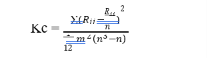
where ,
Kc = Kendall’s coefficient
m = No. of respondents assigning ranks
n = No. of constraints ranked Rj = Rank total of columns j. J = Ranks assigned 1 to n. χcal = Kc (n-1) m
χtab at (n-1) df
If χcal is higher than χtab, the judges are in strong agreement about the ranks they were assigned to the given constraints.
Marketing channels for cocoa refer to the sequence of intermediaries through which cocoa beans pass
from farmers to final buyers or processors. The choice of marketing channel is influenced by factors such as accessibility, payment security, proximity, and company affiliations. In the study area, farmers had access to four primary marketing channels for selling their cocoa produce:
Channel I: Farmers → Cadbury Agent Channel II: Farmers → Heritage Agent
Channel III: Farmers → Village Trader → Cadbury Agent
Channel IV: Farmers → Village Trader → Heritage Agent
These channels reflect the dominant procurement mechanisms adopted by private companies operating in the district. The agents act either as company-appointed buyers or licensed collectors working on a commission basis.
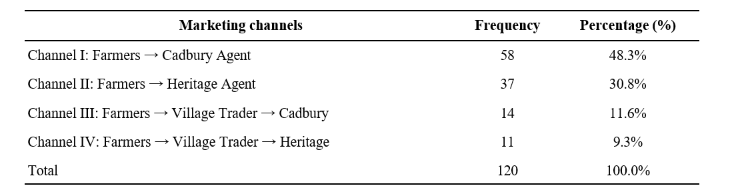
As shown in Table 1, the majority of farmers (48.3%) sold their produce directly to Cadbury agents (Channel I), followed by 30.8% through Heritage agents (Channel II). The remaining farmers sold their produce
via village traders, who then supplied to either Cadbury or Heritage.
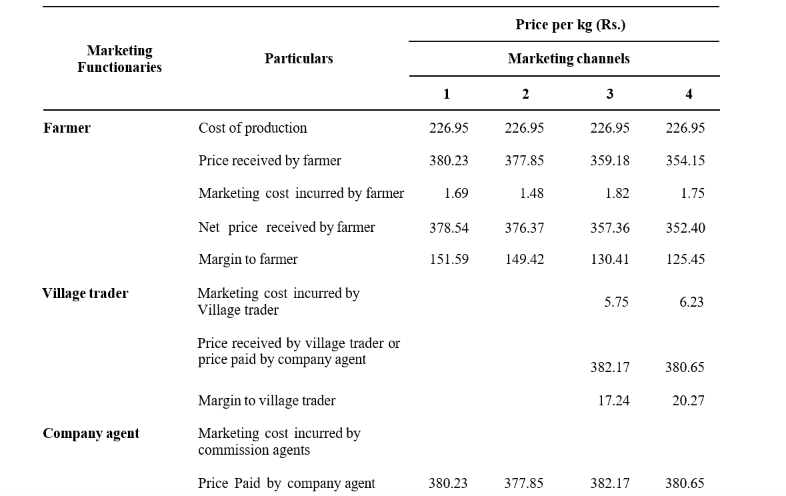
Marketing efficiency was calculated using the Acharya & Agarwal method. The results are summarized below:
The cost of production for farmers remains constant at ( 226.95 per kg across all four marketing channels, but the price received by farmers varies, being highest in Channel 1 (₹380.23/kg) and lowest in Channel 4 (₹354.15/kg). After accounting for marketing costs incurred by farmers, the net price received and farmer margins show a declining trend from Channel 1 to Channel 4, indicating reduced profitability as more intermediaries are involved. Channels 1 and 2 show minimal marketing costs and no price spread, resulting in the highest marketing efficiency (1.00) and a producer’s share of 100 percent in the consumer rupee. In contrast, Channels 3 and 4 involve village traders, which increases total marketing costs and margins, leading to higher price spreads of ₹22.99/kg and ₹26.50/kg, respectively. Consequently, marketing efficiency declines to 0.94 and 0.93, and the producer’s share in the consumer rupee falls to 93.98 percent in Channel 3 and 93.04 percent in
Channel 4, highlighting that direct marketing channels are more efficient and beneficial to farmers.
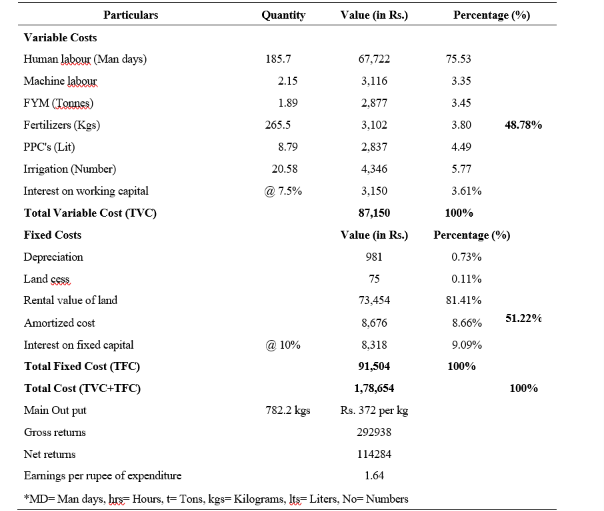
From the above table, per hectare returns of cocoa orchard is presented. Based on the information given by respondents, the yield from hectare of cocoa fluctuates around 13 to 18 quintals based on the favourable climatic conditions like rainfall, low pests and disease attack etc. The mean yield per hectare was 782.2kgs of dried beans per hectare. The price received per kg dried beans by farmer varies based on demand and supply and also varies based on the buyer (village trader and company
agents). The average price per kg of cocoa dried beans was Rs. 372. The gross returns from cocoa was Rs. 2,92,938 with net returns of Rs. 1,14,284 per hectare.
Gross returns/cost of cultivation was 1.64 which indicated that the cocoa crop was profitable.
The cocoa growers were asked on each constraint to identify and rank most important constrains. To verify whether the respondents are in agreement with each
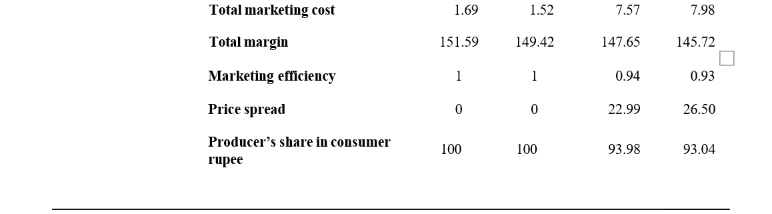
The analysis of marketing efficiency across four cocoa marketing channels in West Godavari district revealed that Channels I and II, where farmers sold directly to company agents (Cadbury and Heritage), were the most efficient.
other, Kendall’s Coefficient of Concordance (Kc) test was applied and the results
Kc = Kendall’s Coefficient = 0.68
ꭓ2 cal value =573.69
ꭓ2 tab value =14.06
The ꭓ2 calculated value of Kendall’s Coefficient of Concordance was higher than table value was significant and that all the interviewed retailers were in agreement in ranking the constraints.
The ranking of marketing-related problems based on the mean scores highlights that the most severe issue is “Non remunerative price for produce” (Rank 1), highlighting that farmers were not receiving fair price for their produce. This was followed by “Price fluctuations” (Rank 2), which cause uncertainty in income and affect farmers’ decision-making. “Lack of market information” ranks third, showing that limited access to timely and accurate market data hinders farmers from making informed choices. The “Lack of storage facilities” came
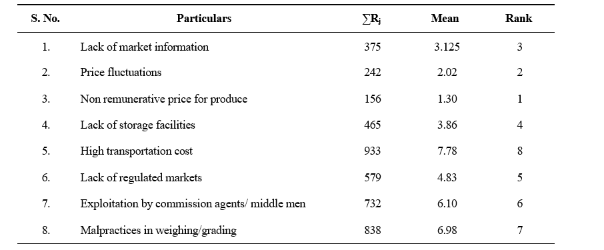
next at Rank 4, suggesting that inadequate storage options compel farmers to sell produce quickly, often at lower prices. “Lack of regulated markets” ranked fifth, reflecting issues such as lack of transparency and vulnerability to exploitation. Exploitation by commission agent/middlemen ranked 6th as most of the middlemen offered less price by showing the quality parameters of product. Mal practices in weighing & grading and high transportation cost were other minor problems expressed by respondents.
The study identified four primary marketing channels, with Channel I (Farmers → Cadbury Agent) and Channel II (Farmers → Heritage Agent) being the most widely adopted due to their direct nature and assured procurement systems. The efficiency analysis revealed that these direct channels were highly efficient, offering a 100% producer share in consumer’s rupee and perfect marketing efficiency (1.00), while Channels III and IV involving village traders showed relatively lower efficiency due to increased marketing costs and reduced farmer margins. Regarding marketing constraints, farmers reported challenges such as non-remunerative prices, price fluctuations, lack of storage facilities, absence of regulated markets, and limited access to market information, as identified through Kendall’s Coefficient of Concordance. Overall, the study suggests that promoting direct marketing linkages with companies, establishing regulated markets, and encouraging farmer
collectives like FPOs can enhance marketing efficiency and ensure better income stability for cocoa farmers in the region.
The study emphasizes that streamlined channels and better infrastructure can boost cocoa marketing efficiency, raise farmer incomes, and support sustainable cocoa growth in West Godavari district.
Promoting direct company procurement with fewer middlemen can improve marketing efficiency and increase farmers’ share of the consumer’s rupee
Price instability and low returns make cocoa farming unpredictable, necessitating support measures like Minimum Support Prices and stabilization funds to protect farmers from market fluctuations.
Price stability and investment in modern storage facilities are vital to reduce income volatility, cut post-harvest losses, and improve cocoa quality and marketability.
Adefemi, O. J. 2019. Profitability and efficiency analysis of cocoa marketing in Ondo State, Nigeria. Journal of Business and African Economy. 5(1): 1-18.
Basavaraj. 2023. Analysis of Marketing Problems of Coconut Growers-A study with Special Reference Tumkur District, Karnataka. Journal of Emerging Technologies and Innovative Research. 10(2): d117-d125.
Farayola, C. O., Akintaro, O. S., Yahaya, A. A and Oni, O. 2013. Determinants of marketing efficiency among small-holder cocoa marketers in Oyo State, Nigeria. International Journal of Management and Social Sciences Research (IJMSSR). 2(11): 33-43.
Heliawaty, H., Rukmana, D and Khotimah, I. W. 2024. Cocoa marketing channel analysis in Margolembo village, Mangkutana district, East Luwu Regency. Agrisocionomics: Journal Sosial Ekonomi Pertanian. 8(1): 336-349.
Kumar, M.S., Chandrakumar, M., Deepa, N and Selvi, R.P. 2022. A study on marketing constraints among coconut farmers in Palakkad district. The Pharma Innovation Journal. 11 (6): 2876-2878.
Jayasekhar, S and Isaac, I. 2018. Review of economic history of cocoa with special reference to India. Journal of Plantation crops. 46(2): 133-138.