
0 Views
Department of Agronomy, ANGRAU-S.V. Agricultural College, Tirupati-517 502.
A field experiment was conducted during summer, 2025 on sandy loam soils of dryland farm of S.V. Agricultural College, Tirupati campus of Acharya N.G. Ranga Agricultural University. The results of the experiment revealed that 100 per cent RDN through neem cake along with foliar spray of seaweed extract @ 2per cent recorded significantly higher seed and stalk yield. Quality parameters like protein and oil content were also high in 100 per cent RDN through neem cake and seaweed extract @ 2 per cent.
KEYWORDS: Organic sesame, protein content, oil content, seed yield, stalk yield.
India stands as the world’s leading producer of oilseeds, contributing approximately 10 per cent of global production and utilizing 20.8 per cent of the world’s cultivable land for this purpose. The country cultivates a wide range of oilseed crops, including groundnut, soybean, sunflower, sesame, mustard, and safflower. Despite this diversity, oilseed productivity remains relatively low due to the dominance of small-scale, rainfed agriculture, which accounts for about 72 per cent of the total oilseed-growing area.
Sesame (Sesamum indicum L.), commonly known as til, is one of the oldest cultivated oilseed crops and is highly valued for its superior oil quality, earning it the title “Queen of Oilseeds.” This multipurpose crop offers significant nutritional and medicinal benefits. Sesame seeds contain 46–52 per cent oil, 20–26 per cent protein, 14–16 per cent sugar, and 5–7 per cent minerals.
Organic sesame oil is rich in natural antioxidants like sesamin, sesamol, and sesamolin, which contribute to its stability and long shelf life. The oil is widely recognized for its stress-relieving, anti-inflammatory, and antioxidant properties. It helps in managing fatigue, calming the nervous system, easing muscle spasms and promoting overall strength and vitality. These qualities make it a preferred choice in traditional therapies such as Ayurveda.
Organic sesame holds immense promise for India’s sustainable agriculture and health-conscious consumer base. With its adaptability, health benefits
and export potential, it serves as a powerful crop for improving farmer income and promoting environmental sustainability. Continued focus on organic research, farmer trainings and market development will be the key aspect to realize the full potential of organic sesame in India.
The field experiment was conducted during summer, 2025 at dryland farm of S.V. Agricultural College, Tirupati campus of Acharya N.G. Ranga Agricultural University, Andhra pradesh. The soil of the experimental site was sandy loam having 0.40 per cent organic carbon, 203 kg ha-1, 26 kg ha-1 and 245 kg ha-1 of available N, P2O5 and K2O respectively. A total rainfall received during the crop period was 2 mm in zero rainy days. The experiment was laid out in a factorial randomized block design with two factors, factor I comprised of 100 per cent RDN through FYM (S1), 100 per cent RDN through neem cake (S2) and 100 per cent RDN through pongamia cake (S3). Factor II consisted of seaweed extract @ 2 per cent, panchagavya @ 3 per cent, water spray and fish amino acid @ 1 per cent. Sesame seeds were sown in lines, 30 cm apart with plant to plant spacing of 15 cm and adopting all the standard package of practices. The recommended 40 kg N ha-1 was applied through organic manures by calculating nitrogen content in respective manures. And these manures were applied one week prior to sowing and foliar spraying was done twice at 30 and 45 DAS. The treatment wise seed and stalk yield of sesame were harvested from each net plot. The quality parameters, oil content of the seed was estimated by using
Nuclear Magnetic Resonance (NMR) Spectrophotometer as per the procedure laid down by Tiwari et al. (1974) and expressed in per cent (%) and for protein content the nitrogen content of the seeds was estimated and it was multiplied by the factor 6.25 and the resultant protein content was expressed in per cent.
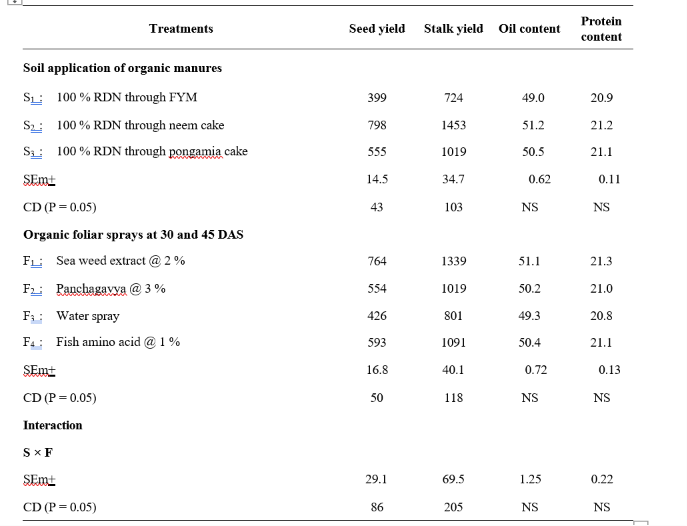
Seed and stalk yields were significantly affected by different organic manures and foliar sprays (Table 1). Significantly higher seed ad stalk yield were recorded with 100 per cent RDN through neem cake. Lower
and stalk yields were recorded with 100 per cent RDN through FYM. Among organic foliar sprays seaweed extract @ 2 per cent recorded higher seed and stalk yields followed by foliar application of FAA @ 1 per cent which was found non-significant with foliar spray of panchagavya @ 3 per cent and lowest was recorded in water spray at 30 and 45 DAS. Interaction between organic manures and organic foliar sprays was found significant. Combination of 100 per cent RDN through neem cake along with foliar spray of seaweed extract @ 2 per cent (S2F1) recorded significantly higher seed and stalk yield compared to other combinations.
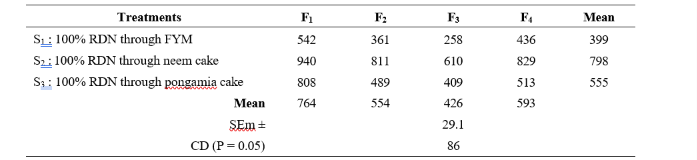
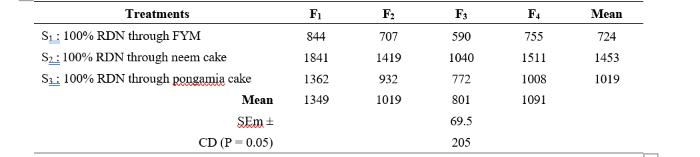
The highest seed yield recorded with application of neem cake (S2) might be due to higher concentration of macro and micronutrients in conjunction with steady nutrient release throughout the crop period. It also has efficient source of NPK along with beneficial micronutrients which enhance the plant activity and resulted in better plant stand, more dry matter and more grain filling ultimately resulted in more seed yield. Similar results were also reported by Lalnunpuia et al. (2018), Ahirwar et al. (2017), Kumar et al. (2017), Vasundhara et al. (2012), Duhoon et al. (2004). (Table 2 and 3)
Protein and oil content were found non-significant with soil application of organic manures and organic foliar sprays and the interaction affect also found to be non significant between them. However higher oil content was recorded in soil application of 100 per cent RDN through neem cake and lowest was recorded in 100 per cent RDN through FYM. Among the organic foliar spray’s, seaweed extract recorded higher oil and protein content and lower was recorded in water spray.
Hence, from the present study it can be concluded that higher seed yield in summer sesame can be realized with the soil application of 100 per cent RDN i.e. 40 kg N ha-1 through neem cake along with foliar spray of seaweed extracts @ 2 per cent twice at 30 and 45 DAS in Southern Agro-climatic Zone of Andhra Pradesh.
Ahirwar, K., Panda, S and Jyotishi, A. 2017. Optimisation of sesame (Sesamum indicum L.) production through integrated nutrient management. International Journal of Current Microbiology and Applied Science. 6:1701-1707.
Duhoon, S.S., Jyotishi, A., Deshmukh, M.R and Singh, N.B. 2004. Optimization of sesame (Sesamum indicum L.) production through bio/natural inputs. In Proceedings of the 4th International Crop Science Congress Brisbane, Australia (Vol. 26).
Kumar, M.S., Bhoyar, S.M., Deshmukh, P.W., Sathyanarayana, E and Karangami, L.D. 2017. Yield and quality of rainfed cotton in response to organic manures under vertisols. Plant Archives. 17 (1): 412-416.
Lalnunpuia, A.A.D., Mahzar, S.H., Thomas, T and Rao, 2018. Effect of different levels of fertilizers and neem cake on soil health growth and yield of potato (Solanum tuberosum L.) cv. Kufri Jyoti. International Journal of Applied Research. 4(11): 74-79.
Tiwari, P.N., Gambhit, P.N and Rajan, T.S. 1974. Rapid and non-destructive determination of seed oil by pulsed nuclear magnetic resonance techniques. Journal of American Oil Chemical Society. 57: 305-308.
Vasundhara, P., Rangaswamy, V and Johnson. 2012. Effect of organic, inorganic, and biochemical amendments on rhizosphere mycoflora and yield of groundnut (Arachis hypogaea L.). Journal of Oilseeds Research. 29(2): 157-160.