0 Views
Institute of Agribusiness Management, ANGRAU-S.V. Agricultural College,Tirupati-517 502.
This study investigates the factors that influence tribal women participation in Van Dhan Vikas Kendras (VDVKs) in Alluri Sitarama Raju district, Andhra Pradesh. A primary survey was conducted in the ASR district with a sample size of 160 members, comprising 80 VDVK beneficiaries and 80 non-beneficiaries. Binary logit regression analysis was used to examine the socio-economic characteristics of sample SHG women. The analysis revealed that awareness, extension services and distance to VDVK centre showed a positive influence on tribal women beneficiaries to participate, while age has shown a significantly negative impact on women’s participation at 1% level of significance. The female-headed families showed a significantly positive impact on women’s participation at 5% level of significance. The findings also recorded that women engaged in VDVKs have improved income, skills and empowerment over the years. Therefore, the socio-economic characteristics enhance SHG participation and the overall effectiveness of the VDVK model.
KEYWORDS: Binary logistic regression, self-help group, tribal women, van dhan vikas kendras.
Van Dhan Vikas Kendras (VDVKs) provides entrepreneurship activities and income support through marketing of value addition to minor forest products. It works under the Pradhan Mantri Van Dhan Yojana scheme (PMVDVY) with the main aim to empower tribal women through marketing of Minor Forest Produce (MFP). Minor Forest Produce (MFP) refers to non-timber forest produce which includes bamboo, brushwood, stumps, canes, tusser, cocoon, honey, waxes, lac, medicinal plants and herbs. Each Kendra includes around 15 SHGs with 300 members and acts as hub for training, processing and skill development for tribal women. The Ministry of Tribal Affairs serves as the central nodal department while Tribal Cooperative Marketing Federation of India (TRIFED) acts as the national nodal agency for this initiative during the year 2018 at nation level. In Andhra Pradesh there are 6225 VDVK SHGs, 415 VDVK Clusters and 123758 gatherers across 8 districts (TRIFED, 2024). Van Dhan Vikas Kendras helps in providing training, machinery, implements and processing units for minor forest products and helps them to fetch high price on their marketed processed products. It also supports tribal women in providing packing and branding. It aims to enhance the livelihoods of tribal communities residing in forest areas. As a whole, it provides entrepreneurship activities and income support through marketing of value addition to minor forest products. The entry of VDVKs eventually empowered tribal women to become micro-entrepreneurs by improving their livelihood with fair profits on sold products (TRIFED, 2024).
The Paderu Revenue Division in Alluri Sitharama Raju district, Andhra Pradesh which comprises 11 mandals and has a population of 604,047 with 576,026 living in rural areas and 28,021 in urban areas. Scheduled Tribes make up 90.71 percent (547,951 individuals) of the population while Scheduled Castes constitute 0.69 percent (4,154 individuals). Major tribal groups include the Bhagatha, Konda Dora, Koyya Dora, Valmiki, Khond, Koya, Gadaba and Porja speaking Telugu, Odia and Kuvi languages. Minor forest products are a crucial income source for these tribal populations, contributing between 20 to 40 percent of their annual earnings. Notably, women play a vital role in collecting and marketing these products, making this activity a key factor in promoting women’s economic empowerment (IBEF, 2021). Van Dhan Vikas Kendras are functioning in 6 mandals in ASR district namely Paderu, Gudem Kotha Veedi, Chintapalli, Koyyuru, G. Madugula and Peddabayalu. The centers provide skill development, infrastructure and market access to beneficiary Self-help group which enable women to market value added minor forest produce. Empowering women is a key to uplifting tribal communities (Dhanasree K., 2014).
The research focuses on analyzing key aspects of Van Dhan Vikas Kendra in promoting tribal women entrepreneurship through the training and marketing of Minor Forest Natural Produce in Alluri Sitarama Raju district. It aims to assess the status and performance of VDVKs’ in enabling effective marketing, evaluate their impact on income generation and empowerment of tribal women. Further, the research tries to explore the factors influencing the participation of women SHGs in VDVK. As a whole, the study intends to find out VDVK contribution towards livelihood opportunities, economic and social empowerment of tribal women in the Alluri Sita Rama Raju district.
The prime objective of the study is to examine the various socio-economic and institutional factors that influence the participation of women Self-Help Group members in VDVK activities.Asample of 160 respondents was selected consisting of 80 VDVK beneficiaries and 80 non-beneficiaries from three mandals Paderu, Chintapalli and G. Madugula. Data was collected and analyzed using binary logistic regression. Information was gathered on socio-economic characteristics which influence the tribal women participation in VDVK.
A Binary Logit Model was employed to analyse the factors influencing tribal women’s participation in VDVKs through SHGs. The dependent variable was binary:
1 = VDVK beneficiary (SHG member participate in VDVK)
0 = VDVK Non-Beneficiary
The general logit model is specified as:

Where,
p = probability of being a VDVK beneficiary
1-p = probability of VDVK non-beneficiary
X_i = vector of explanatory variables
β_0, β_i= regression coefficients
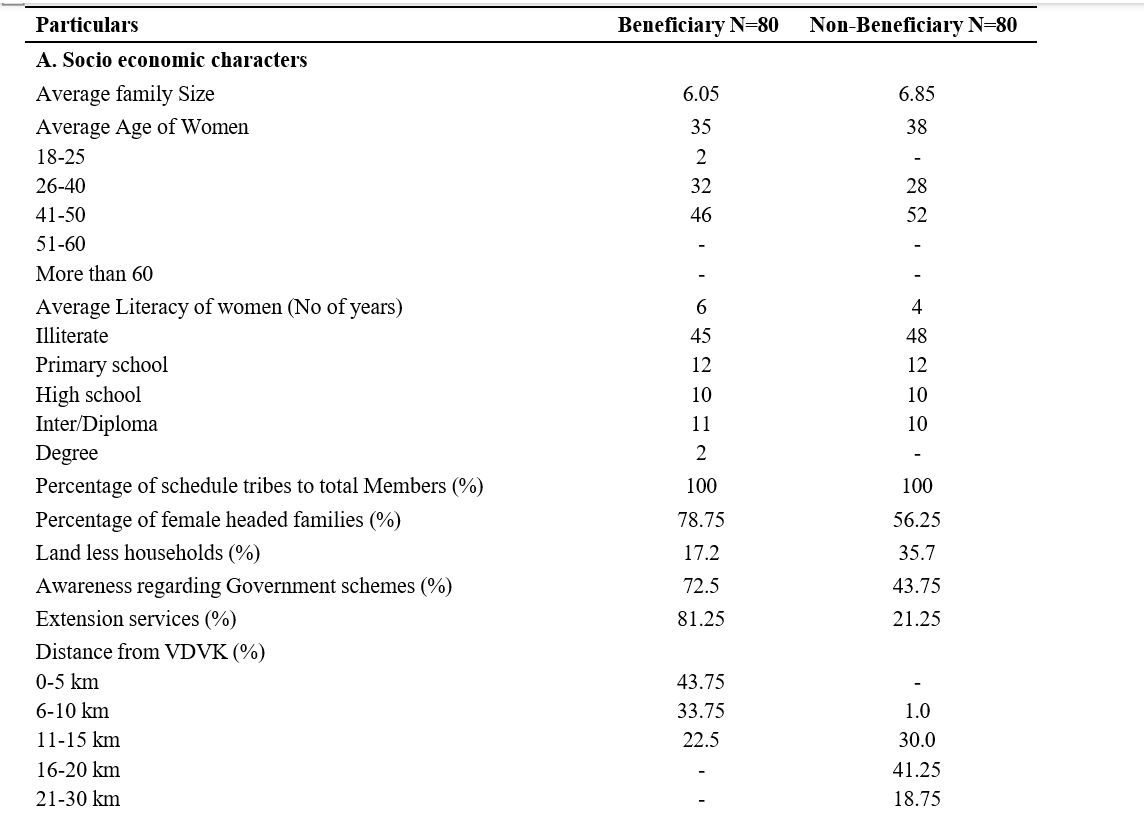
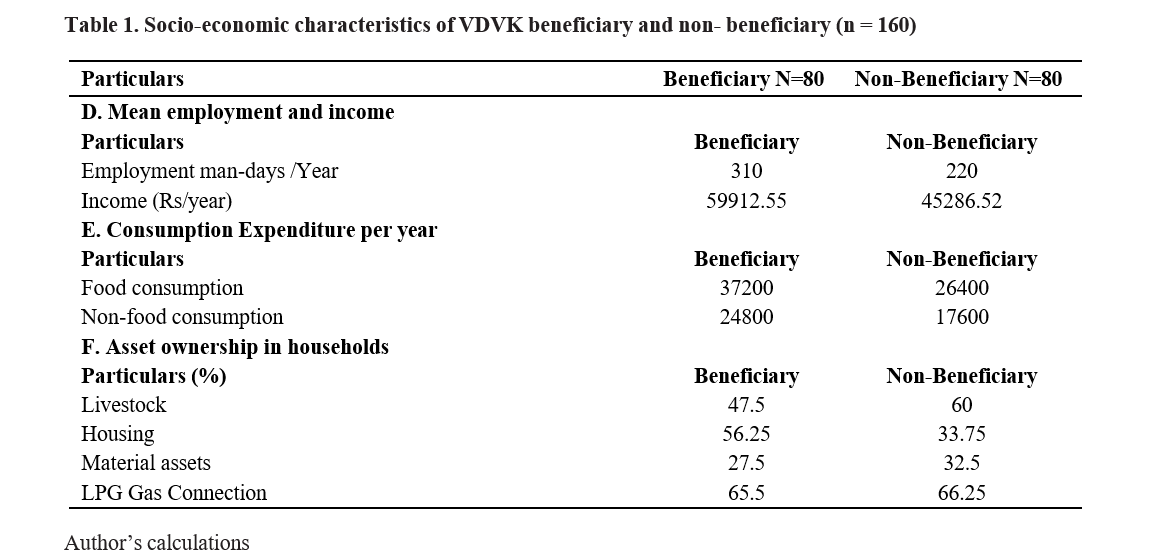
Age plays a crucial role in determining their involvement in entrepreneurial activities. As shown in the table 1, the average age of women is 35 for beneficiaries and 38 for non-beneficiaries. Education signifies the formal or informal learning acquired by individuals that shapes their awareness, communication ability and confidence in engaging with external systems. The average literacy years of beneficiary women are 6 years, while the average literacy years for non-beneficiary women are 4 years. Higher education levels usually result in better decision-making and leadership within SHGs and VDVKs. Land holding size reflects the extent of agricultural or forest-based land resources available to a household, influencing their economic stability and production capacity. In tribal regions, larger land holdings often enable better participation in value addition and processing of Minor Forest Produce (MFP), while marginal or landless households rely more on forest gathering. Understanding land size distribution is essential for planning support interventions, credit linkage and capacity-building efforts under schemes like PMVDVY. The land less households are 17.2 per cent in beneficiaries, while it is 35.7 per cent in non-beneficiaries. Female-headed families represent households where women serve as primary decision-makers and breadwinners. The female headed families among beneficiaries are of 78.75 per cent, while only 56.25 per cent among non-beneficiaries. In tribal societies, such families often face dual responsibilities of income generation and family care, making them more vulnerable but also potentially more responsive to empowerment initiatives. Their participation in Self-Help Groups (SHGs) and Van Dhan Vikas Kendras (VDVKs) often signals a higher level of resilience, leadership and motivation for collective entrepreneurship. The average family size of beneficiaries is 6.05, while it is 6.85 for non-beneficiaries. Family size determines the labour availability within a household and impacts income needs, dependency ratios and participation in livelihood activities. For tribal women, managing larger households can either limit or encourage group participation depending on support systems, making it a key variable in analyzing their engagement with development programmes and MFP-based enterprises. About 72.5 per cent of VDVK beneficiaries are aware
while only 43.75 per cent of non-beneficiaries are aware regarding the schemes of the Government. Awareness regarding Government schemes refers to the level of knowledge tribal women have about various government programs aimed at improving their livelihoods, health, education and economic status. In the context of VDVKs, better awareness helps women access available support, participate actively and benefit from development initiatives. Assessing this factor highlights how effectively information about such schemes reaches the target community. Extension services involve the delivery of technical support, training and awareness-building efforts to rural and tribal populations. About
81.25 per cent of beneficiaries are exposed to the extension services, while only 21.25 per cent of non-beneficiaries are exposed. The frequency of these services indicates how regularly tribal women are engaged by government officials or field-level facilitators. In the PMVDY framework, consistent extension contacts help ensure proper implementation, builds trust and enhances the capacity of SHG members within the VDVKs. Distance from VDVK centre denotes the physical gap between production clusters and their nearest trading centres. The average distance from VDVK for beneficiaries is predominantly within 0-15km, with 43.75 per cent residing 0-5km away, 33.75 per cent within 6-10km and
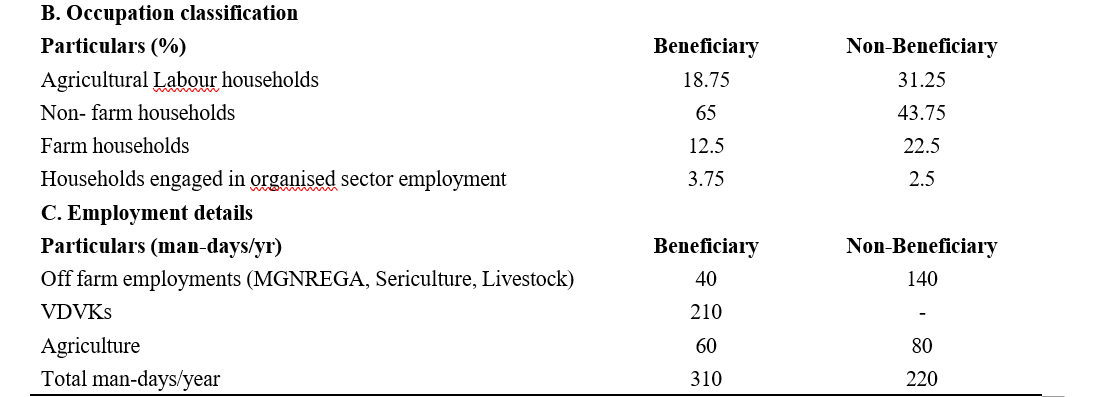
22.5 per cent within 11-15km. For non-beneficiaries, only 1% are within 6-10km, 30% within 11-15km, 41.25 per cent within 16-20km and 18.75 per cent within 21-30km. The non-beneficiaries are more engaged in agricultural labour (31.25%) and farm households (22.5%), while beneficiaries show higher involvement in non-farm activities (65%). A small share from both groups works in the organized sector, with beneficiaries slightly higher in size (3.75%). Beneficiaries recorded higher employment with 310 man-days per year and income of Rs. 59,912.55 per year against non-beneficiaries with 220 man-days and Rs. 45,286.52 per year. Their annual consumption expenditure was also greater, with food consumption at Rs. 37,200 and non-food at Rs. 24,800, while non-beneficiaries spent Rs. 26,400 and Rs. 17,600 respectively.Asset ownership shows that beneficiaries had higher housing (56.25%) and LPG connections (65.5%), whereas non-beneficiaries reported more livestock (60%) and material assets (32.5%). Importantly, VDVKs contributed 210 man-days exclusively to beneficiary households, strengthening their employment base.
To assess the determinants influencing tribal women’s participation in Van Dhan Vikas Kendras (VDVKs), a binary logistic regression model was employed. This model helped to identify key socio-economic, institutional and market-related factors that significantly impact the likelihood of women joining VDVKs. The model results include coefficient value, standard errors, significance levels and odds ratios, as presented in Table-2. The model demonstrated strong explanatory power, with a pseudo-R² value of 0.7650, indicating that 76.5 per cent of the variation in membership decisions could be explained by the included variables. The regression results are presented in Table-2, identifying the significant determinants of VDVK participation.
Age is statistically significant at the 1 percent level, an increase in age was associated with a lower probability of VDVK membership. The odds ratio of 0.711 suggests that the younger individuals are more likely to participate in the VDVK. This confirms that younger tribal women are more likely to engage in organized value-addition activities compared to older women. Significant at the 5 percent level, female-headed families showed a strong positive influence, with an odds ratio of 12.160. This indicates that women from female-headed households were over twelve times more likely to be VDVK members compared to those from male-headed families, reflecting their greater motivation to seek support systems and enhance household income through collective enterprise. Awareness was significant at the 1 percent level and positively influenced VDVK participation. With an odds ratio of 2.042, women who were aware of the scheme were nearly twice as likely to join. This finding underscores the importance of effective information dissemination and village-level sensitization campaigns. Extension Services were the most influential factor in the model, showing significance at the 1 percent level. The odds ratio of 6.115 indicates that access to extension services increased the likelihood of joining a VDVK by more than six times. This result demonstrates the importance of institutional outreach and technical handholding in mobilizing tribal women for enterprise development. Distance was found to have a positive and significant effect at the 10 percent level. With an odds ratio of 1.683, the model suggests that distance is also one of a
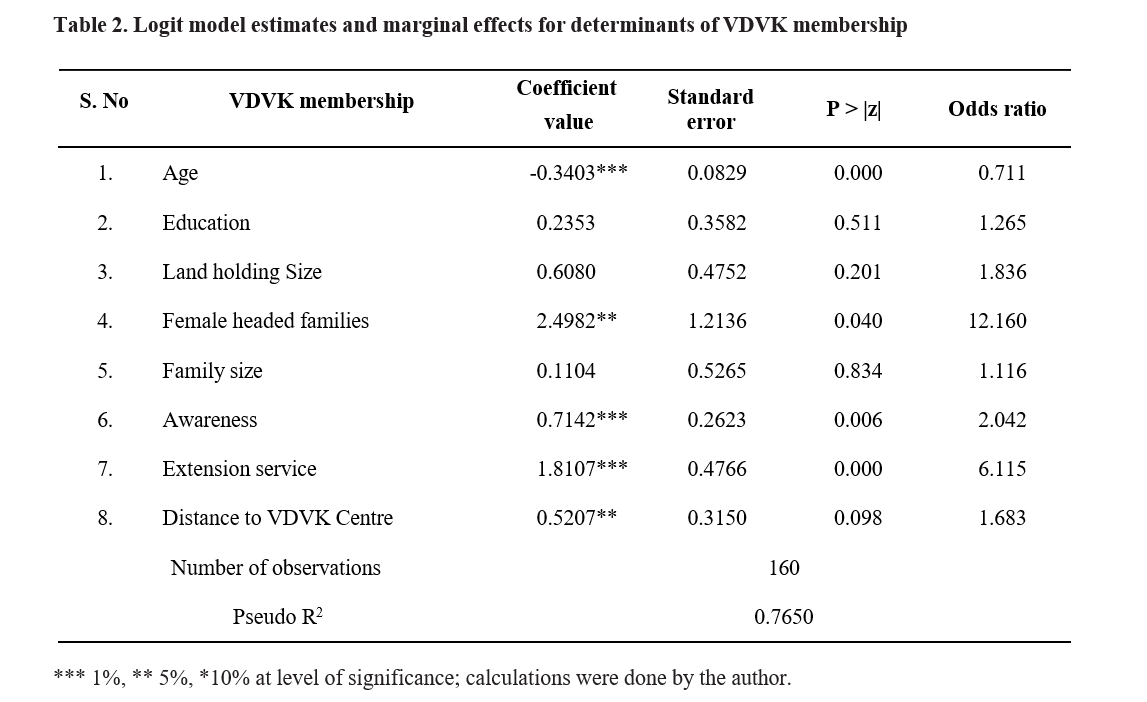
key factor for the women to join the VDVKs in the study area. Variables such as education level, landholding size and family size were found to be statistically insignificant (p > 0.05), indicating they did not substantially affect the likelihood of VDVK membership in the study area.
The results show that, Younger tribal women are more likely to join VDVKs, while female-headed households show a strong positive influence on membership. Awareness of the scheme and access to extension services significantly boost participation, with extension services being the most impactful factor. Distance is also a significant factor for participation in the VDVKs. However, education, landholding size and family size do not significantly affect membership. These findings highlight the key roles of motivation, awareness and support over socio-economic traits in driving VDVK participation. The findings resonate with studies by Joshi (2019), Shah and Panigrahi (2015) and Sukhdeve (2011), which also reported that female headship, awareness and extension support significantly influence women’s involvement in collective enterprise activities. These studies affirm the relevance of targeted institutional support, capacity building and effective communication in enhancing women’s economic empowerment in tribal regions.
The study presents a comprehensive evaluation of the Van Dhan Vikas Kendra (VDVK) scheme in Alluri Sitarama Raju (ASR) district of Andhra Pradesh. The socio-economic profile of VDVK beneficiaries compared to non-beneficiaries reveals significant improvements in livelihood, awareness and empowerment among the former. Beneficiaries had greater access to extension services (81.25%) and higher awareness of government schemes (72.5%) compared to only 21.25 per cent and
43.75 per cent among non-beneficiaries, respectively. This indicates more effective outreach and capacity-building interventions for VDVK participants. A notable
78.75 per cent of beneficiary households were female-headed, reflecting enhanced leadership and women’s empowerment. The findings reaffirm the scheme’s significant role in transforming the socio-economic landscape of tribal communities by fostering value addition, entrepreneurship and institutional linkages in the Minor Forest Produce (MFP) sector.
Dhanasree, K., Vijayabhinandana, B and Kumar, P.B.P. 2014. Socio-economic empowerment of tribal women in high altitude and tribal zone of Andhra Pradesh. International journal of innovative Research in Science, Engineering and Technology. 3(2): 9360-9368.
Joshi, G. 2019. An analysis of women’s self-help groups’ involvement in microfinance program in India. Rajagiri Management Journal. 13(2): 2-11.
Shah, D and Panigrahi, S. 2015. Determinants of participation of women in self-help groups (SGHs) and credit delivery from formal and informal sources to BPL households in Odisha. Indian Journal of Agricultural Economics. 70(3): 405-416.
Sukhdeve, M.I. 2011. Factors influencing empowerment of rural SHG women in Bhandara District of Maharashtra: Logistic regression model. International Journal of Microfinance. 1(1): 102-108.
https://trifed.tribal.gov.in/pmvdy
https://www.ibef.org/exports/minor-forest-produce-industry-india