

0 Views
Department of Agronomy, ANGRAU-S.V. Agricultural College,Tirupati-517 502.
A field experiment was conducted during late rabi, 2024-25 at dryland farm of S.V. Agricultural College, Tirupati to study
the effect of sowing window and varieties on yield and economics of rabi greengram. The treatments comprised of three sowing windows viz., II Fortnight of December (S1), I Fortnight of January (S2) and II Fortnight of January (S3) allotted to main plots and four varieties LGG 607 (V1), LGG 630 (V2), LGG 574 (V3) and IPM-2-14 (V4) allotted to sub plots and replicated thrice. Hence, from the present study, it can be concluded that higher productivity and profitability of greengram can be realized from LGG 630 variety of greengram sown during II Fortnight of December (S1) indicating its suitability for late sowing during rabi season on sandy loam soils of Southern Agro-Climatic Zone of Andhra Pradesh.
KEYWORDS: Greengram, late rabi, productivity, sowing window, varieties.
Pulses are the edible seeds of leguminous plants that are harvested solely for their dry grain. They are not only affordable and versatile but also environmentally friendly, helping to improve soil health through nitrogen fixation. Pulses are primarily grown for their dry edible seeds, contributing significantly to food security, soil fertility and sustainable agriculture. Their cultivation is highly influenced by agro-climatic conditions, making the sowing window the optimal period for planting, a critical factor in achieving good yields and quality produce. Each pulse crop has a specific sowing time depending on the region, climate and variety.
There is also considerable diversity in varieties of pulses, developed through breeding programmes to enhance traits such as drought tolerance, disease resistance and early maturity. Selecting the right variety adapted to the local conditions and sowing window are key for maximizing the productivity. This paper explores the sowing window and varieties of greengram, highlighting their adaptability to Southern Agro-Climatic Zone of Andhra Pradesh and the role of varietal improvement in enhancing productivity of greengram.
The field experiment was conducted during late rabi, 2024-25 at dryland farm of S.V. Agricultural
College, Tirupati. The experimental soil was sandy loam in texture, neutral in reaction (pH 6.7), low in organic carbon (0.4 per cent) and available nitrogen (230 kg ha-1), medium in available phosphorus (25 kg ha-1) and available potassium (250 kg ha-1). The experiment was laid out in a split-plot design with three main plots and four sub plots and replicated thrice.
The treatments comprised of three sowing windows viz., II Fortnight of December (S1), I Fortnight of January (S2) and II Fortnight of January (S3) assigned to main plots and four varieties viz., LGG 607 (V1), LGG 630 (V2), LGG 574 (V3) and IPM-2-14 (V4) allotted to sub plots. The crop was supplied with recommended fertilizer dose of 20 kg N and 40 kg P2O5 through urea and single super phosphate, respectively to all the plots as basal i.e., at the time of sowing.
The data was recorded on yield attributes and yield of greengram at harvest were statistically analysed following the analysis of variance procedure suggested by Panse and Sukhatme (1985). Statistical significance was tested by ‘F’ value at 5 per cent level of probability and wherever the ‘F’ value was found significant, critical difference (CD) was worked out at 5 per cent level of probability and the values were furnished. The treatment differences which were non-significant were denoted by “NS”.
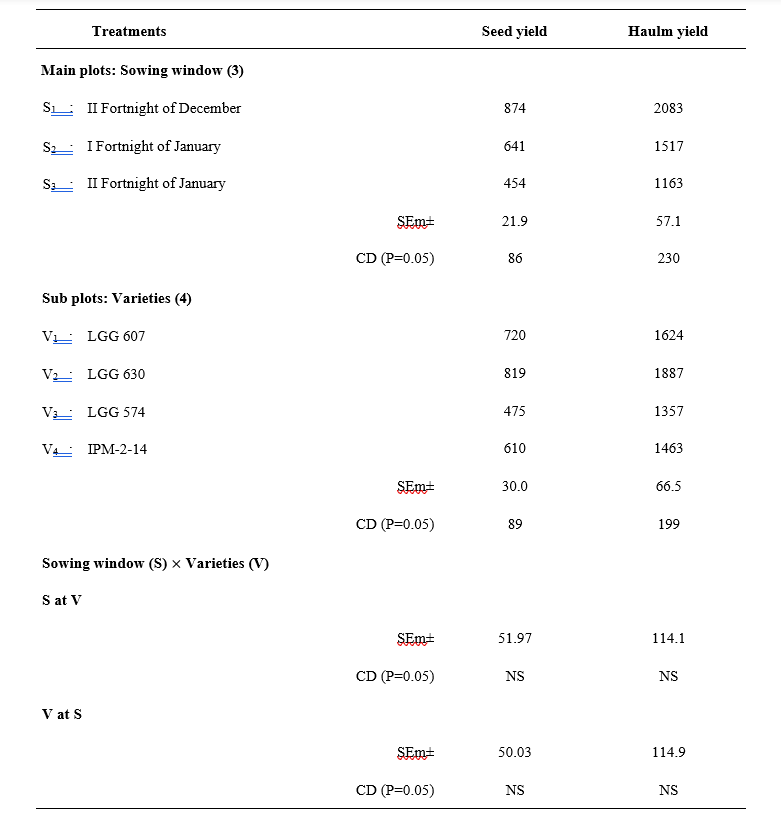
Seed yield and haulm yield were significantly influenced by sowing window and varieties, while the interaction effect of sowing window and varieties was found to be non-significant.
Among the varied sowing windows, greengram sown during II Fortnight of December (S1) recorded significantly higher seed and haulm yield over other sowing windows. The next best sowing window was with the crop sown during I Fortnight of January (S2) and II Fortnight of January (S3) in the order of descent with significant disparity between them. However, the latter sowing window recorded significantly lower seed and haulm yield (Table1).
Early sowing of greengram i.e., II Fortnight of December (S1) resulted in significantly higher seed and haulm yield. This increase in yield can be attributed to favourable environmental conditions during the vegetative and reproductive stages, lower pest and disease incidence and clear weather at maturity. These factors collectively minimized flower and pod drop, thereby contributing positively to the overall yield of the early-sown crop. These results were in conformity with the findings of Dhaka et al. (2018) and Bankar et al. (2020).
Pertaining to varieties, significantly higher seed and haulm yield of greengram was recorded with LGG 630 (V2) which was significantly superior over LGG 607 (V1) and IPM-2-14 (V4). In contrast, significantly lower seed and haulm yield was obtained with LGG 574 (V3). The yield-attributing characters of variety LGG 630 such as higher number of pods branch-1, more number of seeds pod-1, longer pods and greater pod weight have positively correlated with higher yield of greengram. Increase in seed yield during early sown crop might be due to the combination of genetic traits, disease resistance, agronomic advantages and better photosynthetic efficiency. Similar results were reported by Singh et al. (2011) and Niveditha et al. (2022).
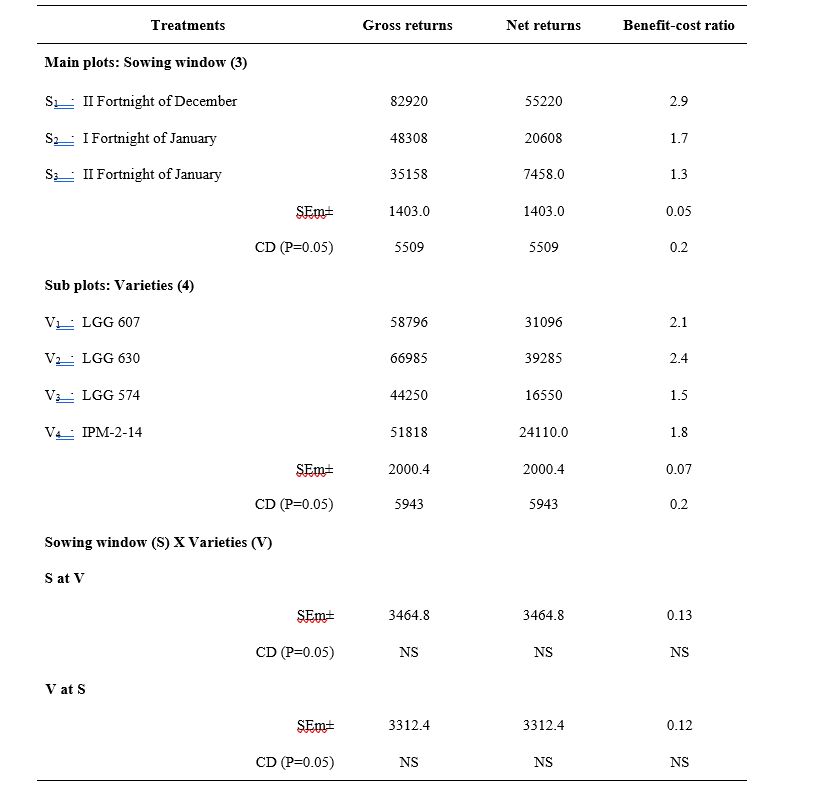
The higher gross returns, net returns and benefit-cost ratio of greengram were obtained with the crop sown during II Fortnight of December (S1), which was followed by the crop sown during I Fortnight of January (S2) and II Fortnight of January (S3), with significant disparity between them and the latter variety registered lower values of above parameters. Highest economic returns with early sown crop might be because of higher seed and haulm yield. These results were in line with the findings of Nagamani et al. (2020) and Ali et al. (2021).
With regard to varieties, LGG 630 (V2) recorded significantly higher gross returns, net returns and benefit-cost ratio. Lower values of the above parameters were realized with LGG 574 (V3). Higher gross returns with LGG 630 (V2) variety of greengram might be because of higher yield attributing characters of that particular variety. Similar results were reported from the findings of Samant (2014) and Marthe et al. (2024).
Hence, it can be concluded that higher productivity and profitability of greengram can be realized from LGG 630 variety of greengram sown during II Fortnight of December (S1) indicating its suitability for late sowing during rabi season on sandy loam soils of Southern Agro-Climatic Zone of Andhra Pradesh.
Ali, A., Arooj, K., Khan, B. A., Nadeem, M. A., Imran, M., Safdar, M. E and Ali, M. F. 2021. Optimizing the growth and yield of mungbean (Vigna radiata L.) cultivars by altering sowing dates. Pakistan Journal of Agricultural Research. 34(3): 559-568.
Bankar D. S., Pawar S. B and Raut G. B. 2020. Studies on effect of weather parameters on greengram (Vigna radiata L.) varieties under different sowing dates. International Journal of Chemical Studies. 8(6): 2529-2532.
Dhaka, A. K., Singh, K., Kumar, S., Singh, B., Bhatia, J. K and Kumar, N. 2018. Thermal energy utilization in mungbean (Vigna radiata L.) as influenced by sowing times and genotypes. Legume Research-An International Journal. 42(6): 800-805.
Marthe, T. R. Choudhary, A. A., Lokesh T and Chavhan N. 2024. Study on yield and economics of summer green gram varieties sown in different sowing windows. Biological Forum -An International Journal. 16(2): 57-59.
Nagamani, C., Sumathi, V and Reddy, G.P. 2020. Yield and nutrient uptake of pigeonpea [Cajanus cajan (L.)] as influenced by sowing window, nutrient dose and foliar sprays. Agricultural Science Digest. 40
(2): 149-153.
Niveditha, M. P., Patil, S. B., Kalaghatagi, S. B and Ashvathama, V. H. 2022. Growth and yield of chickpea genotypes under changing weather scenario in the Northern Dry Zone of Karnataka. Journal of Farm Sciences. 35(02): 192-198.
Panse, V.G and Sukhatme, P.V. 1985. Statistical Methods for Agricultural Workers. ICAR, New Delhi. 100-174.
Samant, T.K. 2014. Evaluation of growth and yield parameters of greengram (Vigna Radiata L.). Agriculture Update. 9(3): 427-430.
Singh, G., Sekhon, H. S., Brar, J. S., Bains, T. S and Shanmugasundaram, S. 2011. Effect of plant density on the growth and yield of mungbean [Vigna radiata (L.) Wilczek] genotypes under different environments in India and Taiwan (No. AVRDC Staff Publication).