

0 Views
Department of Entomology, S.V. Agricultural College, ANGRAU, Tirupati-517 502.
Major paddy growing districts of Kerala viz., Alappuzha, Palakkad, Thrissur, Malappuram, Kottayam and Ernakulam were surveyed and planthoppers were collected, identified and described. The taxonomic characterization was undertaken by studying external morphological features and male genital characters. Eight planthopper species were identified viz., Cemus sp., Coronacella sinhalana (Kirkaldy), Harmalia anacharsis (Fennah), Nilaparvata lugens (Stal), Sogatella furcifera (Fennah), Sogatella kolophon (Kirkaldy), Toya bridwelli (Distant) and Nisia nervosa (Melichar) from family Meenoplidae. Out of the identified species, three species viz., Coronacella sinhalana (Kirkaldy), Harmalia anacharsis (Fennah) and Toya bridwelli (Distant) were new records from Kerala. Distinguishing morphological characters along with colour photographs were provided for better comprehension and easy identification of planthoppers.
KEYWORDS: Cemus, Coronacella, Harmalia, Nilaparvata, Sogatella, Toya and Nisia.
Rice (Oryza sativa L.) is the primary staple food for more than half of the World’s population. In Kerala, rice being one of the major food crop occupies an area of 1.17 lakh hectares with an average production of 2.54 lakh tonnes and productivity is 2172 kg ha-1 (WWW. indiastat.com.2024).
Hemiptera is an important phytophagous order among class Insecta, comprising of two suborders: Homoptera and Heteroptera. Planthoppers belong to the order Hemiptera, suborder Homoptera and division Auchenorrhyncha and super family Fulgoroidea with twenty families. They are phytophagous and act as vectors of viral diseases like rice grassy stunt and rice ragged stunt. The Delphacids stand out as the most diverse and economically significant family of planthoppers, encompassing around 1,835 species, with 55 of these species recognized as pests affecting 25 different crops (Wilson and O’Brien 1987). The effective management of a pest species is achieved only after accurate identification of that particular pest species. The literatures on identification of planthoppers of paddy are scattered in several journals, books and manuscripts, published over several years and in different languages and as such difficult to obtain. The present study was conducted with the objective of studying the planthopper diversity from paddy crop ecosystem in Kerala.
The particular experiment entitled was conducted at Department of Entomology, S.V. Agricultural College, Tirupati district during 2023-2024. A large number of planthopper specimens were collected by undertaking intensive surveys in major paddy growing districts viz., Alappuzha, Palakkad, Thrissur, Malappuram, Kottayam and Ernakulam of Kerala by sweep netting with the help of insect collection net and aspirator. The collected specimens were killed using cotton swab dipped in Ethyl acetate. The remaining killed specimens were dried in a hot air oven at 40-450C for about 5-6 hours. The dried male specimens were further mounted and slides of male genitalia were prepared based on procedure suggested by Knight (1965). The terminology suggested by Blocker and Triplehorn (1985) was followed to describe the different body parts of planthopper.
From the present study, eight different planthopper species belonging to seven genera under family Delphacidae and Meenoplidae were identified and described. The species belonging to family Delphacidae includes Cemus sp., Coronacella sinhalana (Kirkaldy), Harmalia anacharis (Fennah), Nilaparvata lugens (Stal), Sogatella furcifera (Fennah), Sogatella kolophon (Kirkaldy), Toya bridwelli (Distant); whereas Nisia nervosa (Motschulsky) belongs to family Meenoplidae. Among the identified species, three species viz.,
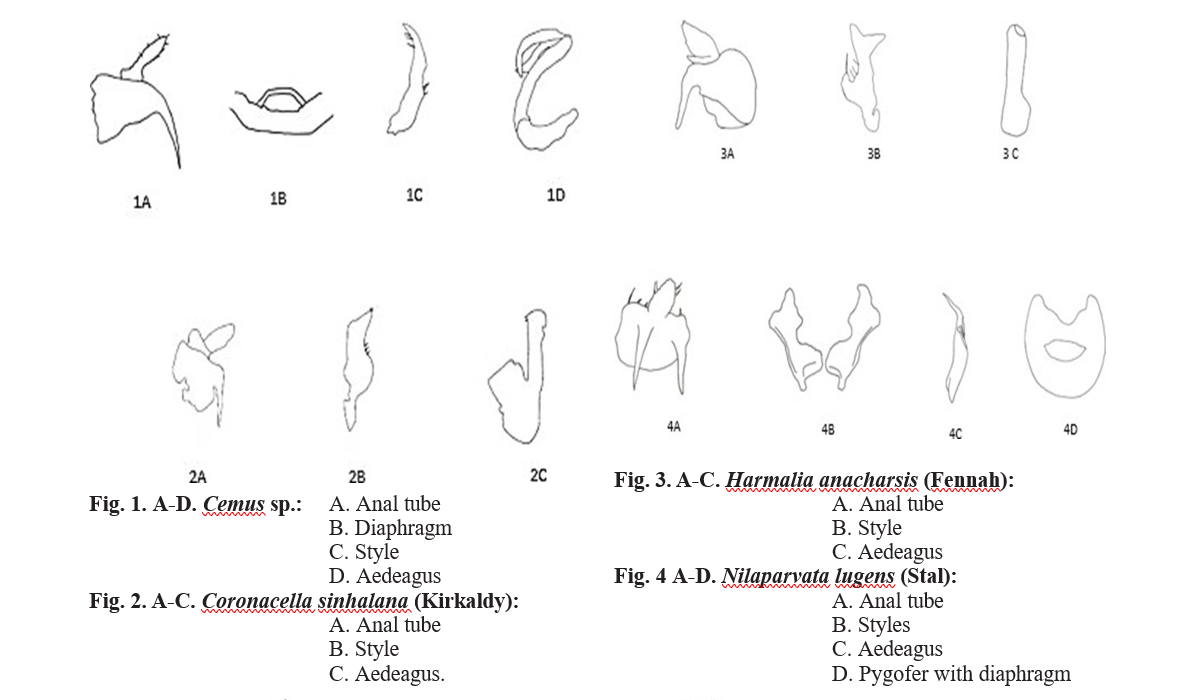
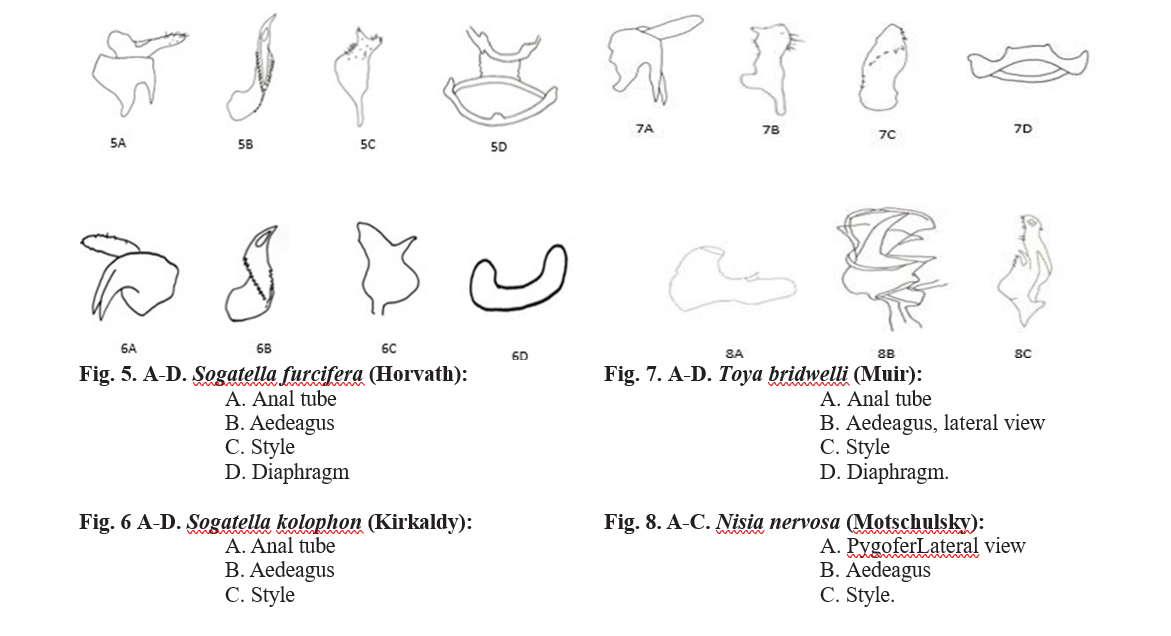
Coronacella sinhalana (Kirkaldy), Harmalia anacharsis (Fennah) and Toya bridwelli (Distant) were new records from paddy crop ecosystem in Kerala.
The key taxonomic and morphological characteristics of the eight identified plant hopper species are briefly summarized below for confirmation.
Reddish black coloured vertex and pronotum. Cream coloured carinae. Black dots present along the veins of forewings and fuscous maculae present apically. Forewings feature characteristic black dots along the veins and fuscous streaks apically, with a distinct pterostigma. Pygofer long and strongly convex ventrally and shorter dorsally, posterior opening relatively small, longer than broad. Aedeagus long, slightly decurved with a long flagellum arising at the apex. Dorsal margin with one or two processes. The genital styles wider at the base and taper gradually towards the apex, margined with small spines.
Off-white coloured vertex with black intercarinal area; frons and gena black. Carina Y- shaped, moderately distinct; slightly convex lateral carina and simple median carina. Antennae extend beyond the frontoclypeal suture, with the basal segment longer than wide but shorter than the second segment. The tibial spur bears 18 teeth. Posterior margin of pygofer slightly incised near the base. Aedeagus short, tubular and with many teeth dorsally near apex. Collar like anal segment with a pair of slender spinose processes directed ventrally.
Light brown coloured body with dark brown coloured frons. Forewing uniformly pale brown, lacking a distinct pterostigma and legs light brown in colour. Head narrower than pronotum and vertex very short, elongated frons. Carinae Y shaped and lighter in colour; ocelli located on the edge of carinae near the eyes. The first tarsal segment is longer than the remaining segments, with a leaf-like tibial spur that is broader; rostrum not reaching hind coxa. Collar like anal segment with a pair of slender spinose processes directed ventrally and armature of diaphragm single lobed. Aedeagus cylindrical, without teeth and maintains a uniform width throughout and genital styles split into two branches at the apex.
Yellowish brown or dark brown coloured body. Distinct carinae present on head, pronotum and mesonotum, lateral carina on pronotum diverging and mesonotal carina parallel. Frons longer than wide, unexcavated, nearly rectangular and has a distinct median carina. Triangular clypeus, much shorter than the frons with median carina and lateral carina. Eyes reniform and medially incised above the antennae. Moderately long antennae and extend beyond the frontoclypeal suture and second segment of antennae is longer and thicker than the first segment with numerous sensoria. Transparent forewings, with darker veins and pterostigma. Post-tarsal segment possess lateral spines that can be observed on both sides of the tarsus and tibial spur with 15 to 35 teeth. Moderately long pygofer, collar like anal segments and diaphragm without median process. Aedeagus tubular, slender, upturned, widening in the middle, tapering towards the apex with 3-5 teeth on the caudal margin ventral to gonopore, and the apex curved upwards. Flattened, short, laterally compressed genital styles with deeply concave inner margin in the middle and sub- apical wider margin.
Yellowish white coloured vertex, with black inter carinal areas. Whitish yellow coloured carina which is darkened laterally. Body of the insect is black dorsally and creamy white ventrally, with a notable yellowish- white area located centrally on the mesothorax in both males and females, so commonly referred to as white- backed planthopper. Moderately long pygofer, collar like anal segment, with a pair of stout spine like processes directed ventrally. Broadly U- shaped diaphragm with dorsal sclerotized horse-shoe shaped armature. Aedeagus simple, moderately long, tubular, usually sinuate with two rows of teeth, and with an apical gonopore. Genital styles distinctive, swollen in basal half; broader at the base and bifurcated at the apex.
Yellowish-white to pale stramineous coloured vertex with light carinae. The face, including the frons, clypeus, and genae entirely pale yellowish brown. Vertex longer sub- medially than it is broad at the base. Pale brown coloured antennae, with second segment 1.5 times as long as first segment and antenna reach up to frontoclypeal suture. Male and female exhibit cryptic
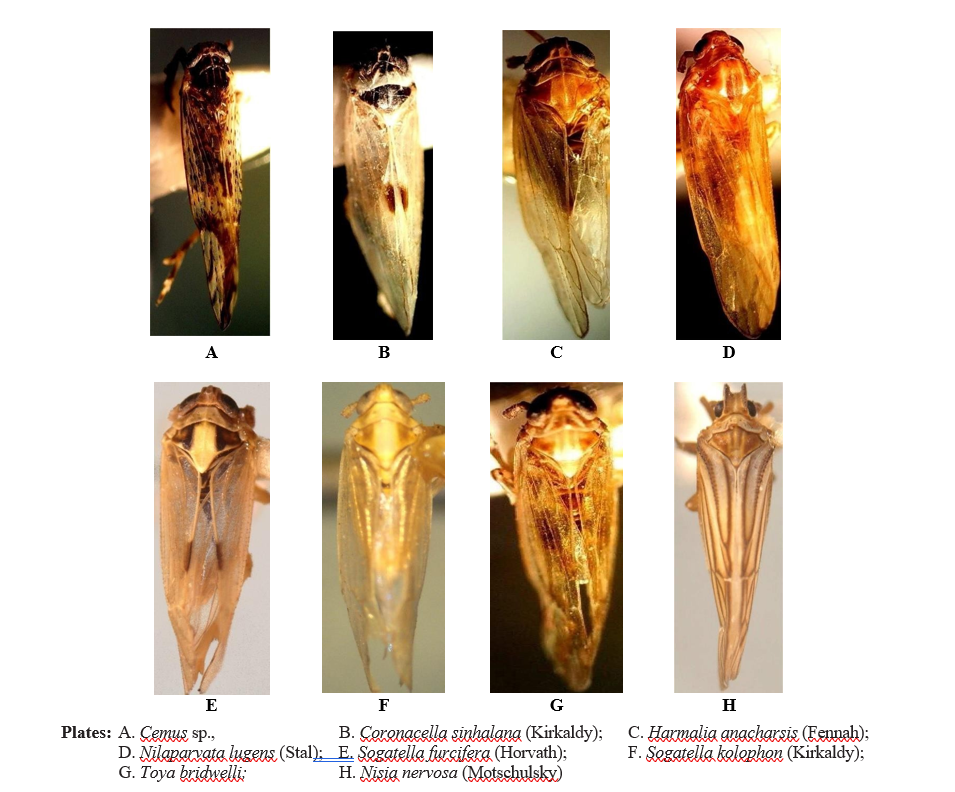
coloration. More or less rounded pygofer with posterior opening slightly longer dorsoventrally, collar like anal segment, with a pair of stout spine like processes, directed ventrally up to the length of anal tube. Aedeagus twisted, moderately long, tubular and genital styles relatively short, broad and flattened.
Body Ochraceous. Head slightly less wide than the pronotum. Y shaped carina, base of clypeus as broad as frons at the apex; hyaline tegmina with or without pterostigma. Pygofer with an expanded dorsocaudal margin and anal tube processes are paired. Aedeagus curved dorsally, bulged with rows of small teeth ascending from ventro dorsal side to apically on both sides. Style roughly quadrangular, with a tooth like extension apically.
Stramineous to white coloured body. Deeply excavated vertex, which is not demarcated from the frons. Clypeus short and triangular. Light straw coloured forewings with darker veins. The claval vein of the forewing geniculate or tuberculate. Legs slender, mobile spur absent, with first two tarsal segments having a row of spines. Pygofer elongated dorsoventrally, anal segment lacks a pair of spines. Aedeagus very broad at base, gradually narrowed and slightly curved with a pair of transparent wing like structures.
A comprehensive attempt to study planthoppers associated with paddy crop in Kerala was not made so far. Wilson (1983) studied, described and provided an illustrated key for identification of nymphal stages of planthoppers commonly associated with rice in Asia. Gunathilagaraj (1999) studied the planthoppers associated with rice crop in India and reported 10 species. Shashank (2009) reported six planthoppers belonging to six genera from rice crop in coastal and central Karnataka. The results obtained are in compliance with Geethanjali (2019) who reported 21 species of planthoppers from paddy crop ecosystem in southern and scarce rainfall zones of Andhra Pradesh.
A total of eight planthopper species belonging to seven genera under the families Delphacidae and Meenoplidae were identified from different paddy growing districts of Kerala viz., Cemus sp., Coronacella sinhalana (Kirkaldy), Harmalia anacharsis (Fennah), Nilaparvata lugens (Stal), Sogatella furcifera (Fennah), Sogatella kolophon (Kirkaldy), Toya bridwelli (Distant) and Nisia nervosa (Melichar). Amongst this three species viz., Coronacella sinhalana (Kirkaldy), Harmalia anacharsis (Fennah) and Toya bridwelli (Distant) were new records from Kerala. The accurate and precise identification of planthopper species associated with paddy crop ecosystem helps in effective management of these planthoppers in point of view, if they attain pest status in future.
Blocker, H. D and Triplehorn, B. W. 1985. External morphology of leafhoppers. In, the leafhoppers and planthoppers. John Wiley and Sons, New York. 41- 60.
Geethanjali, L. 2019. Taxonomic studies on planthopper fauna associated with graminaceous crop ecosystems in Southern and scarce rainfall zones of Andhra Pradesh. M.Sc. (Ag.) Thesis. Acharya N.G. Ranga Agricultural University, Lam, Guntur.
Gunathilagaraj, K. 1999. Rice planthoppers. In, Insect pests of cereals and their management. Anand Prakash and Jagadeswari Rao (eds.). Applied Zoologist Research Association. CRRI Cuttack. 31-58.
Knight, W.J. 1965. Techniques for use in the identification of leafhoppers (Homoptera: Cicadellidae). Entomologist’s gazette. 16(4): 129-136. Production and Productivity of rice in India 2023-2024.
Shashank, P.R. 2009. Taxonomic studies on leafhopper and planthopper fauna associated with rice ecosystem and their management. M.Sc. (Ag.) Thesis. Acharya N.G. Ranga Agricultural University, Guntur, Andhra Pradesh.
Wilson, M.R. 1983. The nymphal stages of some Auchenorrhyncha associated with rice in south-East Asia. In proceedings of the lst International workshop on Biotaxonomy, Classification and Biology of leafhoppers and planthoppers (Auchenorrhyncha) of Economic importance. Knight W J Pant N C Robertson T S and Wilson M R (eds.) 500. London 4-7 October 1982. Commonwealth Institute of Entomology, Queen’s Gate, London. 121-134.
Wilson, S.W and O’ Brien, L.B. 1987. A survey of planthopper pests of economically important plants (Homoptera: Fulgoroidea). In, Proceedings of the IInd International workshop on leafhoppers and planthoppers of economic importance. Wilson M R and Nault L R (eds.) 368 pp London 23rd July – 1st Aug. 1987, Commonwealth Institute of Entomology. 56 Queen’s Gate, London. 343-360.
www.indiastat.com. Ministry of Agriculture and Farmers welfare, Government of India, Production of rice in India 2023-24.