
0 Views
Department of Genetics and Plant Breeding, S.V. Agricultural College, ANGRAU, Tirupati-517 502.
The analysis of variance revealed significant differences among genotypes for all the characters. Studies on genetic variability revealed high phenotypic and genotypic coefficient of variation, heritability, genetic advance as per cent of mean for the traits viz., grain yield per plant, harvest index, number of productive tillers per plant, ear head length and fodder yield per plant indicating simple selection could be practiced for improvement of these characters. The genotypic coefficient of variation for all the characters studied was lesser than the phenotypic coefficient of variation indicating selection was ineffective due to high influence of environment. High GCV and PCV values were observed for grain yield per plant and harvest index. High heritability coupled with high genetic advance as per cent of mean was observed for grain yield per plant, harvest index, fodder yield per plant, 1000 grain weight, plant height, ear head length and number of productive tillers per plant. Thus, these traits are predominantly under the control of additive gene action and hence these characters could be improved by selection.
KEYWORDS: Variability, Grain Yield, GCV, PCV, Heritability and Genetic advance.
Millets have more nutritional value because of their high protein, fibre content, vitamins and minerals like calcium, iron and magnesium. Millets are recommended as dietary supplements for people with diabetes and cardiovascular illness due to their high fibre and protein content (Patil et al., 2019). Finger millet [Eleusine coracana (L.) Gaertn.] also known as African millet or Ragi, it is a self-pollinated allotetraploid (2n=4X=36) crop. It holds significant importance as a versatile member of small millets group, particularly in the North Eastern region of India (Soe et al., 2022). In the face of climate change and depleting natural resources, finger millet emerges as a valuable nutritional resource for less developed nations. Recognizing the economic significance of millets, the Indian government declared 2023 as the “International Year of Millets,” receiving support from 72 countries and the United Nations General Assembly (UNGA) (Yenagi et al., 2010). Ragi is grown in over twenty-five African and Asian nations, with India, Uganda, Nepal and China being the top producers. During the last decade finger millet was grown in 28.1 lakh hectares area and produced 38.3 lakh tonnes of grain with 1362 kg/ha productivity worldwide. India is top on the table with 11.63 lakh hectares area and 16.91 lakh tonnes of grain production with productivity 1454 kg/ha higher than the global productivity in the year 2022- 23 (Bhat et al., 2023). Karnataka is the leading state in acreage and production followed by Uttarakhand, Tamil Nadu, Maharashtra and Odisha (Anonymous, 2023).
Finger millet contains about 5–8% protein, 1–2% ether extractives, 65–75% carbohydrates, 15–20% dietary fiber and 2.5–3.5% minerals (Chethan and Malleshi, 2007). It has the highest calcium content among all cereals (344 mg/100 g). Despite all these merits, this crop has been neglected from the main stream of crop improvement programme. The available genetic variability in finger millet necessitates the characterization of these resources for genetic improvement. Beyond genetic variability, knowledge of heritability and genetic advance measures the extent to which a trait is passed on to offspring, aiding breeders in implementing suitable breeding strategies to achieve specific objectives. In pursuit to develop high yielding varieties, a breeder must know the heritability of traits to be enhanced and predict genetic gain under selection (Johnson et al., 1955)
The experimental materials consisting twenty genotypes were sown in a randomized block design with two replications, during Rabi, 2023 at Agricultural Research Station Perumallapalle, Tirupati. Adopted spacing was 22.5 cm between rows and 10 cm between plants and proper recommended package of practices were followed to raise good and healthy crop stand. Data were collected on ten yield and yield contributing characters viz., days to 50% flowering, days to maturity, plant height (cm), number of productive tillers per plant, ear head length (cm), number of fingers per ear, grain yield per plant (g), fodder yield per plant (g), 1000 grain weight (g) and harvest index (%).
Observations for ten quantitative traits were recorded based on five randomly selected plants in each replication for all the characters except days to 50 percent flowering and days to maturity which were recorded on a plot basis. The analysis of variance (ANOVA) technique suggested by Panse and Sukhatme (1985) was utilized to test the presence of significant difference among the genotypes for all the characters under study. The significance of mean sum of squares for each character was tested against the corresponding error degrees of freedom using ‘F’ Test (Fisher and Yates, 1967). The components of variances were used to estimate genetic parameters like phenotypic and genotypic coefficient of variation (PCV and GCV) as per the formulae given by Burton and De-Vane (1953). Heritability in the broad sense was calculated according to the formula given by Allard (1960) and expressed in percentage. Genetic advance was estimated by using Burton (1953) formula. Statistical analysis was done by using WINDOSTAT program.
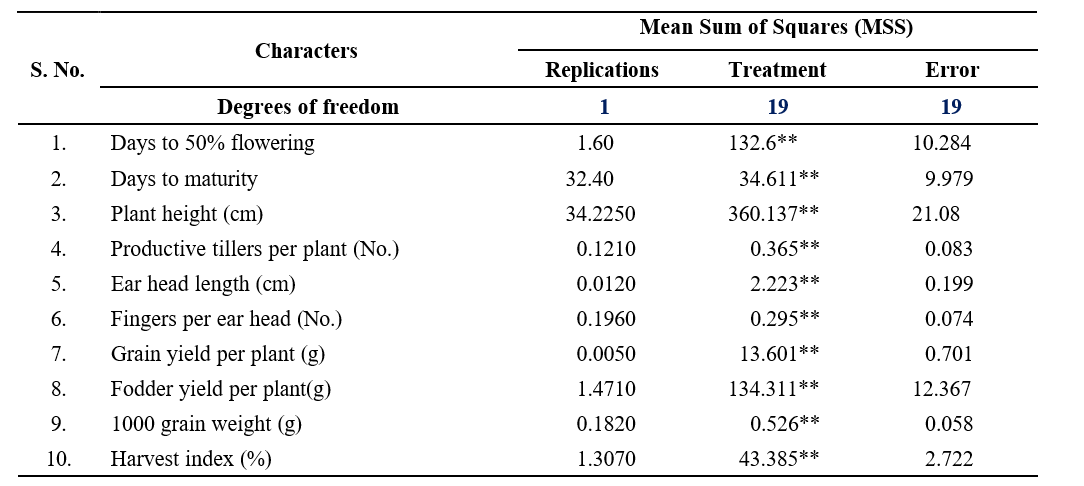
For all the ten traits studied, analysis of variance showed significant differences among all genotypes, which are summarised in Table 1. A considerable amount of genetic variability presented among genotypes suggested a wide range for improvement in yield and its attributing characters. Table 2 showed the genetic variability parameters like GCV (%), PCV (%), Heritability (%), and GAM (%) for all the traits studied.
The results from the analysis show that the phenotypic coefficient of variation (PCV) was reliably higher than the corresponding genotypic coefficient of variation (GCV) and environmental coefficient of variation for all the studied characters. Conferring to Sivasubramanian and Madhavamenon (1973), the GCV and PCV values were classified into three categories: low (0-10 %), moderate (10-20 %) and high (20 % and above).
The characters such as grain yield per plant (GCV: 26.88 %; PCV: 28.30 %) and harvest index (GCV: 26.57 %; PCV: 28.29 %) exhibited higher estimates of
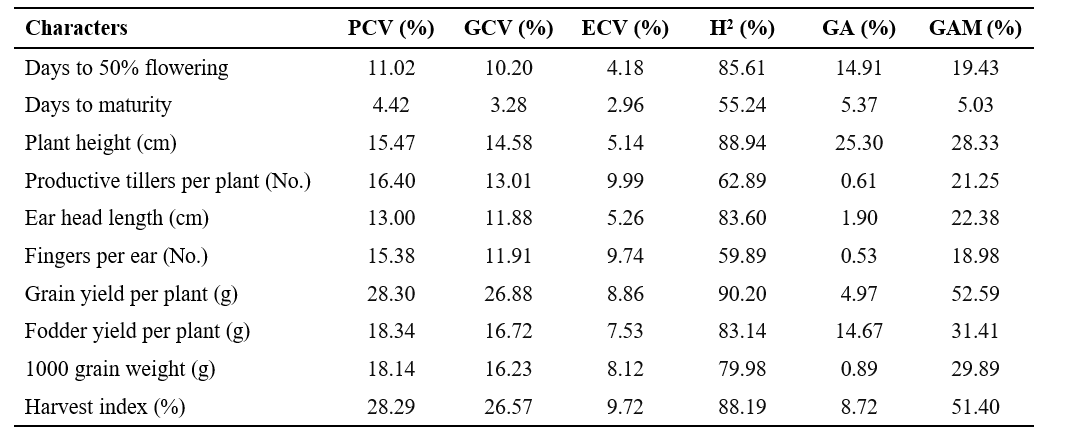
GCV and PCV indicating sufficient amount of variation among finger millet genotypes for these characters. Therefore, direct selection would be effective for further improvement of these characters. Similar results of high estimates of variability were previously reported by Jyothsna et al. (2016), Ulaganathan and Nirmalakumari (2014), Karad and Patil (2013), Priyadarshini et al. (2011), Shet et al. (2009) and Prabhu et al. (2008) for grain yield per plant and Madhavi Latha et al. (2021), Mahanthesha et al. (2017) and Karad and Patil (2013) for the harvest index in finger millet.
Moderate estimates of GCV and PCV were observed for fodder yield per plant ( PCV : 18.34 % ; GCV :16.72 %), 1000 grain weight (PCV : 18.14 % ; GCV : 16.23 %), number of productive tillers per plant (PCV : 16.40 % ; GCV : 13.01 %), plant height (PCV : 15.47 % ; GCV: 14.58 %), number of fingers per ear (PCV: 15.38 %; GCV: 11.91 %), ear head length ((PCV: 13.00 %; GCV: 11.88 %) and days to 50% flowering (PCV: 11.02 % ; GCV : 10.20 %). Similar results of moderate estimates of variability previously reported by Gopal (2021) for days to 50% flowering, Ganapathy et al. (2011) for number of fingers per ear and Ganapathy et al. (2011), Mahanthesha et al. (2017), Aralikatti et al. (2020) for plant height.
Low estimates of GCV and PCV were observed for days to maturity (GCV: 3.28 %; PCV: 4.42 %). Similar results of low estimates of variability previously reported by Ganapathy et al. (2011), Reddy et al. (2013)
and Ulaganathan and Nirmalakumari (2014) for days to maturity.
In the present study, out of ten characters studied, high heritability was recorded for eight characters viz., Grain yield per plant (90.20), plant height (88.94), harvest index (88.19), days to 50% flowering (85.61), ear head length (83.60), fodder yield per plant (83.14), 1000 grain weight (79.98) and number of productive tillers per plant (62.89) which indicates that these characters were less influenced by environment.
Moderate estimates of heritability were recorded for days to maturity (55.24) and number of fingers per ear (59.89).
The characters viz., grain yield per plant (52.59 %), harvest index (51.40 %), fodder yield per plant (31.41 %), 1000 grain weight (29.89 %), plant height (28.33 %), ear head length (22.38 %) and number of productive tillers per plant (21.2 5%) recorded high genetic advance as a percent of mean. Moderate estimates of genetic advance as a per cent of mean were observed for days to 50% flowering (19.43 %) and number of fingers per ear (18.98 %) and low estimates of genetic advance as a per cent of mean was recorded for days to maturity (5.03 %).
High heritability coupled with high genetic advance as per cent of mean was recorded for grain yield per plant 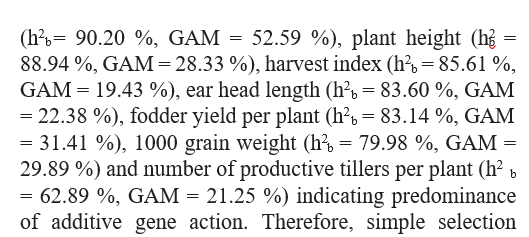
would be effective for improvement of these characters. Previously these results were reported by Madhavilatha et al. (2021), Aralikatti et al. (2020), Anuradha et al. (2019), Rawat et al. (2018), Singamsetty et al. (2018) and Devaliya (2016) for ear head length, Divya et al. (2022), Singamsetty (2018), Prabhu et al. (2008) and Bezaweletaw et al. (2006) for number of productive tillers per plant, Jyothsna et al. (2016), Shinde et al. (2014), Ulaganathan and Nirmalakumari (2014) and Karad and Patil (2013) for 1000 grain weight, Keerthana et al. (2019), Jyothsna et al. (2016), Devaliya (2016) and Ganapathy et al. (2011) for grain yield per plant and Madhavilatha et al. (2021) and Jyothsna et al. (2016) for fodder yield per plant in finger millet.
High heritability coupled with moderate genetic advance as a per cent of mean was recorded for days to 50% flowering (h2 = 85.61%, GAM = 19.43%) indicates that character was governed by additive gene effects and it may be expressed in the next generations. Similar results were reported by Anuradha et al. (2019). Moderate heritability with moderate genetic advance as a per cent of mean was observed for number of fingers per ear head (h2 = 58.89 %, GAM = 18.98 %) which indicates that the character was governed by non-additive gene action. Similar results were previously reported by Anuradha et al. (2019). So, heterosis breeding would be effective for improvement of the character. Moderate heritability coupled with low genetic advance as per cent of mean was recorded for days to maturity (h2 = 55.25 %, GAM = 5.03 %) previously similar results were reported by Keerthana et al. (2019) and Jyothsna et al. (2016).
Allard, R.W. 1960. Principles of plant breeding. John Willey and Sons Inc. New York. 485.
Anuradha, N and Patro, T.S.S.K. 2019. Studies on variability, heritability and genetic advance for quantitative characters in finger millet genotypes. International Journal of Chemical Studies. 7 (3): 2021-2024.
Aralikatti, P.M and Chaturvedi, H.P. 2020. Genetic variability, heritability and genetic advance studies in finger millet (Eleusine coracana (L.) Gaertn) cultivars under foothill condition of Nagaland. Journal of Plant Development Sciences. 12 (7): 411-416.
Bezaweletaw, K., Sripichitt, P., Wongyai, W and Hongtrakul, V. 2006. Genetic variation, heritability and path-analysis in Ethiopian finger millet (Eleusine coracana (L.) Gaertn) landraces. Kasetsart Journal of Natural Sciences. 40 (2): 322-334.
Bhat, B.V., Hariprasanna, K and Ratnavathi, C.V. 2023. Global and Indian scenario of millets. Indian Farming. 73(1): 16-18.
Burton, G.W. 1953. Quantitative inheritance in grasses. Proceeding on 6th International Grass Land Congress Journal. 1 (2): 277-283.
Burton, G.W and De Vane, D.E. 1953. Estimating heritability in tall fescue (Festuca arundinacea) from replicated clonal material.
Chethan, S and Malleshi, N.G. 2007. Finger millet polyphenols: Optimization of extraction and the effect of pH on their stability. Food chemistry. 105(2): 862-870.
Devaliya, S.D. 2016. Genetic Variability Studies in Finger Millet (Eleusine coracana (L.) Gaertn). Ph. D thesis, college of agriculture Navsari Agricultural University, Navsari.
Divya, S., Geetha, K., Kumari, A.N and Rajesh, M. 2022. Genetic studies on variability for quantitative traits in finger millet (Eleusine coracana (L.) Gaertn). Electronic Journal of Plant Breeding. 13 (1): 249-252.
Fisher, R.A and Yates. 1967. Statistical Tables for Biological Agricultural and Medical Research Olivar and Boyd, Edington. 12 (1): 98-102.
Ganapathy, S., Nirmalakumari, A and Muthiah, A.R. 2011. Genetic variability and interrelationship analysis for economic traits in finger millet germplasm. World Journal of Agricultural Sciences. 7 (2): 185-188.
Johnson, H.W., Robinson, H.F and Comstock, R.E. 1955. Estimates of genetic and environmental variability in soybean. Agronomy journal. 47: 314-318.
Jyothsna, S., Patro, T.S.S.K., Ashok, S., Rani, Y.S and Neeraja, B. 2016. Studies on genetic parameters, character association and path analysis of yield and its components in finger millet (Eleusine coracana (L.) Gaertn). International Journal of Theoretical and Applied Sciences. 8 (l): 25-30.
Karad, S.R and Patil, J.V. 2013. Assessment of genetic diversity among finger millet (Eleusine coracana (L.) Gaertn) genotypes. International Journal of Integrative sciences, Innovation and Technology. 2 (4): 37-43.
Keerthana, K., Chitra, S., Subramanian, A., Nithila, S and Elangovan, M. 2019. Studies on genetic variability in finger millet (Eleusine coracana (L.) Gaertn) genotypes under sodic conditions. Electronic Journal of Plant Breeding. 10 (2): 566-569.
Madhavilatha, L., Sudhakar, P., Latha, P., Priya, M.S and Kumar, M.H. 2021.Studies on genetic variability, correlation and path analysis for quantitative traits in finger millet. The Pharma Innovation. 10(6): 709-712.
Mahanthesha, M., Sujatha, M., Pandravada, S.R and Meena, A.K. 2017. Studies on variability, heritability and genetic advance for quantitative characters in finger millet (Eleusine coracana (L.) Gaertn) germplasm. International Journal of Current Microbiology and Applied Science. 6 (6): 970-974.
Panse, V.G and Sukhatme, P.V. 1985. Statistical Methods for Agricultural Workers. Indian Council of Agricultural Research, New Delhi. 361.
Patil,H.E.,Patel,B.KandPali,V.2019.Nutritiveevaluation of finger millet [Eleusine coracana (L.) Gaertn.] genotypes for quality improvement. International Journal of Chemical Studies. 7 (4): 642-646.
Prabhu, D.A., Selvi, B and Govindaraj, M. 2008. Genetic variability and multivariate analysis in finger millet (Eleusine coracana (L.) Gaertn) germplasm for yield characters. Crop Research. 36 (l,2&3): 218-223.
Priyadharshini, C., Nirmalakumari, A., Joel, A.J and Raveendran, M. 2011. Genetic variability and trait relationships in finger millet (Eleusine coracana (L.) Gaertn) hybrids. Madras Agricultural Journal. 98 (1): 18-21.
Rawat, L., Prasad, S., Bisht, T.S., Naithani, D.C and Kumar, J. 2018. Assessment of genetic variability and divergence in finger millet accessions at mid hills of Uttarakhand. International Journal of Current Microbiology and Applied Sciences. 7 (11): 2912-2922.
Reddy, C.V., Reddy, P.V.R.M., Munirathnam, P and Gowda, J. 2013. Studies of genetic variability in yield and yield attributing traits of finger millet (Eleusine coracana (L.) Gaertn). Indian Journal of Agricultural Research. 47 (6): 549-552.
Shet, R.M., Gireesh, C., Jagadeesha, N., Lokesh, G.Y and Jayarame, G. 2009. Genetic variability in segregating generation of interspecific hybrids of finger millet (Eleusine coracana (L.) Gaertn). Environment and Ecology. 27 (3): 1013-1016.
Shinde, S.R., Desai, S.V and Pawar, R.M. 2014. Genetic variability and character association in finger millet (Eleusine coracana (L.) Gaertn). International Journal of Plant Sciences. 9 (l): 13-16.
Singamsetty, A., Patro, T.S.S.K., Anuradha, N and Divya, M. 2018. Studies on genetic variability for yield and yield attributing traits in finger millet (Eleusine coracana (L.) Gaertn). International Journal of Current Microbiology and Applied Sciences. 7: 90-95.
Sivasubramaniyan V and Madhavamenon P. 1973. Genotypic and phenotypic variability in rice. Madras Agricultural Journal. 60 (9): 1217-1221.
Soe, W., Jeena, A.S., Pant, U., Kumar, A and Chaudhary, 2022. Revealing genetic diversity in finger millet [Eleusine coracana (L.) Gaertn] germplasm collected from Uttarakhand hills. Electronic Journal of Plant Breeding. 13 (2):633-644.
Ulaganathan, V and Nirmalakumari, A. 2014. Genetic variability and correlation studies for quantitative traits in finger millet [Eleusine coracana (L.) Gaertn] germplasm. The Ecosan. 6: 21-25.
Yenagi, N.B., Handigol, J.A., Ravi, S.B., Mal, B and Padulosi, S. 2010. Nutritional and technological advancements in the promotion of ethnic and novel foods using the genetic diversity of minor millets in India. Indian Journal of Plant Genetic Resources. 23 (01): 82-86.