

0 Views
Department of Agricultural Extension Education, S.V. Agricultural College, ANGRAU, Tirupati-517 502.
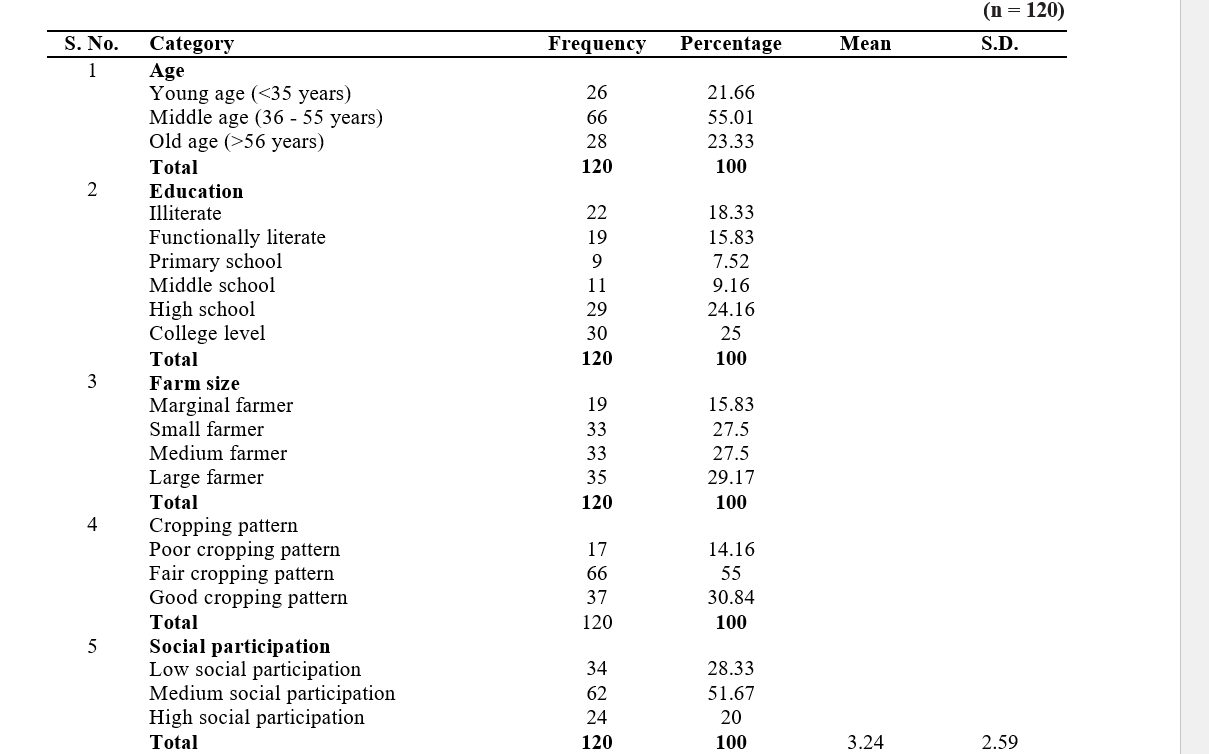
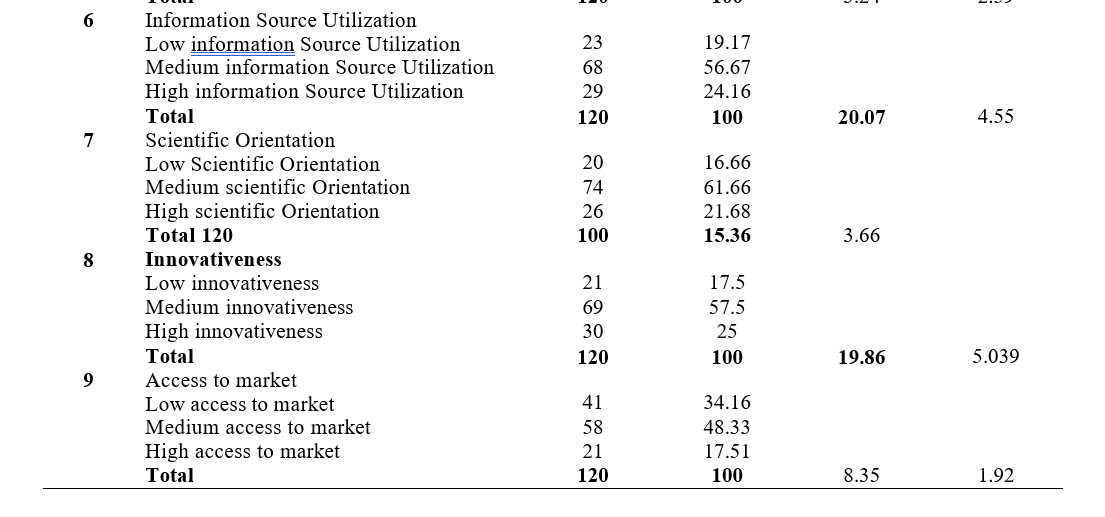
The present study was carried out to know the profile of millet growers in Ananthapuramu and Chittoor districts of Andhra Pradesh over a purposively drawn sample of 120 respondents. The results revealed that more than half of the millet growers were in middle age (55.01%), had college level of education (25.00%), large farmers (29.17%), fair cropping pattern (55.00%), medium social participation (51.67%), medium information source utilization (56.67%), medium level of scientific orientation (61.66%), medium innovativeness (57.50%) and medium access to market (48.33%).
KEYWORDS: Profile, millet growers.
Millets are small-seeded grasses whose grains are used as food or feed by humans and animals. The crops are hardy and grow well in dry zones as rainfed crops under marginal conditions of soil fertility and moisture in short growing season. Millets are one of the oldest foods known to humans and possibly the first cereal grain to be used for domestic purposes. Millet cultivation is declining due to several reasons few of which are processing hardships, low economic gains and lack of awareness about the nutritional significance. Millets due to their beneficial qualities perform a highly specific role in human nutrition. Millets are known as ‘Nutri- cereals’ because they are full of vitamins, minerals, sulphur-containing amino acids and phytochemicals. In terms of nutrition, they are on part with or even better than common cereals like wheat and rice. The area under millets is declining at an alarming rate in spite of the favourable cultivations available. In view of these, a study was undertaken to know the situation of millet crops and profile of millet growers in the Rayalaseema region.
The study was conducted with an Exploratory research design to assess the profile of millet growers in Rayalaseema region of Andhra Pradesh. The study was purposively conducted in two districts with highest area under cultivation of millets. From each district three mandals will be selected purposively based on the highest area under cultivation of millets, thus making a total of six mandals. From each of the selected mandal, two villages were selected purposively, thus making a total of 12 villages. From each of the selected village, ten respondents were selected purposively thus making a total of 120 respondents. The data was collected through a structured comprehensive interview schedule and analyzed using mean and standard deviation for drawing meaningful interpretations.
The millet growers were distributed into different categories based on their selected profile and the results were presented in the Table 1.
More than half (55.01%) of the millet growers were from middle age followed by old age (23.33%) and young age (21.66%) groups. The probable reason for the above trend might be due to agriculture’s highly unpredictable income rural youth lost interest in farming and moved to other non-farm occupations after graduation, particularly private employment, business ownership and self- employment. In the meantime, 23.33 per cent of elderly farmers might have chosen to remain at their homes and take care of allied activities such as animal husbandry to avoid the heavy drudgery and hard work involved in millet cultivation. Similar findings were in conformity with Kavyashree (2016), Singh (2019) and Chavhan (2020).
About (25.00%) of the millet growers were educated up to college level followed by high school (24.16%), illiterate (18.33%), functionally literate (15.83%), middle school (9.16%) and primary school (7.52%) level of education. This above trend might be due to the fact that educational facilities in villages were strengthened and villages were having accessibility to high schools and colleges, good transport facilities in villages and the availability of schools and colleges nearby them. Only very few millet growers had stopped their education up to middle school and the reason might be due to lack of awareness about importance of higher education among family members in the villages. Another plausible reason was the poor economic condition of the millet growers who made their children take up agriculture. This finding was in accordance with the findings of Chavhan (2020), Anilkumar (2021) and Patnaik (2024).
About 29.17 per cent of the millet growers were large farmers followed by 27.50 per cent medium farmers, 27.50 per cent were small farmers and only 15.83 per cent of them were marginal farmers. The above trend highlights that the small farmers constitute the smallest group facing considerable challenges due to limited land and resources. Marginal and medium sized farmers collectively formed a substantial majority with varying degrees of access to technology and market opportunities. Large-scale farmers although fewer in number represent a significant segment characterized by extensive land holdings and substantial investments in mechanization and infrastructure.
About 55.00 per cent of the millet growers had fair cropping pattern followed by good cropping pattern (30.84%) and poor cropping pattern (14.16%). The possible reason might be that majority of millet growers had fair and good cropping patterns, influenced by reaping more income from available piece of land duly maintaining its fertility status. Poor cropping patterns resulted from inadequate irrigation, lack of awareness and limited access to resources. Similar finding was reported by Kumar et al. (2018).
About 51.67 per cent of the millet growers had medium level of social participation followed by low (28.33%) and high (20.00 %) levels of social participation respectively. The above trend of low social participation might be due to various factors such as socio-economic constraints, lack of awareness or cultural barriers, lack of cooperative societies and organizations, and only a few of them are a part of the self-help groups and member in gram panchayat. And the medium social participation level of involvement in social and community activities which likely provides them with some benefits of networking, information exchange and collective problem solving. Lastly, 20 per cent of the growers demonstrate high social participation reflecting a smaller yet significant group that is deeply engaged in community activities and likely plays a pivotal role in local decision-making processes. The results were in conformity with Sul (2018) and Patnaik (2024).
More than half (56.67%) of the millet growers were having medium category of information source utilization, followed by high (24.16%) and low (19.17%) category of information source utilization. Most of the millet growers pertain on informal sources maintaining contact for the sake of information to take decision from the family, followed by friends, neighbour’s and input dealers. The reason might be accessibility of informal sources round the clock. In case of formal sources farmers approach the technical staff of RBK’s as compared to other formal sources because they were providing the timely information at village level. This finding was in accordance with the findings of Kavyashree (2016), Sul (2018) and Chavhan (2020).
About 61.66 per cent of the millet growers had medium level of scientific orientation, followed by high (21.68%) and low (16.66%) level of scientific orientation. The farmers being considerably educated might be the reason for the above trend. The farmers should adopt scientific management practices to make good economic yield from the farm. Proper post-harvest handling of the produce is essential to market millets profitably. Hence, farmers had to perceive things scientifically to overcome such challenges. And the low scientific orientation might be due to the reason that majority of the farmers being old were continuing the farming practices which were followed by their forefathers. This finding was in accordance with the findings of Priya (2015) and Tankodara et al. (2022).
About 57.50 per cent of the millet growers had medium level of innovativeness followed by high (25.00%) and low (17.50%) levels of innovativeness. The possible reason for the above trend might be due to that the farmers with higher education and medium social participation were able to update their knowledge and skills from time to time and ready to accept the new technologies in their farming.
Individual’s curiosity, often working without practical ends in mind has always been a driving force for innovation. Youngsters might be always seeking towards innovative ideas which will help to meet the
changing demands of the society. On the other side, illiterate and resource poor farmers might be lacking awareness, risk taking ability to adopt such technologies. And some of the growers are laggards and do not wish to adopt new technologies are practices. This finding was in accordance with the findings of Chavhan (2020), Anilkumar (2021) and Patnaik (2024).
About 48.33 per cent of the millet growers had medium access to market, followed by low
(34.16%) and high (17.51%) access to market. Majority of the millet growers expressed their response as “difficult to get” regarding availability of inputs and to market their produce. The centre for procurement of inputs and to market the produce was far away to the villages of the millet growers where they can’t get all the inputs easily. The reason for the low market access might be due to the non-availability of proper marketing channels for millets such as regulated market, co- operative and private mandis and warehouse facilities in co-operative societies. This finding was in accordance with the findings of Kumar (2015) and Rao (2016).
The resilience of Indian agriculture, weathering all the vagaries of the monsoon has resulted in fall in food grain production, in spite of an increase in area under fine cereals which had necessitates a paradigm shift towards increase in production of millets, as it has wide adaptability to extremes of soil and climatic conditions. The study indicated that most of the millet growers belonged to middle-aged (3655 years) with medium to high level of education. Most of the millet growers cultivate millets in medium to large size of farms, in kharif season the majority of the respondents were cultivating sorghum, in rabi season cultivating sorghum, followed by finger millet and pearl millet, in kharif season having fair cropping pattern. Further the profile revealed that majority of millet growers were belonged to medium level of social participation, information source utilization, innovativeness and access to market.
Anilkumar. 2021. Training needs of sorghum production technology: A study of growers in Kalaburagi district. M.Sc. (Ag.) Thesis. Dr. Rajendra Prasad Central Agricultural University, Bihar.
Chavhan, P.D. 2020. Impact of sorghum demonstrations on the beneficiary farmers. Panjabrao Deshmukh Krishi Vidyapeeth Krishinagar Po, Akola.
Kavyashree. 2016. Cultivation pattern and constraints in minor millets production in northern Karnataka. M.Sc. (Ag.) Thesis. University of Agricultural Sciences, Dharwad, India.
Kumar, P. 2015. Communication and marketing behaviour of tribal vegetable growers: A study in ranchi district of Jharkhand state. Ph.D. Thesis. Banaras Hindu University, Varanasi.
Kumar, A., Tomer, V and Kaur, A. 2018. Millets : A solution to agrarian and nutritional challenges.
Patnaik, S. 2024. Impact of Odisha millet mission on finger millet farmers of Koraput district. M.Sc. (Ag.) Thesis. Dr. Panjabrao Deshmukh Krishi Vidyapeeth Krishinagar, Akola.
Priya, V.S. 2015. Socio-economic impact of little millet (Samai) cultivation among tribal farmers. M.Sc. (Ag.) Thesis. Tamil Nadu Agricultural University, Coimbatore – 641 003.
Rao, S.N. 2016. A study on knowledge and adoption of turmeric farmers in Guntur district of Andhra Pradesh. M.Sc. (Ag.) Thesis. Acharya N.G. Ranga Agricultural University, Guntur.
Singh, D. 2019. Technological gap in adoption of forage Sorghum cultivation in Haryana. M.Sc. (Ag.) Thesis. Chaudhary Charan Singh Haryana Agricultural University, Hissar (Haryana).
Sul, M.R. 2018. Extent of adoption of recommended cultivation practices of Finger millet in Kolhapur district. M.Sc. (Ag.) Thesis. Mahatma Phule Krishi Vidya Peethrahuri, Ahmednagar, Maharashtra, India.
Tankodara, K., Sharma, P and Choudhary, M. 2022. Factors affecting perceived usefulness of the Sorghum growers about CoFS 29 variety. Gujarat Journal of Extension Education. 33: 89-93.