
0 Views
Department of Agril. Extension Education, S.V. Agricultural College, ANGRAU, Tirupati-517 502.
The present study was conducted in Palakkad district of Kerala to study the profile of men and women involved in banana value chain. A total of 112 respondents (80 farmers, 8 processors, 24 marketers) were randomly selected with a consideration to gender. Exploratory research design was followed for the study. In production, participation was relatively balanced, with men (53.75%) and women (46.25%). Most growers, regardless of gender, were middle-aged and had high school education. The growers also had medium levels of income, leadership, economic motivation, social participation, media exposure, extension contact, and decision-making ability. The processing sector showed equal male and female representation. Male processors were predominantly middle-aged with graduate-level education, while females were evenly distributed between young and middle age groups with higher secondary education. Although both genders had similar levels of income and media exposure, women demonstrated lower leadership ability, extension contact, and decision-making, but higher social participation. The marketing sector was male-dominated (83.33 per cent men and 16.66 per cent women). Both men and women marketers were mostly middle-aged and educated up to higher secondary level, with medium levels of socio-economic traits; however, women had lower extension contact and decision-making ability.
KEYWORDS: Banana Value Chain, Gender, Profile characteristics.
In Kerala, banana value chains were undergoing rapid structural changes, driven by increasing commercialization, market integration, and a growing emphasis on value addition. These shifts have opened up expanding opportunities across the production, processing, and marketing stages. Despite women’s active involvement across all nodes of the banana value chain, many interventions continue to overlook gender- specific roles, constraints, and opportunities. Gender- based divisions of labor, unequal access to productive resources, and disparities in decision-making and benefit-sharing often render women’s contributions invisible and inadequately supported. These persistent inequalities not only restrict women’s empowerment but also undermine the overall efficiency and competitiveness of the banana sector. In this context, understanding the profile characteristics of value chain actors was critical for designing inclusive and sustainable value chain interventions.
The study was purposively conducted in Palakkad district of Kerala during 2025 by adopting an exploratory research design, as it was the highest banana-producing district in the state. Four blocks—Attapadi, Manarkkad, Sreekrishnapuram, and Ottapalam were purposively selected based on the extent of banana cultivation. From each block, two villages were randomly selected. From each village, ten farmers were randomly chosen. Additionally, from each block, two processors, three wholesalers and three retailers, bringing a total number of 112 respondents. Data were collected using structured interview schedules and analyzed using frequency, percentages, standard deviation and the Mann-Whitney U test to determine significant gender differences among the variables.
The profile characteristics such as gender, age, education, annual income, leadership ability, economic orientation, social participation, mass media exposure, decision making and extension contact of stakeholders in banana value chain were presented in Table 1 and Table 2.
The data presented in Table 1 indicated that banana cultivation showed relatively balanced participation between men and women. Out of eighty respondents, 53.75 per cent were men and 46.25 per cent were women. This indicated that farming was slightly male-dominated, though both men and women were actively involved. In the processing sector men and women were almost
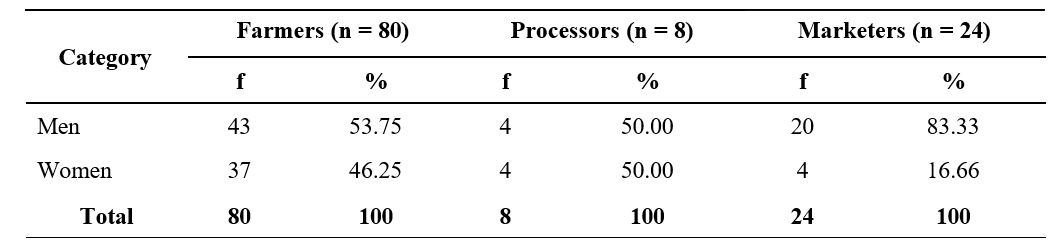
equally represented, each making up 50.00 per cent of the respondents. This suggested balanced involvement in value addition activities and indicated that processing was a less gender-restrictive role within the value chain. The marketing sector, was largely dominated by men. Among the respondents involved in banana marketing, 83.33 per cent were men, while only 16.66 per cent were women. While a few women were involved in banana retailing, none were observed participating in the wholesale sector.
The data presented in the Table 4.1 indicated that majority of male farmers were belonging to middle age group (48.84%) followed by old (39.53%) and young (11.63%) age group. Whereas, in female farmers majority belonged to middle (67.57%) followed by old (18.92%) and young (13.51%) age. In processing, majority of male respondents were belonging to middle age group (75.00%) followed by young (25.00%) age group. In case of female processors, an equal proportion of respondents (50.00 per cent each) belonged to the young and middle age groups. Considering marketers, majority of male marketers were belonging to middle age group (60.00%) followed by young (25.00%) and old (15.00%) age group. In case of female marketers an equal proportion of respondents 50.00 per cent each belonged to the young and middle age groups. The majority of respondents, both male and female, were in the middle age group, indicating that middle age group was the most active in the banana value chain. Middle-aged women’s higher participation in production activities may be due to their active involvement in value chain through Self-Help Groups (SHGs), which offer them support and opportunities in agriculture. Findings of the present study were similar with the findings of Murugan (2017) and Vijayan and Kumar (2023).
It was inferred from Table 2 that, majority of the male farmers (48.84%) of banana growers belonged to high school level of education followed by higher secondary education (20.93%), middle school education (20.93%), primary education (6.98 %) and graduation and above (2.33%) categories. Among female farmers majority had high school (51.35%) level education followed by middle school (29.73%), higher secondary (10.81%), graduation and above (5.41%) and primary education (2.70%) level. In processing sector, majority of the male respondents had graduation and above (75.00%) level of education followed by higher secondary level of education (25.00%). Among female respondents, majority (75.00%) belonged to higher secondary level of education followed by graduation and above (25.00%) level of education. In marketing, majority of the male respondents belonged to higher secondary (45.00%) level of education followed by high school (40.00%), graduation and above (10.00%) and middle school (5.00%) level of education. Among female respondents majority (75.00%) had higher secondary education followed by high school education (25.00%). This trend reflected the increasing emphasis placed on education by the state government and the improved accessibility of educational infrastructure in rural areas. Studies by Murugan (2017) and Bhavani (2023) had matched with the above result.
It was inferred from Table 2 that, majority (74.42%) of the male banana growers had medium level of income followed by high (18.60%) and low (6.98%) level of income. Whereas, in female banana growers majority has medium level of income (67.57%) followed by low (24.32%) and high (8.11%) level of income. In processing sector, among male respondents majority (75.00%) had medium level of income followed by high (25.00%) level of income. Among female respondents majority (75.00%) had medium level of income followed by low (25.00%) level of income. In marketing, among male respondents, more than half (65.00%) of them has medium level of income followed by low (20.00%) and high (15.00%). Among female respondents majority

(75.00%) had medium level of income followed by low (25.00%) level of income. The Mann-Whitney U test had shown that men and women in banana value chain were significantly different in terms of their annual income, which may be attributed to the persistent wage disparities in the agricultural sector. This result was in agreement with the findings of Murugan (2017) and Bhavani (2023).
It was inferred from Table 2 that, almost half of the male banana growers had medium (51.16%) level of leadership ability followed by high (30.23%) and low (18.60%). Among female banana growers majority had medium (64.86%) followed by low (21.62%) and high (13.51%). In processing sector, among male respondents half (50.00%) of the population had high level and other half had medium level of leadership ability. Whereas for women, majority (50% each) had medium to low level of leadership ability. In marketing, majority of the male respondent had medium (65.00%) level of leadership ability followed by high (20.00%) and low (15.00%). Among women majority (75.00%) had medium level followed by low (25.00%) leadership ability. The Mann- Whitney U test revealed that the men and women in banana value chain were significantly different in terms of their leadership ability. The findings are in line with the observations of Farooq (2019).
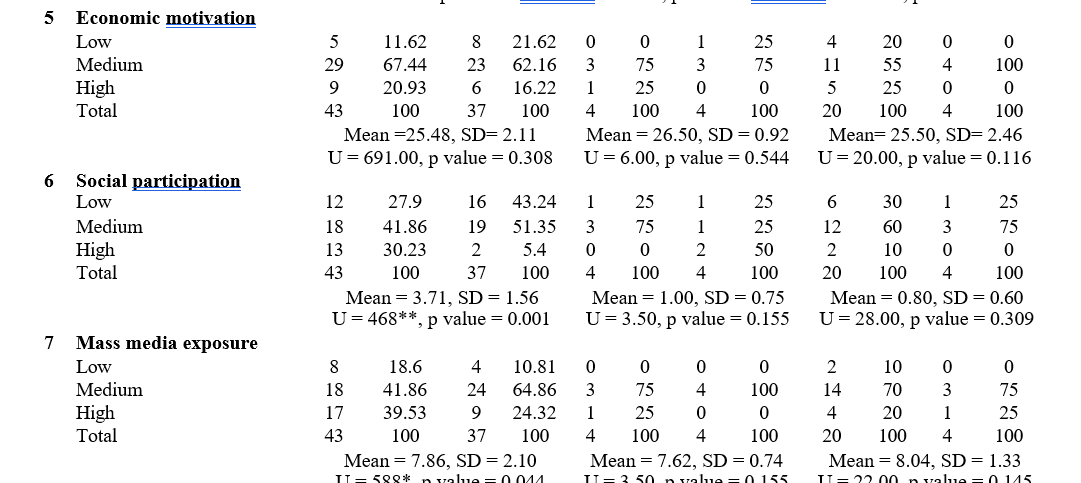
It was inferred from Table 2 that, majority of the male banana growers had medium (67.44%) level of economic orientation followed by high (20.93%) and low (11.62%) economic orientation. Among women banana growers (62.16%) of the respondent had medium level of economic orientation followed by low (21.62%) and high (16.22%) level of economic orientation. In processing sector, majority of the male respondent had medium (75.00%) level of economic orientation followed by high (25.00%). Among women majority had medium (75.00%) level of economic orientation followed by low (25.00%). In marketing sector, more than half of the male respondents showed medium (55.00%) of economic orientation followed by high (25.00%) and low (20.00%). Among women respondents all of them showed medium level of economic response. The Mann- Whitney U revealed that the men and women in banana value chain were not significantly different in terms of their economic orientation. This trend may be attributed to stakeholder investments aimed at higher profits, along with womens collective farming efforts that improved resource use and economic orientation. The results were in accordance with Rashida (2020).
It was inferred from Table 2 that, male banana growers (41.86 %) had medium level of social participation followed by high (30.23%) and low (27.90%). Among women banana growers, almost half of the respondents had medium level (51.35%) of social participation followed by low (43.24%) and high
(5.40%) level of social participation. In processing sector, majority of the male respondents have medium (75.00%) level of social participation followed by low (25.00%). Among the women respondents, 50.00 per cent exhibited a high level of social participation, while
25.00 per cent each had medium and low level of social participation. In marketing sector, majority of the men had medium (60.00%) level of social participation followed by low (30.00%) and high (10.00%). Among women three-fourth (75.00%) of them had medium level followed by low (25.00%) level of social participation. The Mann-Whitney U test revealed that male and female banana farmers differed significantly in terms of their social participation, whereas no significant differences were observed among processors and marketers. Farmers had formal organizations like FPOs and SHGs that enhanced their social participation, while processors and marketers lacked such structures. However, SHGs with value addition units played a role in improving social participation among women processors. The findings were in accordance with Murugan (2017).
It was inferred from Table 2 that, majority (41.86%) of the male banana growers had medium level of mass media exposure, followed by high (39.53%) and low (18.60%). Similarly, among women banana growers, majority (64.86%) had medium level of mass media exposure, followed by high (24.32%) and low (10.81%) mass media exposure. In processing sector, majority (75.00%) of the male respondents had medium level of mass media exposure followed by high (25.00%) level. All of the women respondents had medium (100.00%) level of mass media exposure. In marketing also, majority (70.00%) of the men had medium level of mass media exposure followed by high (20.00%) and low (10.00%) level. For women majority (75.00%) had medium level of mass media exposure followed by high (25.00%) level. The Mann-Whitney U test revealed that male and female banana farmers differed significantly in terms of their mass media exposure, whereas no significant differences were observed among processors and marketers. The findings were in accordance with Maheswaran (2019) and Rashida (2020).
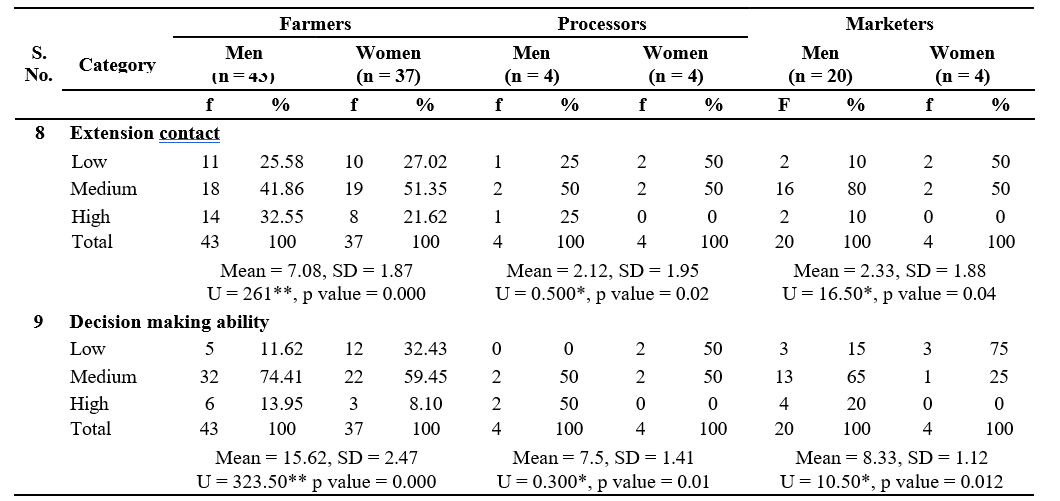
Majority (41.86%) of the male banana growers had medium level of extension contact followed by high (32.55%) and low (25.58%) level of extension contact. Whereas, majority (51.35%) of the female banana growers had medium level of extension contact followed by low (27.02%) and high (21.62%). In the processing sector, half (50.00%) of male processors reported a medium level of extension contact. An equal proportion (25.00%) of male respondents had low and high levels of extension contact, respectively. In contrast, women engaged in banana processing exhibited medium to low (each 50.00%) level of extension contact. In marketing, among the male marketers, a majority (80.00 %) had a medium level of extension contact, followed by an equal proportion (10.00 % each) with low and high levels of contact. In contrast, female marketers reported a medium to low (each 50%) level of extension contact. The Mann- Whitney U test revealed that the men and women in banana value chain were significantly different in terms of their extension contact. This could be attributed to issues such as the untimely availability of support and services from the extension system. The low level of extension contact among female respondents was likely due to limited access and infrequent interactions, stemming from resource constraints, logistical challenges, and geographic remoteness. Other stakeholders had minimal interaction with formal extension services, relying mostly on peers for agricultural information, likely due to low awareness and limited access to resources like business incubation centres. The results were in accordance with Bhavani (2023) and Rooh (2023).
It was inferred from Table 2 that, majority (74.41%) of the male banana growers belong to medium level of decision making followed by high (13.95%) and low (11.62%) decision-making ability. Regarding decision making ability of women banana growers, majority (59.45%) had medium level of decision-making ability followed by low (32.43%) and high (8.10%) decision- making ability. Among male respondents in the processing sector, exhibited a high to medium (each 50.00%) level of decision-making ability. In contrast, among female respondents, 50.00 per cent demonstrated a medium level of decision-making ability, and the other 50.00 per cent exhibited a low level of decision making. The majority (65.00 %) of the male respondents in marketing had medium level of decision-making ability followed by high (20.00%) and low (15.00%) level of decision-making ability categories. Whereas, majority of the women respondents had low (75.00%) level of decision-making ability followed by medium (25.00%) level of decision-making ability. The Mann-Whitney U test revealed that the men and women in banana value chain were significantly different in terms of their decision making ability. The findings were in accordance with Kini (2022) and Gohade (2022).
The findings indicated significant gender disparities across various stages of the banana value chain. Majority of stakeholders exhibited moderate levels in their profile characteristics with significant difference between men and women. Hence it indicates the need for gender-specific analysis to design more targeted and effective interventions. Compiling gender-disaggregated data throughout the banana value chain is crucial for understanding the distinct impacts on men and women. Enhancing women’s involvement, particularly in the processing and marketing segments, necessitates the reinforcement of extension services and institutional support mechanisms. These targeted interventions were found essential for fostering a more inclusive and efficient banana value chain in this study.
Bhavani, V. 2023. Stakeholder analysis of groundnut value chain in Telangana State. M.Sc. thesis. Professor Jayashankar Telangana State Agricultural University, Telegana.
Farooq, F. 2019. Entrepreneurial behaviour of grape growers in Ganderbal district. M.Sc. thesis. Sher- e-Kashmir University of Agricultural Sciences and Technology of Kashmir.
Gohade, G. R. 2022. Decision making pattern of farm women in agricultural activities. M.Sc. Thesis. Vasantrao Naik Marathwada Krishi Vidyapeeth, Parbhani.
Kini J .2022. Gender-aware inclusive value chain: A theoretical perspective. Frontiers in Sustainable Food System. 6. doi: 10.3389/fsufs.2022.1047190
Maheswaran, M. 2019. Development of test to measure level of knowledge of banana growers about integrated pest management. M.Sc. thesis, Anand Agricultural University.
Murugan, R. J. 2017. Training needs of banana growers in Palakkad district of Kerala. M.Sc. thesis, Acharya N.G. Ranga Agricultural University.
Rashida V.K. 2020. Performance analysis of Mahila Kisan Sashaktikaran Pariyojana (MKSP) scheme in Thrissur district. M.Sc. Thesis. Kerala Agricultural University, Thrissur
Rooh, A. 2023. Empowerment of farm women and men – A comparative study in Telangana State. M.Sc. Thesis. Professor Jayashankar Telangana Agricultural University, Telangana
Vijayan, S. R., and Kumar, S. 2023. Socio-economic analysis and marketing of Poovan and Nendran banana in Thiruvananthapuram district of Kerala. International Journal of Environment and Climate Change, 13(8): 1857–1865.