
0 Views
Department of Agronomy, S.V. Agricultural College, ANGRAU, Tirupati-517 502.
A field experiment entitled ‟Organic phosphorus management in green gram” was conducted at dryland Farm, S.V. Agricultural College, Tirupati campus of Acharya N.G. Ranga Agricultural University, Andhra Pradesh, India during rabi season, 2023-24. The experiment was laid out in split plot design and replicated thrice. The results of investigation revealed that among the different sources of organic manures recorded significantly higher values of plant height, leaf area index, dry matter production, seed yield and haulm yield of green gram were observed with 100 % RDP through poultry manure (M3) compared to other manures tried. Foliar application of seaweed extract @ 1 % (S4) resulted in higher values of plant height, leaf area index, dry matter production, seed yield and haulm yield of green gram over the other organic foliar sprays tried. The interaction effect found to be non- significant for all the parameters.
KEYWORDS: Greengram, Poultry manure, Seaweed extract.
Pulses, usually known as food legumes are rich in proteins and are found to be main source of protein to vegetarian population of India. They are the second important constituent of Indian diet after cereals. Pulses supply 25 per cent of protein demand of prevailing vegetarian population. According to World Health Organisation the per capita intake of pulses should be 80 g day-1 and as per the recommendation of Indian Council of Medical Research, the utilization per person should be 47 g day-1. However, at present the per capita consumption is much less than 30 to 35 g day-1. Green gram is cultivated in almost all the states. In India, it is cultivated in 42.38 lakh ha with a production of 30.9 lakh tonnes and productivity of 729 kg ha-1. In Andhra Pradesh, green gram is cultivated in an area of 1.05 lakh ha with a production of 0.82 lakh tonnes and a productivity of 782 kg ha-1(www.Indiastat.com, 2021-22).
Phosphorus nutrition plays a crucial role in green gram production. It not only influences metabolic processes and energy transformation but also significantly impacts root proliferation, which is essential for biological nitrogen fixation. It allows the plants to extract nutrients from lower soil layers, enabling them to thrive even under moisture stress conditions.
Nutrient management is the most critical management strategy for organic growers. Organic manures when applied to the soil improves the soil physico-chemical properties, water holding capacity and microbial activity. Organic foliar nutrition makes the plant more efficient in absorption of nutrients through stomata than uptake through their root and are safe to the crop, natural resources and wildlife.
Solid and liquid organic manures having higher number of beneficial microbes, essential amino acids, macro and micronutrients, growth promoting substances like IAA, GA may greatly help in increasing soil microbial population and soil fertility with further increase in crop growth, yield and quality (Gore and Sreenivasa, 2011). Combination of organic manures viz., FYM, poultry manure along with foliar feeding of organic liquids viz., panchagavya, jeevamrutha and seaweed extract (SWE) may result in cost-effective and eco- friendly nutrient management practices.
A field experiment was conducted at S.V. Agricultural College, Tirupati during rabi, 2023-24 on sandy loam soils. The soil was neutral in reaction, low in organic carbon, available nitrogen, medium in available phosphorus and available potassium. The present experiment was laid out in a split-plot design and replicated thrice. The main plots consisted of four organic manures viz., control (M1), 100 % RDP through farmyard manure (M2), 100 % RDP through poultry manure (M3) and 100 % RDP through sheep manure (M4) as organic manures. The recommended dose of phosphorus was 50 kg P2O5 ha-1. Sub plots consisted of four organic foliar sprays viz., control (water spray) (S1), Panchagavya @ 3 % (S2), Drava jeevamrutham @ 10 % (S3) and Seaweed extract @ 1 % (S4) as foliar sprays at pre flowering and pod development stages. Plant height was measured from the base of the plant to the tip of the terminal bud at 20, 40, 60 DAS and at harvest and the mean value was expressed in centimetres. Leaf area was recorded from five randomly selected plants from sampling area inside the net plot at 20, 40, 60 DAS and at harvest, using LI-COR model, LT-300 leaf area meter with transparent conveyor belt having electronic display and expressed in cm2. Leaf area index was computed by using the following formula as suggested by Watson (1952).
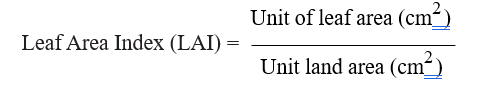
For dry matter production five plants at random from the border rows leaving the extreme rows were destructively sampled at 20, 40, 60 DAS and at harvest. The plant samples were dried under sun initially and later dried in hot air oven at 60°C to a constant weight and expressed in kg ha-1.
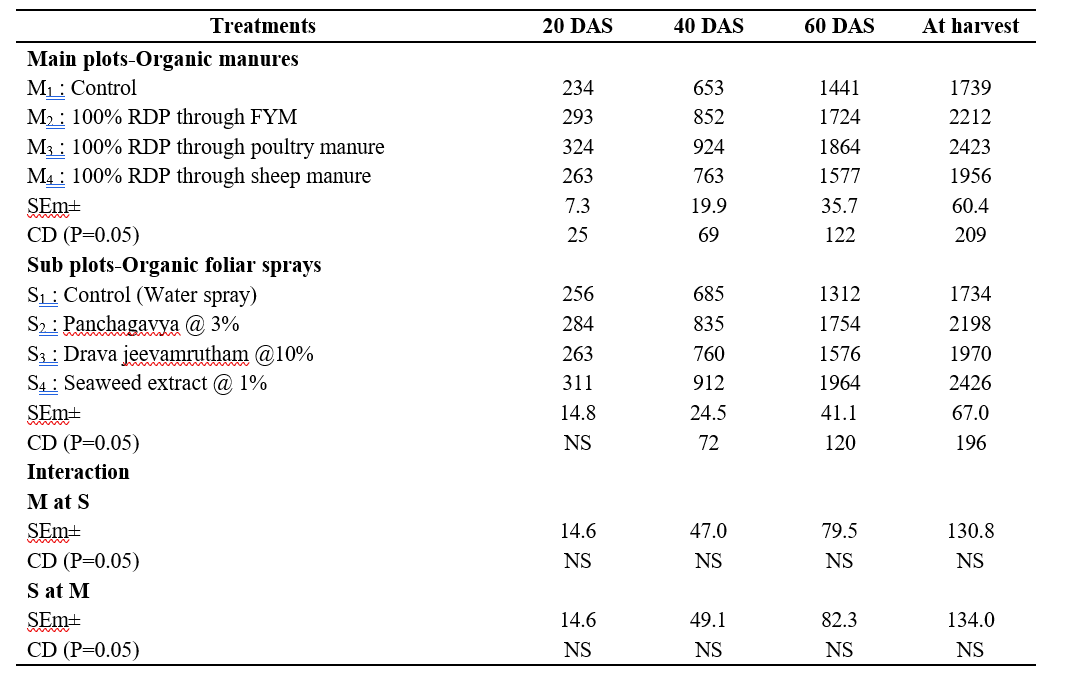
Plant height, leaf area index and dry matter production measured at different growth stages i.e., at 20, 40, 60 DAS and at harvest were significantly influenced by different organic manures and organic foliar sprays except at 20 DAS where in the influence of organic spray was found non significant (Table1, 2 and 3). However, the interaction was statistically non significant.
Among the different organic manures tried, the taller plants, higher leaf area index and higher dry matter production were observed with the application of poultry manure (M3), which was significantly superior to all other remaining treatments. The next best treatments
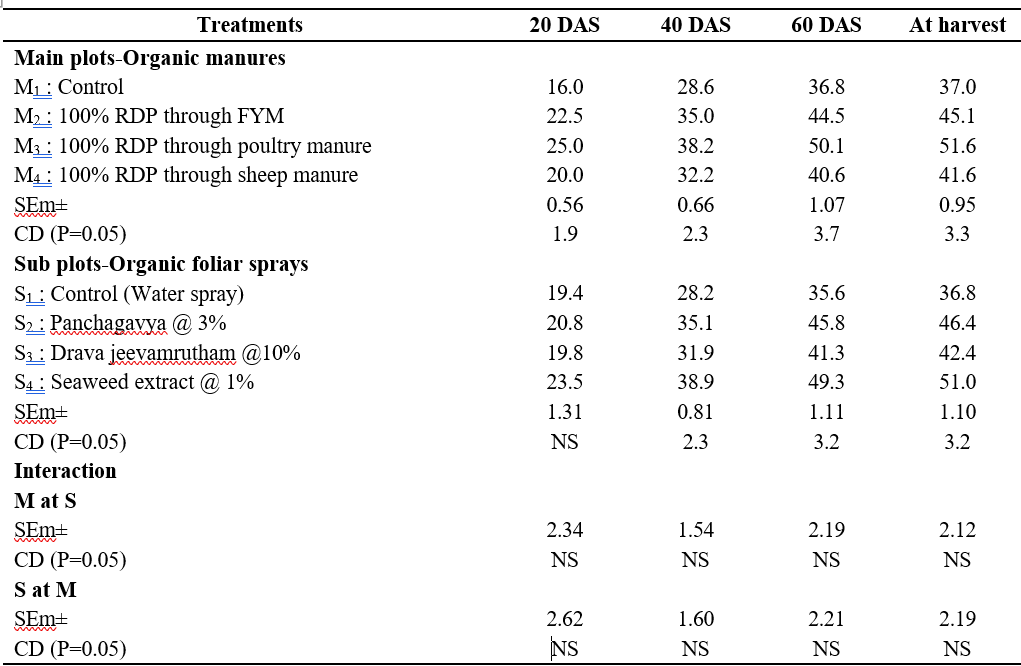
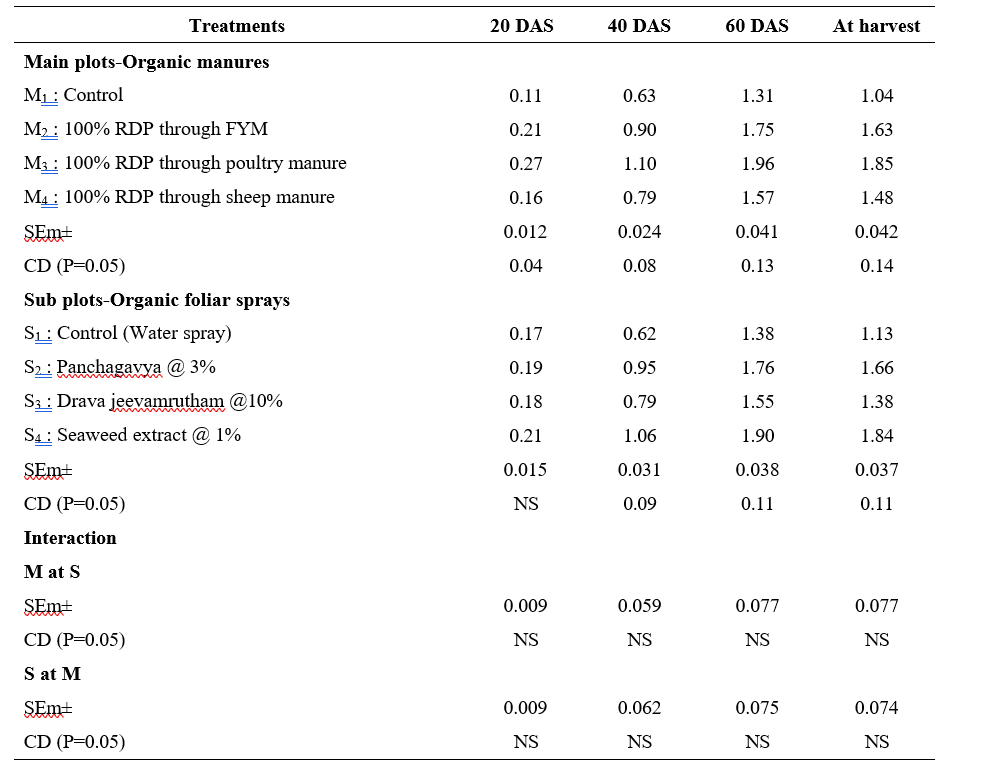
were farm yard manure (M2) and sheep manure (M3) with significant difference between them. The shortest plants, lower leaf area index and dry matter production were observed with control (M1). At all the plant growth stages, increase in plant height, leaf area index and dry matter production with poultry manure application might be due to rich in micro and macro nutrients which are readily available to plants and promote the root growth, enhances the availability of nitrogen to the plants which was helped in more cell division and cell elongation and resulted in increased plant height, leaf area index and dry matter production. The above results are in correlation with the findings of Singh et al. (2015), Singh et al. (2017), Perli et al. (2022) and Bhargavi et al. (2023).
As regards to the organic foliar sprays, the higher plant height, leaf area index and dry matter production was recorded with seaweed extract (S4), which was significantly higher than panchagavya (S2), drava jeevamruthm (S3) and control (S1) with significant differences between them. The lowest plant height, leaf area index and dry matter production was observed with the control (S1). This could be due to the presence of plant hormones along with nutrients in seaweed extract (S4), which stimulate cell division, elongation and differentiation in the meristematic tissues, leading to increased plant growth and development which resulted in higher plant height, leaf area index and dry matter
production. These results are collaborated with the research findings of Singh et al. (2017), Shekh et al. (2018) and Chaudhary et al. (2021).
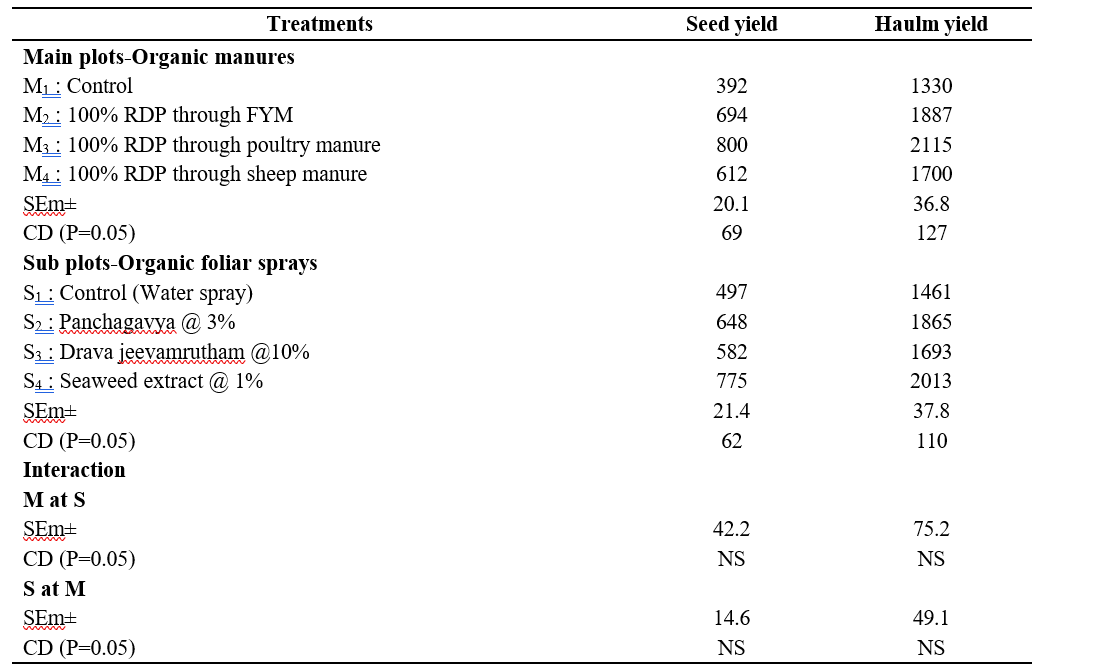
Seed yield of green gram was significantly influenced by different organic manures as well as organic sprays but their interaction effect was found to be non significant (Table 4). Application of poultry manure (M3) was recorded significantly higher seed yield and haulm yield. The next best treatment was application of farm yard manure (M2) followed by sheep manure (M4). Significantly the lower seed yield of green gram was recorded with the control (M1). Increase in nodulation, extensive root system enhanced production of metabolites and their translocation to the sink especially the productive structures (pods and seeds) which might have increased the number of pods plant-1 besides increasing the overall growth and development resulted in increasing the seed yield and haulm with the application of poultry manure (S3). These results were found to be similar with that of Verma et al. (2022).
The higher seed yield and haulm yield recorded with the foliar application of seaweed extract (S4) might be due to the fact that it was found to be rich in micro and macronutrients, plant growth regulators like auxins, cytokinins, gibberellins, vitamins and amino acids which had positive response in green gram. These hormones present in the seaweed extract might have stimulated the necessary growth and development coupled with better translocation and accumulation of photosynthates from source to sink resulting in increased seed yield and haulm yield. Similar results were obtained by Zodape et al. (2010) and Akhila et al. (2017).
The present study indicated that 100 % RDP through poultry manure recorded higher plant height, leaf area index and dry matter production, seed yield and haulm yield. Among a the organic foliar sprays seaweed extract @ 1 % at pre flowering and pod development stages
recorded higher plant height, leaf area index , dry matter production, seed yield and haulm yield of green gram.
Akhila, K., Kaswala, A.R and Dubey, P.K. 2017. Effect of liquid fertilizers on nutritional and cooking quality of organically grown green gram (Vigna radiata). International Journal of Chemical Studies. 5(6): 822-825.
Bhargavi, K., Sumathi, V., Reddy, G.K and Umamahesh, 2023. Influence of organic manures and organic sprays on productivity and economics of summer green gram [Vigna radiata (L.) Wilczek]. International Journal of Environment and Climate Change. 13(10): 3111-3116.
Chaudhary, M.G., Malav, J.K., Vala, Y.B and Desai, N.A. 2021. Influence of different organic sources and seaweed extract on quality, nutrient content, uptake, soil fertility status and soil microbial population after harvest of summer green gram (Vigna radiata L.). The Pharma Innovation Journal. 10: 1390-1394.
Gore, N.S and Sreenivasa, M.N. 2011. Influence of liquid organic manures on growth, nutrient content and yield of tomato (Lycopersicon esculentum Mill.) in the sterilized soil. Karnataka Journal of Agricultural Sciences. 24 (2): 153-157.
Perli, V.H., Tomar, S.S., Kasi, R.G and Deepsikha, M.K. 2022. Influence of organic manures and bio-fertilizers on the growth and yield of green gram (Vigna radiata (L.). The Pharma Innovation Journal. 11(6): 141-144.
Shekh, M.A., Mathukia, R.K., Sagarka, B.K and Chhodavadia, S.K. 2018. Evaluation of some cow- based bio-enhancers and botanicals for organic cultivation of summer groundnut. International Journal of Economic Plants. 5(1): 43-45.
Singh, M., Mishra, J.S and Bhatt B.P. 2017. Effect of integrated nutrient management and production potential and quality of summer mung bean (Vigna radiator L). Journal of Krishi Vvgyan. 5(2):39-45.
Singh, R.V., Tripathi, S.K and Singh, R.P. 2015. Effect of integrated nutrient management on productivity, nutrient uptake and economics of green gram (Vigna radiata L.) in custard apple-based agri-horti system under rainfed condition. Current Advances in Agricultural Sciences. 7(1): 76-78.
Verma, R., Singh, M., Dawson, J., Muddassir, P and Khan, I. 2022. Effect of bio-fertilizers and organic manures on growth and yield of green gram (Vigna radiata L.). The Pharma Innovation Journal. 11(4): 159(9)-1602.
Watson, D.J. 1952. The physiological basis of variation in yield. Advances in Agronomy. 6: 103-109.
www.indiastat.com. 2022. Area, production and productivity of oilseeds. Department of Agriculture Cooperation and Farmers Welfare.
Zodape, S.T., Mukherjee, S., Reddy, M.P and Chaudhary DR. 2010. Effect of (Kappaphycus alvarezii) extract on grain quality, yield and some yield components of wheat (Triticum aestivum L.). International Journal of Plant Production. 3(2): 1735-6814.