

0 Views
Department of Agronomy, S.V. Agricultural College, ANGRAU, Tirupati-517 502.
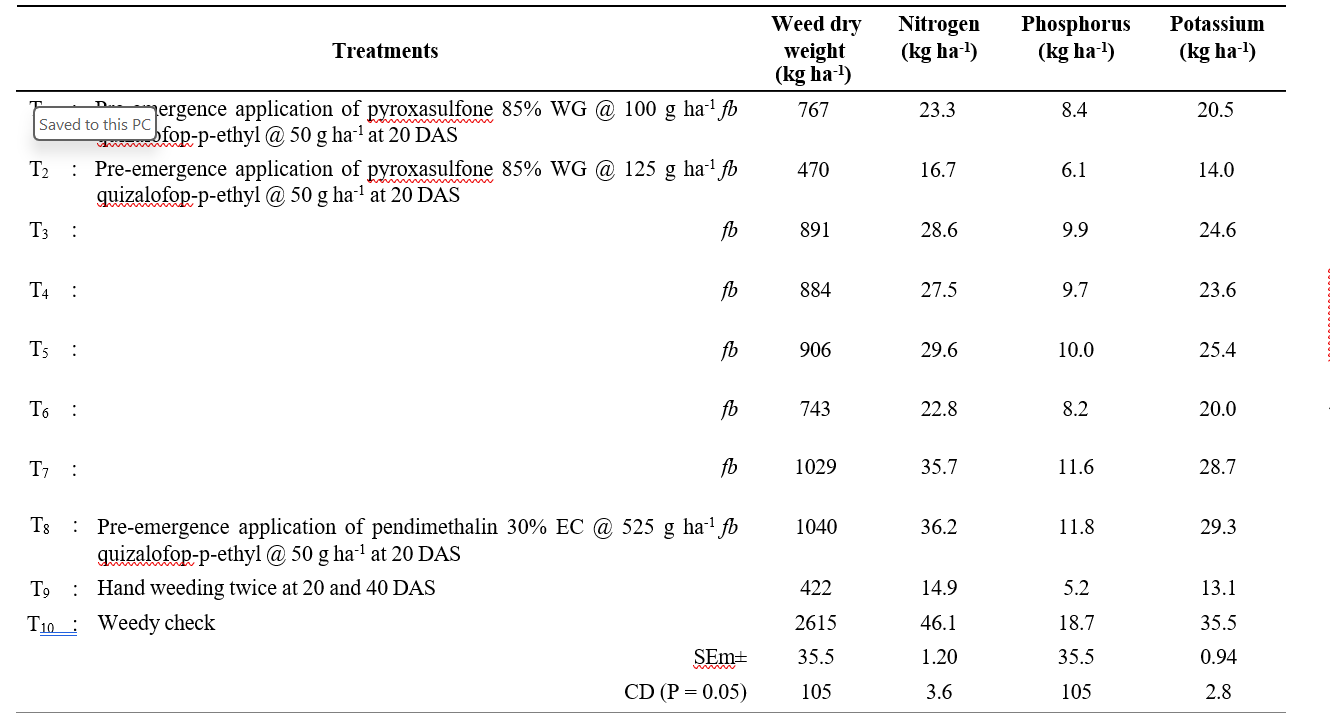
Field experiment entitled “Weed management in rabi sesamum (Sesamum indicum L.)” was conducted in sandy loam soils during rabi 2024-25 at S.V. Agricultural College Farm, Tirupati in randomized block design (RBD) with three replications. The experiment comprised of ten treatments. Considering all the weed management approaches evaluated, the higher uptake of nitrogen, phosphorus and potassium by sesame crop, higher dry matter production and seed yield of sesame were recorded with hand weeding twice at 20 and 40 DAS which was comparable to pre-emergence application of pyroxasulfone 85% WG @ 125 g ha-1 fb quizalofop-p-ethyl @ 50 g ha-1 at 20 DAS. Significantly lower uptake of nutrients, lower dry matter production and seed yield of sesame were recorded with weedy check. The lowest weed dry weight and uptake of nitrogen, phosphorus and potassium by weeds were recorded with hand weeding twice at 20 and 40 DAS which was at par with pre-emergence application of pyroxasulfone 85% WG @ 125 g ha-1 fb quizalofop-p-ethyl @ 50 g ha-1 at 20 DAS. The nutrient loss due to weeds in unweeded check was 46.1, 18.7 and 35.5 kg ha-1 nitrogen, phosphorus and potassium, respectively.
KEYWORDS: Sesame, weeds, herbicides, hand weeding, nutrient uptake.
Sesame, popularly referred to as til, is an annual herbaceous plant of tropical origin belonging to the Pedaliaceae family. Sesame stands as a major traditional oilseed crop widely grown in tropical and subtropical areas of Asia and Africa. Globally, India is the largest sesame producer where 15.31 lakh hectares of area is under sesame cultivation with 8.47 lakh tonnes production and 553 kg ha-1 productivity during 2023-20204. In Andhra Pradesh, 0.31 lakh hectares of area is under sesame cultivation with an annual production of 0.11 lakh tonnes and productivity of 376 kg ha -1 during 2023-24 (www.indiastat.com). Sesame contains 44-57% oil, 18-25% protein and 13-14% carbohydrate. 30.9 to 52.5% of sesame oil consists of oleic and linolenic acids, which make up the majority of the polyunsaturated fatty acids. Among the different biotic stress, weed infestation is the major problem in sesame production. The critical period for crop-weed competition of sesame is from 15 to 30 DAS (Venu et al., 2022). If weeds are kept unchecked during critical period, sesame yield may be reduced up to 70% (Bhavani et al., 2023). Mechanical weed management is difficult in sesame as it is sown by broadcasting and manual weeding which is adopted by most of the farmers adopt is labor intensive, expensive, back breaking, time taking practice and not possible to get labour in time for weeding. Hence, weed control using pre and post emergence at critical stages is essential to reduce yield losses caused by weeds.
A field trial was conducted during rabi, 2024- 25 at Dryland Farm of S.V. Agricultural College, Tirupati campus of Acharya N.G. Ranga Agricultural University, Andhra Pradesh. The experimental field was characterized by sandy loam soil. Available nitrogen, phosphorus and potassium were 154, 26.3 and 185 kg ha-1, respectively. The experiment was designed in a randomized block design with ten treatments and three replications. The treatments comprised of pre-emergence (PE) application of pyroxasulfone 85% WG @ 100 g ha-1 fb quizalofop-p-ethyl @ 50 g ha-1 at 20 DAS (T1), pyroxasulfone 85% WG @ 125 g ha-1 fb quizalofop-p- ethyl @ 50 g ha-1 at 20 DAS (T2), metolachlor 50% EC 500 g ha-1 fb quizalofop-p-ethyl @ 50 g ha-1 at 20 DAS (T3), metolachlor 50% EC 750 g ha-1 fb quizalofop-p- ethyl @ 50 g ha-1 at 20 DAS (T4), imazethapyr 10% SL 20 g ha-1 fb quizalofop-p-ethyl @ 50 g ha-1 at 20 DAS (T5), imazethapyr 10% SL 25 g ha-1 fb quizalofop-p-ethyl @ 50 g ha-1 at 20 DAS (T6), pretilachlor 50% EC 500 g ha-1 fb quizalofop-p-ethyl @ 50 g ha-1 at 20 DAS (T7), pendimethalin 30% EC 525 g hafb quizalofop-p-ethyl @ 50 g ha-1 at 20 DAS (T8), hand weeding twice at 20 and 40 DAS (T9) and weedy check (T10). The variety ‘Sarada’ (YLM-66) was sown by broadcasting on January 3rd. The recommended fertilizer dose of 40:20:20 kg ha⁻¹ of N, P₂O₅ and K₂O was applied. Pre-emergence and post emergence herbicides were applied at 1 and 20 DAS respectively by using spray fluid @ 500 l ha-1 with the help of knapsack sprayer fitted with flat fan nozzle. All other recommended agronomic practices were followed as per crop requirements. At harvest, composite plant samples of both the crop and associated weeds were collected from each plot. These samples were dried, ground finely, and nitrogen, phosphorus, and potassium content were analyzed following the standard procedures outlined by Jackson (1973). Nutrient uptake by the crop and weeds was calculated by multiplying the respective nutrient concentrations with their corresponding dry matter weights and expressed as kg ha-1.
Dry matter production of sesame was significantly influenced by the weed management practices. Hand weeding twice at 20 and 40 DAS (T9) recorded significantly higher dry matter production of sesame which was at par with PE application of pyroxasulfone at 125 g ha⁻¹ fb quizalofop-p-ethyl at 50 g ha⁻¹ (T2). This might be due to sustained weed suppression during critical period of crop-weed competition by these treatments and at later stages by the smothering effect of crop which allowed the crop to make better use of growth resources. Because of the intense competition for growth resources, weedy check (T2) recorded lower dry matter production of sesame. Similar results were found with results of Venu et al. (2022) and Hota et al. (2024).
Weed management practices had a significant influence on nutrient uptake by sesame. Hand weeding twice at 20 and 40 DAS (T9) resulted in higher uptake of N, P, and K by the sesame crop. This treatment was statistically at par with the PE application of pyroxasulfone at 125 g ha⁻¹ fb quizalofop-p-ethyl at 50 g ha⁻¹ (T2). These findings were consistent with the reports of Bhavani et al. (2023) and Giridhar (2024). The significant reduction in weed density and weed dry weight under these treatments created a weed-free environment, thereby enhancing crop growth and nutrient absorption. Nutrient uptake by the crop was positively correlated with both the nutrient content and dry matter production. Consequently, the increased uptake of N, P and K in these treatments was attributed to greater dry matter accumulation and higher nutrient concentrations in the plant tissues. The lower nutrient uptake by the crop in weedy check (T10) was because of reduced dry matter production and limited nutrient acquisition caused by intense weed competition (Rajpurohit et al., 2017).
Hand weeding twice at 20 and 40 DAS (T9) recorded the lowest total weed dry weight which was comparable with PE application of pyroxasulfone 125 g ha-1 fb quizalofop-p-ethyl 50 g ha-1 (T2). Similar results were also reported by Patnaik et al. (2020) and Giridhar (2024). These treatments controlled the weeds upto critical stages of crop weed competition and later emerging weeds were controlled by smothering effect of crop. Significantly superior amount of total weed dry weight was recorded in weedy check (T10) due to uncontrolled weed growth.
An inverse relationship between nutrient uptake by the crop and the associated weeds was found in this study. Lower uptake of nutrients by weeds was noticed in hand weeding twice at 20 and 40 DAS (T9). This result was in line with results of Kamani et al. (2019). Manual removal of weeds at 20 and 40 DAS controlled the weeds and reduced its density and dry weight thus, resulted in lower nutrient uptake by weeds. This treatment was statistically comparable to the pre-emergence application of pyroxasulfone at 125 g ha⁻¹ fb quizalofop- p-ethyl at 50 g ha⁻¹ (T2). This was due to, control of weeds for longer crop growth periods contributed to less density and dry weight of weeds and finally reduced the uptake of nutrients by weeds. These results were in conformity with Mruthul et al. (2015). Higher uptake of N, P and K by weeds was with weedy check (T10), which was significantly higher than the remaining weed management practices due to uncontrolled weed growth. These results were similar with results of Bhaumik et al. (2023).
Among the various weed management practices, significantly higher seed yield of sesame was recorded with hand weeding twice at 20 and 40 DAS (T9) which was at par with PE application of pyroxasulfone 125 g ha-1 fb quizalofop-p-ethyl 50 g ha-1 (T2). This might be due to control of all type of weeds manually in hand weeding resulted in reduced competition for growth resources leading to efficient translocation of assimilates
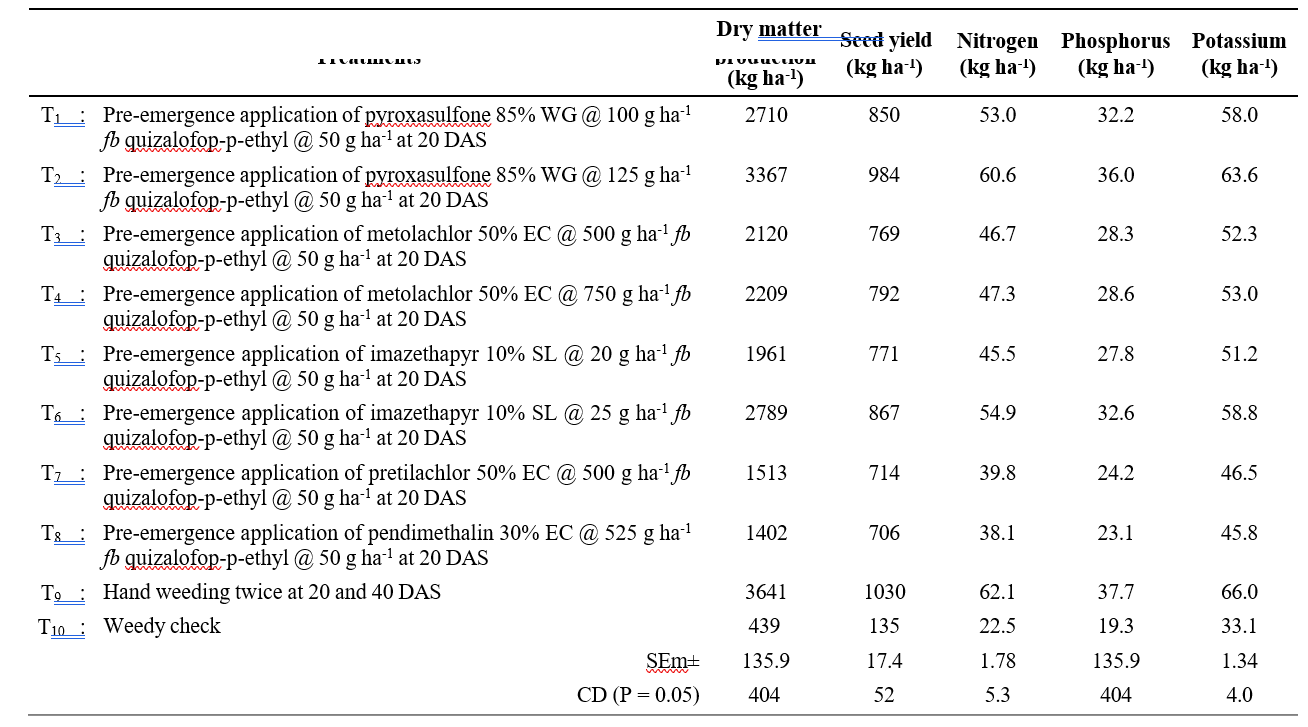
from the source to the developing seed which ultimately reflected in the form of higher seed yield. Similar results were found with results of Hota et al. (2024). Reduction of weed density and dry weight by the sequential application of pre and post-emergence herbicides reduced weed competition for growth resources, allowing for more effective translocation of nutrients from the source to sink and led to increased seed yield. The significantly lower seed yield in the weedy check (T10), was due to intense weed infestation, which led to heightened competition between the crop and weeds for essential growth resources.
Hand weeding twice at 20 and 40 DAS which was at par with pre-emergence application of pyroxasulfone 85% WG @ 125 g ha-1 fb quizalofop-p-ethyl @ 50 g ha-1 at 20 DAS resulted in higher dry matter production, seed yield, N, P and K uptake by sesame and the same weed management practices recorded lower weed dry weight and nutrient uptake by weeds on sandy loam soils.
Bhaumik, G.S., Singh, R.S and Sen, D. 2023. Effect of weed management practices on growth and yield of sesame (Sesamum indicum L.). International Journal of Agriculture, Environment and Biotechnology. 16(2): 105-111.
Bhavani, R., Reddy, G.K., Reddy, P.M., Kumari, P.L and Sagar, G.K. 2023. Nutrient uptake as influenced by methods of sowing and weed management practices in summer Sesame (Sesamum indicum L.). Andhra Pradesh Journal of Agricultural Sciences. 9(2): 100-103.
Giridhar, M. 2024. Weed management in line sown and broadcasted gingelly (Sesamum indicum L.). M.Sc. (Ag.) Thesis. Acharya N.G. Ranga Agricultural University, Guntur, India.
Hota, S., Dash, S and Joshi, B. 2024. Sole and sequential application of herbicides and botanicals for weed management in summer sesame. Plant Science Today. 11(4): 1022-1027.
Jackson, M.L. 1973. Soil chemical analysis. Prentice Hall of India Pvt. Ltd. Kamani, K.B., Ramani, B.B., Kachhadiya, S.P and Rupareliya, V.V. 2019. Effect of pre and post emergence herbicides on weed dynamics, quality and nutrient content of summer sesame, Sesamum indicum. International Journal of Agriculture Sciences. 11(11): 8575-8578.
Mruthul, T., Halepyati, A.S and Chittapur, B.M. 2015. Chemical weed management in sesame (Sesamum indicum L.). Karnataka Journal of Agricultural Sciences. 28(2): 151-154.
Patnaik, L., Deepthi, C., Reddy, M.D and Adhikary, R. 2020. Effect of chemical weed control on weed intensity in summer sesamum (Sesamum indicum L.) under irrigated conditions. Agro Economist – An International Journal. 7(2): 53-60.
Rajpurohit, D.S., Arvadia, L.K., Thumar, V. M., Mawalia, A.K and Dinesh, K. 2017. Yield attributes, yield, quality, weed index, nutrient content and uptake of plant as influenced by different row spacing and weed management practices in summer sesamum (Sesamum indicum L.). Progressive Research–An International Journal. 12(3): 2087-2092.
Venu, M., Reddy, G.S., Mahesh, N and Devi, M.U. 2022. Effect of integrated weed management practices on growth and yield of sesame (Sesamum indicum L.). Biological Forum-An International Journal. 14(2): 271-275.