

0 Views
Department of Agronomy, S.V. Agricultural College, ANGRAU, Tirupati-517 502.
A field experiment was conducted at Dryland farm, S.V. Agricultural college, Tirupati during kharif season of 2023 on sandy loam soils. The experiment was laid down in the randomized block design with factorial concept and replicated thrice. The results revealed that higher green and dry fodder yields in combination with higher uptake of N, P and K was obtained with TSFB 15-4 variety. Application of 120 kg N ha-1 significantly recorded higher green and dry fodder yield along with higher N, P and K uptake as well as available N, P2O5 and K2O in the soil at harvest compared to the lower doses of nitrogen levels tried.
KEYWORDS: Green fodder yield, Dry fodder yield, Nitrogen, Phosphorus, Potassium.
In India only 4.4% of agricultural land is used for fodder crop production. Despite the fact that 866 million tonnes of total fodder is produced each year, 609 million tonnes of green fodder and 1097 million tonnes of dry fodder is still required. The supply of dry and green fodder is not enough. Normally, there will be a 40% shortage of dry and green fodder and by 2025, this shortage may rise to 45%. This can be assisted by fodder crops, particularly fodder pearlmillet. The productivity and quality of fodder is believed to be significantly influenced by a number of different agronomic factors, including nitrogen. The growth and development of crucial plant tissues and cells, such as the cell membranes and chlorophyll, depends on nitrogen, an essential component of all the amino acids that make up plant structure and serve as the building blocks of plant proteins. Therefore, applying nitrogen fertilizer to fodder crops has an impact on plant development, green and dry fodder yield, nutrient uptake and available nutrient status of N, P2O5 and K2O.
A field experiment was conducted at dryland farm, S.V. Agricultural College, Tirupati during kharif season of 2023 on sandy loam soils. The soil was neutral in reaction (6.9 pH), low in available nitrogen (157 kg ha⁻¹), high in available phosphorus (30.9 kg ha⁻¹) and medium in available potassium (250 kg ha⁻¹). The field experiment was laid down with randomized block design with factorial concept consisting of three varieties (V₁: Moti bajra, V₂: TSFB 15-4 and V₃: TSFB 15-18) and four nitrogen levels (control, 40, 80 and 120 kg N ha⁻¹) with three replications. The crop was sown during the month of August with spacing of 30 cm × 10 cm with seed rate of 10 kg ha⁻¹. Recommended dose of fertilizer of 50 kg P₂O₅ ha⁻¹ and 40 kg K₂O kg ha⁻¹ was applied basally. Nitrogen was applied in two equal splits 50% as basal and 50% at 30 DAS as per treatments. Crop was harvested at 50% of flowering stage. Green fodder yield of fodder bajra from the net plot area was taken separately by leaving 5 cm stubbles from ground surface and expressed in t ha⁻¹. After harvesting, heaps were left in the field for one week to get sun dried. Then dry fodder yield of bajra from net plot area was weighed and total dry fodder yield was expressed in t ha⁻¹.
Plant samples of crop were collected from all the plots at harvest and these samples were dried, ground into fine powder and used for estimation of nitrogen, phosphorus and potassium. Nutrient uptake by crop was calculated by using the formula

Post-harvest soil nutrient status was estimated by taking the soil samples at 0-15 cm depth from each treatment plot after harvest of the crop and analysed for chemical properties by using Alkaline potassium permanganate method (Subbiah and Asija, 1956) for available nitrogen, Olsen’s method (Olsen et al., 1954) for available phosphorus and Flame photometry (Jackson, 1973) for available potassium in the soil.
Data pertaining to the yield, N, P and K uptake by fodder bajra and post-harvest soil nutrient status at harvest as influenced by varieties and application of nitrogen levels was discussed in different sections.
Green and Dry fodder yield
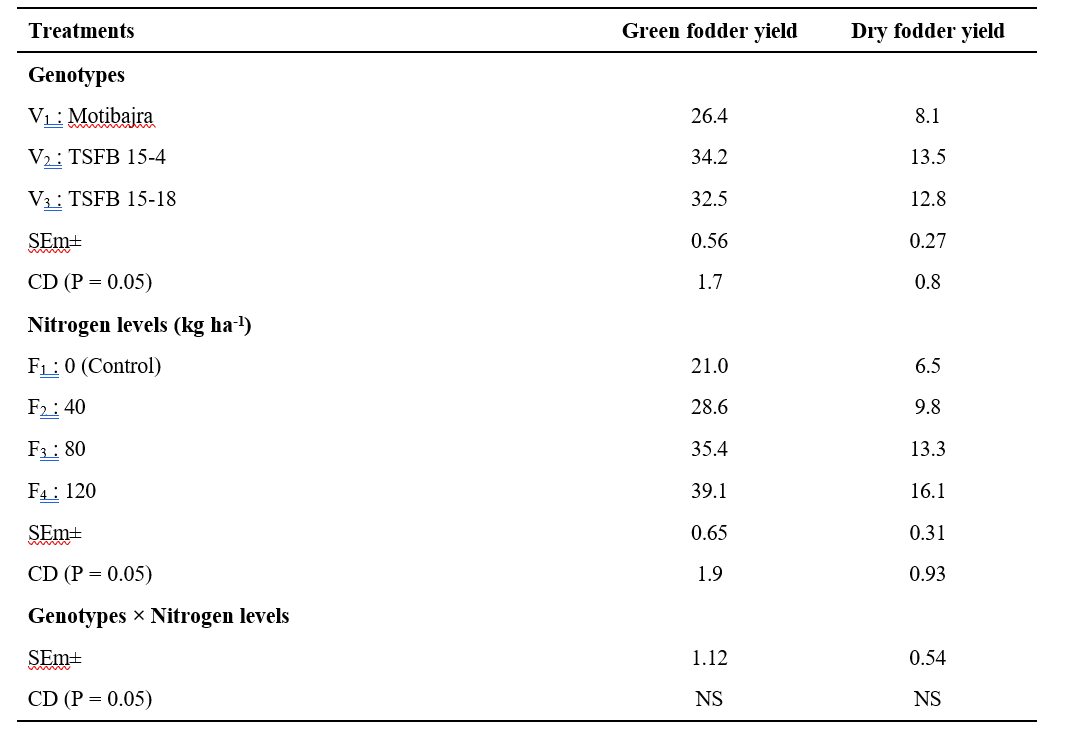
Critical observation of the data revealed that higher green fodder yield of fodder bajra was recorded with the variety TSFB 15-4 (34.2 t ha-1) which was on par with TSFB 15-18 (32.5 t ha-1). Significantly the lowest green fodder yield was recorded with variety Moti bajra (26.4 t ha-1). The similar trend was observed with regard to dry fodder yield i.e. higher fodder yield with TSFB 15-4 (13.5 t ha-1) with 120 kg N ha-1 (16.1 t ha-1). Application of 120 kg N ha-1 recorded significantly the highest green fodder yield (39.1 t ha-1). Statistically the lowest green fodder yield was recorded with control (0 kg N ha-1). All the levels of nitrogen application differed significantly among them. The interaction between varieties and
nitrogen levels found non-significant (Table 1). Increased green fodder and dry fodder yield with increase in nitrogen level might be due to nitrogen is the essential element for synthesis of carbohydrates, integral part of chlorophyll, essential component of amino acids and related proteins within the plants thereby it stimulates the vegetative growth and development, which eventually increased green and dry fodder yield. These results were supported by findings of Bramhaiah et al. (2018), Murali et al. (2021), Anoohya et al. (2022), Gangadhar and Nilanjaya (2022), Anchra et al. (2022) and Shashikala et al. (2023).
The maximum uptake of N, P and K at harvest of fodder bajra was observed with variety TSFB 15-4 which was on par with TSFB 15-18. These two varieties were significantly superior over Moti bajra variety. Significantly the lowest N, P and K uptake was recorded with Moti bajra cultivar of fodder bajra crop.

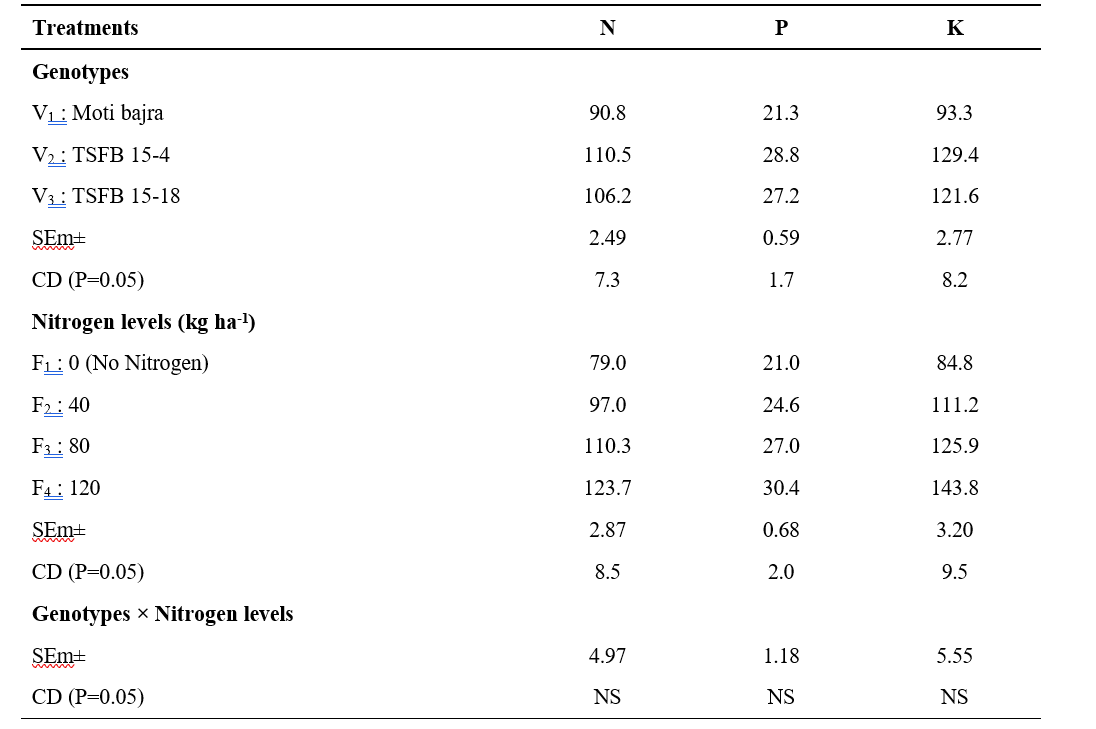
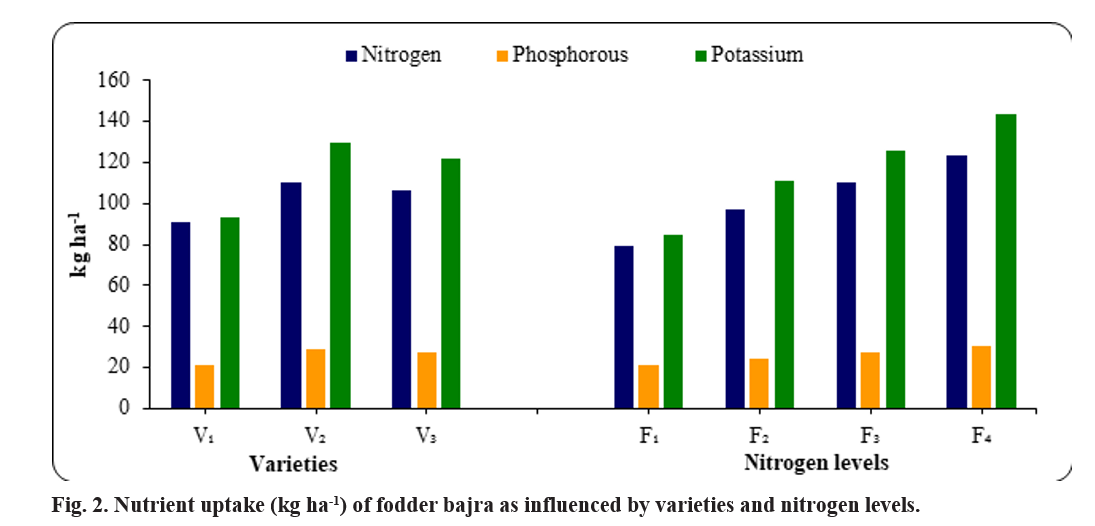
The differential rooting pattern of varieties might have resulted in the difference in N, P and K uptake. With regards to the different N levels applied, significantly the highest N, P and K uptake was obtained with 120 kg N ha-1 and the lowest uptake was obtained with control (0 kg N ha-1). The interaction between varieties and nitrogen levels found non-significant (Table 2). Increased uptake of N, P and K might be due to addition of incremental dose of nitrogen might have resulted in its increased absorption from the soil. Increased absorption of N, P and K impacted the higher production of green fodder yield and dry fodder field. These were in confirmation with findings of Nabooji et al. (2018), Gurjar et al. (2019), Shekara et al. (2020), Gangadhar and Nilanjaya (2022), Anchra et al. (2022) and Satpal et al. (2023).
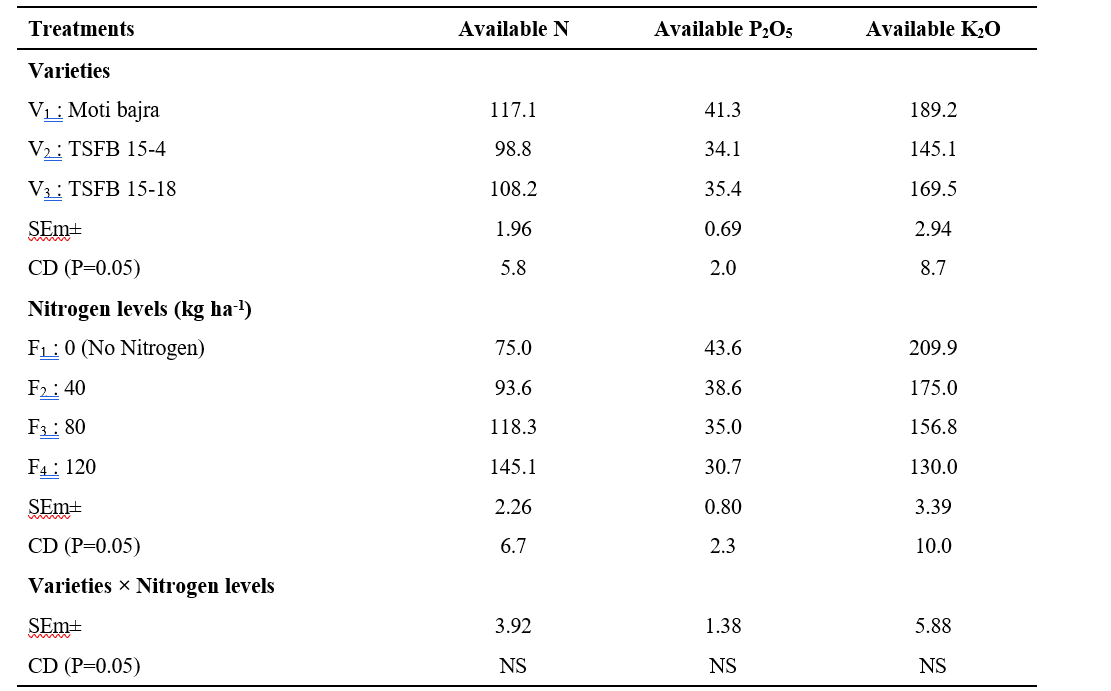
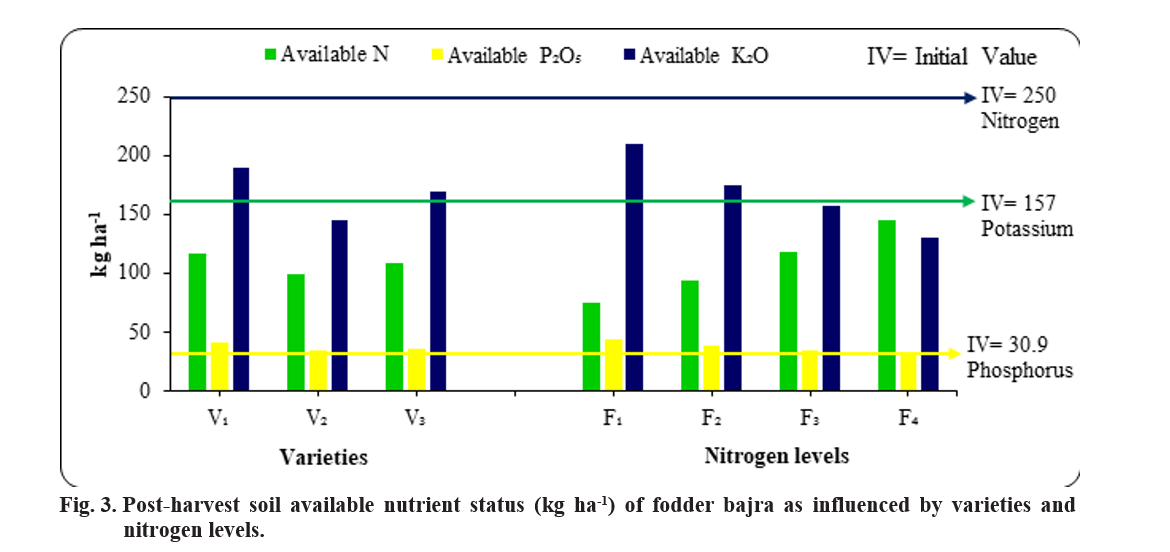
The data presented on post-harvest soil nutrient status revealed that the highest soil available nitrogen, phosphorus and potassium after harvest was recorded with Moti bajra which was significantly superior over other varieties. This was followed by TSFB 15-18 and the lowest was recorded with TSFB 15-4 (Table 3). This might be due to better development of plant height, leaf area and root system which led to more absorption of nutrients in TSFB 15-4. The availability of nitrogen after harvest was found significantly superior with application of 120 kg N ha-1. Due to increase in nitrogen availability, there was an increase in root exudates which act as a substrate for the microorganisms and mineralise the organic nitrogen, thus increasing the nitrogen status of the soil. However, more availability of phosphorus and potassium after harvest has been noticed with control (0 kg N ha-1). The availability of phosphorus and potassium content in the soil was found to be significantly lower with increase dose of nitrogen when compared to the preceding dose. These are in confirmation with findings of Singh et al. (2017) and Singh and chauhan (2017).
From the above study it was concluded that fodder bajra variety TSFB 15-4 sown during kharif season and fertilized with 120 kg N ha-1 resulted in higher green and dry fodder yield with higher nutrient uptake. The variety Moti bajra recorded higher nutrient availability of N, P2O5 and K2O.
Anchra, S., Bairwa, R.C., Abhishek, M.K.R and Meena, A.K. 2022. Yield and qualitative evaluation of fodder pearlmillet (Pennisetum glaucum) varieties under different fertility levels. The Pharma Innovation Journal. 11(2): 264-267.
Anoohya, D., Balazzii, N.R.V.T., Bhanu, R.K., Sukruth Kumar, T., Shashikala, T and Yakadri, M. 2022. Effect of different varieties, nitrogen levels and cutting management on yield and its attributes of fodder bajra (Pennisetum glaucum L.). International Journal of Environment and Climate Change. 12(11): 759-765.
Bramhaiah, U., Chandrika, V., Nagavani, A.V and Latha, P. 2018. Performance of fodder pearlmillet (Pennisetum glaucum L.) varieties under different nitrogen levels in Southern Agro-Climatic Zone of Andhra Pradesh. Journal of Pharmacognosy and Phytochemistry. 7(2): 825-827.
Gangadhar, N and Nilanjaya. 2022. Yield, nitrogen use efficiency and economics of forage pearlmillet as affected by genotypes and nitrogen levels. Forage Research. 48(2): 215-220.
Gurjar, G.S., Choudhary, R.S., Jat, G and Choudhary, R. 2019. Impact evaluation of genotypes and fertility levels on quality traits, nutrient uptake, yield and economics of single-cut fodder sorghum (Sorghum bicolor (L.) Moench). International Journal of Bio- resource and Stress Management. 10(6): 587-592.
Jackson, M.L. 1973. Soil chemical analysis. Prentice Hall of India Pvt. Ltd. New Delhi. 134-204.
Kale, R.V and Takawale, P. 2023. Performance of different fodder pearl millet varieties to varied level of nitrogen under Western Maharashtra. Forage Research. 49(2): 236-238.
Murali, B., Shanti, M., Shailaja, K., Shashikala, T and Susheela, R. 2021. Response of forage pearlmillet genotypes to different nitrogen levels. Journal of Pharmacognosy and Phytochemistry. 10(12): 1514-
1517.
Nabooji, A., Keshavaiah, K.V., Shirgapure, K.H and Shekara, B.G. 2018. Effect of seed rates and nitrogen levels on growth and fodder yield of sweet sorghum. Journal of Pharmacognosy and Phytochemistry. 7(2): 1391-1394.
Olsen, S.R., Cole, C.L., Wetanabe, P.S and Don, L.A. 1954. Estimation of available phosphorus in the soils by extraction with sodium bicarbonate. United States Department of Agriculture. 939.
Satpal, Suresh, K., Satyajeet, Naresh, K., Kharor, N., Jindal, Y., Sharma, B.L and Neelam, K.M. 2023. Agronomic evaluation of fodder maize genotypes at varied nitrogen levels. Forage Research. 49(1): 86-90.
Shashikala, T., Naaiik, R and Kumar, T.S. 2023. Exploring the impact of varying nitrogen levels and cutting management on fodder yield and nutritional quality in fodder pearlmillet (Pennisetum glaucum L.). International Journal of Environment and Climate Change. 13(11): 3799-3804.
Shekara, B.G., Mahadevu, P., Chikkarugi, N.M and Manasa, N. 2021. Performance of fodder pearlmillet genotypes to different levels of nitrogen. Forage Research. 47(2): 193-196.
Singh, K.P., Chaplot, P.C., Choudhary, G.L., Jani, P.P., Kumar, R and Sumeriya, H.K. 2017. Effect of fertility levels on quality of single-cut forage sorghum genotypes. Forage Research. 42(4): 279- 281.
Subbiah, B.V and Asija, G.L. 1956. A rapid procedure for determination of available nitrogen in soil. Current Science. 25: 259-260.
Singh, D and Chauhan, A. 2017. Fodder yield, quality and nutrients uptake potential of different types of sorghum (Sorghum bicolor) varieties in central Gujarat. Forage Research. 43(2): 121-128.