

0 Views
Department of Crop Physiology, S.V. Agricultural College, ANGRAU, Tirupati-517 502.
A field experiment was conducted during Kharif 2024 at RARS, Nandyal to study the impact of plant growth regulators on photosynthesis and yield Parameters in high-density of cotton. The Bt cotton hybrid Navneeth-BG II was grown under three different spacings (90 × 60 cm, 90 × 30 cm, and 90 × 15 cm) and with four treatments including control, detopping at 20th node, mepiquat chloride at 50% squaring, mepiquat chloride at 50% squaring and 50% flowering applications. Results showed that wider spacing improved physiological traits like photosynthesis and stomatal conductance, while closer spacing produced higher seed cotton and lint yields due to higher plant population. Application of mepiquat chloride, especially at 50% squaring, enhanced boll number, yield, and source–sink balance. The combination of closer spacing and mepiquat chloride at 50% squaring proved most effective for maximizing yield and improving physiological efficiency under high-density planting.
KEYWORDS: Bt-cotton, Detopping, HDPS, Mepiquat Chloride, Navneeth BG II.
Cotton is one of the most commercially valuable natural fibre crops, cultivated in over 70 countries worldwide. Owing to its economic significance, it is often referred to as “White Gold” and the “King of Fibre Crops.” In addition to its fibre, cotton is also valued for its oil and as a source of feed for poultry and livestock. The genus Gossypium, belonging to the Malvaceae family, comprises more than 50 species, among which four are widely cultivated. The diploid species (Gossypium herbaceum and Gossypium arboreum) have a chromosome number of (2n = 2x = 26), while the tetraploid species (Gossypium hirsutum and Gossypium barbadense) have (2n = 4x = 52). Among them, (Gossypium hirsutum L.) is the most dominant, being an allo-tetraploid and a major contributor to the global textile industry. In India, cotton is cultivated in an area of about11.8 million hectares, yielding around 25million bales (170kg each) with a productivity of 461 kg/ha. Where as in Andhra Pradesh, the crop covers 4.22 lakh hectares with a production of 7.37 lakh bales and an average yield of 297 kg/ha (AICRP on Cotton Annual Report, 2025).
Light interception plays a vital role in photosynthesis and biomass accumulation in crop growth. High- density planting often limits light availability, especially in the lower canopy, reducing photosynthetic efficiency, while low-density planting underutilizes light. Compact canopies with proper spacing improve light capture and yield. Plant growth regulators have been utilized to analyze their impact on cotton and studies indicated that PGRs enhance yield by increasing the retention of photosynthesis in developing bolls. In developed nations, PGRs are widely used to improve cotton production by regulating plant growth, thereby enhancing lint yield and fibre quality. Among the Plant growth regulators used widely, mepiquat chloride (1,1-dimethylpiperidinium chloride) is extensively utilized to manage plant architecture, regulate growth, and hasten maturity under high planting densities. This growth regulator helps maintain a balance between vegetative and reproductive growth in cotton plants and offsets the effects of excessive nitrogen by reducing overall plant height and lateral branch length. Optimizing spacing and using growth regulators are key strategies to enhance light use efficiency, yield, and fibre quality in cotton.It also improves gross canopy photosynthesis and promotes the development of thicker leaves with reduced surface area. Application of mepiquat chloride has also been shown to increase the number of bolls per unit area under high plant density, enhance boll retention on lower sympodia, and promote synchrony in boll maturation in cotton.
The experiment was conducted at Regional Agricultural Research station, Nandyal, which is situated in scarce rainfall Agro-Climatic Zone of Andhra Pradesh at 15o29 Northern latitude and 78o29 Eastern latitude with an elevation of 211.76m above mean sea level. The statistical design adopted for the experimentation was Split-Plot design, with three replications. The main plots were three crop geometry viz., 90 cm x 60 cm (M1), 90 cm x 30 cm (M2) and 90 cm x 15 cm (M3). The sub plots consisted of viz., S1: control, S2: Dettoping at 20th node, S3: Mepiquat chloride @ 45ppm at 50% squaring, S4: Mepiquat chloride @ 45ppm at 50% squaring and 50% flowering. The test hybrid used was Navneeth BG II (Gossypium hirsutum L.), a high-yielding Bt cotton hybrid.
Leaf gas exchange measurements were estimated using portable photosynthetic system (model CI-340). Totally, three measurements were taken at a constant flow rate of 5 mmol min-1 with a reference CO2 concentration of 380 µmolmol⁻¹ and photosynthetic flux density of 1000 µmolm⁻²s⁻¹.The readings were taken between 10.00 hours to 12.30 hours. Photosynthetic rate, Transpiration rate, Stomatal conductance were measured at flowering stage of the crop using the Photosynthetic system.
Number of bolls per plant, Boll weight (g), Number of sympodia per plant were averaged from the five randomly selected plants from each plot. Seed cotton yield i.e Seed cotton was picked from the plants in the net plot area and weighed. The yield obtained from five tagged plants was also added to this and expressed as seed cotton yield in kg ha1. Lint yield is the cumulative yield lint from three canopy levels pickings in each treatment plot was weighed and expressed in kg ha-1.
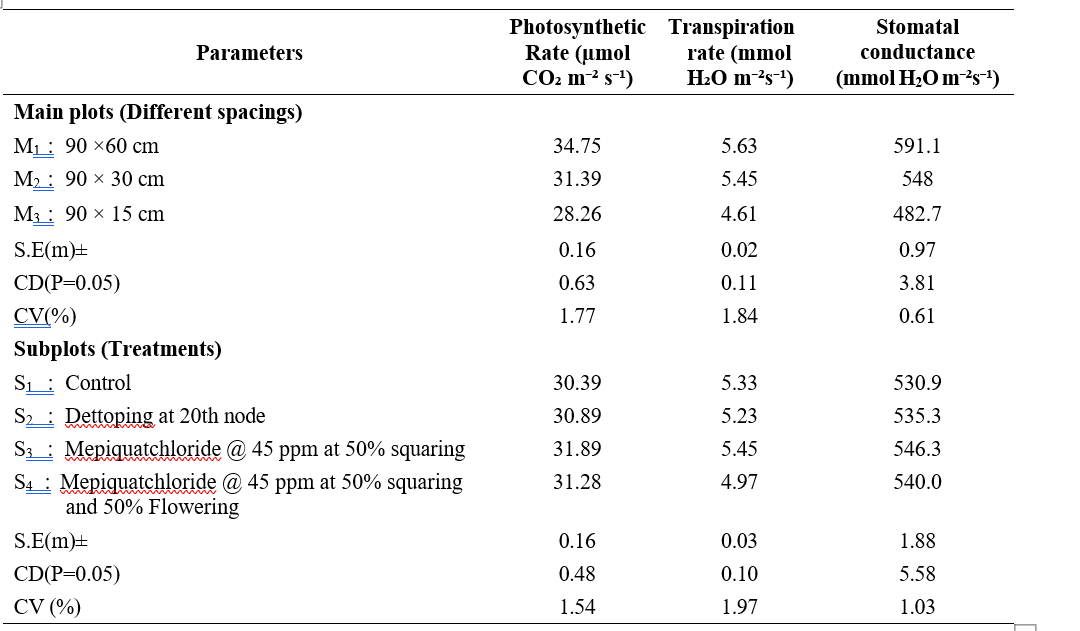
Photosynthetic rate in cotton was significantly influenced by plant spacing and growth regulator treatments. (Table: 1) The widest spacing (90 × 60 cm) recorded the highest rate (34.75 µmol CO₂ m⁻² s⁻¹), while the closest spacing (90 × 15 cm) showed the lowest (28.26 µmol CO₂ m⁻²s⁻¹), indicating that wider spacing improved light interception and canopy aeration. Among growth regulator treatments, mepiquat chloride @ 45 ppm at 50% squaring (S3) resulted in the highest photosynthetic rate (31.89 µmol CO₂ m⁻² s⁻¹), likely due to its role in creating compact canopies and enhancing source-sink balance. Reddy et al., (2017) and Bibi et al., (2008), observed that improved photosynthesis with wider spacing and mepiquat chloride application.
Transpiration rate was significantly influenced by both spacing and growth regulator treatments. (Table: 1) The widest spacing (M1) showed the highest transpiration rate (5.63 mmol H₂O m⁻² s⁻¹), while the closest spacing (M3) had the lowest (4.61), likely due to denser canopies increasing humidity and reducing vapor pressure deficit. Among sub-plot treatments, S3 Mepiquat chloride @ 45 ppm at 50% squaring (S3) recorded the highest transpiration (5.45), while the lowest was in S4 (4.97), possibly due to reduced leaf area and enhanced stomatal control from double mepiquat chloride application. Hebbar et al., (2020), reported improved water use efficiency with mepiquat chloride through lower leaf area and transpiration.
Stomatal conductance was significantly affected by both spacing and growth regulator treatments. (Table: 1). The highest conductance was observed in the widest spacing (M1: 591.1 mmol H2O m⁻² s⁻¹), while the lowest was in the closest spacing (M3: 482.7), suggesting that wider spacing improved light availability and air flow, supporting optimal stomatal function. Among treatments, S3 (Mepiquat chloride at 50% squaring) recorded the highest conductance (546.3), whereas the control (S1) had the lowest (530.9). The application of mepiquat chloride likely contributed to better stomatal regulation and gas exchange. Hussain et al., (2019), reported that mepiquat chloride enhances stomatal conductance by improving plant water relations and reducing stress.
Seed cotton yield was significantly affected by both plant spacing and growth regulator treatments. (Table: 2). The highest yield was recorded under the closest spacing (M3: 1943 kg ha⁻¹), attributed to higher plant density compensating for lower individual plant productivity. Among growth regulator treatments, S3 (mepiquat chloride @ 45 ppm at 50% squaring) produced the highest yield (1988 kg ha⁻¹), while the control (S1) recorded the lowest (1715 kg ha⁻¹). Mepiquat chloride
likely enhanced assimilate partitioning to reproductive organs by suppressing excessive vegetative growth. Reddy et al., (2019) and Venkateswarlu et al., (2015), reported yield benefits from closer spacing and mepiquat chloride application in high density planting systems. Lint yield was significantly influenced by both plant spacing and growth regulator treatments. (Table: 2). The highest yield was observed in the closest spacing M3: (729 kg ha⁻¹), highlighting the benefit of high-density planting for maximizing output. Among the sub-plot treatments, S3 (mepiquat chloride @ 45 ppm at 50% squaring) recorded the highest lint yield (705 kg ha⁻¹), likely due to improved boll retention and increased boll numbers. Patil et al., (2018), reported increased lint yield with mepiquat chloride due to enhanced sink strength.
The number of sympodia per plant, was significantly influenced by plant spacing and growth regulator treatments. (Table 2) Closer spacing (M3) recorded the highest number of sympodia (22.2), suggesting that higher plant density promoted reproductive branching. Among treatments, S4 (split application of mepiquat chloride at squaring and flowering) showed the highest number (23.4), indicating its effectiveness in canopy management and enhancing fruiting branch development. Saleem et al., (2017), noted that growth retardants like mepiquat chloride improve sympodial branching by regulating internode elongation. Boll weight was negatively affected by increasing plant density, with the widest spacing (M1) recording the highest boll weight (6.2 g), while the closest spacing (M3) had the lowest (5.5 g), likely due to reduced assimilate availability per boll. (Table: 2). Among growth regulator treatments, S3 (mepiquat chloride at squaring) showed the highest boll weight (6.1 g), indicating improved source-sink balance and efficient boll filling. Ramegowda et al., (2014), reported enhanced boll weight with mepiquat chloride application due to better allocation of photosynthesis.
The number of bolls per plant was significantly influenced by both spacing and plant growth regulator treatments. (Table 2). The highest boll count was recorded under the closest spacing (M3: 38.9), highlighting the advantage of high-density planting in maximizing total
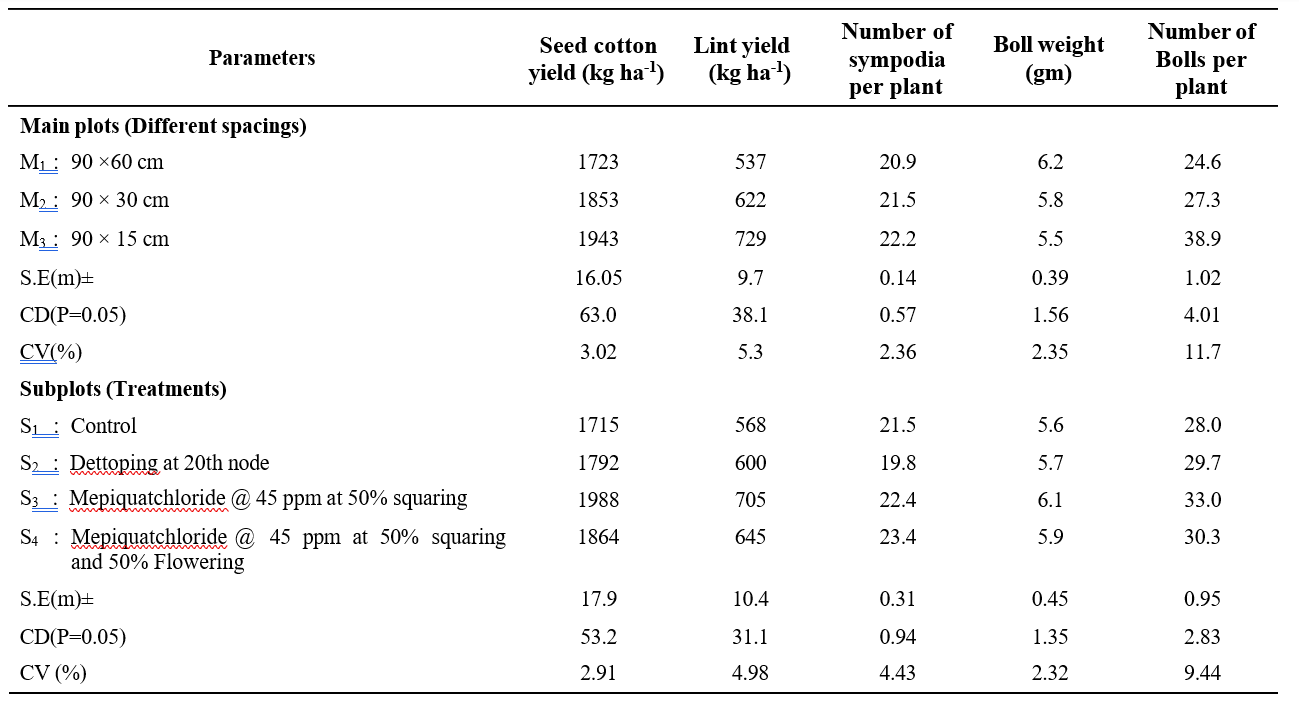
boll production per unit area. Among PGR treatments, S3 (mepiquat chloride at 50% squaring) recorded the highest number of bolls per plant (33.0), suggesting that mepiquat chloride improved boll retention and reduced shedding. Khan et al., (2016), reported that closer spacing combined with mepiquat chloride application increased boll number by enhancing effective fruit set and retention.The results clearly demonstrated that high- density planting and application of mepiquat chloride at 45 ppm during flowering significantly improved key yield parameters in cotton. While boll weight was slightly lower under dense spacing, the overall gains in boll number, lint yield, and seed cotton yield compensated effectively. The combination of optimized plant population and canopy regulation using PGRs is a viable strategy to improve productivity in HDPS cotton cultivation. The study confirms that wider spacing and the use of mepiquat chloride at 50% flowering significantly improved gas exchange parameters in cotton. These findings emphasize the potential of optimized plant architecture and growth regulator use to enhance photosynthesis and water use efficiency under High-DensityPlanting System. Strategic manipulation of canopy structure through spacing and PGRs can lead to better physiological performance and potentially higher yield in cotton crop.
Bibi, A., Sadaqat, H.A and Tahir, M.H.N. 2008. Physiological and agronomic response of cotton to mepiquat chloride under different planting densities. Pakistan Journal of Botany. 40(2): 605– 613.
Hebbar, R.S., Rajkumar, G.R and Venugopalan, M.V. 2020.Canopymanagement in high density planting of cotton through plant growth regulators. Journal of Cotton Research and Development. 34(1): 75–80.
Khan, M.B., Rehman, A and Ali, S. 2016. Optimizingplant densityand growth regulator forbetter yield in cotton (Gossypium hirsutum L.). Journal of Animal and Plant Sciences. 26(3): 761–768.
Ramegowda, P., Ravikumar, R.L and Jayadeva, H.M. 2014. Effect of plant growth retardants on growth, yield and quality of cotton under high-density planting system. Journal of Agricultural Sciences. 27(1): 37–41.
Reddy, K.N., Raju, K.S and Prasad, T.G. 2019. Performance of compact cotton hybrids under different plant densities and fertilizer levels. International Journal of Current Microbiology and Applied Sciences. 8(2): 1208–1216.
Reddy, R.S., Kumar, S and Prasad, G.V. 2017. Influence of spacing and mepiquat chloride on photosynthesis and yield of Bt cotton. International Journal of Agricultural Sciences. 9(12): 4140–4143.
Saleem, M.F., Shahid, M.Q and Anjum, S.A. 2017. Improving cotton yield and quality by using growth regulators and plant spacing. Journal of Integrative Agriculture. 16(5): 1163–1171.
Venkateswarlu, O., Goud, V.V and Sreedevi, B. 2015. Canopy modification and yield improvement through mepiquat chloride in cotton. Agricultural Science Digest. 35(4): 267–270.