

0 Views
Department of Agronomy, S.V. Agricultural College, ANGRAU, Tirupati-517 502.
A field experiment was carried out during summer, 2024 on sandy loam soils of dryland farm, S.V. Agricultural College, Tirupati, to study the Effect of liquid biofertilizers on productivity of sesame (Sesamum indicum L.)”. The present experiment was laid out in a randomized block design and replicated thrice. Application of liquid biofertilizers resulted in significant effects on yield components viz., number of branches plant-1, number of capsules plant-1, number of seeds capsule-1, seed yield and stalk yield of sesame. Among the different treatments tried, significantly higher stature of yield attributes and yield were recorded with the 100 % RDF + seed treatment + soil application of liquid biofertilizers (T5). The lowest values of yield attributes and yield were obtained with absolute control (T1).
KEYWORDS: Sesame, Seed treatment, Soil application, Liquid biofertilizers.
Sesame (Sesamum indicum L.) is one of the most important oilseed crops next to groundnut, rapeseed and mustard in India. Sesame is popularly known as “Queen of oilseed crops” due to its excellent keeping quality of the oil, flavour and taste. Sesame oil contains two antioxidants, such as sesamin and sesamol. Sesame seeds contain 50-60 % oil, 18-25 % protein, 14-16 % carbohydrates and 5-7 % minerals. Sesame is the first alternative to mother’s milk, particularly in milk allergy cases. Due to its anticholesterol properties, sesame oil is extremely beneficial for cardiac problems. However, the productivity of sesame is very low compared to the potential yield owing to lack of suitable crop management practices. The potential yield of any crop could be realized only when backed up with good agronomic management practices. Among the different agronomic management practices, nutrient management is crucial in sesame cultivation as it directly impacts the plants growth and yield. The use of organic manures is limited by the huge quantities needed to meet crop nutritional needs in view of its low nutrient content, the use of chemical fertilizers is limited by residual effects, cost and scarcity. Thus, supplementary application of biofertilizers either through seed treatment or soil application is recommended for improving soil productivity, biological, physical and chemical properties of soil and to get agricultural products with good quality which are free of pollutants. Biofertilizers improves the soil nutrient availability, leading to better nutrient uptake by plants. Among the biofertilizers, liquid bio-fertilizers of high-quality hold great promise in agriculture due to advantages over traditional carrier-based bio-fertilizers with longer shelf life, better nodulation and cost savings on carrier material.
The experiment was conducted during summer, 2024 in field No. 138 of Dryland farm of S.V. Agricultural College, Tirupati campus of Acharya N.G. Ranga Agricultural University. The soil was sandy loam in texture, neutral in soil reaction, low in organic carbon and available nitrogen, medium in available potassium and available phosphorus. The experiment was laid out in RBD and replicated thrice. The treatments consist of absolute control (T1), 100% RDF (T2), 100 % RDF + seed treatment with liquid biofertilizers (T3), 100 % RDF + soil application of liquid biofertilizers (T4), 100% RDF + seed treatment + soil application of liquid biofertilizers (T5), 75 % RDF + seed treatment with liquid biofertilizers (T6), 75 % RDF + soil application of liquid biofertilizers (T7), 75 % RDF + seed treatment + soil application of liquid biofertilizers (T8). The variety YLM-66 (Sarada) was sown on 10-01-2024 and recommended dose of the fertilizer applied was 50- 25-25 N-P2O5-K2O kg ha-1. Seed treatment with liquid
biofertizers viz., Azospirillum, PSB and KSB was done by mixing 10 ml of each bio inoculant with 1 kg of seed and dried for 10-15 min under shade before sowing, then the seeds were sown keeping the distance of 30 cm row to row and seed to seed at a distance of 15 cm. Soil application of liquid biofertilizers viz., Azospirillum, PSB and KSB was done by mixing these bioinoculants each @ 1250 ml ha-1 with 500 kg of well decomposed FYM and applied as basal at 24 hrs before sowing. The data collected on various growth parameters were statistically analysed using the randomized block design method by Panse and Sukhatme (1985).
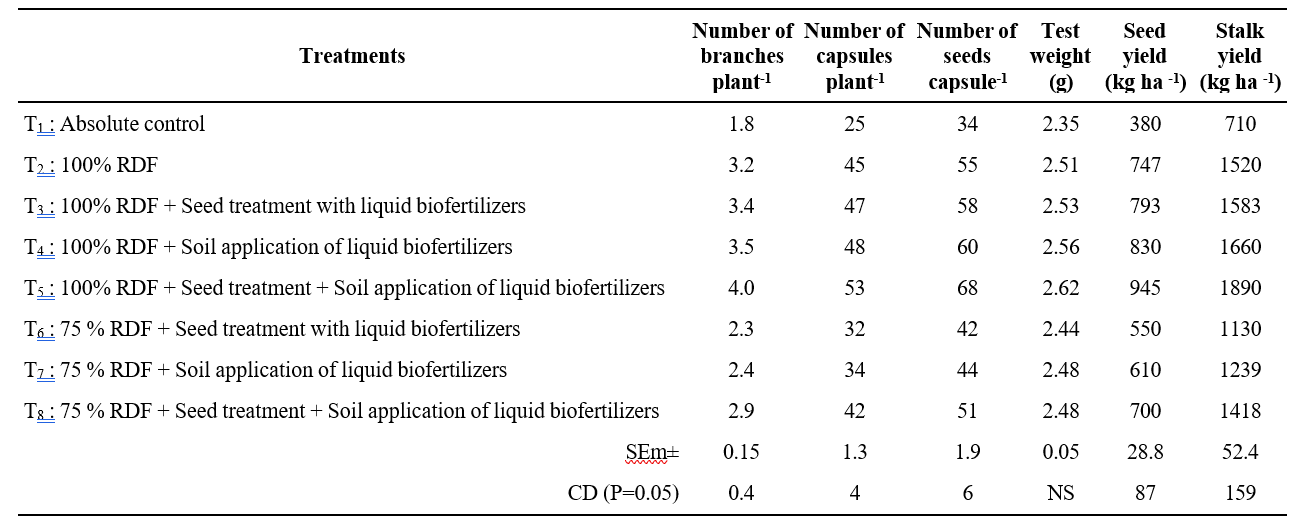
Significantly higher values of all yield attributes of sesame viz., number of branches plant-1, number of capsules plant-1, number of seeds capsule-1 were recorded with application of 100 % RDF + seed treatment + soil application of liquid biofertilizers(T5). It was followed by application of 100 % RDF + soil application of liquid biofertilizers(T4), application of 100 % RDF + seed treatment with liquid biofertilizers(T3) and application of 100 % RDF(T2) in the order of descent with no significant disparity between them. However, the later treatment (T2) was in turn at par with application of 75 % RDF + seed treatment + soil application of liquid biofertizers(T8). Application of 75 % RDF + soil application of liquid biofertilizers(T7) was the next best, but at par with the application of 75 % RDF + seed treatment with liquid biofertilizers (T6) which were in turn statistically superior over the absolute control(T1) that registered the lower values. This might be owed to the balanced nutrition to the crop and improved physical, chemical and biological properties of soil with the administration of liquid fertilizers trough seed treatment and soil application along with the provision of inorganic fertilizers which in turn maintained the nutrient supply throughout the plant growth stages that facilitated increased cell division and cell elongation there by enhanced vegetative growth ultimately increased the number of branches plant-1, number of capsules plant-1 and number of seeds capsule-1. These findings are similar to those of Patel et al., (2023), Rathod et al., (2024), Parmar et al., (2020) and Samant (2020).
The highest seed and stalk yield of sesame were registered with application of 100 % RDF + seed
treatment + soil application of liquid biofertilizers(T5). The next best treatments in recording higher yield were application of 100 % RDF + soil application of liquid biofertilizers(T4), application of 100 % RDF + seed treatment with liquid biofertilizers (T3) and application of 100 % RDF (T2) in the order of descent with no significant disparity between them. However, comparable yields were obtained from 100 % RDF (T2) and 75 % RDF + seed treatment + soil application of liquid biofertilizers(T8). It shows the yield advantage with the application of liquid biofertilizers by partial substitution of inorganic fertilizers. Application of 75% RDF + soil application of liquid biofertilizers(T7) and application of 75 % RDF + seed treatment with liquid biofertilizers (T6) were comparable with one another and both of them were significantly superior over the absolute control(T1). The lowest yield was associated with the absolute control(T1). It might be attributed to the combined application of inorganic fertilizers and liquid biofertilizers that increased availability of nitrogen, phosphorus and potassium in the root zone through atmospheric nitrogen fixation by Azospirillum and solubilization of unavailable phosphates and potassium by PSB and KSB respectively which in turn resulted in the better nutrient uptake and accelerated photosynthetic rate, adequate biomass production that further facilitated the efficient translocation of photosynthates from source to sink there by increasing the sink capacity resulting in the improved yield attributes and ultimately increased the yield of sesame. These results are supported by Sahoo et al. (2010), Lakhran et al. (2015), Aglawe et al. (2021), Shaik et al. (2010) and Gabhane et al. (2018).
The present study indicated that among the nutrient management practices, tried application of 100% RDF (50:25:25 N, P2O5, K2O) + seed treatment + soil application of liquid biofertilizers (Azospirillum, PSB and KSB) recorded higher yield attributes and yield in sesame.
Aglawe, B., Waghmare, Y and Ajinath, B. 2021. Effect of biofertilizer on growth, yield and economics of sesame (Sesamum indicum L.). The Journal of Pharmaceutical Innovation. 10(10): 437-439.
Gabhane, A.R., Gite, P.A and Khadse, V.A. 2018. Effect of compost, biofertilizer and organic sprays on yield, nutrient content and uptake of N, P, K and S by summer sesame. Journal of Pharmacognosy and Phytochemistry. 7(4): 2843-2847.
Lakhran, H., Sadhu, A.C and Kumawat, S. 2015. Quality and yield potential of summer sesame (Sesamum indicum L.) as influenced by sowing time and nutrient management in middle Gujarat. The Bioscan. 10(3): 1409-1411.
Panse, V.G and Sukhatme, P.V. 1985. Statistical Methods for Agricultural Workers. ICAR, New Delhi. 187-202.
Parmar, N., Jat, J.R., Malav, J.K., Kumar, S., Pavaya, R.P and Patel, J.K. 2020. Growth, quality, yield and available nutrient status after harvest of summer sesamum (Sesamum indicum L.) in loamy sand as influence by integrated nutrient management. Journal of Pharmacognosy and Phytochemistry. 9(3): 388-392.
Patel, H.A., Raj, A.D., Khambhu, C.V and Vaja, S.J. 2023. Effect on growth and yield characteristics of summer sesame (Sesamum indicum L.) as influenced by different levels of nitrogen, phosphorus and biofertilizers. The Pharma Innovation Journal. 12(6): 5130-5134.
Rathod, A.D., Thanki, R.B and Seta, S.N. 2024. Enhancing summer sesame (sesamum indicum L.) Productivity through integrated nutrient management: a comprehensive approach for sustainable agriculture. International Research Journal of Modernization in Engineering Technology and Science.6(1): 287- 292.
Sahoo, S.K., Dwibedi, S.K., Sethi, D and Kar, P.C. 2010. Effect of biofertilizers and levels of nitrogen on growth, yield attributes and yield of sesame (Sesamum indicum L.). Environment and Ecology. 28(1): 132-135.
Samant, T.K. 2020. Effect of biofertilizers and sulphur on growth, yield, economics and post-harvest soil chemical properties in sesame (Sesamum Indicum L.) Chemical Science Review and Letters. 9(34): 475-480
Shaikh, A.A., Desai, M.M., Shinde, S.B and Tambe, A.D. 2010. Yield of summer sesamum (Sesamum indicum L.) as influenced by integrated nutrient management. International Journal of Agricultural Sciences. 6(1): 144-146.