

0 Views
Institute of Agribusiness Management, S.V. Agricultural College, ANGRAU, Tirupati-517 502.
Custom Hiring Centres (CHCs) serve as a crucial support system for advancing farm mechanisation, particularly helping marginal and small-scale farmers. CHCs help reduce cultivation costs and guarantee timely farming activities by renting out farm equipment. Despite these advantages, farmers continue to face several operational challenges in accessing CHC services effectively. The current research was conducted in Kurnool district, Andhra Pradesh, to identify the major constraints experienced by CHC users. Data from 100 farmers were analysed using the Garrett ranking method to rank the constraints based on their severity. Findings revealed that the most pressing concerns were the unavailability of machinery during peak seasons, delays in service delivery, and high hiring costs. Other difficulties included a shortage of trained operators, insufficient machinery options, poor equipment maintenance, and limited awareness of available services. Issues like favouritism and lack of transparency also hindered fair access. These insights highlight the need for systemic improvements in CHC functioning. The study suggests steps such as expanding machine inventory, skill development for local operators, implementation of real- time service systems, and improved accountability mechanisms. These actions can greatly improve the efficiency, accessibility, and inclusivity of CHCs, driving sustainable mechanization in agriculture.
KEYWORDS: Custom Hiring Centres (CHCs), Farm mechanization, Farmer constraints in CHCs, Rural mechanization.
Agriculture remains the primary livelihood for a majority of the rural population in India, with about 59.8 per cent of the rural workforce engaged in agricultural activities, as per the Periodic Labour Force Survey (PLFS) 2023-24. However, with increased land fragmentation and rising cultivation expenses, particularly for marginal and small-scale farmers, the demand for accessible and inexpensive automation has grown. Mechanization not only improves efficiency and productivity but also reduces labour dependency, which is particularly important given the growing shortage of work force in agriculture due to urban migration and alternate employment opportunities. Custom Hiring Centres (CHCs) began to arise as a realistic answer to this problem, providing farm machinery and tools for lease. These centres enable farmers especially those with limited capital to use modern equipment without the burden of owning and maintaining costly machines. By doing so, CHCs support timely agricultural operations, minimize drudgery, and support to boost the yield. (Bethi et al. 2023)
CHCs have been supported by the Indian government and multiple state legislatures under a number of programs to guarantee that farm equipment is available even in isolated locations. Despite these initiatives, several ground-level challenges continue to restrict the optimal functioning of CHCs. Farmers often report difficulties such as unavailability of machinery during critical cropping seasons, delayed service delivery, high rental charges, and lack of trained machine operators. Moreover, the variety of equipment available is often limited and not aligned with the specific crop needs of the region. Political favouritism in equipment allocation and poor awareness about the CHC services also reduce their reach and impact. These issues result in unequal access, dissatisfaction among users, and underutilization of resources.
As a result, it is critical to consider these issues from the viewpoint of farmers who rely on CHCs for vital agricultural processes. Gaining an understanding of these limitations can help improve policy design, service delivery, and the overall effect of CHCs on rural lives. The present study aims to explore in greater depth the key challenges faced by farmers in the Kurnool region of Andhra Pradesh in accessing CHCs.
The study was carried out in Kurnool district of Andhra Pradesh in the year 2025. The study area chosen intentionally because of its active implementation of CHCs and a wide range of crop cultivation. A sample of 100 farmers who had used CHC services during the recent crop season was selected through purposive sampling.
Data collection was carried out through face-to-face interviews using a structured and pre-tested schedule in the local language, Telugu. The schedule captured key details, including the types of equipment accessed, difficulties experienced, and suggestions for service improvement. To prioritise the constraints reported by farmers, the Garrett ranking technique was applied.
Participants assigned ranks to each identified problem, and these were subsequently transformed into scores. The mean score for every problem was calculated to determine its relative importance. In addition to primary data, basic statistical tools such as averages and percentages were employed to summarise the findings. Relevant literature and official documents were also consulted to strengthen the interpretation. This thorough technique made it possible to precisely identify and rank the main constraints of CHC.
Garrett’s Ranking Technique was employed to examine the challenges faced by farmers in availing services from Custom Hiring Centres (CHCs). The method involves calculating the percentage position for each rank using the formula:

where Rij is the rank assigned to the i-th constraint by the j-th respondent, and Nj represents the total number of factors ranked by each respondent.
Once percentage positions were determined, the corresponding Garrett scores were obtained from the standard Garrett table. For every identified constraint, the total score was computed by multiplying the number of respondents assigning a particular rank with its respective Garrett value. The mean score was then derived by dividing the total score by the total number of respondents. Finally, all constraints were ranked according to their mean scores, with the highest mean indicating the most critical issue as perceived by farmers.
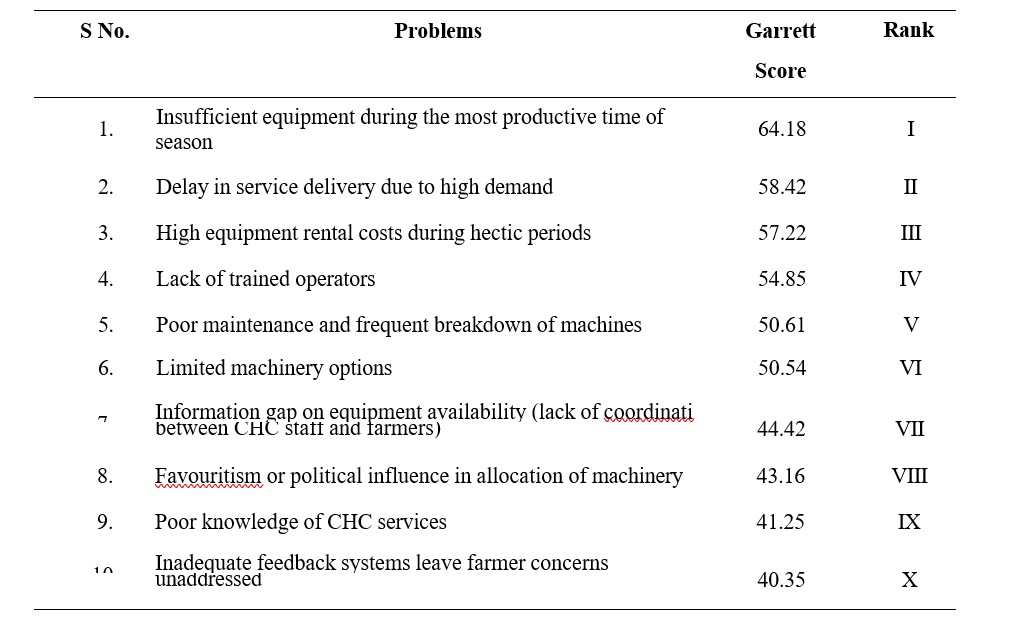
Key challenges in CHC services were identified by analysing ten major constraints using the Garrett ranking technique, based on responses collected from 100 farmers in Table 1.
Insufficient equipment during the most productive time of season was the most listed problem (Garrett Score: 64.18), leading to unmet demand and delayed operations. This was followed by delay in service delivery due to high demand (Score: 58.42) and high equipment rental costs during hectic periods (Score: 57.22), which deter smallholders from utilizing CHC services. Other significant constraints included the lack of trained operators (Score: 54.85), and Poor maintenance and frequent breakdown of machines (Score: 50.61), affecting service reliability. (Meena et al. 2018 and Sharma et al. 2022)
Farmers also reported limited machinery types, inadequate and delayed information on availability, and favouritism in machine allocation, which impacted fair access. Finally, low awareness of CHC services and ineffective feedback systems were cited as concerns. Resolving these problems with enhanced planning, operator training, digital scheduling, and transparent service protocols can greatly enhance the reach and efficiency of CHCs in supporting farm mechanization.
The study concludes that poor resource planning, high rental costs, lack of trained operators, and limited machinery options hinder effective CHC utilization in Kurnool. Addressing these through better scheduling, operator training, and transparent operations can significantly enhance service efficiency and farmer trust.
The recommendations given by beneficiary farmers for improving the efficiency of Custom Hiring Centres (CHCs) are presented in Table 2. The majority of farmers (93.00%) highlighted the need to boost the accessibility of equipment during peak crop times of year, noting present shortages and delays.
Additionally, 78 per cent of respondents suggested lowering rental charges, reflecting financial constraints faced by smallholders. About 65per cent recommended establishing CHCs closer to villages to reduce travel time and improve accessibility. Another 52 per cent called for
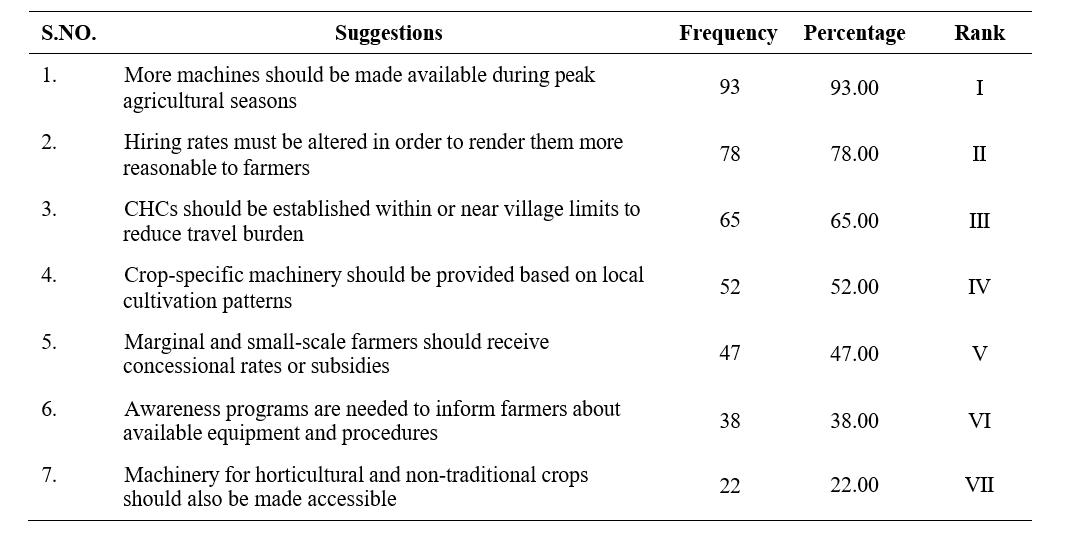
crop-specific machinery aligned with local cultivation patterns, while 47 per cent advocated for concessional rates for marginal and small-scale farmers. A smaller proportion of farmers (38.00%) highlighted the need for awareness campaigns to improve understanding of CHC services and booking procedures. Meanwhile, 29 per cent recommended extending CHC services to horticultural crops, signalling the need for service diversification. (Verma et al. 2022)
Overall, the responses underline the importance of improving access, affordability, and availability of machinery, alongside targeted support and outreach, to ensure CHCs better serve the needs of diverse farming communities.
Suitable strategies to overcome barriers in obtaining CHC services
Based on the suggestions and feedback gathered from 100 beneficiary farmers in Kurnool district, several strategies can be proposed to enhance the accessibility and effectiveness of CHCs. Farmers emphasized issues such as limited availability of machinery, high rental charges, long distances to CHCs, there is a dearth of awareness about operations. These findings highlight the importance for a multi-dimensional approach to improve the functioning and reach of CHCs.
The analysis revealed that the predominant constraint in accessing Custom Hiring Centre (CHC) services was the insufficient availability of equipment during peak agricultural seasons (Garrett Score = 64.18, Rank I), followed by delays in service delivery due to excessive demand (58.42, Rank II) and high rental charges during busy periods (57.22, Rank III). Other notable issues included the lack of trained operators (54.85) and frequent machinery breakdowns due to inadequate maintenance (50.61).
Addressing these challenges requires enhancing the availability of machinery during peak agricultural seasons (93.00%) and rationalizing rental rates to ensure affordability for small and marginal farmers (78.00%). Further recommendations included establishing CHCs within or near village limits (65%) and provision of crop- specific machinery based on local cultivation patterns (52.00%). Overall, the results emphasize the necessity of improving equipment availability, enhancing operational efficiency, and strengthening farmer awareness to ensure the effective functioning of CHCs.
Bethi, H., Rao, K.S and Reddy, B.V. 2023. Custom Hiring Centres and Mechanization Access: A Decade of Progress in India. Journal of Agricultural Policy and Mechanization. 12(1): 34–42.
Dutta, A., Roy, K and Saikia, B. 2021. Exploring access barriers to CHCs among farmers in Assam. North- East India Agricultural Review. 29(1): 23–30.
Kumar, A and Thomas, R. 2023. Evaluating custom hiring service penetration in Odisha’s tribal belts. Journal of Tribal Agricultural Studies. 12(1): 1–9.
Meena, H.R., Singh, R and Chauhan, S. 2018. Accessibility challenges of CHC units in Rajasthan. Journal of Rural Development. 37(4): 428–436.
Patel, J and Desai, K. 2019. Village-level disparities in access to CHC services in Gujarat. Agricultural Extension Journal. 16(2): 130–138.
Raghavan, V and Narayanan, M. 2019. An evaluation of CHC service delivery in Tamil Nadu. South India Agricultural Extension Review. 5(1): 30–38.
Ravi, S and Emmanuel, A.M. 2025. Terrain barriers and inclusive access to CHCs in hilly regions of Kerala. International Journal of Hilly Agriculture. 3(1): 12– 20.
Sharma, P and Rao, V. 2022. Smallholder and tenant farmer access to CHC services in Maharashtra. Journal of Rural Mechanization and Extension. 15(2): 90–98.
Verma, P., Tiwari, R and Yadav, S. 2022. Accessibility constraints and recommendations in CHC operations in Bundelkhand, Uttar Pradesh. Journal of Bundelkhand Agri-Socio Research. 10(2): 119–127.