

0 Views
Institute of Agribusiness Management, S.V. Agricultural College, ANGRAU, Tirupati-517 502.
The present study, titled “Business analysis of women agripreneurs in Southern Andhra Pradesh”, specifically in the districts of Tirupati, Chittoor and SPSR Nellore. The study was conducted with an objective of identifying challenges faced by the women agripreneurs. Using purposive random sampling, primary data was collected from 30 women agripreneurs. The main challenges were multiple role conflicts, lack of training, poor market access, high interest rates and limited institutional support. Despite hurdles, women-led agribusinesses showed promise for rural development. The study emphasizes the need for targeted training, financial access and policy support to scale women-led agri-enterprises effectively.
KEYWORDS:Challenges; Agri-enterprises; Women agripreneurs.
India, with its vast population and dynamic economic environment, had experienced a significant increase in women’s participation in entrepreneurial activities, particularly in agriculture and allied sectors (Tiwari, 2022). This shift reflects broader social changes and policy support enabling women to overcome traditional barriers and assume leadership roles in enterprise development (Singh and Raghuvanshi, 2012). Women entrepreneurs, particularly in agripreneurship, have shown the ability to contribute meaningfully to rural livelihoods and national economic growth (Dhulipudi et al., 2024). Agripreneurship, defined as entrepreneurship in agriculture and allied activities such as food processing, dairy and horticulture, has provided women with opportunities to enhance their income, independence, and community involvement (Bairwa et al., 2012).
Despite these developments, women-led agri- enterprises continue to face persistent challenges including limited access to capital, inadequate technical training and institutional barriers. Against this backdrop, the present study was undertaken to identify the challenges that were encountered by women agripreneurs.
The study was conducted in the state of Andhra Pradesh, selected for its strong agricultural base and supportive ecosystem for women entrepreneurs. The districts of Tirupati, Chittoor and SPSR Nellore were purposively chosen due to their active participation of women in various agricultural enterprises. A purposive random sampling design was used to select 30 women agripreneurs actively engaged in agri-based enterprises. Lists of potential respondents were obtained from Krishi Vigyan Kendras (KVKs), MSME departments and other supporting organizations. From these, women involved specifically in agri-related enterprises were shortlisted and randomly selected to ensure diverse representation.
Primary data was collected using a structured and pre-tested questionnaire interview schedule focused on various categories of challenges being faced by women viz., personal challenges, technical, marketing, financial and institutional challenges. Garrett’s Ranking Technique was used to analyse the identified challenges. Garrett ranking technique helped to identify and prioritize the most significant challenges faced by respondents based on their individual rankings. Each respondent was asked to rank challenges, with the most significant challenge given the highest priority as I. This ranking method helps in identifying and analyzing the major challenges systematically and these ranks were converted into scores using a specific formula to calculate percent position. The converted scores were then averaged to determine the Garrett mean score for each challenge. The challenge with the highest mean score was considered the most critical. This technique provides a systematic and quantitative way to analyze subjective opinions.
The tool used for analysis of challenges was Garrett’s Ranking Technique. The method involves calculating the percentage position for each rank using the formula:

The information related to the challenges faced by women agripreneurs was gathered through a survey using a well-structured and pre-tested schedule. Respondents were asked to rank the constraints, with the most significant challenge given the highest priority. This ranking method helped in identifying and analyzing the major challenges systematically.
Results from the Table 1 indicated that, among the personal challenges faced by women agripreneurs were: multiple role conflicts (Rank I), inability to manage time for business (Rank II), inadequate risk-taking ability (Rank III), poor decision-making (Rank IV), limited family support (Rank V) and low self-confidence (Rank VI). The results suggested that balancing multiple roles emerged as the most significant personal challenge, reflecting the burden of household and business responsibilities on women agripreneurs. Additionally, time constraints and limited confidence in decision- making and risk-taking highlight the need for targeted capacity-building and family support initiatives.
Results from Table 1 indicated that, among the technical challenges faced by women agripreneurs were: inadequate training (Rank I), non-availability of skilled labour (Rank II), lack of organizational guidance (Rank III), lack of consultancy and counselling facilities (Rank IV), less managerial experience (Rank V) and lack of awareness on new technologies (Rank VI).The findings highlighted that inadequate training was the most critical issue, suggesting the need for structured, hands-on capacity-building programs. Furthermore, the absence of skilled labour and limited organizational guidance point to a gap in external technical support, while the lack of awareness of new technologies and managerial experience further restricts innovation and operational efficiency in their enterprises.
Results from Table 1 indicated that, among the marketing challenges faced by women agripreneurs were: inadequate market information (Rank I), lack of diversification knowledge e on market sources (Rank II), more competition (Rank III) and low demand for produce (Rank IV). The findings suggested that insufficient access to timely and accurate market information severely impacted pricing and sales decisions. The lack of knowledge regarding diverse market outlets and stiff competition from established players hindered market penetration. Additionally, low consumer demand for certain agri-products further challenged the sustainability of these enterprises.
Results from Table 1 indicated that, among the financial challenges faced by women agripreneurs were: high rate of interest (Rank I), inadequate working capital (Rank II), lack of awareness of funding schemes and loan facilities (Rank III), lack of financial guidance (Rank IV) and unavailability of collateral security for getting loans (Rank V).
The high cost of borrowing and limited access to working capital emerged as the most pressing financial barriers. The lack of awareness and guidance regarding formal funding opportunities reflected a need for greater financial literacy. Additionally, the issue of not possessing collateral further limited access to institutional credit, especially for women from weaker economic backgrounds.
Results from Table 1 indicated that, among the institutional challenges faced by women agripreneurs were: poor access to institutional credit (Rank I), multiple approvals and licensing works (Rank II), heavy compliances (Rank III) and lack of exclusive instructions for providing timely guidance (Rank IV). Poor access to institutional credit ranked highest, reinforcing the earlier financial barriers faced by these women. The complexity and volume of licensing and regulatory approvals, combined with bureaucratic delays and lack of clear guidance, created hurdles in formalizing and scaling their enterprises. These institutional inefficiencies limited their ability to fully benefit from government schemes and formal sector linkages.
The above analysis clearly revealed that women agripreneurs faced adiverseset of challenges cutting across personal, technical, economic, financial and institutional domains. Among these, personal responsibilities and lack of technical training emerged as the most critical barriers, significantly affecting their efficiency and business performance. Economic limitations such as inadequate market information and stiff competition, combined with financial difficulties like high interest rates and limited
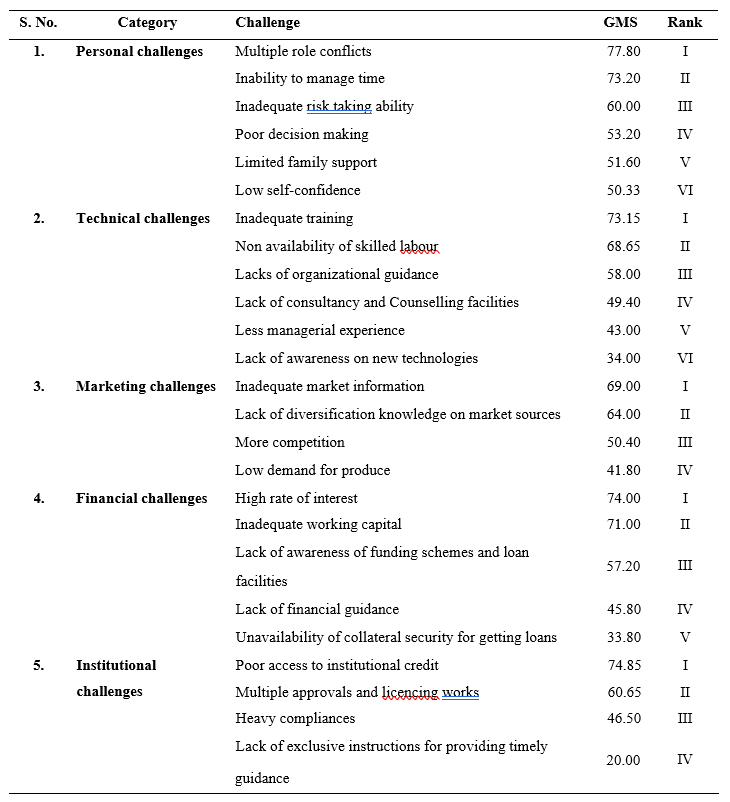
access to credit, further constrain their entrepreneurial potential. Additionally, institutional issues, including complex regulatory procedures and poor infrastructure, add to the burden. Addressing these ranked challenges through targeted interventions such as skill development programs, financial literacy, improved market access and gender-sensitive policies is essential to empower women agripreneurs and enhance the sustainability of their agri- enterprises.
Bairwa, S. L and Kushwaha, S. 2012. Agro industry scenario in India. In: Prof. S. P. Singh “Agricultural research and sustainable development in India”, pp 159-182. Bharti publications, New Delhi.
Dhulipudi, S. M., Sree Devi, P., Prasanthi, P., Jnana Venkata Prasad, G., Ramakrishna, V., Raju, U., Sri Satya, G., Uma, G and Sree Brahmanandam, 2024. A case study of women’s entrepreneurship dynamics in three rural districts of Andhra Pradesh, a south Indian state. Journal of Infrastructure, Policy and Development. 8(11): 9228.
Singh, R and Raghuvanshi, N. 2012. Women entrepreneurship issues, challenges and empowerment through self help groups: An overview of Himachal Pradesh. International Journal of Democratic and Development Studies. 1(1): 45-58.
Tiwari, B. 2023. A study related to challenges and problems faced by rural women entrepreneurs. International Journal of Advanced Research in Commerce, Management and Social Science. 6(1): 39-42.