
0 Views
Department of Genetics and Plant Breeding, S.V. Agricultural College, ANGRAU, Tirupati-517 502.
Forty diverse genotypes of castor (Ricinus communis L.) were evaluated during kharif, 2024 to estimate genetic variability, broad sense heritability, and genetic advance for 12 metric traits. The analysis of variance revealed significant amount of variation among the genotypes for all the traits studied. It was noted that the estimates of phenotypic coefficient of variation (PCV) were higher than the genotypic coefficient of variation (GCV), indicating role of environment in governing the traits. Notably, traits like number of capsules on primary spike and total seed yield have high PCV and GCV implying the wide spectrum of variability for these traits. High heritability coupled with high genetic advance as a percentage of the mean was recorded for effective primary spike length, number of capsules on primary spike, number of effective spikes per plant, 100 seed weight and total seed yield. This indicates a predominant additive gene action in the expression of these traits, suggesting that direct selection for them would be rewarding towards genetic improvement of castor.
KEYWORDS: PCV, GCV, Genetic advance, Heritability.
Castor (Ricinus communis L., 2n=2x=20), a premier non-edible commercial oilseed crop, belongs to spurge family, commonly known as Euphorbiaceae. India is the global supplier of castor oil and its by-products. India alone produces 18.79 Lakh metric tonnes of castor bean from 10.30 lakh ha cultivated area with an average productivity of 1824 kg ha-1 (INDIASTAT, 2023-24). In India, castor is chiefly grown in the states of Gujarat followed by Rajasthan, Andhra Pradesh, Telangana, Tamil Nadu, Karnataka and Madhya Pradesh. Castor oil contains substantial quantity of the unusual hydroxylated fatty acid “ricinolate” which enhances its consumption as a lubricant in power engines. It can readily be dissolved in alcohol and transformed into biodiesel even at low temperatures. It is also used to manufacture soaps, printing inks, linoleum, varnishes and plasticizers. Castor oil is a potent laxative and is also a curing agent for skin problems viz., sunburn, crinkles and stretch symbols, etc. The by-product of castor oil expeller is the cake which contains vital organic nitrogen (6.4%), P2O5 (2.5%) and K2O (1%) including micronutrients for organic farming. The plant stems are used as firewood and to prepare paper pulp by the paper mills. Beyond this, fresh castor leaves are used to rear eri-silkworms, while desiccated leaves are used as an insecticide in agriculture.
The success of plant breeding hinges on the existing genetic variability within the crop (Zheng et al., 2010). Assessing and estimating genetic variability in the germplasm is crucial before initiating any crop improvement program or selecting appropriate breeding techniques. This analysis aids in developing high- yielding and high-quality cultivars, ultimately increasing production. Heritability plays a key role in determining the transmissibility of traits to future generations, which is vital for selecting component traits to improve yield. Heritability estimates, along with genetic advances, are more reliable in predicting the genetic gain achieved via selection compared to heritability estimates alone.
The present investigation was carried out during kharif, 2024 at Agricultural Research Station, Ananthapuramu, Andhra Pradesh. The experimental material utilized for the present study comprised of 40 castor genotypes sown under rainfed alfisols in alpha lattice design replicated twice. Each genotype was planted in two rows of 6 m length adopting a spacing of 90 cm × 60 cm. All the recommended package of practices were adopted to raise a healthy crop. Observations on five randomly selected plants in each genotype for 12 metric traits viz., days to 50% flowering of primary spike, days to maturity of primary spike, plant height up to primary spike (cm), number of nodes to primary raceme, effective primary spike length (cm), number of capsules per primary spike, number of effective spikes per plant, volume weight (g/100ml), hundred seed weight (g), total seed yield (kg/ha), final plant stand (no./plot) and oil content (%) were studied. Oil content in castor genotypes were estimated by Nuclear Magnetic Resonance Spectrometry (NMR) at Indian Institute of Oilseeds Research (IIOR), Hyderabad. The statistical analysis for various traits was computed using R statistical package.
High magnitude of variability enhances the likelihood of developing desirable genotypes in crop plants. The primary objective of germplasm conservation is to collect and preserve the genetic diversity of native crop species, ensuring its availability for both present and future generations. In this study, significant differences among the castor genotypes were observed for all the traits examined, indicating the presence of considerable genetic variability. Such variability provides a valuable resource for crop improvement programs, enabling breeders to select and combine favourable traits effectively.
Traits with high heritability are generally easier to improve through selection, as their expression is less influenced by environmental factors and are more controlled by genetic makeup. Consequently, the selection process becomes more efficient, and the response to selection is greater. These findings underscore the importance of evaluating and conserving diverse germplasm to sustain long-term agricultural productivity and adaptability to changing environmental conditions.
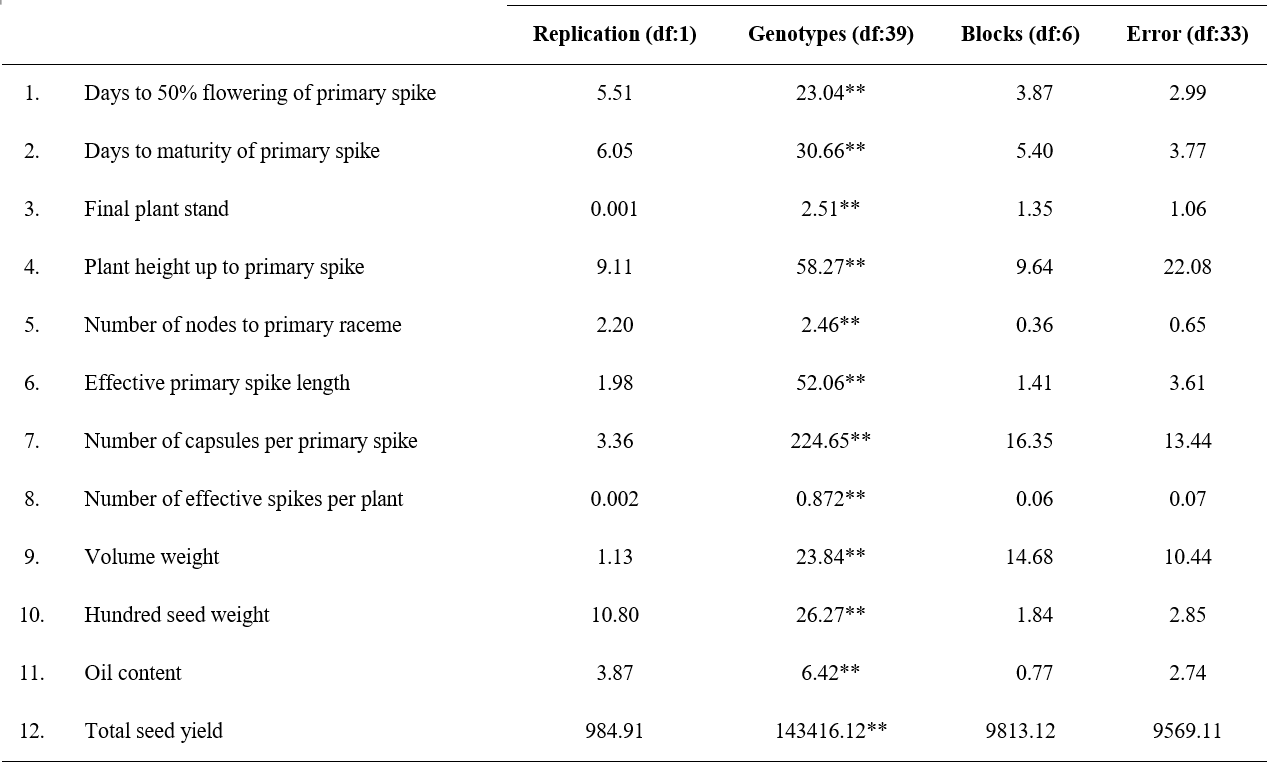
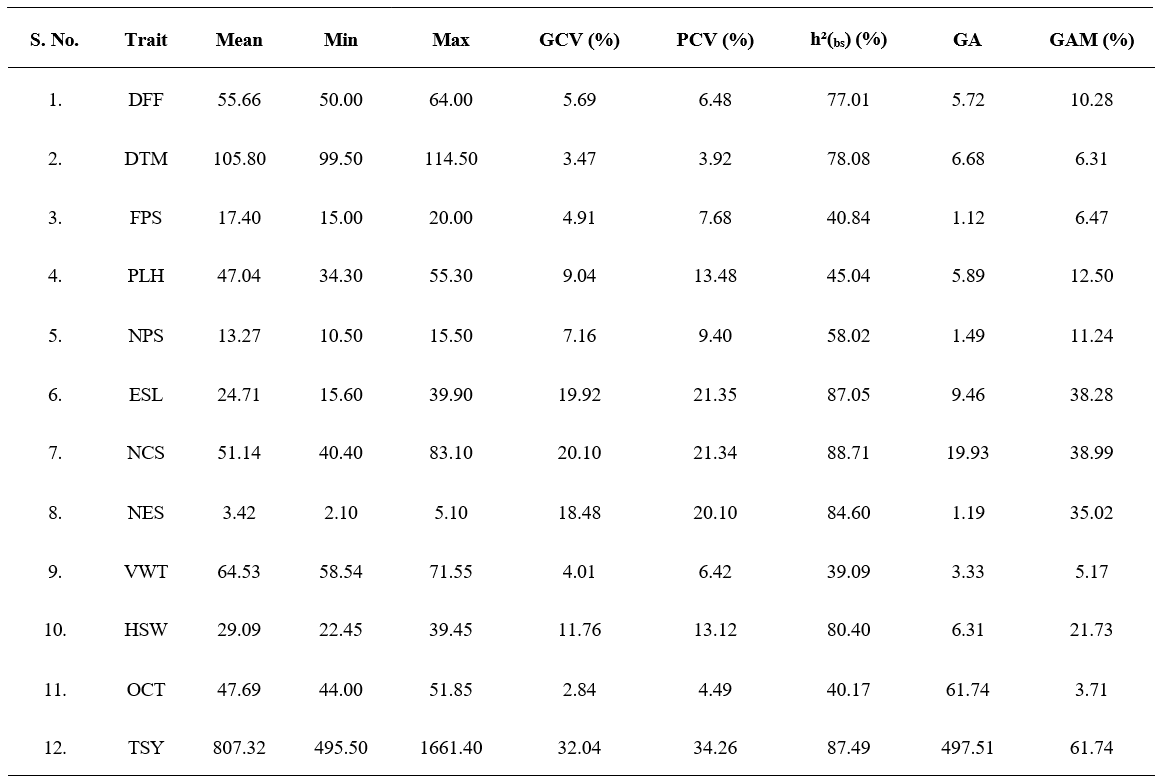
The analysis of variance, along with estimates of genetic variability, heritability, and genetic advance as a percentage of the mean, are presented in Tables 1 and 2. In addition, the graphical representation of PCV, GCV, heritability, and genetic advance as a percentage of the mean for various traits is illustrated in Figure 1. Highly significant differences were observed among the genotypes for all the traits under study, indicating the presence of substantial genetic variability within the population. This variation provides ample scope for selection and genetic improvement. The character days to 50% flowering of primary spike recorded a mean of 55.60 days, while days to maturity of primary spike averaged at 105.80 days. The final plant stand had a mean of 17.40 plants per plot, and plant height up to the primary spike averaged 47.04 cm. The number of nodes to the primary raceme showed a mean of 13.27, whereas the effective primary spike length had a mean of 24.71 cm. The number of capsules per primary spike averaged 51.14, and the number of effective spikes per plant showed a mean of 3.42. Volume weight recorded a mean value of 64.53 g/100 ml, while hundred seed weight had an average of 29.09 g. The total seed yield had a mean of 807.32 kg/ha, and oil content averaged 47.69 %.
Range of variation for days to 50% flowering ranged from 50.00 (ACI-16) to 64.00 (ACI-25) days, and days to maturity varied between 99.50 (ACI-16) and 114.50 (ACI-25) days. Final plant stand ranged from
15.00 (ACI-11) to 20.00 (ACI-16)plants per plot, while plant height up to the primary spike varied from 34.30 (DCS-9) to 55.30 (ACI-26) cm. The number of nodes to the primary raceme fluctuated between 10.50 (JC-24) and 15.50 (ACI-01), while effective primary spike length extended from 15.60 (ACI-30) to 39.90 (ACI-01) cm. The number of capsules per primary spike ranged from 40.40 (ACI-21) to 83.10 (ACI-26), and the number of effective spikes per plant varied between 2.10 (ACI-27) and 5.10 (ACI-01). Volume weight ranged from 58.45 (ACI-05) to 71.55 (ACI-02) g/100 ml, and hundred seed weight varied from 22.45 (ACI-19) to 39.45 (ACI-26) g. Total seed yield showed a wide range of variation from 495.50 (ACI-05) to 1661.40 (ACI-28) kg/ha, whereas oil content ranged between 44.00 (ACI-11) and 51.85 (ACI- 34) %.
High estimates of PCV and GCV were recorded for number of capsules per primary spike (20.10% and 21.34%) and total seed yield (20.10% and 21.34%). Moderate PCV and GCV were noticed for hundred seed weight (GCV 11.76%, PCV 13.12%). Moderate GCV and High PCV were noticed for the traits effective primary spike length (GCV 19.92%, PCV 21.35%) and number of effective spikes per plant (GCV 18.48%, PCV 20.10%). Low GCV and moderate PCV were noticed for plant height up to primary spike (9.04%, PCV 13.48%).
Low PCV and GCV were noted for number of nodes to primary raceme (GCV 7.16%, PCV 9.40%), and final plant stand (GCV 4.91%, PCV 7.68%) days to 50% flowering of primary spike (GCV 5.69%, PCV 6.48%), days to maturity of primary spike (GCV 3.47%, PCV 3.92%) and oil content (GCV 2.84%, PCV 4.49%).

DFF-Days to 50% flowering of primary spike
NCS –Number of capsules per primary spike
DTM-Days to maturity of primary spike
NES –Number of effective spikes per plan
FPS – Final plant stand
VWT- Volume weight
PLH-Plant height up to primary spike
HSW- Test weight
NPS-Number of nodes to primary raceme
TSY- Total Seed yield
ESL- Effective primary spike length
OCT- Oil content
Fig.1. Genotypic and phenotypic coefficient of variability, Heritability and Genetic advance as per cent mean for 12 traits studied in castor genotypes.
The results are in consonance with the findings of Rukhsar et al. (2018) for days to 50% flowering of primary spike, Deepak et al. (2024) for Days to maturity of primary spike. Abimiku et al. (2012), Getinet et al. (2014) and Dapke et al. (2016) for plant height up to primary spike. Getinet et al. (2014) and Rukhsar et al. (2018) for number of nodes to primary spike. Dapke et al. (2016) for effective primary spike length. Deepak et al. (2024) for number of capsules per primary spike. Halilu et al. (2013) and Rukhsar et al. (2018) for number of effective spikes per plant. Yamanura and Kumar (2020) for hundred seed weight. Rajavardhan et al. (2023) and Deepak et al. (2024) for total seed yield. Yamanura and Kumar (2020) and Rajavardhan et al. (2023) for oil content.
High heritability accompanied by moderate genetic advance was observed for the days to 50% flowering of primary spike (77.01% and 10.28%). while high heritability coupled with low genetic advance was recorded for days to maturity of primary spike (78.08% and 6.31%). These patterns suggest the involvement of non-additive gene action in the inheritance of these traits. Similarly, moderate heritability combined with moderate genetic advance was found for plant height up to primary spike (45.04% and 12.50%) and number of nodes to primary spike (58.02% and 11.24%) while moderate heritability and low genetic advance (39.09% and 5.17%) for volume weight. This indicates limited scope for improvement of these traits.
High heritability associated with high genetic advance as a percentage of the mean was recorded for five traits viz., effective primary spike length (87.05% and 38.28%), number of capsules per primary spike (88.71% and 38.99%), number of effective spikes per plant (84.60% and 35.02%) and 100 seed weight (80.40% and 21.73%) and total seed yield (87.49% and 61.74%) This indicates a predominant influence of additive gene action in the expression of these traits, suggesting that direct selection would be rewarding towards genetic improvement.
Similar results were reported by Udaya et al. (2013) and Dapke et al. (2016) for days to 50% flowering of primary spike. Rukhsar et al. (2018) for days to maturity of primary spike. Najan et al. (2010) and Patel and Patel (2014) for plant height up to primary spike. Rukhsar et al. (2018) for number of nodes to primary spike,. Rukhsar et al. (2018), Deepak et al. (2024) for effective primary spike length and number of capsules on primary spike. Udaya et al. (2013) for number of effective spikes per plant. Sadaiah et al. (2021) and Deepak et al. (2024) for hundred seed weight. Rajavardhan et al. (2023) and Deepak et al. (2024) for total seed yield.
Number of capsules on primary spike and total seed yield have high PCV and high GCV indicates the presence of high range of variability. High heritability coupled with high genetic advance as a percentage of the mean was recorded for effective primary spike length, number of capsules on primary spike, number of effective spikes per plant, 100 seed weight and total seed yield. This indicated a predominant influence of additive gene action in the expression of these traits, suggesting that direct selection would be rewarding towards their genetic improvement in castor.
Future scope: Future research should focus on selecting yield attributing traits like effective primary spike length, number of capsules on primary spike, number of effective spikes per plant, 100 seed weight and total seed yield aid in genetic improvement of castor.
Abimiku, O.E., Azagaku, E.D and Ndor, E. 2012. Genetic variability and correlation studies in some quantitative characters in castor (Ricinus cummunis L.) accessions. Asian Journal of Agricultural Sciences. 4(6): 368- 372.
Dapke, J. S., Naik, M. R., Vaidya, G.B., Vanve, P.B., Narwade, A.V and Rajkumar, A.K. 2016. Genetic variability in castor (Ricinus communis L.). European Journal of Biotechnology and Bioscience. 4(4): 39-40.
Deepak, K.A., Manjunatha, T., Hemalatha, V and Chary, D.S. 2024. Variability, Correlation Patterns and Principal Component Analysis (PCA) for Seed Yield and Contributing Traits in Castor (Ricinus communis L.). Journal of Advances in Biology & Biotechnology. 27(8): 1217-1227.
Getinet, A., Beemnet, M. K., Girma, T and Chalachew, 2014. Phenotypic variability in Ethiopian castor (Ricinus communis L.) accessions. International Journal of Advanced Biological and Biomedical Research. 2(12): 2909-2914.
Halilu, A. D., Aba, D. A and Ogunwole, J.O. (2013). Genetic variability, genetic gain and relationships of yield and yield components in castor (Ricinus communis L.). Research & Reviews in Biosciences. 7(5): 181-186.
INDIASTAT, 2023-2024. Agriculture Area and Crops Growth Statistics 2023, 2024 [online] Available at:<https://www.indiastat.com/data/agriculture> [Accessed 18 June 2024].
Najan, B. R., Kadam, J. R and Kadlag, A. D. 2010, Genetic variability studies in castor (Ricinus communis L.). Journal of Oilseeds Research. 27: 77-79.
Patel, J.K and Patel, P.C. 2014. Genetic Variability, Heritability and Genetic Advance for yield and yield components in castor genotypes. International Journal of Plant Science.9(2): 385-388.
Rajavardhan, Y., Lal, J.J., Lakshmamma, P., Kumar, C.V and Kumar, A.A., 2023. Role of Genetic Variability and Their Associated Character on Yield Attributing Traits in Castor (Ricinus communis L.) Germplasm Lines. International Journal of Environment and Climate Change. 13(10): 265-271.
Rukhsar Patel M.P., Parmar, D.J and Kumar, S. 2018. Genetic variability, character association and genetic divergence studies in castor (Ricinus communis L.). Annals of Agrarian Science.16:143-148.
Sadaiah, K., Neelima, G., Rani, C.V.D., Rani, V.D., Madhuri, G., Nalini, N., Sujatha, M., Shankar, V.G., Kumar, M.P., Lavanya, C and Lal, J.J. (2021). Genetic parameters, diversity and character association studies in germplasm lines of castor (Ricinus communis L.). Electronic Journal of Plant Breeding, 12(4):1134-1141.
Udaya, B. K., Satyanarayana Rao, V and Srinivasa Rao, M 2013. Genetic variability in castor (Ricinus communis L.) for yield and its contributing traits. International Journal of Food and Veterinary Sciences.3(3): 103-108.
Yamanura, M and R Mohan Kumar. 2020. Study of genetic variability, path coefficient and genetic diversity in castor (Ricinus communis L.). The Pharma Innovation Journal. 9(8): 285-292.
Zheng, L., Qi, J.M., Fang, P.P., Su, J.G., Xu, J.T and Tao, A.F. 2010. Genetic diversity and phylogenetic relationship of castor as revealed by SRAP analysis. Wuban Zhiwuxue. 28: 1-6.