Data Envelopment Analysis model was employed for measuring technical efficiency of rice. Suppose there are n homogenous Decision-Making Units (DMUs) and in order to produce r number of outputs (r=1,2,3…. k), s number of inputs were utilized (s=1,2,3…m) by each DMU, i (i=1,2,3…n). Assume also that the input and output vectors of ith DMU are represented by xi and yi respectively and the data for all DMUs be denoted by the input matrix (X) m*n and output matrix (Y) k*n. Accounting for financial limitations or imperfect competitive market effects, the DEA model for variable returns to scale (VRS) which was developed by Banker, Charnes and Cooper (BCC) (Banker et al., 1984) was used. The input minimization process to measure technical efficiency of rice for each DMU could be expressed as equation (1):
Minθ,λ,ϕ
Subjected to -yi + Yλ ≥ 0, ϕxi– Xλ ≥ 0,
N1, λ = 1
λ ≥ 0……………………….. Eq (1)
where,
Y – output matrix for n farms.
θ – the total technical efficiency of ith farm.
λ represents N*1 vector of weights (constants) X – input matrix for n farms.
yi – yield of the ith farm in kg/ha.
xi – the input vector of x1i, x2i…x7i inputs of ith farm.
x1i – Total land used by ith farm (in ha)
x2i – Seed (kg/ha) used on the ith farm
x3i – Total Fertilizer used (kg/ha) on the ith farm
x4i – Total Plant protection chemicals used (litres/
- ha) on the ith farm
x5i – Ground water volume (m3/ha) used on the ith farm x6i – Total man power used (hours/ha) on the ith farm x7i – Total machine power (hours/ha) on the ith farm
where, in the restriction N1’ ë = 1, N1’ is convexity constraint which is a N*1 vector of ones and ë is a N*1 vector of weights (constants) which defines the linear combination of peers of the ith DMU. 1 ≤ f ≤ ¥ and
f -1 is the proportional increase in output that could be achieved by the ith DMU with the input quantities held constant and 1/ f defines a technical efficiency score which varies between zero and one. If f = 1 then the farm is said to be technically efficient and if f ≤ 1 the farm lies below the frontier and is technically inefficient.
Information about the number of irrigations for rice cultivation, time of irrigation, bore depth, diameter of suction pipe, and power of the engine were collected. Using this information in an approximate estimation model as used by Srivastava et al., (2009), groundwater extraction was measured in litres using the following formula and then converted into m3.
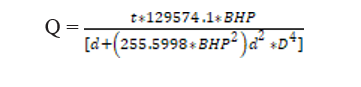
where,
Q represents the volume of water in litres t is the total irrigation time in hours
d is the depth of bore in m
D is the diameter of the suction pipe in inches.
BHP is the power of the engine.
RESULTS AND DISCUSSIONS
Efficiency measures
The technical efficiency is defined as the ability of a farm to produce the maximum feasible output from a given bundle of inputs or to use minimum feasible amount of inputs to produce a given level of output. These two definitions of technical efficiency lead to what is respectively known as the ‘output-oriented’ and the ‘input-oriented’ efficiency measures. Input-oriented models were chosen in the study to reflect the reality where the main aim is to use resources more efficiently and not to increase production. The study used single- output, multiple-input model, input-oriented Variable Returns to Scale Data Envelopment Analysis model to estimate the technical efficiencies.
Descriptive Statistics of inputs and outputs at farm level
To measure farm efficiency, the major inputs used by majority of rice farmers were considered. Descriptive statistics of output and input variables to analyze the technical efficiency is presented in table 1. The output was measured as yield obtained from rice crop in kg/ha. The yield was obtained from rice crop in year 2023-24 by the farmer. The average yield obtained was 5495.83
Table 1. Descriptive statistics of input and output variables of sample rice farmers
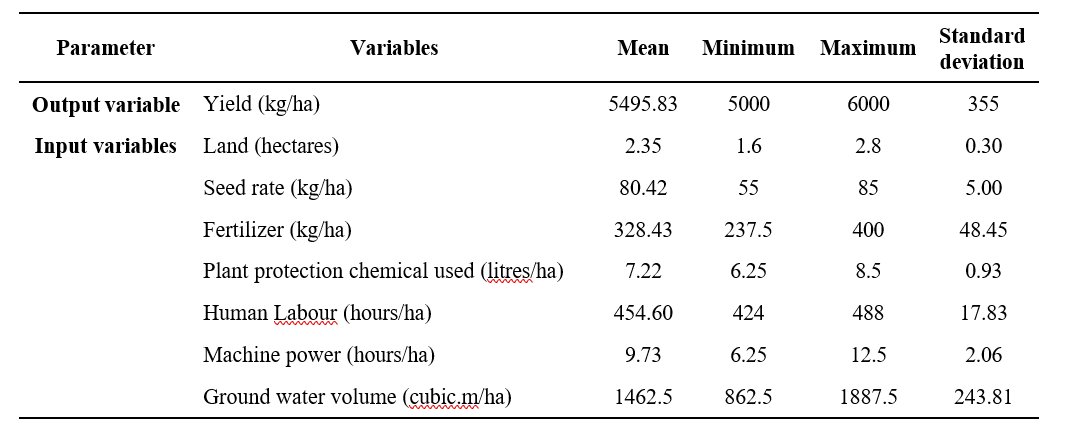
kg/hawhile the minimum yield was 5000 kg/ha and maximum yield obtained was 6000 kg/ha. The standard deviation was 355 which was quite high, which indicates large variability among the rice farmers selected in the study.
The major inputs used by farmers were land, seed, fertilizer, and plant protection chemicals, ground water for irrigation, human labor and machine labor.
The average land utilized by the farmer was 2.35 ha, the average seed consumed by the farmer was 80.42 kg per ha, the average fertilizer used by the farmer was 328.43 kg per ha, the average plant protection chemical used by the farmer was 7.22 lit/ha and the volume of ground water used by the farmer was 1462.5 cubic.m/ha. The mean human-labour utilized was 454.60 hours/ha and the mean machine power utilised was 9.73 hours/ha. The descriptive statistics of inputs state that the farmers were using larger amounts of fertilizer, human labor and water for irrigation with higher variability.
Technical Efficiency of sample rice farmers
The technical efficiency of sample rice farmers are indicated in table 2. The results from table 2 show the mean technical efficiency as 0.907. This indicates that the farmers can still reduce their inputs includes seed, fertilizer, water requirement, chemical application, machine hours and human labour by 9.3 per cent to produce same amount of output (as the model is input-oriented) (Abedullah et al., 2007; Ogundele and Okoruwa, 2004). Among the 120 sample rice farmers, 40 farmers were operating at an efficient level 1. This means 33.33 per cent farmers are fully efficient. Next, 15 farmers were operating from 0.9 to 0.99 efficiency level. They contributed 12.5 per cent of the sample rice farmers. This implies that 25 per cent of the farmers were operating at optimum efficient level. Furthermore, 65 farmers (54.17%) were operating at 0.80-0.89 level efficiency and no farmers were operating at less than 0.8 level efficiency. (Tipi et al., 2009). This indicates that 54.17 per cent of the farmers were operating at near
Table 2. Frequency distribution of technical efficiency of sample rice farmers
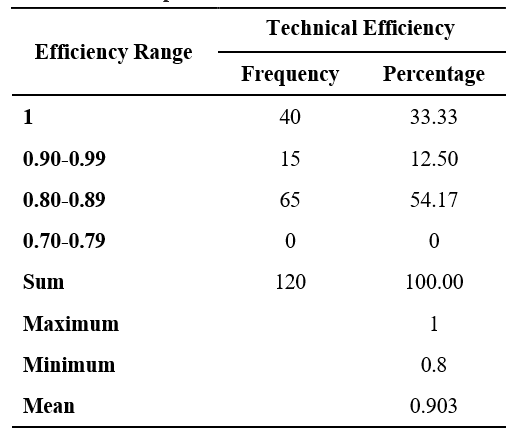
optimum efficient level. This implies that there were technically efficient farmers in the study however most of them were striving to reach the optimum efficiencylevel. In overall, farmers were operating at more than 80 per cent efficiency level. The mean technical efficiency was 0.907. This could be implied that the 65 sample farmers (54.17%) who were just below the optimum efficiency level can reduce their inputs by 9.3 per cent and can achieve the efficiency level of those 45.83 per cent farmers who were operating at optimum efficiency level. It also indicates that 90.7 per cent of current inputs are enough to sustain the production.
The model suggested that the technical efficiency of the farmers is 0.903. On an average, the farmers are 90 percent technically efficient which means there exists less potentiafor improving resource use efficiency in rice production because they are already effectively utilizing resources such as labour, land and capital. However, to achieve long-term improvements in rice productivity, the focus should shift towards advancing the production function through the adoption of new technologies. This entails prioritizing research and development efforts aimed at creating high-yielding and superior quality rice varieties. Such initiatives require increased investment in research-related activities to innovate and enhance overall agricultural productivity.
LITERATURE CITED
Abedullah, Kouser, S and Mushtaq, K. 2007. Analysis of technical efficiency of rice production in Punjab (Pakistan): Implications for future investment strategies. Pakistan economic and social review.231-244.
Banker, R.D., Charnes, A and Cooper, W.W. 1984. Some models for estimating technical efficiency and scale inefficiencies in data envelopment analysis. Management Science. 30: 1078-1092.
DRDA (2021). District Composite Water Resource Management Report. District Rural Development Agency, Ramanathapuram Ogundele, F.O. and V.O. Okoruwa. 2004. A comparative analysis of technical efficiency between traditional and improved rice variety farmers in Nigeria. African Journal of Economic Policy.11(1): 91–108.
Srivastava, S.K., Kumar, R. and Singh, R.P. 2009. Extent of groundwater extraction and irrigation efficiency on farms under different water-market regimes in Central Uttar Pradesh.Agricultural Economics Research Review. 22: 87-97.
Tipi, T., Yildiz, N., Nargeleçekenler, M and Çetin, 2009.Measuring the technical efficiency and determinants of efficiency of rice (Oryza sativa) farms in Marmara region, Turkey. New Zealand Journal of Crop and Horticultural Science. 37(2): 121-129.