

0 Views
Department of Agronomy, S.V. Agricultural College, ANGRAU, Tirupati-517 502.
This study assessed the incidence of Alternaria leaf blight in sunflower crops across major growing regions of Andhra Pradesh during the 2023–24 Rabi season. Surveys conducted in five districts revealed notable variability in Percent Disease Incidence (PDI), ranging from 18.5% to 49.6%. The highest incidence was observed in Tirupati village of Chittoor district (49.6%), while the lowest was recorded in Mudigguba village of Ananthapur district (18.5%). The disease was more severe in sunflower hybrids than in open-pollinated varieties, with the hybrid ‘NDSH 1012’ showing high susceptibility, particularly during the flowering stage. PDIs varied across black and red soils, indicating that soil characteristics may influence disease severity. These results highlight the importance of adopting region-specific management strategies, including the use of resistant varieties such as ‘Advanta’ and ‘Kaveri’, timely interventions during the flowering period and appropriate soil management practices. Utilizing localized PDI data for planning can significantly improve disease control and enhance sunflower productivity in Andhra Pradesh.
KEYWORDS: Alternaria leaf blight, Survey, Percent disease index.
Sunflower is one of the most important edible oilseed crops grown worldwide after soybean and groundnut. The crop has grown in popularity due to its short maturity period, high oil quality, photo-insensitivity, and drought tolerance. The word “Helianthus” is derived from greek word ‘Helios’ meaning ‘sun’ and ‘anthos’ meaning ‘flower’. According to Agricultural statistics at a glance (2021-2022), In india sunflower is cultivated in 0.22 million hectares with a production of 0.23 million tonnes and productivity of 1023 kg/ha. The major sunflower producing states are Karnataka (0.12 million hectares) and Maharastra (0.02 million hectares).
The major composition of sunflower oil is linoleic acid (polyunsaturated fat) and oleic acid (mono-saturated fat). Sunflower oil contains 5% palmitic acid, 6% stearic acid, 30% oleic acid (monounsaturated omega-9) and 59% linoleic acid (polyunsaturated omega-6) (Avni et al., 2016)
The sunflower crop is attacked by number of pests and diseases right from germination to harvest causes huge loss to the growers. The important sunflower affecting diseases are leaf spot, leaf blight., etc.
Sunflower is infected with so many fungal, bacterial, viral diseases. Among fungal diseases, leaf spot causes yield loss. Among the biotic stresses for successful sunflower production, susceptibility to the leaf spot and leaf blight diseases is one of the major constraint.
Alternaria leaf spot is the most common foliar disease on sunflower. This disease can affect the sunflower plants in all growing stages such as emergence, leaves, stems and flowering. The disease causes direct yield loss by reduction in the number of seeds per head (16–65%) and thousand-seed weight (15–79%). Symptoms of the disease are dark brown, oval to circular spots with pale margins and halo. In severe infection, lesions become irregular by coalescing, leading to blight, defoliation and death of the plant.
The loss due to Alternaria spp. is proportionate to the disease intensity and varies considerably depending on the stage of the plant growth at which disease occurs. It is essential to undertake survey and surveillance of the disease in every year which helps us to know the rhythmic changes in regional severity and status of the disease. Hence in this study, a roving survey has been made to document the disease severity in major districts of Andhra Pradesh, india.
Survey for the incidence of sunflower leaf blight disease in Andhra Pradesh and collection of infected leaf samples.
Roving survey was conducted to record the incidence of Alternaria leaf blight disease on sunflower in major growing areas of Andhra Pradesh (A.P.) during Rabi season during 2023-24. The districts covered under this study are Ananthapuramu, Chittoor, Kurnool, Prakasam, Kadapa and Nandyal from Andhra Pradesh (Table 1). The leaf blight incidence in different sunflower varieties and hybrids cultivated in those districts were recorded along with data on various stages of crop growth and the percent disease incidence (PDI) were used.
Per cent disease incidence =
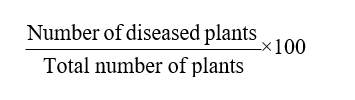
The information on hybrids, soil types, stage of the crop, latitude, longitude and percent disease incidence in these areas were collected and calculated the details are given in Table1.
In Ananthapuram district, the survey included five villages among them Kadiri village of Kadiri mandal, the isolate code AKK from the Ganga Kaveri hybrid at the vegetative stage observed in black soil recorded a PDI of 48.5%. The second isolate, B. Papuru village in Narpala mandal, with isolate ABPN from the Ganga Kaveri hybrid at vegetative stage observed in black soil, recorded a PDI of 29.0%. The third isolate at Bandlapalli village in Narpala mandal, with the code ABN isolate from Ganga Kaveri hybrid at the young stage observed in red soil, recorded a PDI of 45.2%. At Mudiguba village in Mudigubba mandal with the AMM isolate from the Advanta hybrid at the seedling stage observed in black soil recorded a PDI of 18.5%. The fifth isolate atgv d, Belguppa village in Belguppa mandal with the ABB isolate from Advanta at the flowering stage observed in black soil, recorded a PDI of 43.2%.
In Kurnool district, the survey included Veldurthi village of Veldurthi mandal with the isolate KVV from Advanta hybrid at the flowering stage observed in black soil, recorded a PDI of 48.1%.
In Kadapa district,the survey included four villages of four mandals among them Sirigapalli village in Jammalamadugu mandal with isolate KSJ from the Zaneka hybrid at the flowering stage were observed in black soil, recorded a PDI of 29.6%. At Dhobudupalli village in Kondapuram mandal with isolate KDK from Zaneka hybrid at the flowering stage were observed in black soil, recorded a PDI of 42.3%. At Murgampalli village in Tadipatri mandal with isolate KMT from Zaneka hybrid at the flowering stage were observed in black soil, recorded a PDI of 30.5%. The fourth isolate at Bondala Dinne village in Tadipatri from Zaneka hybrid at the flowering stage were observed in black soil, recorded a PDI of 40.1%.
In Nandyal district, five Villages of five Mandals were surveyed. Among them Nandyal village in Nandyal mandal with isolate NNN from the NDSH 1012 hybrid at the flowering stage observed in black soil, recorded a PDI of 48.1%. The second, isolate at Pamulapadu village in Pamulapadu mandal with isolate NPP from NDSH 1012 hybrid at the flowering stage observed in black soil, recorded a PDI of 50.5%. The third, isolate at Rudravaram village in Rudravaram mandal with isolate NRR from NDSH 1012 hybrid at the flowering stage observed in black soil, recorded PDI of 30.6%. At Kambala Palli village in Pamulapadu mandal with isolate NKP from NDSH 1012 hybrid at the flowering stage observed in black soil, recorded a PDI of 21.3%. The fifth, isolate at Kokkarancha village in Kothapalle mandal with isolate NKK from NDSH 1012 hybrid at the flowering stage observed in black soil, recorded a PDI of 28.4%.
In Chittoor district, the survey included five villages of five mandals i.e., Tirupati, Nagari, M.Kuthuru, Vellavadi, and Buagraharam villages. The first Tirupati village with isolate CTT isolate from KBSH-44 hybrid at the flowering stage were observed in red soil, had recorded a PDI of 49.6%. The second, isolate at Nagari village with isolate CNN from KBSH-53 hybrid at the vegetative stage observed in black soil, recorded a PDI of 36.8%. The third, isolate at M.Kuthuru village in Palamaner mandal with isolate CMP from KBSH-53 hybrid at the seedling stage observed in black soil, recorded a PDI of 27.2%. The fourth, isolate at Vellavadi village in Nagari mandal with isolate CVN from KBSH-53 hybrid at the vegetative stage observed in black soil, recorded a PDI
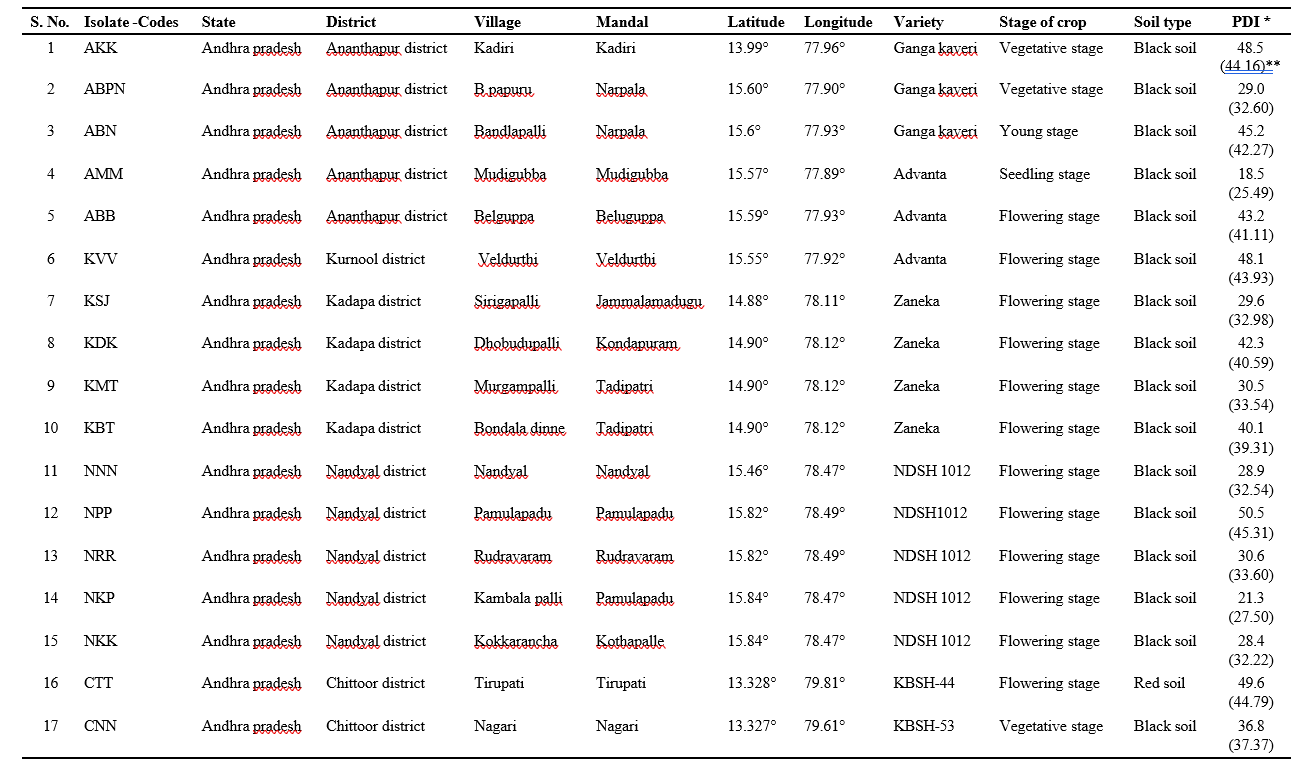
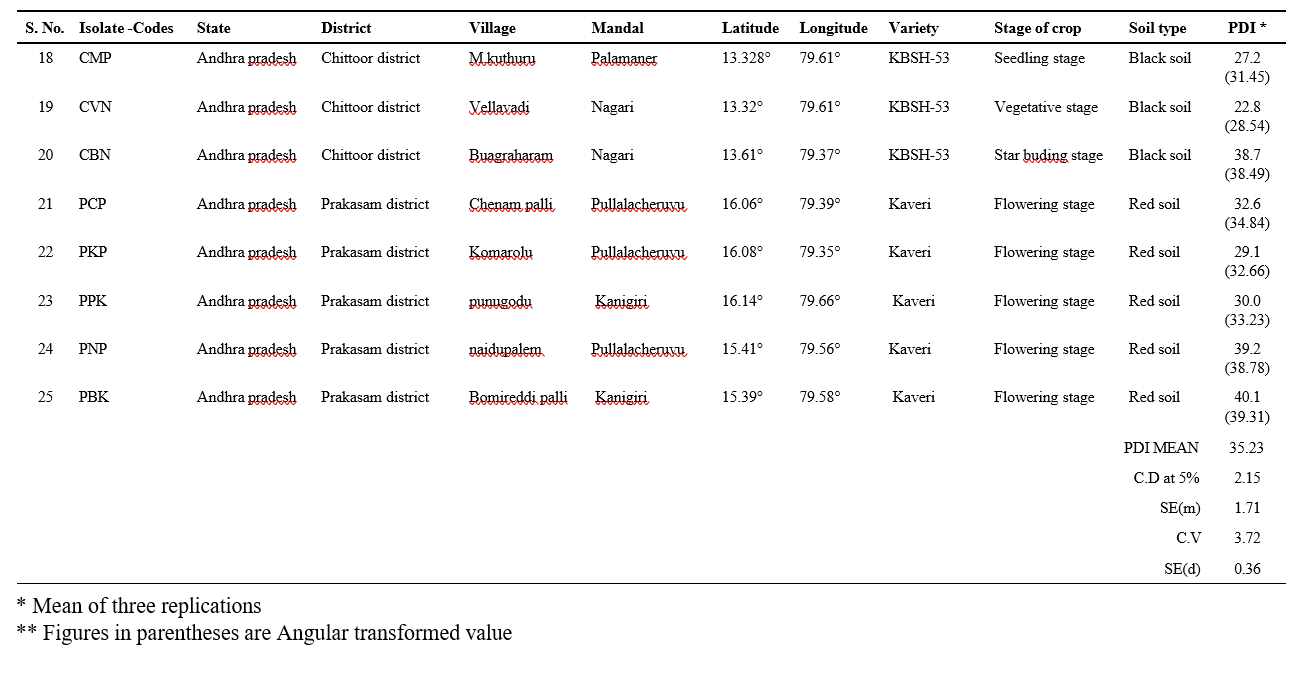
of 22.8%. The fifth, isolate at Buagraharam village in Nagari mandal with isolate CBN from KBSH-53 hybrid at the star budding stage observed in black soil, recorded a PDI of 38.7%.
In Prakasam district, the survey included five villages of five mandals i.e., Chenam Palli, Komarolu, Punugodu, Naidupalem, and Bomireddi Palli villages. Among them Chenam Palli village in Pullalacheruvu mandal with isolate PCP from the Kaveri hybrid at the flowering stage observed in red soil, recorded a PDI of 32.6%. The second, isolate at Komarolu village in Pullalacheruvu mandal with isolate PKP from Kaveri hybrid at the flowering stage observed in red soil with recorded a PDI of 29.1%. The third, isolate at Punugodu village in Kanigiri mandal with isolate PPK from Kaveri hybrid at the flowering stage observed in red soil, recorded a PDI of 30.0%. The fourth, isolate at Naidupalem village in Pullalacheruvu mandal with isolate PNP from Kaveri hybrid at the flowering stage observed in red soil a PDI of 39.2%. The fifth, isolate at Bomireddi Palli village in Kanigiri mandal with isolate PBK from Kaveri hybrid at the flowering stage observed in red soil, recorded a PDI of 40.1%.
A survey conducted across several districts in A. P. revealed significant variation in the PDI for Alternaria leaf blight. The ‘NDSH 1012’ hybrid showed high susceptibility (50.5%), especially during the flowering stage, consistently exhibiting higher PDI compared to seedling and vegetative stages. Both black and red soil types displayed varying PDI (between varying, 0.9%), indicating that soil properties influence disease severity. The highest disease incidence was observed in Pamulapadu village (50.5%) of Nandyal district, while the lowest was recorded in Mudigubba village (18.5%) of Ananthapuramu district. Average disease incidences of 36.8% and 39.2% were noted in Nagari village of Chittoor district and Naidupalem village of Prakasam district, respectively. The disease was more severe (49.6%) in variety KBSH 44 in Chittoor compared to other varieties. Implementing targeted interventions, particularly during the flowering stage, selecting resistant hybrids like Advanta and Kaveri. Based on PDI data will enhance disease control and improve sunflower crop health in A. P.
The present results were in agreement with the findings of Singh et al., (2019) observed that field surveys were undertaken during two consecutive cropping seasons (2015-16 and 2016-17) in the initial study revealed higher illness incidence in both states. Throughout both farming seasons, Karnataka consistently had higher disease indicators than Maharashtra. Interestingly, district Dharwad in Karnataka has the highest mean disease incidence during both Alternaria leaf spot and Fusarium wilt (55.41% and 41.42%, respectively) among all surveyed districts. Kgatle et al., (2019) conducted study to identify the causative agent, prevalence and geographical distribution of ALB in South Africa’s major sunflower production areas. Surveys were carried out at commercial sunflower production fields and commercial cultivar trials throughout the growing seasons 2012/13, 2013/14 and 2014/15. Between 90 and 120 days following planting, the plants were surveyed and ALB-symptomatic leaves were taken. Alternaria alternata was identified as the major ALB pathogen in all fields. Similarly, Prasad et al. (2020) examined the sunflower leaves with dark specks caused by leaf blight were gathered from 117 farms throughout nine Indian states during the rainy and spring seasons of 2009-10, 2010-11 and 2011-12. Similarly, Ajith et al., (2023) who surveyed in six major sunflower growing regions of northern Karnataka, including Gadag, Vijayapura, Bagalkote, Belagavi, Bellary and Haveri, during Kharif 2022 and Rabi 2022-23. The survey data revealed that leaf blight was prevalent across all growing locations, showing significant variations in severity based on location, season, cultivated hybrids, soil type and crop growth stage.
The average Percent Disease Incidence (PDI) observed across all surveyed locations during the Rabi 2023–24 season is 35.23%, representing the overall disease burden as calculated from the arithmetic mean of all sampled sites. A difference between two means, whether between varieties, locations, or treatments is considered statistically significant at the 5% level if it exceeds 2.15, indicating a true difference unlikely to have occurred by chance. Conversely, if the difference is 2.15 or less, it is deemed not statistically significant, suggesting the variation may be due to random sampling error rather than a genuine effect.
The study underscores the significant impact of Alternaria leaf blight on sunflower cultivation in A.P. The variability in disease incidence across different regions, soil types, and crop stages highlights the need for region-specific management strategies. The findings suggest that targeted interventions, particularly during the flowering stage, and the selection of resistant hybrids like ‘Advanta’ and ‘Kaveri’ are crucial for effective disease management. The significant variability in disease index across different regions, hybrids, and soil types underscores the importance of developing region-specific interventions. Selecting resistant hybrids, implementing appropriate soil management practices, and focusing on critical growth stages like flowering can enhance disease control and improve sunflower yields. The findings contribute valuable insights into the epidemiology of Alternaria leaf blight and offer a foundation for future research and management practices.
Ajith, C.R., Ashtaputre, S.A and Rao, M.S.L. 2023. Seasonal distribution of leaf blight of sunflower (Helianthus annus L.) caused by Alternaria helianthi (Hansf.) Tubaki and Nishihara in major sunflower growing regions of northern Karnataka. The Pharma Innovation Interantional Journal. 12(11):321-327.
Avni, T., Anupriya, S., Rai, P., Maan, K and Naryansamy, C.C.N. 2016. Effects of heating and storage on nutritional value of sunflower oil. DU Journal of Undergraduate Research and Innovation. 2(1):196- 202.
Kgatle, M.G., Flett, B., Truter, M., Ramusi, M and Aveling, T.A. 2019. Distribution of Alternaria leaf blight of sunflowers caused by Alternaria alternata in South Africa. Journal of Agriculture and Rural Development in the Tropics and Subtropics (JARTS). 120(1):71-77.
Singh, N., Anand, G and Kapoor, R. 2019. Incidence and severity of fungal diseases of safflower in India. Crop Protection.125:104-905.