

0 Views
Department of Genetics and Plant Breeding, S.V. Agricultural College, ANGRAU, Tirupati-517 502.
The present investigation was carried out at dry land farm of S.V Agricultural College, Tirupati, Andhra Pradesh during
Rabi 2023-24. Sixty-four genotypes including checks were evaluated in Augmented block design for 20 DUS traits and 10 yield and yield attributing traits viz., days to 50% flowering, plant height, number of primary branches per plant, number of capsules per plant, capsule length, number of seeds per capsule, 1000-seed weight and seed yield per plant to study character association and the magnitude of direct and indirect effects of yield component traits on seed yield per plant. The association analysis revealed that plant height, number of capsules per plant and showed strong significant and positive correlation with seed yield per plant indicating that yield improvement could be possible through the indirect selection of these traits. The path coefficient analysis has disclosed that an ideal sesame plant should have more plant height followed by more number of capsules per plant to boost seed yield per plant as plant height and number of capsules per plant exhibited high and moderate direct effect on seed yield per plant respectively.
KEYWORDS: Sesamum, Seed yield, Character association, Path analysis, direct and indirect effects.
Sesame (Sesamum indicum L.) generally known as benni seeds, gingelly seeds and til etc. belongs to the family Pedaliaceae. Globally, it is highly valuable oilseed crop which is commonly known as “queen of oilseeds”. Sesame oil contains oleic acid (35 to 54%), linoleic acid (39 to 59%), about 10% of palmitic acid and around 5% of stearic acid (Wacal et al., 2019). Some of the quality traits like oil content, protein content and fatty acid composition in sesame are the most important characters for both oil and confectionary purposes. Oleic acid and linoleic acid are two essential fatty acids that play a crucial role in maintaining human health. Foods that are deep-fried using sesame oil exhibit prolonged durability as the oil contains protective antioxidants known as lignans, sesamol, and sesaminol.
In India, Sesame is cultivated in an area of 15.23 lakh hectares with an annual production of 8.02 lakh tonnes and productivity of 527kg/ha (Ministry of Agriculture, 2023-24). Gujarat, Uttar Pradesh, Andhra Pradesh, Tamil Nadu, Karnataka, West Bengal, Bihar and Assam are the major sesame-growing states of India. In Andhra Pradesh, this crop occupies an area of 0.23 lakh hectares with a production of 0.07 lakh tonnes and productivity of 287 kg/ha (Ministry of Agriculture, 2023-24). The average productivity in Andhra Pradesh (287 kg/ha) is very less as compared to the Indian average (527 kg/ha), necessitates the development of high yielding varieties.
Sesame production is lower in India as compared to the world. To address the current issue, developing of improved and high yielding varieties is necessary. Correlation helps in assessing relationship among yield and yield attributing traits. Information about the association of several yield components can be obtained through correlation analysis. Hence, correlation provides a more robust understanding of the nature of the relationship among the characters, which is crucial for yield enhancement. Path coefficient analysis provides a thorough understanding of contribution of various characters by partitioning the correlation coefficient into components of direct and indirect effects (Wright, 1921), which helps the breeder in determining the yield components. Hence, association analysis and path coefficient analysis are to be carried out to determine the direction of selection and the characters to be considered in improving the yield in sesame.
The experiment was laid out in an Augmented Block Design. The design consisted of 6 blocks and each block had 10 genotypes and 4 checks. Each genotype was sown in single row of four meters length with a spacing of 30 cm between rows and 15 cm between the plants. The crop was provided with fertilizers to supply 40:20:20 N:P: K kg ha-1. Half of N and entire P and K were applied as basal dose and second half of N was applied as top dressing after 30 days of sowing. The crop was raised under completely irrigated conditions. All the recommended cultural and agronomic measures were followed during the crop period.
Observations were recorded on randomly five selected plants for yield attributing characters viz., plant height (cm), number of primary branches per plant, number of capsules per plant, capsule length (cm), number of seeds per capsule, thousand seed weight (g), and seed yield per plant (g), Whereas the trait days to 50% flowering which is recorded on per plot basis. The correlation coefficients were calculated to determine the degree of association of the yield components with seed yield and also among themselves. Phenotypic correlation coefficients were compared against ‘r’ values given in Fisher and Yates (1963) tables for (n – 2) degrees of freedom at probability levels of 0.05 and 0.01 to test their significance. Significance of correlation coefficients was tested by comparing phenotypic correlation coefficients with the table values (Fisher and Yates, 1963) at (n-2) degrees of freedom at 5% and 1% level where ‘n’ denotes the number of paired observations used in the calculation. Path coefficients analysis was carried out by using the phenotypic and genotypic correlation coefficients, to know the direct and direct effects of the yield components on yield suggested by Wright (1921) and as illustrated by Dewey and Lu (1959). Path coefficient values were rated as described by Lenka and Mishra (1973).
The nature and magnitude of association among yield and yield attributing traits by providing the symmetrical measurement of degree of association between two variables or characters. Therefore, identification of important yield attributes and information about their association with yield and also with each other is very useful for developing the efficient breeding strategy and for developing high yielding varieties. The association of yield and yield attributing traits is given in Table 1.
Seed yield per plant had positive and significant association with plant height (0.481**) followed by number of capsules per plant (0.370**) and number of primary branches per plant (0.107*). It implied that selection of genotypes with high plant height, number of capsules per plant and number of primary branches per plant would result in simultaneous yield improvement. Similar kind of positive association was reported by Kaliayarasi et al. (2019a), Navaneetha et al. (2019), Takele and Abera (2023), Kante et al. (2022) and Gadifew et al. (2024) for plant height; Patil and Lokesha (2018), Sasipriya et al. (2018), Navaneetha et al. (2019), Umamaheswari et al. (2019), Takele and Abera (2023), Kante et al. (2022) and Gadifew et al. (2024) for number of capsules per plant; Patil and Lokesha (2018), Navaneetha et al. (2019) and Gadifew et al. (2024) for number of primary branches per plant.
The desirable and undesirable associations among yield attributing traits as well as with yield were revealed by inter-se association. Association of different traits gives an insight about simultaneous selection of characters and yield can be improved by improving the favourable components based on the desirable associations. Results of inter-se associations between the traits were explained hereunder.
Days to 50% flowering showed positive significant association with number of primary branches per plant (0.529**) followed by number of capsules per plant (0.515**) and plant height (0.389**) and negative significant association with test weight (-0.423**).
Days to maturity registered negative significant association with capsule length (-0.183*). Plant height had significant positive association with number of capsules per plant (0.515**) and number of seeds per capsule (0.345**) and negative significant association with test weight (-0.245*). Therefore, selection of taller genotypes would be helpful in increasing seed yield per plant by having more number of capsules per plant and more number of seeds per capsule.
Number of primary branches per plant showed positive significant association with number of capsules
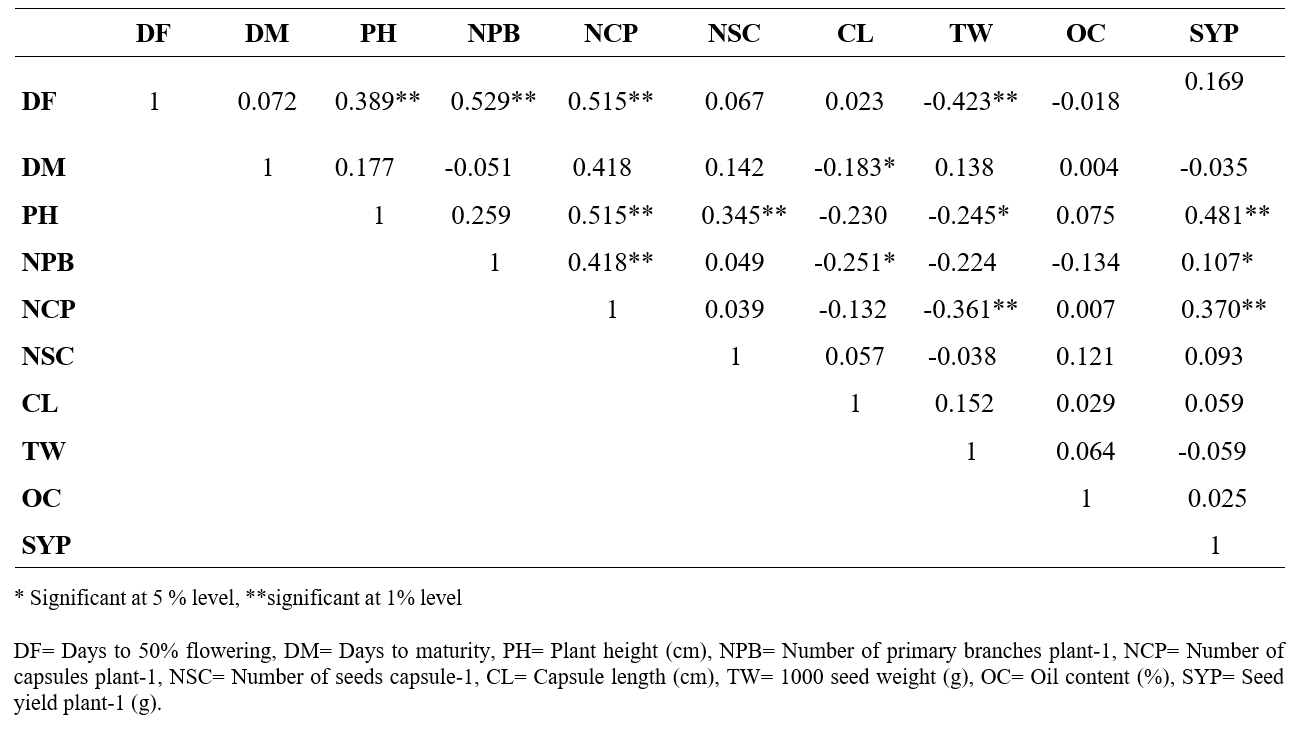
per plant (0.418**) and negative significant association with capsule length (-0.251*). Number of capsules per plant had negative significant association with test weight (-0.361**).
Among the ten traits studied in sesame, plant height, number of capsules per plant and number of primary branches per plant showed strong significant and positive correlation with seed yield per plant, indicating that yield improvement could be possible through the indirect selection of these traits.
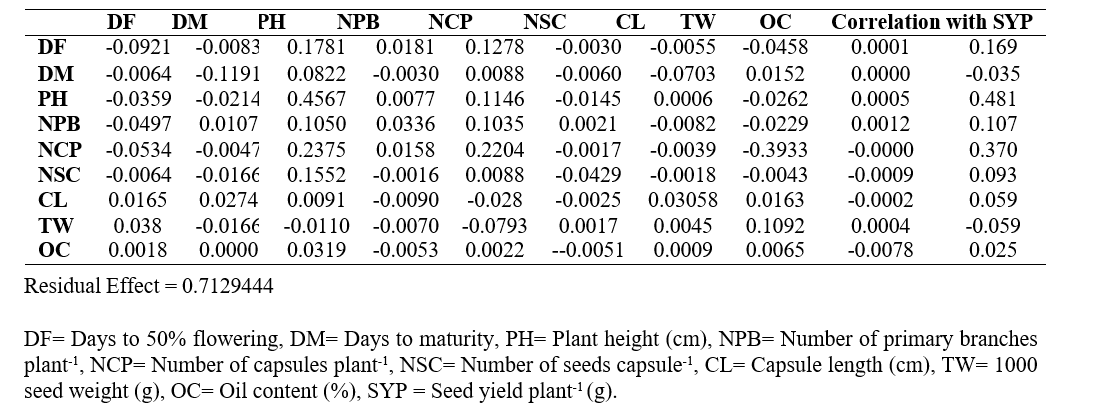
Path coefficient analysis provides information about the cause and effect of different yield components which gives better index for selection other than mere correlation coefficient. Correlation gives only the relation between two variables while, path analysis allows partitioning of the correlation coefficients as direct and indirect effects through other attributes. The path coefficients among yield and yield attributing traits are provided in Table 2.
Plant height exhibited significant positive correlation (0.481**) and high direct effect (0.4567) on seed yield per plant. Similar result of direct effect of plant height was reported by Umamaheswari et al. (2019). Whereas, Abate and Mekbeb (2015) and Sorathiya et al. (2021) reported moderate direct effect. Number of capsules per plant displayed significant positive correlation (0.370**) and moderate direct effect (0.2204) on seed yield per plant.
In contrast, high direct effect of number of capsules per plant was given by Kumar and Vivekanandan (2009), Ibrahim and Khidir (2012), Vanishree et al. (2011), Abate (2018), Haibru et al. (2018), Vinoth
(2018), Sasipriya et al. (2018), Patil and Lokesha (2018), Saravanan et al. (2020), Patidar et al. (2020), Sarathiya et al. (2021), Ahmed and Hassan (2021), Kumar et al. (2022), Disowja et al. (2020) and Bharati et al. (2021).
Regarding indirect effects, days to 50% flowering had low positive indirect effect on seed yield per plant via plant height (0.1781), plant height recorded low positive indirect effect via number of capsules per plant (0.1146). Number of primary branches per plant exhibited low positive indirect effect via plant height (0.1050) and number of capsules per plant (0.1035). Ibrahim and Khidir (2012) reported high indirect effect of number of primary branches per plant via number of capsules per plant.
Number of capsules per plant showed moderate positive indirect effect via plant height (0.2375) and high negative indirect effect via test weight (-0.3933). Number of seeds per capsule recorded low positive indirect effect via plant height (0.1552). Fazal et al. (2015) reported indirect effect of number of seeds per capsule via number of capsules per plant.
The aforesaid points therefore have clearly disclosed that an ideal sesame plant should have more plant height followed by more number of capsules per plant to boost seed yield per plant.
The study shows that seed yield per plant in sesame is significantly and positively correlated with plant height, number of capsules per plant, and number of primary branches per plant. This indicates that selection for genotypes exhibiting these traits can lead to improved seed yield.
Path coefficient analysis revealed that plant height has a high direct positive effect on seed yield per plant, while the number of capsules per plant shows a moderate direct positive effect. While other traits exhibited significant correlations, their effects on seed yield were often mediated indirectly through other yield components. Specifically, days to 50% flowering, number of primary branches per plant, and number of seeds per capsule had indirect positive effects on yield, mainly through plant height and number of capsules per plant.
To boost sesame seed yield, directly selecting for increased plant height and number of capsules per plant is the most effective method. This strategy can be enhanced by indirectly selecting for traits that positively affect these two primary yield components.
Abate, M and Mekbib, F. 2015. Assessment of genetic variability and character association in Ethopian low altitude sesame (Sesamum indicum L.) genotypes. Journal of Advanced Studies in Agricultural, Biological and Environmental Sciences. 2(3): 55- 66.
Abate, M. 2018. Correlation and path coefficient analysis in mid-altitude sesame (Sesamum indicum L.) germplasm collection of Ethiopia. African Journal of Agricultural Science. 13(46): 2651-2658.
Ahmed, A.A. and Hassan, T.H.A., 2021. Genetic variability and path coefficient analysis of some sesame (Sesamum indicum L.) genotypes for seed yield and their components. Journal of Plant Production, 12(4): 377-382.
Dewey, D.R and Lu, K., 1959. A correlation and path‐ coefficient analysis of components of crested wheatgrass seed production. Agronomy journal. 51(9): 515-518.
Dibyabharati, S. (2022) Genetic analysis of quantitative traits and selection of transgressive segregants in crosses of sesame (Sesamum indicum L.). Ph.D. (Ag.) Thesis. Odisha University of Agriculture and Technology, Bhubhaneswar.
Disowja, A., Parameswari, C., Gnanamalar, R. P and Vellaikumar, S. 2020. Evaluation of sesame (Sesamum indicum L.) based on correlation and path analysis. Electronic Journal of Plant Breeding. 11(2): 511-514.
Fazal, A., Mustafa, H.B.M., Ejaz-ul-Hasan, Anwar, M., Tahir, H.H.N and Sadaqa, H.A. 2015. Interrelationship and path coefficient analysis among yield and yield related traits in sesame (Sesamum indicum L.). Journal of Nature and Science.13(5): 27-32.
Fisher, R.A and Yates, F. 1963. Statistical Tables for Biological, Agricultural and Medical Research, Sixth edition, Oliver and Boyd, Edinburgh.
Gadifew, S., Demelash, H., Abate, A and Abebe, T.D., 2024. Association of quantitative traits and genetic diversity in Ethiopian sesame (Sesamum indicum L.) genotypes. Heliyon. 10(4): 1-14.
Haibru, G., Dash, M., Pradhan, B., Lenka, D and Tripathy, S.K. 2018. Genetic parameters of variability and character association studies for yield and some capsule shattering traits in sesame germplasm. Journal of Pharmacognosy and Phytochemistry. 7(5): 585-590.
Ibrahim, S. E and Khidir M. O. 2012. Genotypic correlation and path coefficient analysis of yield and some yield components in sesame (Sesamum indicum L.). International Journal of AgriScience. 2(8): 664-670.
Kaliayarasi, R., Lokeshkumar, K., Mohanraj, M., Priyadharshini, A and Rajasekar, R. 2019a. Genetic variability parameters for yield and yield related traits in sesame (Sesamum indicum L.). International Journal of Current Microbiology and Applied Sciences. 8(8): 819-825.
Kante, S., Wadikar, P.B., Sargar, P.R. and Patil, S.S. 2022. Correlation analysis for seed yield and its related attributes in genotypes of sesame (Sesame indicum L.). International Journal of Plant and Environment. 8(01): 87-90.
Kehie, T., Shah, P., Chaturvedi, H. P and Singh, A. P. 2020. Variability, correlation and path analysis studies in sesame (Sesamum indicum L.) genotypes under foothill condition of Nagaland. International Journal of Current Microbiology and Applied Sciences. 9(5): 2917-2926.
Kumar, K.B and Vivekanandan, P. 2009. Correlation and path analysis for seed yield in sesame (Sesamum indicum L.). Electronic Journal of Plant Breeding. 1(1): 70-73.
Kumar, V., Sinha, S., Sinha, S., Singh, R.S and Singh,
S.N. 2022. Assessment of genetic variability, correlation and path analysis in sesame (Sesamum indicum L.). Electronic Journal of Plant Breeding. 13(1): 208-215.
Lenka, D. and Misra, B., 1973. Path-coefficient analysis of yield in rice varieties. Indian Journal of Agricultural Sciences. 43 (4): 376-379.
Ministry of Agriculture. 2023-2024. Annual report on sesame production and productivity in India. Government of India. Htt://WWW.agricop.nic.in/ annual-report.
Navaneetha, J.S., Murugan, E and Parameswari, C. 2019. Correlation and path analysis for seed yield and its components in sesame (Sesamum indicum L.). Electronic Journal of Plant Breeding. 10(3): 1262-1268.
Patidar, B., Tripathi, D., Patidar, S., Patidar, M and Kumari, G. 2020. The association and path coefficient analysis for yield and yield attributing traits in sesame (Sesamum indicum L.). Journal of Pharmacognosy and Phytochemistry. 9(3): 1674-1678.
Patil, M and Lokesha, R. 2018. Estimation of genetic variability, heritability, genetic advance, correlations and path analysis in advanced mutant breeding lines of sesame (Sesamum indicum L.). Journal of Pharmacognosy and Natural Products. 4(1): 1-5.
Saravanan, M., Kalaiyarasi, R and Viswanathan, P.L. 2020. Assessment of genetic variability, character association and path analysis in F2 population of sesame (Sesamum indicum L.). Electronic Journal of Plant Breeding. 11(2): 447-450.
Sasipriya, S., Paimala, K., Eswari, K.B and Balram, M. 2018. Correlation and path analysis for seed yield and its components in sesame (Sesamum indicum L.). Electronic Journal of Plant Breeding. 9(4): 1594-1599.
Sorathiya, H. P., Babariya, C. A., Babiaya, A. V and Rathod, V. T. 2021. Phenotypic and genotypic path coefficient analysis in black sesame (Sesamum indicum L.). Journal of Emerging Technologies and Innovative Research. 8(8): 379-383.
Takele, F and Abera, G. 2023. Variability study in Ethiopian sesame (Sesamum indicum L.) genotypes at Western Oromia. International Journal of Precision Farming. 1(1): 1-7.
Umamaheswari, S., Suganthi, S., Sathiskumar, P and Kamaraj, A. 2019. Genetic variability, correlation and path analysis in sesame (Sesamum indicum L.). Plant Archives. 19(2): 4543-4548.
Vanishree, R.L., Diwan, J.R. and Ravi, M.V. 2011. Study on character association and contribution of yield related traits to seed yield in segregating generation (F4 families) of sesame (Sesamum indicum L.). Electronic Journal of Plant Breeding. 2(4): 559- 562.
Vinoth, V. 2018. Correlation and path analysis studies in hybrids of line x tester for yield and yield component traits in sesame (Sesamum indicum L.). Electronic Journal of Plant Breeding. 9(3): 1206-1212.
Wacal C., Ogata N., Basalirwa D., Sasagawa D., Kato M., Handa T., Masunaga T., Yamamoto S., Nishihara E. 2019. Fatty acid composition of sesame (Sesamum indicum L.) seeds in relation to yield and soil chemical properties on continuously monocropped upland fields converted from paddy fields. Agronomy. 9(12): 801.
Wright, S., 1921. Outlined the theory of path analysis on the basis of standardized partial regression analysis. Annals of Mathematical Statistics. 5: 161-215.